

Welcome to Carbon Brief’s Cropped.
We handpick and explain the most important stories at the intersection of climate, land, food and nature over the past fortnight.
This is an online version of Carbon Brief’s fortnightly Cropped email newsletter. Subscribe for free here.
Key developments
Trump takes office
ENVIRONMENTAL ORDERS: In his first week in office, US president Donald Trump signed “a flurry of executive orders with implications for Earth’s climate and environment”, the Associated Press reported. Among the orders were one directing the US to withdraw once again from the Paris Agreement and another stating “that the Endangered Species Act cannot be an obstacle to energy development”. He also signed one “halting new federal leases for offshore wind projects”, citing the impacts of offshore wind projects on marine life, according to WBUR. The outlet carried an article refuting the president’s claims.
CORN CAUTION: Robert F. Kennedy, Jr., Trump’s nominee for head of the Department of Health and Human Services, is raising alarm in the country’s cornbelt, the Guardian reported. The outlet explained that “Kennedy has vowed to ban high fructose corn syrup and seed oils, a move that would significantly reduce demand for a host of crops”. Vox covered the shift in political alignment for Kennedy, who was once an environmental lawyer at the Natural Resources Defense Council. Vox wrote that “his migration to the far right…[is] part of a much broader shift in the environmental movement”.
FUNDING FREEZE: On Monday, the National Science Foundation abruptly cancelled grant-review panels, a move that “sparked confusion among panellists” and researchers alike, according to NPR. The outlet added that “delays in grant approval inevitably mean delays in funding research”. Later that day, a leaked memo from the Office of Management and Budget ordered a pause in all federal grant funding. It “specifically targeted many large federal energy and climate programmes in its sweeping freeze and review of grant funding”, Heatmap reported. The targeted programmes include conservation payments from the US Department of Agriculture and climate and atmospheric research under the National Oceanic and Atmospheric Administration. A federal judge temporarily blocked the order before it could go into effect on Tuesday, the Washington Post said.
UK’s nature decline
OFF-TARGET: A new report from the UK’s Office for Environmental Protection (OEP) found that the government “is falling short” on meeting its legally binding environmental targets, the Guardian said. The report also highlighted that “the window to stop the decline of England’s nature is swiftly closing”. Separately, the Guardian reported that UK ministers dropped a bill that would have made the country’s international commitments on climate and environment, such as those made at COP, legally binding.
OFFSETTING EXPANSION: Carbon Brief analysis found that the UK would need to plant a forest “twice the size of Greater London” to offset the emissions that would result from the proposed expansion of Heathrow, Gatwick and Luton airports. Operations at these airports would add 92m tonnes of carbon dioxide equivalent (CO2e) into the atmosphere by 2050, if companies meet their flight targets, the analysis found. The environment minister backed the expansion of the airports, saying mitigation measures can offset the environmental impacts, the Times noted.
FUNDING INFRASTRUCTURE: The UK government announced a new nature-restoration fund, aimed at accelerating new infrastructure projects by allowing developers “to meet their environmental obligations faster”. The fund will cover a range of projects, such as new wind farms, railways, roads and data centres across the country. Currently, builders must comply with their environmental obligations on a project-by-project basis, but the new fund will “[pool] contributions…to fund larger interventions for nature”, the government added. However, environmental groups are concerned about this reform’s environmental impacts, saying “high carbon infrastructure such as airport expansion” could also be covered by the bill, Business Green reported.
Spotlight
Colombia’s land reform conference
At the UN biodiversity summit in October, Carbon Brief interviewed Nury Martínez, president of the Colombian farmers’ organisation Fensuagro. She is also a member of the South America coordinating committee of Vía Campesina, a global organisation representing more than 200 million peasants in 80 countries.
Martínez told Carbon Brief about the main expectations of the peasant movement for the second conference on agrarian reform and rural development, which will address farmers’ demands to access and work larger swathes of land. It will take place in Colombia during the first quarter of 2026.
This second conference will take stock of the first one, held in 2006, which delivered a set of voluntary guidelines for governance and land tenure, and will discuss a new agrarian reform.

What does the proposed agrarian reform consist of?
Land must fulfil a social function. That’s why we say that land is for those who work it – because there are large tracts of land where the owners don’t use it, or [they] have extensive livestock where a cow has four or five hectares and we have no land to produce food.
We propose an integral and popular agrarian reform because we believe that it goes beyond access to land, [but also includes] access to the goods of nature, such as water, seeds, access to territories…[We want] to stop the hoarding [of land] in the hands of a few.
What would be the result of these agrarian reforms? Transforming the way in which food is being produced for the world?
We say strengthen peasant production because we have always produced without chemicals. We are making the transition to agroecology, to rescuing culture and ancestral knowledge. [But] you can’t do agroecology if you don’t have land, territory.
We are proposing food sovereignty because we consider food [to be] a human right. [Also] access to technical assistance, fair commercialisation and [strengthening of] local markets.
Would agrarian reform be implemented at the global level, or only in Colombia?
The second conference will be held in Colombia in the first quarter of 2026, but it is a global event, with the participation of more or less 119 countries that are part of the United Nations.
The countries supported it being in Colombia because the Colombian government is implementing the National Agrarian Reform System. Right now we are having the possibility of access to land after more than 100 years.
News and views
‘NEW PHASE’ OF BIRD FLU: Bird flu is forcing farmers to slaughter their flocks, contributing to a doubling in the price of US eggs since 2023, Associated Press reported. The current outbreak, which started in 2022, has led to the killing of more than 145m of chickens, turkeys and other birds, the newswire noted. The New York Times said the outbreak, which has worsened over the past weeks, has “enter[ed] a new phase”, with some cattle suffering from reinfection. The outlet pointed out that since the virus first struck cattle last year, more than 900 herds and dozens of people have been infected, with one person dying as a result.
TRACEABILITY IN BRAZIL: Brazil’s government will begin to implement a “cattle traceability” system that will be mandatory as of 2027 and must be fully operational by 2032, Infobae reported. The system will “monitor and record the history, location and trajectory of each identified animal” to meet “the health requirements of international markets”, the outlet added. Elsewhere, Reuters reported that the governor of Mato Grosso, one of the largest farming states in Brazil, is set to veto a bill that “sought to weaken protections for endangered biomes”, including the Amazon.
PACIFIC PROTECTION: The Pacific island nation of the Marshall Islands announced its first-ever marine protected area (MPA), Oceanographic Magazine reported. The marine sanctuary will cover 48,000 square kilometres of “the most pristine ecosystems in the Pacific Ocean”, said National Geographic Pristine Seas, an initiative focused on ocean conservation that helped provide the scientific basis for establishing the MPA. The area will “be fully protected from fishing” and will be managed with “special emphasis on traditional knowledge and Indigenous insights”, the outlet wrote.
FIRES AND FOOD: Prospect Magazine wrote that “the insidious effects [of climate change] on global food production and security are barely mentioned” in discussions of the recent LA wildfires. It added that extreme weather’s impacts on crops “can be seen the world over”. Meanwhile, Trump issued an executive order to ignore existing regulations and deliver more water from California’s Central Valley, CalMatters reported. The outlet wrote that “Trump cited the Los Angeles fires [as justification], even though the actions he is ordering…would primarily serve farms”.
COURTING CONSERVATION: Nepal’s supreme court struck down a controversial new law that would allow infrastructure development – “such as hydropower plants, hotels and railway lines” – in protected areas, Mongabay reported. The outlet called the decision “one of the most important in Nepal’s conservation history”. Paraphrasing one judge’s arguments, Mongabay wrote: “It would be wrong to pit development and environment against each other by adhering to the belief that development can take place only when there’s damage to the environment.”
Watch, read, listen
MASS MORTALITY: The New Republic looked at the growing phenomenon of mass animal die-offs and what these events can teach scientists about resilience.
UNITED FOR A RIVER: This Scroll.in video showed how people are leading conservation of southern India’s Jatari river, which is home to unique flora and fauna species.
FARMERS’ LAWSUIT: A comment piece in Nature broke down a lawsuit filed by Swiss farmers suing their government to strengthen climate action.
OLD SOLUTION: A Grist story explored how farmers in the UK and US use the ancient practice of gleaning – collecting leftover crops after the harvest – to cut food waste.
New science
- Fertiliser use has a “large and significant negative effect” on the diversity of pollinators and flowering plants in a grassland ecosystem, according to new research published in npj Biodiversity. The authors wrote that the results of the two-year study “strongly suggest that financial incentives are necessary to offset yield reductions to improve biodiversity outcomes in agricultural grasslands”.
- A study in Philosophical Transactions of the Royal Society B detailed a new metric for assessing the impact of land-use change on species extinctions. The researchers say the maps can be used to “estimate the impact on extinctions of diverse actions that affect change in land cover, from individual dietary choices through to global protected area development”.
- New research in Nature Ecology and Evolution analysed data from 2.2m records of plant species from 1921 to 2021 and found that plant collections grown in botanical gardens have significant constraints with implications for conservation, such as limited growth. The study stresses the “urgent need” for re-evaluating biodiversity management in botanical gardens to fulfil their conservation goals.
In the diary
- 2 February: World Wetlands Day
- 3-8 February: Meeting of the standing committee of the Convention on International Trade in Endangered Species of Wild Fauna and Flora (CITES) | Geneva
- 25-27 February: Resumed session of the UN biodiversity summit COP16 | Rome
Cropped is researched and written by Dr Giuliana Viglione, Aruna Chandrasekhar, Daisy Dunne, Orla Dwyer and Yanine Quiroz. Please send tips and feedback to cropped@carbonbrief.org

The post Cropped 29 January 2025: Trump takes office; UK nature ‘falling short’; Egg prices soar appeared first on Carbon Brief.
Cropped 29 January 2025: Trump takes office; UK nature ‘falling short’; Egg prices soar

Three countries have been named by the Paris Agreement’s compliance committee for failing to submit a nationally determined contribution (NDC) and repeatedly snubbing offers of help with their climate plans.
After months of internal debate over whether to identify serial non-responders, the Paris Agreement’s Implementation and Compliance Committee (PAICC) named the three countries which have failed to engage with it over their NDCs on Friday.
It named Democratic Republic of Congo, Senegal and North Korea in a footnote of its annual report, adding that it decided to name them “with a view to facilitating engagement”, adding that representatives of the three nations had been invited to its meeting in early 2027 “with the purpose of identifying any challenges and constraints”.
“The Committee noted the importance of Parties engaging with the Committee in a timely manner, while noting that some delays may be due to the national capabilities and circumstances of the Parties”, the report said.
-
Under US pressure, World Bank says it will back gas “where appropriate”
The US wants the World Bank to expand its gas support while climate campaigners are pushing for it to end – its head spoke this week of limited backing for the fossil fuel -
IPCC scientists vow to press on with climate reports despite political deadlock
After governments again failed to agree a timeline, nearly 120 IPCC authors pledged to complete their assessment on time and with full scientific rigour -
Paris Agreement committee snubbed over missing NDC climate plans
Many governments have still not submitted a nationally determined contribution to the UN, breaching a key requirement of the Paris Agreement

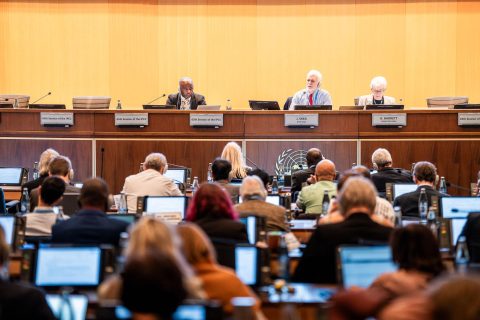

In July, PAICC said 12 countries had ignored its repeated attempts to discuss why they had not published an NDC as required every five years under the 2015 Paris accord.
Members of the committee had been divided over whether to name them, but at a September meeting decided to do so in their annual report to the annual climate COP summit.
By the time the report was published on Friday, only Congo, Senegal and North Korea “had not communicated an NDC or submitted a [Biennial Transparency Report] and had not yet responded to any of the Committee’s notifications, despite several reminders issued by the Committee in this regard”.
Rainforest and renewable energy ambitions
The silence from Congo and Senegal is notable because the former is home to much of the Congo Basin rainforest while the latter has sought billions of dollars in climate finance to support its renewable energy ambitions.
After Brazil, Congo has more rainforest than any country in the world. This forest, and the country’s peatlands, absorb huge amounts of greenhouse gas but are fast being lost to expanding farmland, charcoal production, logging and mining.
Senegal signed a Just Energy Transition Partnership with Canada and wealthy European nations in 2023, to help it meet its renewable energy targets under the-then government of Macky Sall. It was chair of the Least Developed Countries group between January 2022 and December 2023.

Tejas Rao, who is researching the PAICC as part of a doctoral thesis at Cambridge University, said the governments of the three countries should engage with the committee.
“Engagement costs these governments very little and the committee has shown it will listen,” he said.
“Silence leaves the committee with no basis to help, and it leaves the [governments] exposed to the narrative that they are simply disengaged,” he told Climate Home News.
Paris Agreement requirement
The 2015 Paris Agreement requires all parties to publish an NDC every five years outlining their emissions reduction targets, with each plan meant to be more ambitious than the country’s last NDC.
The latest set – the third round of plans, with new targets for 2035 – was due in February 2025. While most countries missed this deadline, all but around 30 – mostly small emitters but including Egypt, Vietnam and Argentina – have now submitted them.
Over the year, the PAICC – which is made up of government climate officials from developed and developing countries – has been communicating with governments that have not submitted NDCs and trying to overcome barriers to them doing so.
Some nations have cited exceptional circumstances as the reason for not submitting an NDC, a process that requires a significant amount of work in tracking emissions and consulting on how to curb them across the economy. For example, a letter from a Sudanese official to the PAICC, seen by Climate Home News, said that the country’s civil war had led to the suspension of its NDC preparation.
-
IPCC scientists vow to press on with climate reports despite political deadlock
After governments again failed to agree a timeline, nearly 120 IPCC authors pledged to complete their assessment on time and with full scientific rigour -
Under US pressure, World Bank says it will back gas “where appropriate”
The US wants the World Bank to expand its gas support while climate campaigners are pushing for it to end – its head spoke this week of limited backing for the fossil fuel -
Who shapes climate science? The equity question facing the IPCC
Early completion of the next global climate science assessment reports risks excluding research from the Global South, which is key to ensuring the findings are fair
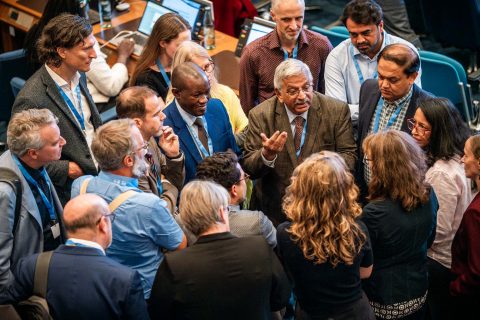
The US and Iran are not signed up to the Paris Agreement and so do not have active NDCs, nor does Taiwan, which is not a UN member state.
Rao said that because the PAICC is “facilitative and non-punitive”, naming the countries “is meant to open a door, not close one – the invited consultation is the point”.
“In recent months, governments that explained their constraints, whether capacity, finance or domestic process, have been met with follow-up and support rather than sanction, and the number of silent governments has fallen sharply,” Rao said.
The post Paris Agreement committee names three countries snubbing it over NDCs appeared first on Climate Home News.
Paris Agreement committee names three countries snubbing it over NDCs