It has been more than one year since the gavel came down at the last UN biodiversity summit, where almost every country in the world agreed on a plan to protect nature.
The Kunming-Montreal Global Biodiversity Framework was signed off at the COP15 summit in Montreal, Canada in December 2022. (See Carbon Brief’s in-depth summary of the key outcomes.)
The landmark deal contained a number of goals and targets for countries to achieve over the coming years – such as setting aside land for wildlife, reducing pesticide risks and restoring ecosystems.
In the months since, more nature pledges have been announced, a new biodiversity fund was established and more science showing the impacts of humans on nature has been published.
Countries will gather at the next UN biodiversity summit, due to be held in Colombia this October, to take stock of progress since the deal was given the green light and submit new national plans outlining how they will protect biodiversity.
Carbon Brief has taken an in-depth look at progress on individual nature issues and the key biodiversity updates since the COP15 summit.
- What was agreed at the UN biodiversity summit in Montreal?
- What has happened since the Global Biodiversity Framework was adopted?
- Key negotiation issues
- What do we know about the next UN biodiversity summit?
What was agreed at the UN biodiversity summit in Montreal?
The UN biodiversity summit takes place every two years, unlike the climate COP, which takes place annually.
At COP15 – the last round of biodiversity talks in Montreal in December 2022 – almost every country in the world agreed to a landmark deal to repair nature.
The Kunming-Montreal Global Biodiversity Framework (GBF) included four long-term global goals and 23 specific targets, with an overall mission of halting and reversing biodiversity loss by 2030.
Some of the key targets include conserving 30% of the world’s land and 30% of the ocean by 2030, reducing the impact of invasive species, cutting pesticides, sustainably managing agriculture and prioritising involvement of Indigenous peoples and local communities in different ways.
Alongside the overall framework, dozens of other decisions were made around the more technical aspects of the negotiations, including figuring out ways to monitor national progress and gather finance to fund action, particularly in lower-income countries.

Although the agreements made at the summit are not legally binding, nations also agreed on a plan to report on, review and voluntarily increase their ambitions to tackle biodiversity loss. This is similar to the plan drawn up to implement the Paris Agreement for climate change.
A lack of implementation was widely cited as one of the major factors behind the failure of the Aichi targets, the last set of global biodiversity aims.
Although the COP15 agreement was widely seen as a success, some countries – particularly the Democratic Republic of Congo – felt frustrated and outraged at the manner in which the GBF was given the green light.

In the final stages of the summit, the deal was seen to be quickly gavelled through by summit president, Chinese environment minister Huang Runqiu, despite objections from the DRC minutes earlier in the plenary.
Following the close of the plenary, there were arguments over the manner in which the final approval happened, but all countries eventually supported the deal.

In the wake of the agreement, UN secretary general António Guterres said that “we are finally starting to forge a peace pact with nature”.
Canadian environment minister Steven Guilbeault said that the GBF is a “major win for our planet and for all of humanity”, which will chart a course “away from the relentless destruction of habitats and species”.
The International Indigenous Forum on Biodiversity welcomed the “timely recognition” of Indigenous peoples and local community contributions, roles, rights and responsibilities to nature. A statement from the group said:
“We have spoken and you have heard us, let us now put those words into action.”
What has happened since the Global Biodiversity Framework was adopted?
Several events and meetings since COP15 have addressed nature and biodiversity in different ways.
On 15 February 2023, Dr David Cooper took over from Elizabeth Maruma Mrema as the new acting executive secretary of the Convention on Biological Diversity (CBD). The CBD is an international treaty established in 1992 with the objective of conserving and sustainably using biodiversity, and ensuring the fair sharing of benefits from the use of genetic resources.
Before his appointment, Cooper had assisted the CBD secretariat as deputy executive secretary, contributing to a “successful finalisation and adoption of the Kunming-Montreal Global Biodiversity Framework”, according to the CBD. He was a lead author of three editions of the Global Biodiversity Outlook and other assessments.
Mrema was appointed deputy executive director of the UN Environment Programme.
March saw the emergence of the High Seas Treaty, a legally binding global agreement for conserving and sustainably using areas of the ocean beyond national jurisdictions – also known as the “high seas” or international waters. Carbon Brief reported that the treaty “provides the framework for establishing protected areas where previously there had not been a clear mechanism for doing so”. (For more on the high seas treaty, see: Oceans.)
The Amazon Summit, held in August last year, gathered leaders of the eight Amazon basin countries, who delivered the Belém Declaration. The document will strengthen the Amazon Cooperation Treaty Organization to prevent the rainforest “from reaching the point of no return”. The summit’s outcomes were labelled as “hopeful, but insufficient” by various civil and Indigenous organisations for having no specific targets for curbing deforestation.
In late 2023, countries from the Amazon, the Congo Basin and south-east Asia agreed to protect their rainforests and boost nature finance during the Three Basins Summit in the Republic of the Congo. However, experts told Carbon Brief at the time that the meeting failed to reach a unified alliance and was, ultimately, “underwhelming”.
October marked the official end of COP15 with a meeting in Nairobi, which served to finish off some “outstanding business in Montreal” and advance the recommendations from the Subsidiary Body on Scientific, Technical and Technological Advice (SBSTTA) on implementation and review. Delegates also issued a draft recommendation on climate change and biodiversity.
Key negotiation issues
Over the past year, there have been a number of summits, finance pledges and intergovernmental talks relating to biodiversity.
Below, Carbon Brief outlines the progress on the key biodiversity COP negotiation topics and related issues in the months since Montreal – from movement on the “30 by 30” goal to the focus on Indigenous rights.
Halting and reversing biodiversity loss
Back in Montreal, countries agreed that the overall mission of the GBF should be to “halt and reverse biodiversity loss by 2030”.
The GBF has been likened to the “Paris Agreement for nature”, with some comparing the 2030 goal of halting and reversing biodiversity loss to the aspirational 1.5C temperature limit.
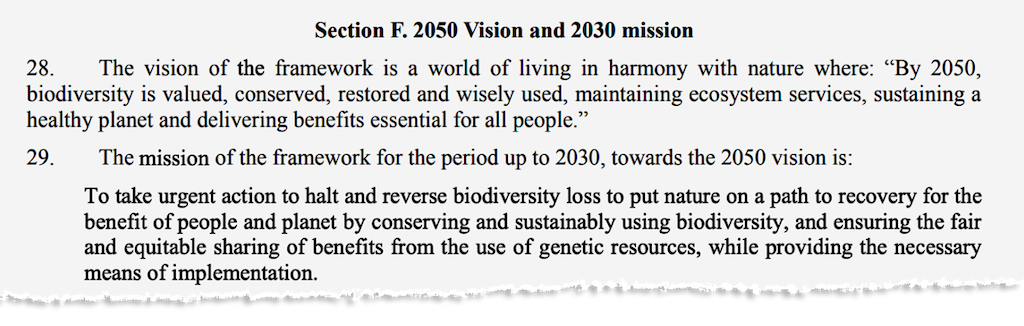
After the GBF was agreed, Carbon Brief spoke to a range of biodiversity scientists who said that halting and reversing biodiversity loss by 2030 would be incredibly challenging.
A landmark report released in 2019 by the world’s biodiversity authority, the Intergovernmental Science-Policy Platform on Biodiversity and Ecosystem Services (IPBES), found that one million animal and plant species now face extinction. This is more than at any other point in human history.
Across the world, populations of mammals, birds, amphibians, reptiles and fish decreased by an average of 69% between 1970 and 2016, according to a 2022 WWF report on more than 30,000 animal populations. In tropical central and South America, the animal populations covered by the study fell by an average of 94% over this period.
Scientists also told Carbon Brief that achieving the mission would largely be decided by meeting the targets of the GBF that tackle the direct causes of biodiversity loss.
These include target 18, which addresses subsidies harmful to biodiversity; target 7, which addresses pollution; and targets 5 and 9, which address the “sustainable use” of biodiversity. (Progress on several targets is discussed in more detail below.)
One issue that negotiators have continued to work on since the GBF was agreed is developing a set of indicators for measuring biodiversity loss.
While many people associate “biodiversity” with iconic species and tropical rainforests, the term actually covers the whole spectrum of Earth’s biological diversity, ranging from the organisation of genes within organisms to the communities of animals and plants that make up ecosystems. This complexity makes biodiversity loss particularly difficult to measure.
At COP15, countries decided to set up a technical group to develop biodiversity loss indicators ahead of COP16, spearheaded by Colombia and the UK. Comprising 45 experts, the group has met several times virtually in 2023 and will meet for in-person discussions in Cambridge, England in March of this year.
30 by 30
One aim that grabbed the attention of politicians, media, activists – and even celebrities – at COP15 was the pledge to protect 30% of the world’s land and seas for nature by 2030, commonly referred to as “30 by 30”. It is contained within target 3 of the GBF.

The fight to get 30 by 30 into the GBF was spearheaded by a group of countries calling itself the High Ambition Coalition for Nature and People (HACN&P). It is led by Costa Rica and France, with the UK acting as a co-chair for the ocean component of the pledge.
Since COP15, the HACN&P set up a secretariat directed by former Costa Rican biodiversity negotiator Rita El Zaghloul.
During an interview at the COP28 climate summit in Dubai in December 2023, El Zaghloul told Carbon Brief that with the GBF agreed, the HACN&P has shifted its focus to ensuring the most vulnerable countries have the tools required to meet the target.
At COP28, she announced that the HACN&P had created a new “30 by 30 solutions toolkit” and a financial and technical “matchmaking” service. Explaining the purpose of these tools to Carbon Brief, she said:
“Because it was HACN&P that started the 30 by 30 movement, it is also our responsibility to ensure that countries have the sufficient support and tools to meet the target.
“We know that it is an ambitious target, because we have to move from approximately 17% on land and 8% on oceans [that is currently protected] to 30% on both. Many of the megadiverse countries are developing countries and small island developing states, so we need to provide them with the tools.”
Elsewhere at COP28, China surprised delegates by announcing that it was joining the HACN&P. The announcement came from COP15 president and China environment minister Huang Runqiu via videolink at a high-level session on 30 by 30.

El Zaghloul told Carbon Brief that the announcement came after more than two years of talks with China, who were initially reluctant to join the initiative while still maintaining the “neutral” role of COP15 president.
As of the end of COP28 in December 2023, 118 countries had joined the HACN&P. This compares to 114 in December 2022. (There are 196 countries, including the EU, that are party to the CBD. All of these countries have committed to 30 by 30 through the GBF.)
Finance
At COP15 in Montreal, the gavel went down adopting the GBF and its finance package amid controversy and objections from biodiverse developing countries.
The final finance target seeks to mobilise “at least $200bn per year” by 2030 from “all sources” – domestic, international, public and private. For comparison, the biodiversity finance gap for conservation is estimated at roughly $700bn per year for this decade.
Developed countries – along with others that “voluntarily assume” their obligations – are expected to “substantially and progressively increase” their international finance flows for nature “to at least $20bn per year by 2025 and to at least $30bn per year by 2030”, according to the GBF’s Target 19l.

Despite calls from many developing countries for a distinct fund housed under the COP, COP15 requested the Global Environment Facility (GEF) set up a special trust fund. This would be called the “Global Biodiversity Framework Fund” (GBF Fund) and be established “in 2023, and until 2030” to receive “financing from all sources”.
On June 29 last year, the GEF’s governing board approved plans to set up this “game-changing” new fund to finance the Framework’s implementation.
The GEF’s governing board approved plans to establish the fund on 29 June last year. A month later, at the GEF assembly in Vancouver, 186 countries ratified and officially launched the GBF Fund.
At the GEF assembly, COP15 hosts Canada contributed an initial capitalisation of C$200m ($147.3m), while the UK pledged £10m ($12.6m).
As much as 20% of the funds are intended for supporting Indigenous-led initiatives to protect and conserve biodiversity.

Indigenous groups – often sidelined from direct access to conservation funding – welcomed the dedicated allocation. Brazil’s Indigenous minister Sonia Guajajara pointed out that this “should not just be an aspirational criterion, but a concrete target that needs to be constantly updated” and called for “shared governance mechanisms that include recipient countries”.
Separately, at least 36% of the fund’s resources are to support small island developing states and least-developed countries.
At the assembly, Cuba and Honduras called for “simplified processes for obtaining” funding, the Earth News Bulletin reported. At the same time, the DRC, Namibia, Yemen and the Gambia “urged” more direct access to funds and minimising transaction costs.
At a side event on the sidelines of the UN general assembly in September, Germany pledged the final €40m ($43.3m) to put the fund into operation.
On Nature Day at COP28, Japan then pledged ¥650m ($43.8m). While this took the fund’s initial total capitalisation to about $247m, this falls far short of the “at least $20bn per year by 2025” target that developed countries were to raise. The US and EU, who supported and “welcomed” the fund, are yet to commit any new money.
The fund’s governing body will meet for the first time on 8 and 9 February this year in Washington DC to discuss its budget, business plan and how resources are allocated, with projects set to be funded by the end of 2024.
Projects backed by all eligible countries will have to go through consecutive selection rounds for funding based on criteria, including their potential to generate global environmental benefits, alignment with the GBF’s goals and National Biodiversity Strategies and Action Plans (NBSAPs), and their ability to raise resources from the private sector.

Not all the money raised will go to funding biodiversity projects directly: it will also have to cover staff costs, travel, consultants, monitoring and independent evaluation.
Additionally, if the fund’s current budget request is approved, it will have to pay the World Bank – the GEF’s host– an indirect charge of 11% on all direct costs for administrative support – a 300% increase from last year.
The UN Environment Programme’s State of Finance for Nature 2023 report, released at COP28, found that public finance still accounts for the majority of conservation spending in the GBF’s first year. At the same time, it found that contributions from biodiversity offsets and credits grew sharply in 2022 as countries including the UK, France and Australia rolled out new nature markets.
The report also noted that philanthropy – “driven by support for 30 by 30” – and private finance mobilised by debt instruments such as blue bonds and rhino bonds grew last year as well. But, it added, these small numbers paled in comparison with $7tn in nature-negative investments made the same year.
Implementation
Ensuring that the targets contained within the GBF are actually implemented by countries will be the major challenge in the coming years, experts tell Carbon Brief.
Details for how the agreement should be implemented – the so-called “teeth” of the deal – are contained within Section J of the GBF itself and a separate document called “mechanisms for planning, monitoring, reporting and review”. (It is worth noting that the GBF and its underlying documents are not legally binding.)
The agreed plan for how the GBF should be implemented by countries follows three key steps – sometimes referred to as “present, review and ratchet”. This closely mirrors the implementation schedule of the Paris Agreement.
Section J of the GBF specifies that countries should present national biodiversity strategies and action plans, or “NBSAPs”, that are “in alignment” with the GBF and its goals and targets. The underlying document adds that this should be done “by COP16”.
Since the end of COP15, France, the EU, Luxembourg, Hungary, Japan and Spain have submitted updated NBSAPs. The UK has indicated it will release its new NBSAP in May of this year.
In September 2023, an “accelerator partnership” to “fast-track and upscale” new NBSAPs was officially launched at New York Climate Week, after first being agreed at COP15. The initiative is headed by Colombia and Germany, with the support of various UN bodies.
As for the “review” step, countries have agreed to conduct a global analysis of whether NBSAPs align with the GBF at COP16 and hold a “global review” of progress at COP17 and COP19.
After this, countries “may take the outcome of the global reviews into account in future revisions and implementation of their” NBSAPs. This is the “ratchet” element of the implementation mechanism.
In October 2023, negotiators met in Nairobi to officially close COP15. The aim of this meeting was to tie up loose ends remaining from the landmark agreement of the GBF in Montreal in 2022.
The event brought together scientific and technical experts to give advice on what should be included in the global review earmarked for COP17 in 2026. Bernadette Fischler Hooper, the head of global advocacy at WWF International, told Carbon Brief:
“The technical experts and scientific experts discussed what should be in this report. So it was very focused on what that report should contain.”
Nature-based solutions
The use of nature to mitigate and adapt to climate change – known as nature-based solutions – featured a number of times in the GBF’s targets.
At COP28 in Dubai, nature-based solutions were also discussed at different stages. The global stocktake text – a key outcome of the summit that showed how countries can increase action to meet climate goals – “encourages” the implementation of nature-based solutions.

A report released in June by the International Institute for Sustainable Development recommended ways to ensure that nature-based solutions will boost biodiversity and ecosystems.
In a list of draft recommendations from the final round of intergovernmental talks on nature-based solutions, the co-chairs suggested ways to support their use.
These include setting up a database of policies related to nature-based solutions to enable learning between countries, analysing the technical tools available to support implementing such solutions and making a how-to guide for accessing finance for these projects.
At COP28, more than 150 companies and financial institutions said they would increase investments in nature-based solutions.
At COP16, nature-based solutions will likely feature in many national biodiversity action plans and will continue to be one of the key talking points, experts tell Carbon Brief.
For example, Spain intends to prioritise a number of different areas including nature-based solutions over the next few years to meet its climate and biodiversity targets, according to its revised NBSAP.
Invasive species
Invasive alien species are animals, plants or other organisms that have spread into places outside their natural habitats. These can negatively impact both nature and people, according to IPBES.
Target 6 of the GBF aims to reduce the establishment and introduction of invasive alien species by 50% by 2030.

Since the GBF was agreed at COP15, there have been advances in the knowledge of the distribution of invasive species across the world and the ways countries can handle biological invasions.
In September last year, IPBES published an assessment report on invasive alien species, which notes that humans have introduced 37,000 invasive alien species.
The report, based on more than 13,000 scientific studies, says that despite this, more than 80% of countries lack national legislation or regulations to address invasive species. However, it outlines three frameworks for governments to manage biological invasions, from introduction pathway management to species-based and site-based management. (For more, read Carbon Brief’s coverage of the IPBES report.)
According to reporting by the Earth Negotiations Bulletin (ENB), the CBD’s SBSTTA Nairobi meeting in October emphasised the need to develop strategies to simultaneously address two main causes of biodiversity loss – climate change and invasive alien species – and to step up collaboration among environmental agreements to implement the GBF.
It also reported that the SBSTTA adopted eight resolutions, including one on invasive alien species. Among other things, such a resolution addresses how to identify and minimise cross-border e-commerce of live organisms or manage invasive alien species by preventing risks from climate change.
The secretariat of the CBD issued a document providing draft voluntary guidance and advice on matters regarding invasive alien species. These guidelines included the best methodologies for managing invasive alien species, such as cost-benefit, cost-effectiveness and multicriteria analysis.
The SBSTTA recommended the use of the IPBES report on invasive species for implementing the GBF, the CBD and NBSAPs. It also called on COP16 to acknowledge the importance of enhancing information availability and accessibility to strengthen the management of invasive species, according to the ENB.
The full IPBES assessment on invasive species could be approved at COP16, ENB reported.
Links between climate and biodiversity
Several experts tell Carbon Brief that there was a marked increase in the attention paid to biodiversity and nature at the UN climate summit, COP28, compared to previous editions.
An event hosted during the summit’s thematic “nature” day saw the hosts of COP28 and COP15 – the United Arab Emirates and China, respectively – announce a Joint Statement on Climate, Nature and People.
The statement included a pledge by its signatories to work towards “comprehensiveness and cohesion” between countries’ national climate policies (“nationally determined contributions” or “NDCs”) and their national plans for nature (“national biodiversity strategies and action plans” or “NBSAPs”). Dr David Cooper, CBD acting executive secretary, says the statement was “very welcome”. He tells Carbon Brief:
“Countries have to now, in the light of the Kunming-Montreal [Global] Biodiversity Framework, develop their national targets and include them in their national biodiversity strategies and action plans, and they are currently doing that.
“It’s clear that in light of the stocktake [at COP28] NDCs will have to be ramped up. So that’s a big opportunity to make sure that the role of nature, the role of biodiversity [and] ecosystems is fully used in that…The need to protect those sinks and so on is also an additional motivation for strengthening the ambition of the NDCs.”
Pepe Clarke, global oceans practice lead at WWF-International, tells Carbon Brief:
“We’re continuing to see closer integration of biodiversity considerations into global climate negotiations, which is a really positive and continuing trend.”
Indigenous rights
According to the International Indigenous Forum on Biodiversity (IIFB), Indigenous rights figure in seven of the GBF’s targets, including spatial planning, area-based conservation, sustainable use and participation and respect for the rights of Indigenous peoples and local communities.
For example, Target 22 aims to ensure the participation of Indigenous peoples and local communities in decision-making and the respect of their rights over their lands and territories.

After the framework was agreed, the IIFB welcomed such recognition and said it would collaborate to implement the GBF and apply the “monitoring and reporting framework through community-based monitoring”.
In a meeting convened in November 2023, delegates reviewed the work programme for the section of the CBD that aims to respect and preserve Indigenous peoples’ knowledge and practices. They will continue these discussions at COP16.
The working group also looked at creating a permanent subsidiary body to offer advice to the COP and to enhance the participation of Indigenous peoples and local communities in other subsidiary bodies of the CBD.
In a comment piece, WWF’s head of policy research and development, Guido Broekhoven, said one of the goals of the GBF Fund (GBFF), created in August 2023, is elevating funding for conservation actions undertaken by Indigenous peoples.
The Global Environmental Fund, which administers the biodiversity fund, allocated 20% of funds from the GBFF to Indigenous peoples and local communities. The first instalment of the fund is expected to be delivered before COP16, Down to Earth reported.
Lucy Mulenkei, co-chair of the IIFB, said in a press release that “the creation of this fund and its commitment to supporting Indigenous Peoples and local communities is an important and clear recognition of the fundamental role they have had for generations [in] protecting biodiversity”.
However, Broekhoven noted in his comment piece that there needs to be more climate finance directly reaching communities protecting ecosystems, such as the Amazon and the Congo rainforest. He said that doing so “is critical to encouraging all countries to announce ambitious NBSAPs ahead of COP16 and to keeping the goal of halting and reversing biodiversity loss by 2030 in sight”.
Oceans
In the year since COP15, the world has moved forward on several marine-related treaties and policies, including the High Seas Treaty, an agreement on fishery subsidies at the World Trade Organization (see: harmful subsidies) and a global treaty on plastic pollution. In addition, debates around deep-sea mining have continued at both the national and international levels.
Officially finalised in June, the High Seas Treaty – a legally binding framework governing the use and conservation of international waters – has garnered more than 80 signatures since it opened for countries to sign at the UN general assembly in September. Dr Rachel Tiller, a chief scientist at Norway’s SINTEF Ocean, tells Carbon Brief:
“The path of getting a treaty up and standing and walking, is that first you have to sign it. And that doesn’t mean anything else other than that you intend not to in any way hinder its continued life…You’ve only said that ‘we have an intention of continuing this process and we intend to be part of it’.”
On 22 January, Palau became the first country to ratify the treaty. In total, 60 countries must do so before the treaty can come into effect. During this time, Clarke says, technical preparatory work can be done, but no formal work under the treaty body can be undertaken.
Tiller adds:
“What I worry, and what some others worry, about is now it’s going to be a race to do everything before they ratify – that everybody wants to do whatever they need to do before there’s some kind of legal agreement stopping them or hindering them in some way.”

While Norway recently approved seabed mining in its territorial waters in the Arctic Ocean, debates around such mining in international waters have continued at the International Seabed Authority. There is a “steadily growing number of countries that are coming off the fence” to support a moratorium, or a precautionary pause, on seabed mining, Clarke tells Carbon Brief.
If a pause took effect, Clarke says, “there would also need to be a significant body of work done on the scientific and technical side of things, to better understand the risks associated with seabed mining”. But it is unlikely that an agreement will be reached this year, he adds.
Overall, Clarke tells Carbon Brief:
“There has been quite significant forward progress in terms of the foundational architecture of agreements and government commitments needed to take forward key elements of the ocean policy agenda…[But] we’ve not seen the step change, particularly in protection, that we’re going to need to deliver the GBF in full by 2030.”
Digital sequence information
A new global mechanism and fund for sharing benefits from digital sequence information (DSI) was hailed by many as one of the big wins that clinched the deal at COP15. Digital sequence information refers to data derived from genetic resources, which is often sourced from biodiverse regions and communities who may not always benefit from its publication or use.
The COP decision on DSI established an ad hoc open-ended working group to finesse much of the crucial fine print that remains before COP16.
The group held its first meeting in Geneva in November 2023, where it identified five sets of core questions on how the fund is governed, who contributes to it, who benefits, what “non-monetary benefits” should look like and how the mechanism could work with existing national and other multilateral approaches to benefit-sharing.

According to the meeting report, countries agreed that the fund should contribute to achieving the GBF’s finance target and closing the $700bn biodiversity finance gap, with the COP deciding strategic funding priorities.
Developing and developed countries differed on several subjects, such as legally binding obligations on donors versus voluntary contributions and potential sources of funding, such as profit-sharing or a 1% retail levy on products derived from DSI. Another unresolved issue is how to distribute these benefits: by country allocation, on a project basis or something else.
Japan, Switzerland and the US – which is not party to the CBD – stressed “solely voluntary” contributions to the fund in their submissions, claiming this would be simple and easy to implement quickly.
Countries came together in favour of elements around capacity-building and the fund being used to meet biodiversity-related Sustainable Development Goals and the self-identified needs of Indigenous peoples and local communities..
Brazil, India, Argentina, Indonesia and the African Group maintained that non-monetary benefit sharing should go beyond just capacity building on how to use DSI and could include collaborative research.
According to Third World Network, “a very controversial question” that remains is whether funding allocations should be based, at least partially, on the geographical origins of genetic material.
In its closing plenary on 18 November, the working group adopted a final outcome on possible elements for the mechanism and fund.
But with much of the work still unfinished, they constituted an Informal Advisory Group to carry on intersessional work until the group’s second meeting in August 2024. That group convened online for the first time on 23 January to discuss data governance and DSI databases and is scheduled to meet five more times before August.
DSI developments under the CBD are being closely monitored for coherence with other treaty bodies and access-and-benefit sharing mechanisms, particularly the High Seas Treaty, the International Treaty on Plant Genetic Resources for Food and Agriculture (ITPGRFA) and the World Health Organization’s pandemic preparedness framework.
Amid these ongoing negotiations, groups such as the DSI Scientific Network are calling for all current benefit-sharing mechanisms to be “harmonised” and saying that they should not “hinder” or “undermine” science.
Dr Siva Thambisetty, an intellectual property expert at the London School of Economics and an advisor to the G77+China bloc, tells Carbon Brief that the group’s viewpoint that “biology does not respect UN legal boundaries” is “catchy, but there is nothing natural about DSI use, circulation and storage – the consequences of which are closely connected to infrastructure, power and choice.”
Thambisetty adds that the GBF “must not sideline consensually-formed gains on benefit-sharing” under the High Seas Treaty but, instead, follow its lead.
Harmful subsidies
At COP15, countries agreed to identify – by 2025 – and then “eliminate, phase out or reform incentives, including subsidies” that are harmful for biodiversity.
The agreement also said that these incentives should be “substantially and progressively” reduced by at least $500bn each year by 2030, “starting with the most harmful incentives”.
Harmful subsidies were discussed at the COP28 climate summit in Dubai, particularly around fossil fuels.
The global stocktake text calls for the phasing out of “inefficient…subsidies that do not address energy poverty or just transitions, as soon as possible”. (For more on how countries plan to reduce biodiversity harmful subsidies, read Carbon Brief’s Q&A.)
The UN Development Programme recently published a report outlining a “step-by-step” guide to redirecting biodiversity harmful subsidies.
A World Bank report, published in June last year, said that explicit and implicit subsidies for fossil fuels, agriculture and fisheries now exceed $7tn each year. They are “harming people, the planet and economies”, the report said.
Early last year, the UK made moves away from harmful farming subsidies through its new funding scheme for farms in England, which is intended to replace the payments from the EU’s Common Agricultural Policy. The UK’s funding scheme was updated with more funding and incentives in recent weeks.
Over the past few months, German farmers have been protesting against government plans to phase out and cut some agricultural subsidies and tax breaks.

In other subsidy developments, the UK and the Gambia were among the countries to recently accept the World Trade Organization (WTO) agreement on setting new rules to curb fishing-related subsidies.
The deal – agreed in 2022 – has now been accepted by 55 WTO members, which brings it halfway to the 110 needed for it to take effect.
It might “reach the necessary threshold over the next year or so” as subsidy negotiations continue, according to WWF’s Clarke.
These talks are ongoing and a draft text on curbing subsidies that add to overcapacity and overfishing will be discussed at a WTO ministerial conference in Abu Dhabi in February. Clarke tells Carbon Brief that the fishery negotiations are “complex”, adding:
“Colleagues who have now been engaging with this technical negotiation track have really expressed to me how concerned they are about the fact that this seems to be entering into a traditional trade negotiation, where each country is seeking to advance its own interests rather than deal with a common challenge.”
What do we know about the next UN biodiversity summit?
The next biodiversity summit, COP16, will take place in Colombia from 21 October to 1 November 2024. Six cities have offered to host, but the exact location has yet to be decided, according to the CBD.
Turkey withdrew as host last July after being hit by three earthquakes earlier in the year that killed more than 50,000 people and displaced millions.
It is understood that the CBD was in talks with a number of countries in Europe and South America in recent months until Colombia’s offer was announced at COP28 in December 2023.
The country plans to move away from fossil fuels under its current leftwing government, but still relies heavily on oil production revenue.
CBD acting executive secretary Cooper says it is “exciting” for the conference to take place in a “mega-diverse country” with “very strong Indigenous peoples’ organisations [and] a very strong scientific base”.
He adds that the Colombian environment minister, Susana Muhamed, is a “very inspiring leader” who could boost political will and “momentum in implementing the GBF”.
Muhamad has said that the slogan of COP16 will be “peace for nature”.

Other environment ministers from around the world will attend COP16, but presidents and prime ministers are generally not invited to the UN biodiversity summits. Cooper says that there are currently no plans to invite them to Colombia either. He tells Carbon Brief:
“It is important, though, that leaders are fully engaged. We will only achieve the goals and targets of the Kunming framework through a whole government approach.”
Cooper says he wants to see nations to “come with a strong commitment and strong actions already in place”. He notes:
“The first important function of COP16 is to put the spotlight on countries in terms of what has been achieved, what is being achieved, what hasn’t been achieved and needs to be achieved.”
Ahead of COP16, countries need to submit updated national biodiversity strategies and action plans that better align with the Kunming-Montreal deal (See: Implementation).
China, France, Japan, Hungary, the EU and others have already submitted their plans.
Other issues due to be finalised at COP16 include the monitoring framework for the GBF and a strategy for financial resource mobilisation. Talks on digital sequence information are also due to wrap up, and Cooper says that he wants to see “very clear progress” towards 2025 financial goals.
Another expected announcement is a global plan of action on the ties between health and biodiversity.

Over the course of 2024, meetings of different groups focused on indicators, risk assessment, benefit sharing and implementation will take place. Key SBSTTA and implementation subsidiary body meetings will happen in Nairobi in May.
In addition, 2024 is a major election year for dozens of countries around the world – including biodiverse superpowers India, Indonesia, Mexico and Brazil. The DRC also held a presidential vote late last year.
Cooper says that while nature is “less of a political football than climate change”, there is always a risk of “populist politicians or vested interests trying to drive a wedge” between sectors – especially agriculture and biodiversity conservation. He tells Carbon Brief:
“We have to make the case and really try and prevent these communities from being driven apart.”
Road to COP16
| 22-26 Jan | Conference on cooperation among the biodiversity-related conventions for implementation of the GBF | Bern |
| 5-9 Feb | Meeting of the GEF Council | Washington DC |
| 26-29 Feb | World Trade Organization ministerial meeting | Abu Dhabi |
| 26 Feb-1 Mar | UN Environment Assembly | Nairobi |
| 18-29 Mar | 29th session of the International Seabed Authority, Part I | Kingston |
| 10-12 Apr | UN Ocean Decade conference | Barcelona, Spain |
| 23-29 Apr | Intergovernmental Negotiating Committee on plastic pollution | Ottawa |
| 13-18 May | CBD Subsidiary Body on Scientific, Technical and Technological Advice | Nairobi |
| 21-29 May | CBD Subsidiary Body on Implementation | Nairobi |
| 17-21 Jun | Meeting of the GEF Council | Washington DC |
| 15 Jul-2 Aug | 29th session of the International Seabed Authority, Part II | Kingston |
| 12-16 Aug | Meeting of the open-ended working group on digital sequencing information | Montreal |
| 10-24 Sep | UN general assembly | New York |
| 16-18 Oct | CBD Subsidiary Body on Implementation | – |
| 21 Oct-1 Nov | CBD COP16 | Colombia |
The post Q&A: What progress has been made on protecting nature a year on from COP15? appeared first on Carbon Brief.
Q&A: What progress has been made on protecting nature a year on from COP15?
Climate Change
The 2026 budget test: Will Australia break free from fossil fuels?
In 2026, the dangers of fossil fuel dependence have been laid bare like never before. The illegal invasion of Iran has brought pain and destruction to millions across the Middle East and triggered a global energy crisis impacting us all. Communities in the Pacific have been hit especially hard by rising fuel prices, and Australians have seen their cost-of-living woes deepen.
Such moments of crisis and upheaval can lead to positive transformation. But only when leaders act with courage and foresight.
There is no clearer statement of a government’s plans and priorities for the nation than its budget — how it plans to raise money, and what services, communities, and industries it will invest in.
As we count down the days to the 2026-27 Federal Budget, will the Albanese Government deliver a budget for our times? One that starts breaking the shackles of fossil fuels, accelerates the shift to clean energy, protects nature, and sees us work together with other countries towards a safer future for all? Or one that doubles down on coal and gas, locks in more climate chaos, and keeps us beholden to the whims of tyrants and billionaires.
Here’s what we think the moment demands, and what we’ll be looking out for when Treasurer Jim Chalmers steps up to the dispatch box on 12 May.
1. Stop fuelling the fire
2. Make big polluters pay
3. Support everyone to be part of the solution
4. Build the industries of the future
5. Build community resilience
6. Be a better neighbour
7. Protect nature
1. Stop fuelling the fire

In mid-April, Pacific governments and civil society met to redouble their efforts towards a Fossil Fuel Free Pacific. Moving beyond coal, oil and gas is fundamental to limiting warming to 1.5°C — a survival line for vulnerable communities and ecosystems. And as our Head of Pacific, Shiva Gounden, explained, it is “also a path of liberation that frees us from expensive, extractive and polluting fossil fuel imports and uplifts our communities”.
Pacific countries are at the forefront of growing global momentum towards a just transition away from fossil fuels, and it is way past time for Australia to get with the program. It is no longer a question of whether fossil fuel extraction will end, but whether that end will be appropriately managed and see communities supported through the transition, or whether it will be chaotic and disruptive.
So will this budget support the transition away from fossil fuels, or will it continue to prop up coal and gas?
When it comes to sensible moves the government can make right now, one stands out as a genuine low hanging fruit. Mining companies get a full rebate of the excise (or tax) that the rest of us pay on diesel fuel. This lowers their operating costs and acts as a large, ongoing subsidy on fossil fuel production — to the tune of $11 billion a year!
Greenpeace has long called for coal and gas companies to be removed from this outdated scheme, and for the billions in savings to be used to support the clean energy transition and to assist communities with adapting to the impacts of climate change. Will we see the government finally make this long overdue change, or will it once again cave to the fossil fuel lobby?
2. Make big polluters pay

While our communities continue to suffer the escalating costs of climate-fuelled disasters, our Government continues to support a massive expansion of Australia’s export gas industry. Gas is a dangerous fossil fuel, with every tonne of Australian gas adding to the global heating that endangers us all.
Moreover, companies like Santos and Woodside pay very little tax for the privilege of digging up and selling Australians’ natural endowment of fossil gas. Remarkably, the Government currently raises more tax from beer than from the Petroleum Resource Rent Tax (PRRT) — the main tax on gas profits.
Momentum has been building to replace or supplement the PRRT with a 25% tax on gas exports. This could raise up to $17 billion a year — funds that, like savings from removing the diesel tax rebate for coal and gas companies, could be spent on supporting the clean energy transition and assisting communities with adapting to worsening fires, floods, heatwaves and other impacts of climate change.
As politicians arrive in Canberra for budget week, they will be confronted by billboards calling for a fair tax on gas exports. The push now has the support of dozens of organisations and a growing number of politicians. Let’s hope the Treasurer seizes this rare window for reform.
3. Support everyone to be part of the solution
As the price of petrol and diesel rises, electric vehicles (EVs) are helping people cut fuel use and save money. However, while EV sales have jumped since the invasion of Iran sent fuel prices rising, they still only make up a fraction of total new car sales. This budget should help more Australians switch to electric vehicles and, even more importantly, enable more Australians to get around by bike, on foot, and on public transport. This means maintaining the EV discount, investing in public and active transport, and removing tax breaks for fuel-hungry utes and vans.
Millions of Australians already enjoy the cost-saving benefits of rooftop solar, batteries, and getting off gas. This budget should enable more households, and in particular those on lower incomes, to access these benefits. This means maintaining the Cheaper Home Batteries Program, and building on the Household Energy Upgrades Fund.
4. Build the industries of the future

If we’re to transition away from fossil fuels, we need to be building the clean industries of the future.
No state is more pivotal to Australia’s energy and industrial transformation than Western Australia. The state has unrivaled potential for renewable energy development and for replacing fossil fuel exports with clean exports like green iron. Such industries offer Western Australia the promise of a vibrant economic future, and for Australia to play an outsized positive role in the world’s efforts to reduce emissions.
However, realising this potential will require focussed support from the Federal Government. Among other measures, Greenpeace has recommended establishing the Australasian Green Iron Corporation as a joint venture between the Australian and Western Australian governments, a key trading partner, a major iron ore miner and steel makers. This would unite these central players around the complex task of building a large-scale green iron industry, and unleash Western Australia’s potential as a green industrial powerhouse.
5. Build community resilience
Believe it or not, our Government continues to spend far more on subsidising fossil fuel production — and on clearing up after climate-fuelled disasters — than it does on helping communities and industries reduce disaster costs through practical, proven methods for building their resilience.
Last year, the Government estimated that the cost of recovery from disasters like the devastating 2022 east coast floods on 2019-20 fires will rise to $13.5 billion. For contrast, the Government’s Disaster Ready Fund – the main national source of funding for disaster resilience – invests just $200 million a year in grants to support disaster preparedness and resilience building. This is despite the Government’s own National Emergency Management Agency (NEMA) estimating that for every dollar spent on disaster risk reduction, there is a $9.60 return on investment.
By redirecting funds currently spent on subsidising fossil fuel production, the Government can both stop incentivising climate destruction in the first place, and ensure that Australian communities and industries are better protected from worsening climate extremes.
No communities have more to lose from climate damage, or carry more knowledge of practical solutions, than Aboriginal and Torres Strait Islander peoples. The budget should include a dedicated First Nations climate adaptation fund, ensuring First Nations communities can develop solutions on their own terms, and access the support they need with adapting to extreme heat, coastal erosion and other escalating challenges.
6. Be a better neighbour
The global response to climate change depends on the adequate flow of support from developed economies like Australia to lower income nations with shifting to clean energy, adapting to the impacts of climate change, and addressing loss and damage.
Such support is vital to building trust and cooperation, reducing global emissions, and supporting regional and global security by enabling countries to transition away from fossil fuels and build greater resilience.
Despite its central leadership role in this year’s global climate negotiations, our Government is yet to announce its contribution to international climate finance for 2025-2030. Greenpeace recommends a commitment of $11 billion for this five year period, which is aligned with the global goal under the Paris Agreement to triple international climate finance from current levels.
This new commitment should include additional funding to address loss and damage from climate change and a substantial contribution to the Pacific Resilience Facility, ensuring support is accessible to countries and communities that need it most. It should also see Australia get firmly behind the vision of a Fossil Fuel Free Pacific.
7. Protect nature

There is no safe planet without protection of the ecosystems and biodiversity that sustain us and regulate our climate.
Last year the Parliament passed important and long overdue reforms to our national environment laws to ensure better protection for our forests and other critical ecosystems. However, the Government will need to provide sufficient funding to ensure the effective implementation of these reforms.
Greenpeace has recommended $500 million over four years to establish the National Environment Agency — the body responsible for enforcing and monitoring the new laws — and a further $50 million to Environment Information Australia for providing critical information and tools.
Further resourcing will also be required to fulfil the crucial goal of fully protecting 30% of Australian land and seas by 2030. This should include $1 billion towards ending deforestation by enabling farmers and loggers to retool away from destructive practices, $2 billion a year for restoring degraded lands, $5 billion for purchasing and creating new protected areas, and $200 million for expanding domestic and international marine protected areas.
Conclusion
This is not the first time that conflict overseas has triggered an energy crisis, or that a budget has been preceded by a summer of extreme weather disasters, highlighting the urgent need to phase out fossil fuels. What’s different in 2026 is the availability of solutions. Renewable energy is now cheaper and more accessible than ever before. Global momentum is firmly behind the transition away from fossil fuels. The Albanese Government, with its overwhelming majority, has the chance to set our nation up for the future, or keep us stranded in the past. Let’s hope it makes some smart choices.
The 2026 budget test: Will Australia break free from fossil fuels?
Climate Change
What fossil fuels really cost us in a world at war
Anne Jellema is Executive Director of 350.org.
The war on Iran and Lebanon is a deeply unjust and devastating conflict, killing civilians at home, destroying lives, and at the same time sending shockwaves through the global economy. We, at 350.org, have calculated, drawing on price forecasts from the International Monetary Fund (IMF) and Goldman Sachs, just how much that volatility is costing us.
Even under the IMF’s baseline scenario – a de facto “best case” scenario with a near-term end to the war and related supply chain disruptions – oil and gas price spikes are projected to cost households and businesses globally more than $600 billion by the end of the year. Under the IMF’s “adverse scenario”, with prolonged conflict and sustained price pressures, we estimate those additional costs could exceed $1 trillion, even after accounting for reduced demand.
Which is why we urgently need a power shift. Governments are under growing pressure to respond to rising fuel and food costs and deepening energy poverty. And it’s becoming clearer to both voters and elected officials that fossil dependence is not only expensive and risky, but unnecessary.
People who can are voting with their wallets: sales of solar panels and electric vehicles are increasing sharply in many countries. But the working people who have nothing to spare, ironically, are the ones stuck with using oil and gas that is either exorbitantly expensive or simply impossible to get.
Drain on households and economies
In India, street food vendors can’t get cooking gas and in the Philippines, fishermen can’t afford to take their boats to sea. A quarter of British people say that rising energy tariffs will leave them completely unable to pay their bills. This is the moment for a global push to bring abundant and affordable clean energy to all.
In April, we released Out of Pocket, our new research report on how fossil fuels are draining households and economies. We were surprised by the scale of what we found. For decades, governments have reassured people that energy price spikes are unfortunate but unavoidable – the result of distant conflicts, market forces or geopolitical shocks beyond anyone’s control. But the numbers tell a different story.
What we are living through today is not an energy crisis. It is a fossil fuel crisis. In just the first 50 days of the Middle East conflict, soaring oil and gas prices have siphoned an estimated $158 billion–$166 billion from households and businesses worldwide. That is money extracted directly from people’s pockets and transferred, almost instantly, into fossil fuel company balance sheets. And this figure only captures the immediate impact of price spikes, not the permanent economic drain of fossil dependence. Fossil fuels don’t just cost us once, they cost us over and over again.
First, through our bills. Every time there is a war, an embargo or a supply disruption, fossil fuel prices surge. For ordinary people, this means higher costs for energy, transport and food. Many Global South countries have little or no fiscal space to buffer the shock; instead, workers and families pay the price.
Second, through our taxes. Governments around the world continue to pour vast sums of public money into fossil fuel subsidies. These are often justified as a way to protect the most vulnerable at the petrol pump or in their homes. But in reality, the benefits are overwhelmingly captured by wealthier households and corporations. The poorest 20% receive just a fraction of this support, while public finances are drained.
Third, through climate impacts. New research across more than 24,000 global locations gives a granular account of the true costs of extreme heat, sea level rise and falling agricultural yields. Using this data to update IMF modelling of the social cost of carbon, we found that fossil fuel impacts on health and livelihoods amount to over $9 trillion a year. This is the biggest subsidy of all, because these massive and mounting costs are not charged to Big Oil – they are paid for by governments and households, with the poorest shouldering the lion’s share.
Massive transfer of wealth to fossil fuel industry
Adding up direct subsidies, tax breaks and the unpaid bill for climate damages, the total transfer of wealth from the public to the fossil fuel industry amounts to $12 trillion even in a “normal” year without a global oil shock. That’s more than 50% higher than the IMF has previously estimated, and equivalent to a staggering $23 million a minute.
The fossil fuel industry has become extraordinarily adept at profiting from instability. When conflict drives up prices, companies do not lose, they gain. In the current crisis, oil producers and commodity traders are on track to secure tens of billions of dollars in additional windfall profits, even as households face rising bills and governments struggle to manage the fallout.
Fossil fuel crisis offers chance to speed up energy transition, ministers say
This growing disconnect is impossible to ignore. Investors are advised to buy into fossil fuel firms precisely because of their ability to generate profits in times of crisis. Meanwhile, ordinary people are told to tighten their belts.
In 2026, unlike during the oil shocks of the 1970s, clean energy is no longer a distant alternative. Now, even more than when gas prices spiked due to Russia’s invasion of Ukraine in 2022, renewables are often the cheapest option available. Solar and wind can be deployed quickly, at scale, and without the volatility that defines fossil fuel markets.
How to transition from dirty to clean energy
The solutions are clear. Governments must implement permanent windfall taxes on fossil fuel companies to ensure that extraordinary profits generated during crises are redirected to support households. These revenues can be used to reduce energy bills, invest in public services, and accelerate the rollout of clean energy.
Second, we must shift subsidies away from fossil fuels and towards renewable solutions, particularly those that can be deployed quickly and equitably, such as rooftop and community solar. This is not just about cutting emissions. It is about building a more stable, fair and resilient energy system.
Finally, we need binding plans to phase out fossil fuels altogether, replacing them with homegrown renewable energy that can shield economies from future shocks. Because what the current crisis has made clear is this: as long as we remain dependent on fossil fuels, we remain vulnerable – to conflict, to price volatility and to the escalating impacts of climate change.
The true price of fossil fuels is no longer hidden. It is visible in rising bills, strained public finances and communities pushed to the brink. And it is being paid, every day, by ordinary people around the world.
It’s time for the great power shift.
Full details on the methodology used for this report are available here.
The Great Power Shift is a new campaign by 350.org global campaign to pressure governments to bring down energy bills for good by ending fossil fuel dependence and investing in clean, affordable energy for all


The post What fossil fuels really cost us in a world at war appeared first on Climate Home News.
Climate Change
Traditional models still ‘outperform AI’ for extreme weather forecasts
Computer models that use artificial intelligence (AI) cannot forecast record-breaking weather as well as traditional climate models, according to a new study.
It is well established that AI climate models have surpassed traditional, physics-based climate models for some aspects of weather forecasting.
However, new research published in Science Advances finds that AI models still “underperform” in forecasting record-breaking extreme weather events.
The authors tested how well both AI and traditional weather models could simulate thousands of record-breaking hot, cold and windy events that were recorded in 2018 and 2020.
They find that AI models underestimate both the frequency and intensity of record-breaking events.
A study author tells Carbon Brief that the analysis is a “warning shot” against replacing traditional models with AI models for weather forecasting “too quickly”.
AI weather forecasts
Extreme weather events, such as floods, heatwaves and storms, drive hundreds of billions of dollars in damages every year through the destruction of cropland, impacts on infrastructure and the loss of human life.
Many governments have developed early warning systems to prepare the general public and mobilise disaster response teams for imminent extreme weather events. These systems have been shown to minimise damages and save lives.
For decades, scientists have used numerical weather prediction models to simulate the weather days, or weeks, in advance.
These models rely on a series of complex equations that reproduce processes in the atmosphere and ocean. The equations are rooted in fundamental laws of physics, based on decades of research by climate scientists. As a result, these models are referred to as “physics-based” models.
However, AI-based climate models are gaining popularity as an alternative for weather forecasting.
Instead of using physics, these models use a statistical approach. Scientists present AI models with a large batch of historical weather data, known as training data, which teaches the model to recognise patterns and make predictions.
To produce a new forecast, the AI model draws on this bank of knowledge and follows the patterns that it knows.
There are many advantages to AI weather forecasts. For example, they use less computing power than physics-based models, because they do not have to run thousands of mathematical equations.
Furthermore, many AI models have been found to perform better than traditional physics-based models at weather forecasts.
However, these models also have drawbacks.
Study author Prof Sebastian Engelke, a professor at the research institute for statistics and information science at the University of Geneva, tells Carbon Brief that AI models “depend strongly on the training data” and are “relatively constrained to the range of this dataset”.
In other words, AI models struggle to simulate brand new weather patterns, instead tending forecast events of a similar strength to those seen before. As a result, it is unclear whether AI models can simulate unprecedented, record-breaking extreme events that, by definition, have never been seen before.
Record-breaking extremes
Extreme weather events are becoming more intense and frequent as the climate warms. Record-shattering extremes – those that break existing records by large margins – are also becoming more regular.
For example, during a 2021 heatwave in north-western US and Canada, local temperature records were broken by up to 5C. According to one study, the heatwave would have been “impossible” without human-caused climate change.
The new study explores how accurately AI and physics-based models can forecast such record-breaking extremes.
First, the authors identified every heat, cold and wind event in 2018 and 2020 that broke a record previously set between 1979 and 2017. (They chose these years due to data availability.) The authors use ERA5 reanalysis data to identify these records.
This produced a large sample size of record-breaking events. For the year 2020, the authors identified around 160,000 heat, 33,000 cold and 53,000 wind records, spread across different seasons and world regions.
For their traditional, physics-based model, the authors selected the High RESolution forecast model from the Integrated Forecasting System of the European Centre for Medium-Range Weather Forecasts. This is “widely considered as the leading physics-based numerical weather prediction model”, according to the paper.
They also selected three “leading” AI weather models – the GraphCast model from Google Deepmind, Pangu-Weather developed by Huawei Cloud and the Fuxi model, developed by a team from Shanghai.
The authors then assessed how accurately each model could forecast the extremes observed in the year 2020.
Dr Zhongwei Zhang is the lead author on the study and a researcher at Karlsruhe Institute of Technology. He tells Carbon Brief that many AI weather forecast models were built for “general weather conditions”, as they use all historical weather data to train the models. Meanwhile, forecasting extremes is considered a “secondary task” by the models.
The authors explored a range of different “lead times” – in other words, how far into the future the model is forecasting. For example, a lead time of two days could mean the model uses the weather conditions at midnight on 1 January to simulate weather conditions at midnight on 3 January.
The plot below shows how accurately the models forecasted all extreme events (left) and heat extremes (right) under different lead times. This is measured using “root mean square error” – a metric of how accurate a model is, where a lower value indicates lower error and higher accuracy.
The chart on the left shows how two of the AI models (blue and green) performed better than the physics-based model (black) when forecasting all weather across the year 2020.
However, the chart on the right illustrates how the physics-based model (black) performed better than all three AI models (blue, red and green) when it came to forecasting heat extremes.

The authors note that the performance gap between AI and physics-based models is widest for lower lead times, indicating that AI models have greater difficulty making predictions in the near future.
They find similar results for cold and wind records.
In addition, the authors find that AI models generally “underpredict” temperature during heat records and “overpredict” during cold records.
The study finds that the larger the margin that the record is broken by, the less well the AI model predicts the intensity of the event.
‘Warning shot’
Study author Prof Erich Fischer is a climate scientist at ETH Zurich and a Carbon Brief contributing editor. He tells Carbon Brief that the result is “not unexpected”.
He adds that the analysis is a “warning shot” against replacing traditional models with AI models for weather forecasting “too quickly”.
The analysis, he continues, is a “warning shot” against replacing traditional models with AI models for weather forecasting “too quickly”.
AI models are likely to continue to improve, but scientists should “not yet” fully replace traditional forecasting models with AI ones, according to Fischer.
He explains that accurate forecasts are “most needed” in the runup to potential record-breaking extremes, because they are the trigger for early warning systems that help minimise damages caused by extreme weather.
Leonardo Olivetti is a PhD student at Uppsala University, who has published work on AI weather forecasting and was not involved in the study.
He tells Carbon Brief that “many other studies” have identified issues with using AI models for “extremes”, but this paper is novel for its specific focus on extremes.
Olivetti notes that AI models are already used alongside physics-based models at “some of the major weather forecasting centres around the world”. However, the study results suggest “caution against relying too heavily on these [AI] models”, he says.
Prof Martin Schultz, a professor in computational earth system science at the University of Cologne who was not involved in the study, tells Carbon Brief that the results of the analysis are “very interesting, but not too surprising”.
He adds that the study “justifies the continued use of classical numerical weather models in operational forecasts, in spite of their tremendous computational costs”.
Advances in forecasting
The field of AI weather forecasting is evolving rapidly.
Olivetti notes that the three AI models tested in the study are an “older generation” of AI models. In the last two years, newer “probabilistic” forecast models have emerged that “claim to better capture extremes”, he explains.
The three AI models used in the analysis are “deterministic”, meaning that they only simulate one possible future outcome.
In contrast, study author Engelke tells Carbon Brief that probabilistic models “create several possible future states of the weather” and are therefore more likely to capture record-breaking extremes.
Engelke says it is “important” to evaluate the newer generation of models for their ability to forecast weather extremes.
He adds that this paper has set out a “protocol” for testing the ability of AI models to predict unprecedented extreme events, which he hopes other researchers will go on to use.
The study says that another “promising direction” for future research is to develop models that combine aspects of traditional, physics-based weather forecasts with AI models.
Engelke says this approach would be “best of both worlds”, as it would combine the ability of physics-based models to simulate record-breaking weather with the computational efficiency of AI models.
Dr Kyle Hilburn, a research scientist at Colorado State University, notes that the study does not address extreme rainfall, which he says “presents challenges for both modelling and observing”. This, he says, is an “important” area for future research.
The post Traditional models still ‘outperform AI’ for extreme weather forecasts appeared first on Carbon Brief.
Traditional models still ‘outperform AI’ for extreme weather forecasts
-
Greenhouse Gases9 months ago
Guest post: Why China is still building new coal – and when it might stop
-
Climate Change9 months ago
Guest post: Why China is still building new coal – and when it might stop
-
Greenhouse Gases2 years ago嘉宾来稿:满足中国增长的用电需求 光伏加储能“比新建煤电更实惠”
-
Climate Change2 years ago
Bill Discounting Climate Change in Florida’s Energy Policy Awaits DeSantis’ Approval
-
Climate Change2 years ago嘉宾来稿:满足中国增长的用电需求 光伏加储能“比新建煤电更实惠”
-
Renewable Energy6 months agoSending Progressive Philanthropist George Soros to Prison?
-
Carbon Footprint2 years agoUS SEC’s Climate Disclosure Rules Spur Renewed Interest in Carbon Credits
-
Greenhouse Gases10 months ago
嘉宾来稿:探究火山喷发如何影响气候预测


