Despite their dramatic name, false killer whales aren’t an orca species. These animals are dolphins—members of the same extended family as the iconic “killer whale” (Orcinus orca). Compared to their namesake counterparts, these marine mammals are far less well-known than our ocean’s iconic orcas.
Let’s dive in and take a closer look at false killer whales—one of the ocean’s most social, yet lesser-known dolphin species.
Appearance and anatomy
False killer whales (Pseudorca crassidens) are among the largest members of the dolphin family (Delphinidae). Adults can grow up to 20 feet long and weigh between 1,500 and 3,000 pounds, though some individuals have been recorded weighing even more. For comparison, that’s roughly double the size of a bottlenose dolphin—and slightly larger than a typical sedan.
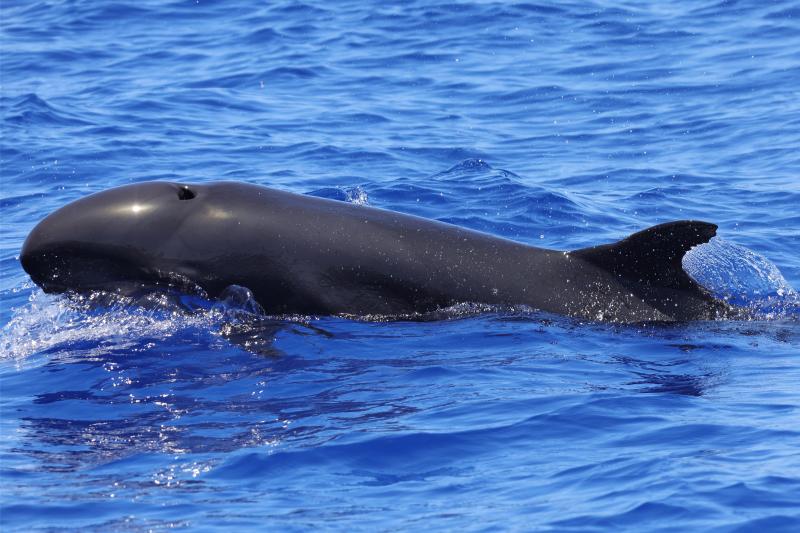
These animals are incredibly powerful swimmers with long, torpedo-shaped bodies that help them move efficiently through the open ocean in search of prey. Their skull structure is what earned them their name, as their head shape closely resembles that of orcas. With broad, rounded heads, muscular jaws and large cone-shaped teeth, early scientists were fascinated by the similarities between these two marine mammal species.
Although their heads may look somewhat like those of orcas, there are several ways to distinguish false killer whales from their larger namesake counterparts.
One of the most noticeable differences has to do with their coloration. While orcas are known for their iconic black-and-white pattern with paler underbellies, alternatively, false killer whales are typically a uniform dark gray to black in color—almost as if a small orca decided to roll around in the dirt. If you’ve ever seen the animated Disney classic 101 Dalmatians, the difference is a bit like when the puppies roll in soot to disguise themselves as labradors instead of showing their usual black-and-white spots.
Their teeth also present a differentiator. The scientific name Pseudorca crassidens translates almost literally to “thick-toothed false orca,” a nod to their sturdy, cone-shaped teeth that help these animals capture prey. Orcas tend to have more robust, bulbous heads, while false killer whales appear slightly narrower and more streamlined.
Behavior and diet
False killer whales are both highly efficient hunters and deeply social animals. It’s not unusual to see them hunting together both in small pods and larger groups as they pursue prey like fish and squid.
Scientists have even observed false killer whales sharing food with each other, a behavior that is very unusual for marine mammals. While some dolphin and whale species work together to pursue prey, they rarely actively share food. The sharing of food among false killer whales spotlights the strong social bonds within their pods. Researchers believe these tight-knit social connections help false killer whales thrive in offshore environments where they’re always on the move.
Maintaining these close bonds and coordinating successful hunts requires constant effective communication, and this is where false killer whales excel. Like other dolphins, they produce a variety of sounds like whistles and clicks to stay connected with their pod and locate prey using echolocation. In the deep offshore waters where they live, sound often becomes more important than sight, since sound travels much farther underwater than light.
Where they live
False killer whales are highly migratory and travel long distances throughout tropical and subtropical waters around the world. They prefer deeper waters far offshore, and this pelagic lifestyle can make them more difficult for scientists to study than many coastal dolphin species.
However, there are a few places where researchers have been able to learn more about them—including the waters surrounding the Hawaiian Islands.
Scientists have identified three distinct groups of false killer whales in and around Hawaii, but one well-studied group stays close to the main Hawaiian Islands year-round. Unfortunately, researchers estimate that only about 140 individuals remained in 2022, with populations expected to decline without action to protect them. This is exactly why this group is listed as endangered under the U.S. Endangered Species Act and is considered one of the most vulnerable marine mammal populations in U.S. waters.
Never Miss An Update
Sign up for Ocean Conservancy text messages today.
Current threats to survival
False killer whales are currently listed as Near Threatened on the IUCN Red List. From climate change-induced ocean acidification and harmful algal blooms to marine debris and fishing bycatch, false killer whales face the same mounting pressures that are impacting marine ecosystems around the world. As their prey becomes scarce due to increasing threats, populations of top predators like these decline, serving as a powerful signal that the ocean’s overall health is in critical need of protection.
Here at Ocean Conservancy, we’re working daily to confront these threats head-on and protect the ecosystems and wildlife we all cherish so dearly. But we can’t do it without you. Support from ocean lovers is what powers our work to protect our ocean, and right now, our planet needs all the help it can get. Visit Ocean Conservancy’s Action Center today and join our movement to create a better future for our ocean, forever and for everyone.
The post All About False Killer Whales appeared first on Ocean Conservancy.
https://oceanconservancy.org/blog/2026/03/31/false-killer-whales/
Ocean Acidification
The Invisible Invasion: Why Do Some Species Get Attention and Others Don’t?
The freshwater jellyfish Craspedacusta sowerbii is one of the world’s most widespread invasive species, now found across freshwater systems on nearly every continent. Yet most people have never heard of it.
Our recent European study revealed that:
- more than 80% of people did not know the species’ scientific name,
- nearly half thought it was a marine jellyfish,
- and only one-third recognized it as non-native or invasive.
https://besjournals.onlinelibrary.wiley.com/doi/full/10.1002/pan3.70344
This raises an interesting question: How can a species spread globally while remaining almost socially invisible? Part of the answer may be surprisingly simple: freshwater jellyfish are tiny, transparent, seasonal, and mostly harmless to humans. Imagine if these jellyfish caused severe stings in swimmers. Imagine Danish lakes suddenly filled with painful jellyfish blooms. The media response, public concern, and political attention would likely be immediate and enormous. Instead, the species remains largely unnoticed because it does not directly threaten human comfort or safety.
This contrast says a lot about how society perceives environmental risk. In 2026, millions followed the dramatic rescue attempt of “Timmy,” a stranded humpback whale in Germany. The rescue operation reportedly involved over a million euros, massive media attention, livestreams, and emotional public engagement.
https://www.theguardian.com/world/2026/apr/28/timmy-whale-barge-rescue-attempt-germany
At the same time, silent aquatic invasions capable of altering ecosystems across continents often struggle to receive even basic research funding. Speaking as a jellyfish researcher, this contrast is difficult to ignore.
Research on gelatinous organisms and cryptic invasions frequently receives limited support, despite their potentially important ecological consequences under climate change and global species redistribution. Another study where I was also involved, highlights a related issue: the language and narratives we use strongly shape public understanding of ecological problems.
https://www.reabic.net/journals/mbi/2026/1/MBI_2026_Vilizzi_etal.pdf
Similarly, previous research on jellyfish media coverage showed that jellyfish associated with painful stings or dangerous blooms receive dramatically more media attention and stronger emotional responses from the public.
https://link.springer.com/article/10.1007/s11852-016-0423-2
Perhaps freshwater jellyfish represent the opposite extreme: an invasive species spreading quietly because it lacks the dramatic narrative that usually drives headlines. And maybe this is one of the biggest challenges in modern ecology:
not only detecting environmental change
but learning how to communicate the quiet ones before they become impossible to ignore.
The Invisible Invasion: Why Do Some Species Get Attention and Others Don’t?
Ocean Acidification
Chemie: macht das Unsichtbare sichtbar
English version below
Wenn man an Chemie denkt, denkt man wahrscheinlich schnell an explodierende Gläser, ätzende Säuren und verrückte Professoren, aber nicht an den Ozean. Hier an Bord wird unsere Wissenschaftsteam auch von zwei chemischen Ozeanographen begleitet, Tobias Steinhoff und Kristin Kampen.
Den beiden habe ich die Frage gestellt, „Was findet ihr an der chemischen Ozeanografie spannend?“: Es ist unglaublich interessant, was es alles an unsichtbaren Prozessen im Meer gibt, die unser aller Leben beeinflussen: In der chemischen Ozeanographie untersuchen wir, wie sich chemische Bestandteile im Meer verhalten, z.B. wie sich gelöste Gase (wie CO₂ und Sauerstoff), Nährsalze (wie Nitrat und Phosphat), Spurenmetalle und organische Verbindungen im Meerwasser verhalten und verteilen. Der Ozean nimmt CO₂ auf, produziert Sauerstoff und transportiert Nährstoffe durch den Ozean und überall wirken chemische Prozesse mit. Diese Zusammenhänge zu verstehen ist Grundlage unserer Arbeit.
Auf unserer Ausfahrt in der Labradorsee nehmen sie Seewasserproben und extrahieren gelöstes organisches Material (DOM). Dies umfasst alle organischen Verbindungen, die im Meerwasser gelöst sind, also nicht als Partikel vorliegen. Das sind zum Beispiel Zucker, Aminosäuren, Fette und komplexere Moleküle, die aus abgestorbenen Organismen, Ausscheidungen von Meereslebewesen oder dem Abbau von Algen stammen. Als einer der größten Kohlenstoffspeicher spielt DOM eine zentrale Rolle im marinen Kohlenstoffkreislauf. Die Labradorsee ist eine der wichtigsten Regionen für die Bildung des North Atlantic Deep Water (NADW). Oberflächenwasser sinkt in die Tiefe und nimmt dabei DOM mit. Das NADW verteilt dieses Material dann über Jahrhunderte durch die Weltmeere und entzieht so der Atmosphäre langfristig Kohlenstoff. Zusätzlich werden kontinuierliche Messungen von pCO₂/O₂ im Oberflächenwasser während der Fahrt durchgeführt, um sich den Austausch von CO₂ zwischen Ozean und Atmosphäre anzuschauen. Viele Prozesse sind hierbei immer noch nicht vollständig verstanden, wie z.B. der Gasaustausch bei hohen Windgeschwindigkeiten.


Da es hier auf See, besonders in dieser Region, oft sehr stürmisch zugeht, ist kein Geheimnis und es geht natürlich besonders in einem Chemie Labor dann doch mal etwas zu Bruch. Wie läuft diese Arbeit also bei 11bft und 6 Meter Wellen ab. Wasserproben müssen meist innerhalb von 24 Stunden verarbeitet werden. Da kann man nicht immer Rücksicht auf die Wetterbedingungen nehmen. Einige Arbeiten werden immer noch nasschemisch gemacht und unter Einsatz von Glasmaterial. Sowohl das genaue Abmessen von Reagenzien als auch das Zusammenhalten der Glasware ist nicht immer einfach bei einem rollenden Schiff (und auch nicht immer erfolgreich). Man versucht zwar den doch dann plötzlichen Bewegungen des Schiffes entgegenzuwirken und alle Proben Behälter, Kisten und Flaschen zu sichern. Man wird aber dann doch mal von einem umkippenden Mülleimer überrascht und die noch neu verpackten Plastikröhrchen oder andere Fliegengewichte im Regal finden bei der einen oder anderen Welle ihren Weg auf die gegenüberliegende Seite im Labor. Dazu kommt, dass beim Arbeiten mit chemischen Stoffen und Proben doch des Öfteren beide Hände für die Arbeit gebraucht werden. Wird man dann allerdings von einer Welle überrascht, erfordert das Festhalten mit der dritten Hand (Fuß falls man schnell genug ist), einiges an Bauchmuskeln.

Foto: Julia Pelle
Das Besondere an der Arbeit auf See ist, dass man neben der alltäglichen Schreibtischarbeit auch praktisch arbeiten kann. Dabei ist man auf die enge Zusammenarbeit mit seinen Kollegen angewiesen und lernt sie dabei viel besser kennen. Zusätzlich sind auch viele andere Forschungsbereiche mit an Bord, wodurch es einen spannenden Austausch zwischen den einzelnen Gruppen gibt.
Zum Schluss hier noch ein kleiner Tipp am Rande von unseren Chemikern und für deine erste Forschungsseereise: Laschen, laschen, laschen und immer ein Ohr am Bordfunk: Der Arbeitsplan ist bei den Wetterbedingungen eher ein Vorschlag und kann sich stündlich ändern (die nächste CTD Station ist immer um die Ecke).
Chemistry: Making the Invisible Visible
When you think of chemistry, you probably quickly imagine exploding glassware, corrosive acids, and crazy professors, but not the ocean. Here on board, our scientific team is also accompanied by two chemical oceanographers, Tobias Steinhoff und Kristin Kampen.
I asked them the question: “What do you find exciting about chemical oceanography?”
“It is incredibly fascinating how many invisible processes exist in the ocean that influence all of our lives. In chemical oceanography, we study the fate of various chemical components in the ocean: for example, how dissolved gases (such as CO₂ and oxygen), nutrients (such as nitrate and phosphate), trace metals, and organic compounds behave and are distributed in seawater. The ocean absorbs CO₂, produces oxygen, and transports nutrients through complex cycles, including chemical processes. Understanding these relationships forms the basis of our work.”
During our expedition in the Labrador Sea, they collect seawater samples and extract dissolved organic material (DOM). This includes all compounds dissolved in seawater, meaning they are not present as particles. Examples include sugars, amino acids, fats, and more complex molecules that originate from dead organisms, excretions from marine life, or the breakdown of algae. As one of the largest carbon reservoirs, DOM plays a central role in the marine carbon cycle.


The Labrador Sea is one of the most important regions for the formation of North Atlantic Deep Water (NADW). Surface water sinks into the depths, carrying DOM with it. NADW then distributes this material throughout the world’s oceans over centuries, thereby removing carbon from the atmosphere over the long term. In addition, continuous measurements of pCO₂ and O₂ in surface water are taken during the voyage to study the exchange of CO₂ between the ocean and the atmosphere. Many processes involved are still not fully understood, such as gas exchange under high wind speeds.
It is no secret that conditions at sea especially in this region are often very stormy, and in a chemistry lab, things can occasionally break. So how does this work at 11 Beaufort and 6-meter waves? Water samples usually need to be processed within 24 hours, so you cannot always take weather conditions into account. Some work is still done using wet chemistry and glass equipment. Accurately measuring reagents and holding glassware steady is not always easy on a rolling ship (and not always successful). Although efforts are made to counteract sudden ship movements and to secure all sample containers, boxes, and bottles, you may still be caught off guard by a tipping trash bin, and newly packaged plastic tubes or other lightweight items can suddenly fly across the lab with the next wave.
On top of that, when working with chemicals and samples, both hands are often needed. If a wave hits unexpectedly, holding on with a “third hand” (your foot, if you are quick enough) requires quite a bit of core strength. What makes working at sea special is that, alongside everyday desk work, you can also do hands-on work. This requires close cooperation with colleagues, allowing you to get to know them much better. In addition, many other research disciplines are on board, which creates exciting exchanges between different groups.
Finally, here is a small tip from our chemists for your first research expedition: strap everything down, strap everything down, strap everything down and always keep one ear on the ship’s radio. The work schedule is more of a suggestion under these weather conditions and can change hourly (the next CTD station is always just around the corner).
Ocean Acidification
Between Storms and Science: Easter in the Labrador Sea (04.04.26–13.04.26)
Between all the scientific work, we celebrated Easter on board, although the weather had other plans for us. Due to rough conditions, we weren’t able to carry out any CTD casts.

Easter itself was spent in a mix of rest and small celebrations. Some of us enjoyed a long Easter breakfast with traditional Easter bread, while others took the opportunity to sleep in. In the evening, we gathered with both crew and scientists for a small celebration. The ship’s cook even organized a quiz, and those who answered correctly were rewarded with Easter chocolate.
The next day, the weather improved, and we began early with the recovery of K1, a 3,495-meter-long mooring in the middle of the Labrador Sea.
We joined the nautical officers on the bridge before sunrise to search for it. Fortunately, K1 has a floating buoy with a light, so we were able to spot it even in the dark. The actual recovery started at first light, and it began to snow while we were working.


Amid all the CTDs and mooring operations, there was also a personal highlight: my (Sarah’s) birthday. Although I’ve spent birthdays away from home before, this one felt especially unique, being so far out at sea, with only limited internet contact.
Normally, I work the 4-8 shift, but my incredibly kind shift team gave me the morning off. That meant I could sleep in and even find time to call family and friends back home. In the afternoon, I was surprised with my favourite cake, baked by Julia.
Our work continued with the mooring array at 53°N, which consists of seven moorings. So far, we have recovered five (K7, K8, K9, DSOW1 and DSOW2), and three of them have already been redeployed (K7, K8 and DSOW1,).
Deploying K7 turned out to be particularly tricky. On our first attempt, sea ice drifted toward us faster than expected, forcing us to recover nearly half of the mooring again. While the ship itself can handle drifting ice, deploying a mooring is much more delicate: a long cable with instruments and floats is released behind the ship before the anchor is dropped, allowing the system to sink into place.
Two days later, we tried again and this time, the deployment was successful.

Afterwards, we moved closer to the sea ice, which was a highlight for many of us. Seeing the ice up close and even spotting a seal swimming nearby, made the experience unforgettable.


Due to the continuing harsh weather, the decision was made to return to K1 and make use of an upcoming weather window for deployment the following day.
German:
Zwischen Stürmen und Wissenschaft: Ostern in der Labradorsee (04.04.26 – 13.04.26)
Zwischen all der wissenschaftlichen Arbeit haben wir Ostern an Bord gefeiert, auch wenn das Wetter andere Pläne für uns hatte. Aufgrund der rauen Bedingungen konnten wir keine CTD-Messungen durchführen (Messungen von Leitfähigkeit, Temperatur und Tiefe im Ozean).

Ostern selbst war eine Mischung aus Erholung und kleinen Feierlichkeiten. Einige von uns genossen ein ausgedehntes Osterfrühstück mit traditionellem Osterbrot, während andere die Gelegenheit nutzten, etwas länger zu schlafen. Am Abend kamen Crew und Wissenschaftler*innen zu einer kleinen Feier zusammen. Der Koch organisierte sogar ein Quiz, und wer die Fragen richtig beantwortete, wurde mit Oster-Schokolade belohnt.
Am nächsten Tag besserte sich das Wetter, und wir begannen früh mit der Bergung von K1, einer 3.495 Meter langen Verankerung mitten in der Labradorsee. (Eine Verankerung ist eine lange, am Meeresboden befestigter Draht, der mit Instrumenten ausgestattet ist, um über längere Zeit Ozeandaten zu messen.)
Noch vor Sonnenaufgang gingen wir mit den nautischen Offizieren auf die Brücke, um nach ihr Ausschau zu halten. Glücklicherweise verfügt K1 über eine schwimmende Boje mit Licht, sodass wir sie bereits im Dunkeln entdecken konnten. Die eigentliche Bergung begann bei Tagesanbruch und es begann sogar zu schneien.


Zwischen all den CTD-Einsätzen und Verankerungsarbeiten gab es auch ein persönliches Highlight: meinen (Sarahs) Geburtstag. Obwohl ich schon öfter Geburtstage fernab von zu Hause verbracht habe, war dieser besonders, so weit draußen auf dem Meer und mit nur eingeschränktem Internetkontakt.
Normalerweise arbeite ich in der 4-8 Uhr Schicht, aber mein unglaublich nettes Schichtteam hat mir den Morgendienst freigegeben. So konnte ich etwas länger schlafen und hatte sogar Zeit, mit Familie und Freunden zu Hause zu telefonieren. Am Nachmittag wurde ich dann noch mit meinem Lieblingskuchen überrascht, den Julia für mich gebacken hat.
Unsere Arbeit ging weiter mit dem Verankerungs-Array bei 53°, das aus sieben Verankerungen besteht. Bisher haben wir fünf geborgen (DSOW1, DSOW2, K7, K8 und K9), von denen drei bereits wieder ausgebracht wurden (DSOW1, K7 und K8).
Das Ausbringen von K7 erwies sich als besonders schwierig. Beim ersten Versuch trieb das Meereis schneller auf uns zu als erwartet, sodass wir fast die Hälfte der Verankerung wieder einholen mussten. Obwohl das Schiff selbst gut durch treibendes Eis navigieren kann, ist das Ausbringen einer Verankerung deutlich anspruchsvoller: Dabei wird ein langer Draht mit Messinstrumenten und Auftriebskörpern hinter dem Schiff ausgesetzt, bevor am Ende der Anker gelöst wird und das gesamte System absinkt.
Zwei Tage später versuchten wir es erneut, diesmal mit Erfolg.

Anschließend fuhren wir näher an das Meereis heran, was für viele von uns ein besonderes Highlight war. Das Eis aus nächster Nähe zu sehen und sogar eine Robbe in der Nähe schwimmen zu beobachten, machte das Erlebnis unvergesslich.


Aufgrund der weiterhin rauen Wetterbedingungen wurde schließlich entschieden, zu K1 zurückzukehren, um ein bevorstehendes Wetterfenster für die Ausbringung am nächsten Tag zu nutzen.
Between Storms and Science: Easter in the Labrador Sea (04.04.26–13.04.26)
-
Climate Change9 months ago
Guest post: Why China is still building new coal – and when it might stop
-
Greenhouse Gases9 months ago
Guest post: Why China is still building new coal – and when it might stop
-
Greenhouse Gases2 years ago嘉宾来稿:满足中国增长的用电需求 光伏加储能“比新建煤电更实惠”
-
Climate Change2 years ago
Bill Discounting Climate Change in Florida’s Energy Policy Awaits DeSantis’ Approval
-
Climate Change2 years ago嘉宾来稿:满足中国增长的用电需求 光伏加储能“比新建煤电更实惠”
-
Renewable Energy6 months agoSending Progressive Philanthropist George Soros to Prison?
-
Carbon Footprint2 years agoUS SEC’s Climate Disclosure Rules Spur Renewed Interest in Carbon Credits
-
Greenhouse Gases10 months ago
嘉宾来稿:探究火山喷发如何影响气候预测