

Christopher Wright is the principal analyst at CarbonBridge, a decarbonisation consulting firm.
The Santa Marta Conference has rightly been hailed as a pivotal opportunity to re-imagine the world’s relationship with fossil fuels. However, the sixty-odd countries gathered this week represent only 15% of the world’s total fossil fuel production, and a small but critical handful of nations in attendance remain deeply committed to expanding their fossil fuel output.
While the discussions at Santa Marta have focused on overcoming economic dependency on fossil fuels, the reality on the ground for many of these countries is that fossil fuel production continues to rise. Despite the rapid global growth of renewable electrification, fossil fuel output has similarly increased.
-
Santa Marta: Ministers grapple with practicalities of fossil fuel phase-out
Around 60 governments that want to make progress on transitioning away from coal, oil and gas are meeting in Colombia to work out how they can do it an equitable way -
Fossil fuel crisis offers chance to speed up energy transition, ministers say
As climate diplomacy resumes in Berlin, ministers say the Iran war-driven fuel crisis is exposing the risks of fossil dependence


This trend is evident even among the countries gathered at Santa Marta, where according to a CarbonBridge analysis, net fossil fuel production has grown over the last five years, particularly driven by expansions in oil and gas output.
Across all countries gathered in Santa Marta, approximately 14 countries are responsible for the lion’s share of oil production, which has increased by 4% since 2020. Similarly, just eight countries account for 96% of the conference’s natural gas production, which has collectively grown by 5% over the past decade.
While coal production has seen a slight decline since 2020, recent production increases in Turkey and Pakistan, with renewed growth in Australia, could similarly see increased production in the near future.
However, most surprisingly, only six countries present at Santa Marta account for over 80% of fossil fuel production among all nations in attendance: Canada, Australia, Brasil, Mexico, Norway and Nigeria.
For these nations, the transition journey ahead is complex. All six countries are aiming to significantly expand renewable energy capacities, and Norway stands as a global leader in electric vehicle adoption.
However, fossil fuel production is not merely a domestic concern for these countries; it plays a central role in their international exports, and remains a foundational pillar of their economic utures. In fact, a deeper look into trends and regulatory frameworks across this suite of countries indicates that their current trajectories are geared toward continued fossil fuel expansion.
Canada
In Canada, oil and gas production continues to climb, with 2025 marking a year of record highs. Oil production rose by 4% to reach 5.34 million barrels per day (MMb/d), while natural gas production surged by 3.4%, reaching 8.2 billion gigajoules. And only yesterday, Shell made a $13.5 bln bet on Canada’s oil and gas future.
Led by Prime Minister Mark Carney, Canada is set to implement an industrial carbon pricing scheme and could double Canada’s clean energy capacity over the next two years. However, he has also been vocal about his support for new oil and gas expansions, new pipeline developments, and has even set a goal to transform Canada’s largely non-existent liquefied natural gas (LNG) industry over the next 15 years, with aspirations to rival the production capacity of the US by 2040.
Brazil
Brazil’s state-owned oil company Petrobras has committed to a massive USD $109 billion expansion of their production to 2030. This hefty investment follows a record 11% production increase in 2025, with Petrobras pumping out 3.77 million barrels per day. Despite hosting the UN climate negotiations last year and generating 89% of the country’s electricity from low-carbon sources in 2025, Brazil’s drive for fossil fuel expansion highlights the gap between national climate transitions and critical export opportunities.
Australia
Australia, the world’s second-largest coal exporter, faces a similar dislocation between its domestic electricity transition and its export economy, as it prepares to assume a leadership role at COP31. Australia is home to the world’s highest solar power per capita and leads the world in home battery rollouts. However, it remains critically dependent on fossil fuel exports, even as questions arise over long-term demand. Currently, gas export volumes, which dipped in 2025, are projected to reach record levels by 2027; pending legal action against the Barossa, Scarborough, and Browse expansions. While thermal coal production is projected to decline slightly through 2030, increases in metallurgical coal are expected to offset these declines, in part due to recent pro-mining regulatory shifts in Queensland.
Mexico
Mexico is one of three major oil producers that make up over 60% of the conference’s annual oil production. However, its oil industry recorded the largest output declines of any major producer in Santa Marta over the last decade. The state-owned oil company Pemex, currently carries close to $100 billion in debt, and was granted $12bn in debt support from the government last year. When combined with import shifts from the US, and potential competition from Venezuela, there is a real chance that Mexico’s oil production could decline further going forward. However, the goal right now from Pemex and the Mexican government, is to increase current production by close to 10% by 2030.
Nigeria
Nigeria’s national oil company, NNPCL, has similarly seen declines over the last decade, but is now pursuing a $60 billion partnership to expand its oil and gas output and solidify its role as one of Africa’s largest fossil fuel producers. This comes even as the federal government was granted $800,000 to explore opportunities to transition away from oil expansion last year.
Norway
In contrast to these countries, Norway stands as one of the few major oil producers at the conference projected to decrease its fossil fuel output. With a forecasted 15% reduction in oil and gas production by 2030, Norway appears to be taking early steps toward a transition. However, the decline in production is more a reflection of the age of its existing oil fields than a proactive shift in government policy. Despite acknowledging the need to diversify its economy, the Norwegian government continues to explore new oil and gas fields, plans to launch new licensing rounds, and hopes to spur on further oil and gas investments, which have almost doubled since 2017.
For these nations, the road ahead is fraught with complexities. While the Santa Marta conference offers an opportunity for dialogue, and renewable energies will undoubtedly continue to expand, the largest fossil fuel producers gathered in Colombia remain structurally focused on growth, rather than phase-downs.
Dollars and cents continue to drive economic decisions, especially in the midst of a global energy crisis. Despite growing calls to utilise this opportunity to reshape development pathways, countries most economically embedded in existing energy markets will need far more convincing, before turning their backs on billions in fossil fuel revenues.
The post Six nations at Santa Marta could shape fossil fuel futures appeared first on Climate Home News.

Climate Change
WA EPA warned Woodside of ‘serious, significant and irreversible’ harms to Scott Reef from gas plans, new documents reveal
SYDNEY/PERTH, Tuesday 27 October 2026 — In response to Western Australian Environmental Protection Authority (WA EPA) documents about Woodside’s plans to drill for gas at Scott Reef, as reported today, the following comments can be attributed to Glenn Walker, Head of Nature at Greenpeace Australia Pacific:
“These WA EPA documents show the depth of concern echoed by multiple regulators about Woodside’s plans to drill for oil and gas at Scott Reef, a proposal that flouts legislated nature protection principles.
“The WA EPA appears to have informed Woodside that the Browse project was bound for rejection based on an extensive review process and the opinion of multiple state government departments and independent experts.
“Greenpeace analyses have confirmed this year that Woodside’s gas drilling plans at Scott Reef still risk destroying vulnerable green turtle homes, further endangering pygmy blue whales with atomic bomb-level seismic blasting noise, and unleashing the worst oil spill in Australian history.
“The federal environment department raised similar red flags about oil spill risk from Woodside’s Scott Reef drilling plans in 2025 and 2026 before handing the project’s assessment over to the National Environmental Protection Authority.
“Woodside’s suggested ‘fixes’ in response to grave concerns for the wellbeing of Scott Reef and threatened species have been unilaterally criticised by independent experts for lacking in scientific basis and adequate detail.
“It would be a major backflip for both the WA EPA and the National EPA to now recommend approving this project. It is now critical that these regulators maintain their independence from corporate and political influence and reject this destructive project once and for all.”
-ENDS-
Notes to editor
Greenpeace Technical assessments of Woodside’s Browse Pygmy Blue Whale Management Plan, the Turtle Management Plan, and an analysis of Woodside’s Browse Oil Spill Modelling and Risk Mitigation Plan
High res images and footage of Scott Reef can be found here
Media contact:
Emma Sangalli at emma.sangalli@greenpeace.org or 0431 513 465
The surprise re-election of Brazil’s President Luiz Inácio Lula da Silva on Sunday, in a tight race against right-wing candidate Flávio Bolsonaro, has raised hopes the country can meet a flagship target to end deforestation in all its biomes by 2030 and advance international fundraising to protect rainforests.
Defying expectations to win an unprecedented fourth term in office, Lula – who turns 81 this week – said in his acceptance speech that “we will show the world how climate policy is handled in this country”, and highlighted that, during his last four years as leader, the country has reduced deforestation every year.
Earlier this month, new data from Brazil’s space agency showed that forest-clearing in the Amazon fell to its lowest on record, after the introduction of a deforestation action plan that constrained illegal cattle ranching from expanding into the world’s largest rainforest.
Brazil leads “encouraging” decline in global rainforest destruction in 2025
At an international level, the country has long championed forest conservation, spearheading the creation of the newly established Tropical Forest Forever Facility (TFFF). As president of last year’s COP30 climate summit, the country is also developing a global roadmap to halt forest loss by the end of the decade, in line with a global goal, which will be presented at the upcoming UN climate summit in Antalya.
‘Much more needs to be done’
In 2023, Lula’s previous administration introduced a deforestation action plan that set a target of zero deforestation by 2030, achieving swift results. His re-election paves the way for this downward trend to continue.
Carlos Nobre, a veteran Brazilian climate scientist and co-chair of the Science Panel for the Amazon, said Brazil now has a “historic opportunity” to prevent a tipping point where large parts of the Amazon rainforest could turn into savanna, with dangerous impacts for the planet’s climate.
“The reduction in deforestation over recent years has been crucial, but much more needs to be done. Ending deforestation by 2030, tackling forest degradation and accelerating large-scale forest restoration are urgent priorities,” he said.
Anders Haug Larsen, advocacy director at the Norway Rainforest Foundation, described the election result as a “relief”, adding it makes it more attractive for donors to support rainforest protection in the country.
“Hope is a scarce commodity these days,” he said. “The international community must grasp this opportunity to strengthen efforts towards zero deforestation in the Amazon.”
Rainforest fund boosted by election result
Brazil was the original proponent of the TFFF, one of the highest-profile initiatives aimed at channelling new finance to protect the world’s rainforests. The fund aims to raise public seed capital to invest in financial markets, and then pay rainforest countries from the returns on those investments.
Despite being a developing country, Brazil has pledged $1 billion to the fund and is expected to play a key role in helping reach its goal to raise $10 billion from governments by the end of this year.
“We need more countries to come on board to meet the mobilisation target of $10 billion this year, and this election should inject trust in the calls from rainforest countries for support to their forest protection efforts,” Larsen said.
Brazil confident new rainforest fund will reach $10bn donor milestone
On Monday, the day after the election result, the Netherlands announced a €500-million contribution to the fund, which will be disbursed over ten years and is still subject to parliamentary approval. This brings the total pledged to the TFFF from a range of countries to $7.8 billion.
Norway’s climate minister Sigrun Aasland told a TFFF event on the sidelines of the UN biodiversity summit in Yerevan that she was hopeful the $10bn goal could be achieved by the end of this year.
Brazilian officials have led the TFFF’s fundraising efforts and said they are in conversations with more potential donors including China, Korea and Japan.
Congress shifts further to the right
Sonia Guajajara, former minister of Indigenous Peoples in Lula’s government, celebrated the president’s re-election but cautioned that the 20 indigenous territories created under his current administration must be consolidated, as they are “essential to tackling the climate crisis and preserving our biomes”.
Veteran Brazilian diplomat Bráulio Ferreira de Souza Dias, meanwhile, noted that Lula faces a difficult political scenario, as right-wing pro-Bolsonaro lawmakers have gained more seats in both legislative chambers. He added that the courts will become key battlegrounds to challenge anti-climate legislation.
Observatório do Clima, a network of Brazilian green groups, said seven out of every ten representatives and senators who will make up the next legislature are likely to vote against the climate and environmental agenda, urging Lula’s administration to strengthen its action in parliament and expand alliances.
Still, Ferreira de Souza Dias echoed the widespread view among climate policy-makers that a Bolsonaro win would have been “terrible” for the rainforest and Indigenous peoples, and said the country had avoided a scenario where deforestation threatened to increase again.
The post Lula’s election win in Brazil raises hopes for zero deforestation drive appeared first on Climate Home News.
Lula’s election win in Brazil raises hopes for zero deforestation drive
African governments are developing policies to manage waste from solar panels, batteries and other clean tech equipment as installations surge, with officials warning the energy transition could create a new environmental problem unless it is accompanied by investment in recycling and reuse.
Many African households and businesses are increasingly turning away from unreliable grid power or deciding not to wait for access, and are installing more solar panels and battery storage. Data from energy think-tank Ember, published in August, projects that the continent will install a record 17 gigawatts (GW) of solar capacity in 2026 – equal to around 100,000 solar panels every day. This would mark the third consecutive year of record growth, following increases of 51% in 2025 and 25% in 2024.
While generally a welcome sign of progress towards a cleaner energy mix, this trend could also create a headache for African officials. Anselm Marungu, Namibia’s deputy minister of environment, forestry and tourism, believes rules should be put in place to ensure that valuable materials can be recovered from discarded solar panels, batteries and inverters at the end of their useful life.
-
Made in Nigeria: The race to build an African solar industry from scratch
A solar power revolution is gathering pace in Africa and Nigeria wants a slice of the fast-growing industry, but competing with Chinese imports won’t be easy -
Indian start-ups mine e-waste for battery minerals but growing industry has a dark side
Recycling e-waste can unlock a vast and sustainable supply of transition minerals but in India the sector relies on a neglected informal economy -
DR Congo’s power-hungry mining sector drives record solar surge
As solar deployment rapidly accelerates across Africa, miners in the DRC are driving significant demand for clean energy to replace expensive diesel


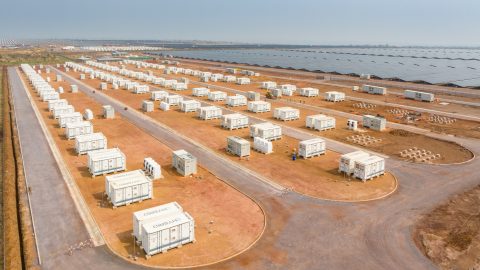
Some of the materials and minerals the world needs for manufacturing clean energy technologies – including glass, aluminium, copper, cobalt, lithium and nickel – can be obtained by recycling solar panels, inverters and batteries.
The International Energy Agency (IEA) estimates that recycling could reduce growth in new mining needs by 40% for copper and cobalt and by 25% for lithium and nickel by 2050, thereby reducing the social and environmental impacts associated with conventional extraction.
Speaking at a pan-African policy conference on circular value chains this month, Marungu said the success of these technologies depends not just on how quickly they are installed, but also on whether the materials are sourced responsibly, the equipment maintained and its components recovered to create economic opportunities across their entire life-cycle.
He called for sound policies, sustainable investment and circular business models that can become the foundation of new industries, green jobs and stronger African value chains. Solar panels, batteries, inverters and tubes “must not become tomorrow’s environmental burden”, he added.
From importation to end of life
When not properly disposed of or handled during recycling, discarded solar panels and batteries can release hazardous substances into the environment, contaminating soil and water and exposing waste workers and nearby communities to toxic materials which can cause lung cancer and damage vital organs.
Innocent Barikor, director-general of Nigeria’s National Environmental Standards and Regulations Enforcement Agency (NESREA), said the rapid uptake of off-grid renewable energy has made it necessary to strengthen waste management rules and develop a framework for reusing materials from equipment.