Global temperatures in 2023 blew past expectations to set the warmest year on record, even topping 1.5C in one of the main datasets.
This warmth has continued into 2024, meaning that this year is also on track to potentially pass 1.5C in one or more datasets.
Crossing 1.5C in one or even two years is not the same as exceeding the 1.5C limit under the Paris Agreement. The goal is generally considered to refer to long-term warming, rather than annual temperatures that include the short-term influence of natural fluctuations in the climate, such as El Niño.
Nonetheless, recent warming has led to renewed debate around whether the world might imminently pass the 1.5C Paris Agreement limit – sooner than climate scientists and Intergovernmental Panel on Climate Change (IPCC) have previously estimated.
Here, Carbon Brief provides an updated analysis of when the world will likely exceed the Paris 1.5C limit (in a scenario where emissions are not rapidly cut), using both the latest global surface temperature data and climate model simulations.
The findings show that, while the best estimate for crossing 1.5C has moved up by approximately two years compared to Carbon Brief’s earlier 2020 analysis, it remains most likely to happen in the late 2020s or early 2030s – rather than in the next few years.
Understanding global temperature targets
Human emissions of CO2 and other greenhouse gasses have substantially warmed the planet over the past 150 years. On top of this human-driven warming, there is year-to-year natural variability largely associated with El Niño and La Niña events.
A big El Niño or La Niña event can result in global temperatures up to 0.2C warmer or cooler, respectively, than they would otherwise be.
As the world has been warming by around 0.2C per decade, a large El Niño event can represent an early look at what typical global temperatures will be a decade in the future. Or, to put it another way, human emissions are adding a permanent super-El Niño’s worth of heat to the climate system each decade.
In the 2015 Paris Agreement, the international community agreed to limit warming to well-below 2C above pre-industrial levels and “pursue efforts to limit the temperature increase to 1.5C”. While there is no set definition for the time period against which the goal is measured, it is generally interpreted to refer to long-term, human-driven warming.
For example, the IPCC’s recently completed sixth assessment report (AR6) uses the midpoint of a 20-year period as a way to avoid overinterpreting short-term natural variability.
While a useful approach, this definition has the unfortunate side-effect that scientists will not know for sure that the world passed 1.5C until 10 years after it has happened.
This has led the community to propose a number of alternative approaches, such as Carbon Brief’s 2020 analysis and a 2023 Nature commentary by Prof Richard Betts and colleagues at the UK Met Office.
An updated approach for determining exceedance
Here, Carbon Brief provides an update to our 2020 analysis of both observations and the latest generation of climate models to assess when the world will likely pass the 1.5C limit across different surface temperature datasets.
While the IPCC’s 20-year average is one approach to remove short-term variability, it comes with the important downside of not being able to extend up to the present day. An alternative approach is a smoothed average using a local regression (LOWESS).
LOWESS provides an estimated value at each point in time based on a weighting where nearby points are given the highest weights and those further away are given less weight. It is an approach commonly used in timeseries analysis that can account for changes in the behaviour of data over time without assuming it is linear.
However, LOWESS approaches still require a choice on the part of the user; namely, how many nearby points should be considered when determining the smoothed average. The figure below shows three potential options that could be used: a window of the nearest 10 years, 20 years or 30 years around each point.
The data shown are a composite average of four different global surface temperature records – NASA’s GISTEMP; NOAA’s GlobalTemp; Hadley/UEA’s HadCRUT5; and Berkeley Earth – that extend back into the 1800s.

Annual global mean surface temperatures from a composite average of NASA’s GISTEMP, NOAA’s GlobalTemp, Hadley/UEA’s HadCRUT5, and Berkeley Earth (black dots) along with LOWESS fits using 10-year, 20-year, and 30-year windows. Chart by Carbon Brief.
In this case, both 20-year and 30-year windows show similar long-term changes in temperature, while a shorter 10-year window does not fully remove short-term variability associated with El Niño and La Niña events.
For this analysis, Carbon Brief selected a 30-year window for removing natural variability, though a 20-year window would have given nearly identical results. (As discussed above, there are a number of alternative approaches that could be used. These are assessed in the UK Met Office’s Climate Dashboard, though they all give comparable results to the LOWESS approach used here.)
To determine when the world will pass 1.5C and 2C, Carbon Brief combines smoothed averages of both observed temperatures and climate model projections.
The observed temperatures are used to determine the level of warming to date – 1.3C in the composite average – while climate models are used to assess the range of possible warming into the future. This approach has an advantage over just using climate models as it avoids any historical mismatch between modelled and real-world temperatures.
The figure below shows the combined smoothed average from the observations and climate models, with the climate models normalised to the observations in 2023. Global temperatures are assessed to be 1.3C in 2023, with a wide range of possible future warming determined by the spread in warming after 2023 across 37 different climate models in the CMIP6 ensemble using the SSP2-4.5 current-policy-type scenario.

Annual global average surface temperatures from the composite average (black dots) along the 30-year LOWESS fit (black line), combined with 37 CMIP6 models smoothed using the same 30-year LOWESS fit. Models and observations are aligned using the smoothed average values for 2023. Chart by Carbon Brief.
This approach suggests that the world will pass 1.5C around the year 2030 (representing the 50th percentile, or central estimate, of all the model runs), with a range of anywhere from 2028 (5th percentile) up to 2036 (95th percentile).
Similarly, the world will pass 2C around the year 2048, with a range of 2040 to 2062 across all models assessed.
The figure below shows distribution of exceedance years (that is, the year in which the target is exceeded) across all of the different CMIP6 models. The width of the plot indicates the portion of models that show the temperature limit passed in a given year – the wider the plot, the more agreement across the models.

The results are broadly similar to Carbon Brief’s 2020 analysis, though the best estimate of when the world will pass 1.5C has moved up from 2032 to 2030, reflecting both a higher estimate of warming to date (including the development of HadCRUT5) and an inclusion of more CMIP6 model runs than were available at the time.
The 5th and 95th percentile has narrowed to 2028-36 compared to 2026-42 in the 2020 analysis, showing the impact of three additional years of data on reducing the resulting model spread.
Sensitivity to the choice of datasets
While the averaging of different datasets into a composite average follows the approach used in the IPCC AR6 and by the WMO, it somewhat obscures important differences in estimates of warming since pre-industrial times across different research groups.
While the long-term warming the world has experienced in the composite average is 1.3C as of 2023 (similar to the results in the new Forster et al study), applying the same LOWESS smoothing approach to each individual record yields fairly different results, ranging from as low as 1.22C to 1.41C across the four different groups:
- Composite Average: 1.30C
- Berkeley Earth: 1.41C
- HadCRUT5: 1.30C
- NASA GISTEMP: 1.24C
- NOAA GlobalTemp: 1.22C
These differences reflect a number of factors, including what land station data is included in each record, the ocean sea surface temperature datasets used and how different groups fill in the gaps between observations – particularly in the early part of the record when station data is more sparse.
The table below gives the resulting 1.5C exceedance years when Carbon Brief’s approach is applied to each different temperature record:
| Projected year of 1.5C breach | |||
|---|---|---|---|
| Dataset | 50th percentile | 5th percentile | 95th percentile |
| Composite | 2030 | 2028 | 2036 |
| Berkeley Earth | 2027 | 2025 | 2031 |
| HadCRUT5 | 2030 | 2028 | 2036 |
| NASA GISTEMP | 2032 | 2029 | 2040 |
| NOAA GlobalTemp | 2033 | 2030 | 2041 |
Using the Berkeley Earth record gives a central estimate of passing 1.5C as early as 2027 (ranging from 2025 to 2031), while NOAA gives an estimate as late as 2033 (2030 to 2041).
Similarly, here are the results for the 2C exceedance year:
| Projected year of 2C breach | |||
|---|---|---|---|
| Dataset | 50th percentile | 5th percentile | 95th percentile |
| Composite | 2048 | 2040 | 2062 |
| Berkeley Earth | 2045 | 2037 | 2056 |
| HadCRUT5 | 2048 | 2040 | 2062 |
| NASA GISTEMP | 2050 | 2041 | 2067 |
| NOAA GlobalTemp | 2051 | 2042 | 2068 |
It is worth noting that there is no “correct” answer as to the best surface temperature record to use. Rather, the range of results across the different records represent real uncertainty around when the world will pass 1.5C and 2C.
Other approaches get similar results
This analysis is far from the first time the scientific community has asked when the world will pass various climate limits or how to best calculate the level of warming the world has experienced to date.
Copernicus/ECMWF provide a regularly updated “global temperature trend monitor” that uses a more simple approach – a linear trend over the past 30 years – to assess when global temperatures will likely exceed 1.5C in their ERA5 dataset.
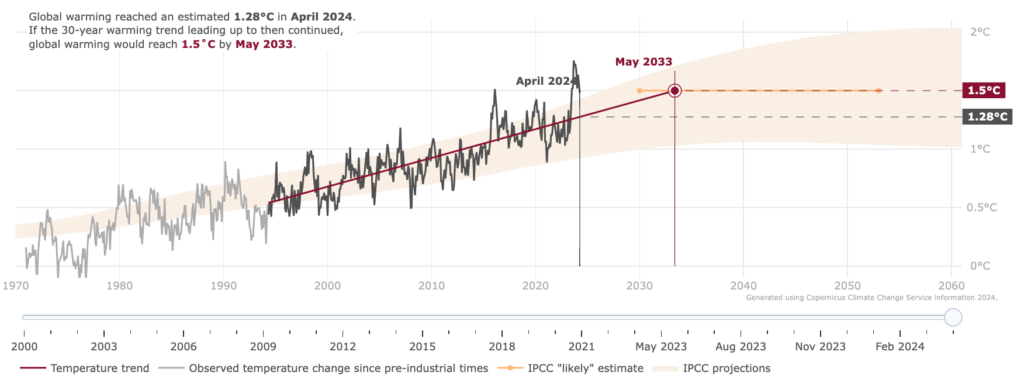
This approach gives a slightly later date, 2033, than the climate model-based approach Carbon Brief uses. This reflects the fact that most models anticipate a modest acceleration in the rate of warming that might not be fully captured using a linear trend over the past 30 years.
An alternative approach to determining when the world will pass 1.5C is to use the “assessed warming projections” developed for AR6. These assessed warming projections more closely match observed temperatures than the full CMIP6 ensemble.
They also provide a narrower range of future warming than the full set of CMIP6, as they give less weight to “hot models” in CMIP6 that are inconsistent with the IPCC’s assessment of the likely range of climate sensitivity.

Annual global average surface temperatures from the composite average (black dots) along the 30-year LOWESS fit (red line), combined the AR6 assessed warming projection for SSP2-4.5 as published and without any baseline alignment. Chart by Carbon Brief.
In addition, AR6 features an estimate of 1.5C exceedance dates based on the ScenarioMIP assessment of CMIP6 models (and previously covered by Carbon Brief here).
These three different approaches are compared to Carbon Brief’s new assessment in the table below:
| Approach | 1.5C exceedance year |
|---|---|
| Carbon Brief (Composite, SSP2-4.5) | 2030 (2028 to 2036) |
| Copernicus | 2033 |
| AR6 Assessed Warming (SSP2-4.5) | 2031 (2024 to 2043) |
| AR6 ScenarioMIP (SSP2-4.5) | 2030 (2021 to 2046) |
Both AR6 approaches include a wider range than the Carbon Brief approach as they rely on models that have differing estimates of current global temperatures relative to pre-industrial.
For example, the AR6 assessed warming projections give a best estimate of 2023 global temperatures (in the absence of short-term natural variability) as 1.31C, with a range from as low as 1.15C to as high as 1.48C. However, these are comparable to the range of warming to date (1.22C to 1.41C) across the different surface temperature records.
There is no single best way to assess when the world will likely pass 1.5C. But both Carbon Brief’s approach and those of other groups all agree it will most likely happen in the late 2020s or early 2030s in a world (SSP2-4.5) where global emissions remain around current levels.
The post Analysis: What record global heat means for breaching the 1.5C warming limit appeared first on Carbon Brief.
Analysis: What record global heat means for breaching the 1.5C warming limit
Greenhouse Gases
Cropped 25 February 2026: Food inflation strikes | El Niño looms | Biodiversity talks stagnate
We handpick and explain the most important stories at the intersection of climate, land, food and nature over the past fortnight.
This is an online version of Carbon Brief’s fortnightly Cropped email newsletter.
Subscribe for free here.
Key developments
Food inflation on the rise
DELUGE STRIKES FOOD: Extreme rainfall and flooding across the Mediterranean and north Africa has “battered the winter growing regions that feed Europe…threatening food price rises”, reported the Financial Times. Western France has “endured more than 36 days of continuous rain”, while farmers’ associations in Spain’s Andalusia estimate that “20% of all production has been lost”, it added. Policy expert David Barmes told the paper that the “latest storms were part of a wider pattern of climate shocks feeding into food price inflation”.
-
Sign up to Carbon Brief’s free “Cropped” email newsletter. A fortnightly digest of food, land and nature news and views. Sent to your inbox every other Wednesday.
NO BEEF: The UK’s beef farmers, meanwhile, “face a double blow” from climate change as “relentless rain forces them to keep cows indoors”, while last summer’s drought hit hay supplies, said another Financial Times article. At the same time, indoor growers in south England described a 60% increase in electricity standing charges as a “ticking timebomb” that could “force them to raise their prices or stop production, which will further fuel food price inflation”, wrote the Guardian.
‘TINDERBOX’ AND TARIFFS: A study, covered by the Guardian, warned that major extreme weather and other “shocks” could “spark social unrest and even food riots in the UK”. Experts cited “chronic” vulnerabilities, including climate change, low incomes, poor farming policy and “fragile” supply chains that have made the UK’s food system a “tinderbox”. A New York Times explainer noted that while trade could once guard against food supply shocks, barriers such as tariffs and export controls – which are being “increasingly” used by politicians – “can shut off that safety valve”.
El Niño looms
NEW ENSO INDEX: Researchers have developed a new index for calculating El Niño, the large-scale climate pattern that influences global weather and causes “billions in damages by bringing floods to some regions and drought to others”, reported CNN. It added that climate change is making it more difficult for scientists to observe El Niño patterns by warming up the entire ocean. The outlet said that with the new metric, “scientists can now see it earlier and our long-range weather forecasts will be improved for it.”
WARMING WARNING: Meanwhile, the US Climate Prediction Center announced that there is a 60% chance of the current La Niña conditions shifting towards a neutral state over the next few months, with an El Niño likely to follow in late spring, according to Reuters. The Vibes, a Malaysian news outlet, quoted a climate scientist saying: “If the El Niño does materialise, it could possibly push 2026 or 2027 as the warmest year on record, replacing 2024.”
CROP IMPACTS: Reuters noted that neutral conditions lead to “more stable weather and potentially better crop yields”. However, the newswire added, an El Niño state would mean “worsening drought conditions and issues for the next growing season” to Australia. El Niño also “typically brings a poor south-west monsoon to India, including droughts”, reported the Hindu’s Business Line. A 2024 guest post for Carbon Brief explained that El Niño is linked to crop failure in south-eastern Africa and south-east Asia.
News and views
- DAM-AG-ES: Several South Korean farmers filed a lawsuit against the country’s state-owned utility company, “seek[ing] financial compensation for climate-related agricultural damages”, reported United Press International. Meanwhile, a national climate change assessment for the Philippines found that the country “lost up to $219bn in agricultural damages from typhoons, floods and droughts” over 2000-10, according to Eco-Business.
- SCORCHED GRASS: South Africa’s Western Cape province is experiencing “one of the worst droughts in living memory”, which is “scorching grass and killing livestock”, said Reuters. The newswire wrote: “In 2015, a drought almost dried up the taps in the city; farmers say this one has been even more brutal than a decade ago.”
- NOUVELLE VEG: New guidelines published under France’s national food, nutrition and climate strategy “urged” citizens to “limit” their meat consumption, reported Euronews. The delayed strategy comes a month after the US government “upended decades of recommendations by touting consumption of red meat and full-fat dairy”, it noted.
- COURTING DISASTER: India’s top green court accepted the findings of a committee that “found no flaws” in greenlighting the Great Nicobar project that “will lead to the felling of a million trees” and translocating corals, reported Mongabay. The court found “no good ground to interfere”, despite “threats to a globally unique biodiversity hotspot” and Indigenous tribes at risk of displacement by the project, wrote Frontline.
- FISH FALLING: A new study found that fish biomass is “falling by 7.2% from as little as 0.1C of warming per decade”, noted the Guardian. While experts also pointed to the role of overfishing in marine life loss, marine ecologist and study lead author Dr Shahar Chaikin told the outlet: “Our research proves exactly what that biological cost [of warming] looks like underwater.”
- TOO HOT FOR COFFEE: According to new analysis by Climate Central, countries where coffee beans are grown “are becoming too hot to cultivate them”, reported the Guardian. The world’s top five coffee-growing countries faced “57 additional days of coffee-harming heat” annually because of climate change, it added.
Spotlight
Nature talks inch forward
This week, Carbon Brief covers the latest round of negotiations under the UN Convention on Biological Diversity (CBD), which occurred in Rome over 16-19 February.
The penultimate set of biodiversity negotiations before October’s Conference of the Parties ended in Rome last week, leaving plenty of unfinished business.
The CBD’s subsidiary body on implementation (SBI) met in the Italian capital for four days to discuss a range of issues, including biodiversity finance and reviewing progress towards the nature targets agreed under the Kunming-Montreal Global Biodiversity Framework (GBF).
However, many of the major sticking points – particularly around finance – will have to wait until later this summer, leaving some observers worried about the capacity for delegates to get through a packed agenda at COP17.
The SBI, along with the subsidiary body on scientific, technical and technological advice (SBSTTA) will both meet in Nairobi, Kenya, later this summer for a final round of talks before COP17 kicks off in Yerevan, Armenia, on 19 October.
Money talks
Finance for nature has long been a sticking point at negotiations under the CBD.
Discussions on a new fund for biodiversity derailed biodiversity talks in Cali, Colombia, in autumn 2024, requiring resumed talks a few months later.
Despite this, finance was barely on the agenda at the SBI meetings in Rome. Delegates discussed three studies on the relationship between debt sustainability and implementation of nature plans, but the more substantive talks are set to take place at the next SBI meeting in Nairobi.
Several parties “highlighted concerns with the imbalance of work” on finance between these SBI talks and the next ones, reported Earth Negotiations Bulletin (ENB).
Lim Li Ching, senior researcher at Third World Network, noted that tensions around finance permeated every aspect of the talks. She told Carbon Brief:
“If you’re talking about the gender plan of action – if there’s little or no financial resources provided to actually put it into practice and implement it, then it’s [just] paper, right? Same with the reporting requirements and obligations.”
Monitoring and reporting
Closely linked to the issue of finance is the obligations of parties to report on their progress towards the goals and targets of the GBF.
Parties do so through the submission of national reports.
Several parties at the talks pointed to a lack of timely funding for driving delays in their reporting, according to ENB.
A note released by the CBD Secretariat in December said that no parties had submitted their national reports yet; by the time of the SBI meetings, only the EU had. It further noted that just 58 parties had submitted their national biodiversity plans, which were initially meant to be published by COP16, in October 2024.
Linda Krueger, director of biodiversity and infrastructure policy at the environmental not-for-profit Nature Conservancy, told Carbon Brief that despite the sparse submissions, parties are “very focused on the national report preparation”. She added:
“Everybody wants to be able to show that we’re on the path and that there still is a pathway to getting to 2030 that’s positive and largely in the right direction.”
Watch, read, listen
NET LOSS: Nigeria’s marine life is being “threatened” by “ghost gear” – nets and other fishing equipment discarded in the ocean – said Dialogue Earth.
COMEBACK CAUSALITY: A Vox long-read looked at whether Costa Rica’s “payments for ecosystem services” programme helped the country turn a corner on deforestation.
HOMEGROWN GOALS: A Straits Times podcast discussed whether import-dependent Singapore can afford to shelve its goal to produce 30% of its food locally by 2030.
‘RUSTING’ RIVERS: The Financial Times took a closer look at a “strange new force blighting the [Arctic] landscape”: rivers turning rust-orange due to global warming.
New science
- Lakes in the Congo Basin’s peatlands are releasing carbon that is thousands of years old | Nature Geoscience
- Natural non-forest ecosystems – such as grasslands and marshlands – were converted for agriculture at four times the rate of land with tree cover between 2005 and 2020 | Proceedings of the National Academy of Sciences
- Around one-quarter of global tree-cover loss over 2001-22 was driven by cropland expansion, pastures and forest plantations for commodity production | Nature Food
In the diary
- 2-6 March: UN Food and Agriculture Organization regional conference for Latin America and Caribbean | Brasília
- 5 March: Nepal general elections
- 9-20 March: First part of the thirty-first session of the International Seabed Authority (ISA) | Kingston, Jamaica
Cropped is researched and written by Dr Giuliana Viglione, Aruna Chandrasekhar, Daisy Dunne, Orla Dwyer and Yanine Quiroz.
Please send tips and feedback to cropped@carbonbrief.org
The post Cropped 25 February 2026: Food inflation strikes | El Niño looms | Biodiversity talks stagnate appeared first on Carbon Brief.
Cropped 25 February 2026: Food inflation strikes | El Niño looms | Biodiversity talks stagnate
Greenhouse Gases
Dangerous heat for Tour de France riders only a ‘question of time’
Rising temperatures across France since the mid-1970s is putting Tour de France competitors at “high risk”, according to new research.
The study, published in Scientific Reports, uses 50 years of climate data to calculate the potential heat stress that athletes have been exposed to across a dozen different locations during the world-famous cycling race.
The researchers find that both the severity and frequency of high-heat-stress events have increased across France over recent decades.
But, despite record-setting heatwaves in France, the heat-stress threshold for safe competition has rarely been breached in any particular city on the day the Tour passed through.
(This threshold was set out by cycling’s international governing body in 2024.)
However, the researchers add it is “only a question of time” until this occurs as average temperatures in France continue to rise.
The lead author of the study tells Carbon Brief that, while the race organisers have been fortunate to avoid major heat stress on race days so far, it will be “harder and harder to be lucky” as extreme heat becomes more common.
‘Iconic’
The Tour de France is one of the world’s most storied cycling races and the oldest of Europe’s three major multi-week cycling competitions, or Grand Tours.
Riders cover around 3,500 kilometres (km) of distance and gain up to nearly 55km of altitude over 21 stages, with only two or three rest days throughout the gruelling race.
The researchers selected the Tour de France because it is the “iconic bike race. It is the bike race of bike races,” says Dr Ivana Cvijanovic, a climate scientist at the French National Research Institute for Sustainable Development, who led the new work.
Heat has become a growing problem for the competition in recent years.
In 2022, Alexis Vuillermoz, a French competitor, collapsed at the finish line of the Tour’s ninth stage, leaving in an ambulance and subsequently pulling out of the race entirely.
Two years later, British cyclist Sir Mark Cavendish vomited on his bike during the first stage of the race after struggling with the 36C heat.
The Tour also makes a good case study because it is almost entirely held during the month of July and, while the route itself changes, there are many cities and stages that are repeated from year to year, Cvijanovic adds.
‘Have to be lucky’
The study focuses on the 50-year span between 1974 and 2023.
The researchers select six locations across the country that have commonly hosted the Tour, from the mountain pass of Col du Tourmalet, in the French Pyrenees, to the city of Paris – where the race finishes, along the Champs-Élysées.
These sites represent a broad range of climatic zones: Alpe d’ Huez, Bourdeaux, Col du Tourmalet, Nîmes, Paris and Toulouse.
For each location, they use meteorological reanalysis data from ERA5 and radiant temperature data from ERA5-HEAT to calculate the “wet-bulb globe temperature” (WBGT) for multiple times of day across the month of July each year.
WBGT is a heat-stress index that takes into account temperature, humidity, wind speed and direct sunlight.
Although there is “no exact scientific consensus” on the best heat-stress index to use, WBGT is “one of the rare indicators that has been originally developed based on the actual human response to heat”, Cvijanovic explains.
It is also the one that the International Cycling Union (UCI) – the world governing body for sport cycling – uses to assess risk. A WBGT of 28C or higher is classified as “high risk” by the group.
WBGT is the “gold standard” for assessing heat stress, says Dr Jessica Murfree, director of the ACCESS Research Laboratory and assistant professor at the University of North Carolina at Chapel Hill.
Murfree, who was not involved in the new study, adds that the researchers are “doing the right things by conducting their science in alignment with the business practices that are already happening”.
The researchers find that across the 50-year time period, WBGT has been increasing across the entire country – albeit, at different rates. In the north-west of the country, WBGT has increased at an average rate of 0.1C per decade, while in the southern and eastern parts of the country, it has increased by more than 0.5C per decade.
The maps below show the maximum July WBGT for each decade of the analysis (rows) and for hourly increments of the late afternoon (columns). Lower temperatures are shown in lighter greens and yellows, while higher temperatures are shown in darker reds and purples.
Six Tour de France locations analysed in the study are shown as triangles on the maps (clockwise from top): Paris, Alpe d’ Huez, Nîmes, Toulouse, Col du Tourmalet and Bordeaux.
The maps show that the maximum WBGT temperature in the afternoon has surpassed 28C over almost the entire country in the last decade. The notable exceptions to this are the mountainous regions of the Alps and the Pyrenees.
The researchers also find that most of the country has crossed the 28C WBGT threshold – which they describe as “dangerous heat levels” – on at least one July day over the past decade. However, by looking at the WBGT on the day the Tour passed through any of these six locations, they find that the threshold has rarely been breached during the race itself.
For example, the research notes that, since 1974, Paris has seen a WBGT of 28C five times at 3pm in July – but that these events have “so far” not coincided with the cycling race.
The study states that it is “fortunate” that the Tour has so far avoided the worst of the heat-stress.
Cvijanovic says the organisers and competitors have been “lucky” to date. She adds:
“It has worked really well for them so far. But as the frequency of these [extreme heat] events is increasing, it will be harder and harder to be lucky.”
Dr Madeleine Orr, an assistant professor of sport ecology at the University of Toronto who was not involved in the study, tells Carbon Brief that the paper was “really well done”, noting that its “methods are good [and its] approach was sound”. She adds:
“[The Tour has] had athletes complain about [the heat]. They’ve had athletes collapse – and still those aren’t the worst conditions. I think that that says a lot about what we consider safe. They’ve still been lucky to not see what unsafe looks like, despite [the heat] having already had impacts.”
Heat safety protocols
In 2024, the UCI set out its first-ever high temperature protocol – a set of guidelines for race organisers to assess athletes’ risk of heat stress.
The assessment places the potential risk into one of five categories based on the WBGT, ranging from very low to high risk.
The protocol then sets out suggested actions to take in the event of extreme heat, ranging from having athletes complete their warm-ups using ice vests and cold towels to increasing the number of support vehicles providing water and ice.
If the WBGT climbs above the 28C mark, the protocol suggests that organisers modify the start time of the stage, adapt the course to remove particularly hazardous sections – or even cancel the race entirely.
However, Orr notes that many other parts of the race, such as spectator comfort and equipment functioning, may have lower temperatures thresholds that are not accounted for in the protocol, but should also be considered.
Murfree points out that the study’s findings – and the heat protocol itself – are “really focused on adaptation, rather than mitigation”. While this is “to be expected”, she tells Carbon Brief:
“Moving to earlier start times or adjusting the route specifically to avoid these locations that score higher in heat stress doesn’t stop the heat stress. These aren’t climate preventative measures. That, I think, would be a much more difficult conversation to have in the research because of the Tour de France’s intimate relationship with fossil-fuel companies.”
The post Dangerous heat for Tour de France riders only a ‘question of time’ appeared first on Carbon Brief.
Dangerous heat for Tour de France riders only a ‘question of time’
Greenhouse Gases
DeBriefed 20 February 2026: EU’s ‘3C’ warning | Endangerment repeal’s impact on US emissions | ‘Tree invasion’ fuelled South America’s fires
Welcome to Carbon Brief’s DeBriefed.
An essential guide to the week’s key developments relating to climate change.
This week
Preparing for 3C
NEW ALERT: The EU’s climate advisory board urged countries to prepare for 3C of global warming, reported the Guardian. The outlet quoted Maarten van Aalst, a member of the advisory board, saying that adapting to this future is a “daunting task, but, at the same time, quite a doable task”. The board recommended the creation of “climate risk assessments and investments in protective measures”.
‘INSUFFICIENT’ ACTION: EFE Verde added that the advisory board said that the EU’s adaptation efforts were so far “insufficient, fragmented and reactive” and “belated”. Climate impacts are expected to weaken the bloc’s productivity, put pressure on public budgets and increase security risks, it added.
UNDERWATER: Meanwhile, France faced “unprecedented” flooding this week, reported Le Monde. The flooding has inundated houses, streets and fields and forced the evacuation of around 2,000 people, according to the outlet. The Guardian quoted Monique Barbut, minister for the ecological transition, saying: “People who follow climate issues have been warning us for a long time that events like this will happen more often…In fact, tomorrow has arrived.”
IEA ‘erases’ climate
MISSING PRIORITY: The US has “succeeded” in removing climate change from the main priorities of the International Energy Agency (IEA) during a “tense ministerial meeting” in Paris, reported Politico. It noted that climate change is not listed among the agency’s priorities in the “chair’s summary” released at the end of the two-day summit.
US INTERVENTION: Bloomberg said the meeting marked the first time in nine years the IEA failed to release a communique setting out a unified position on issues – opting instead for the chair’s summary. This came after US energy secretary Chris Wright gave the organisation a one-year deadline to “scrap its support of goals to reduce energy emissions to net-zero” – or risk losing the US as a member, according to Reuters.
Around the world
- ISLAND OBJECTION: The US is pressuring Vanuatu to withdraw a draft resolution supporting an International Court of Justice ruling on climate change, according to Al Jazeera.
- GREENLAND HEAT: The Associated Press reported that Greenland’s capital Nuuk had its hottest January since records began 109 years ago.
- CHINA PRIORITIES: China’s Energy Administration set out its five energy priorities for 2026-2030, including developing a renewable energy plan, said International Energy Net.
- AMAZON REPRIEVE: Deforestation in the Brazilian Amazon has continued to fall into early 2026, extending a downward trend, according to the latest satellite data covered by Mongabay.
- GEZANI DESTRUCTION: Reuters reported the aftermath of the Gezani cyclone, which ripped through Madagascar last week, leaving 59 dead and more than 16,000 displaced people.
20cm
The average rise in global sea levels since 1901, according to a Carbon Brief guest post on the challenges in projecting future rises.
Latest climate research
- Wildfire smoke poses negative impacts on organisms and ecosystems, such as health impacts on air-breathing animals, changes in forests’ carbon storage and coral mortality | Global Ecology and Conservation
- As climate change warms Antarctica throughout the century, the Weddell Sea could see the growth of species such as krill and fish and remain habitable for Emperor penguins | Nature Climate Change
- About 97% of South American lakes have recorded “significant warming” over the past four decades and are expected to experience rising temperatures and more frequent heatwaves | Climatic Change
(For more, see Carbon Brief’s in-depth daily summaries of the top climate news stories on Monday, Tuesday, Wednesday, Thursday and Friday.)
Captured

Repealing the US’s landmark “endangerment finding”, along with actions that rely on that finding, will slow the pace of US emissions cuts, according to Rhodium Group visualised by Carbon Brief. US president Donald Trump last week formally repealed the scientific finding that underpins federal regulations on greenhouse gas emissions, although the move is likely to face legal challenges. Data from the Rhodium Group, an independent research firm, shows that US emissions will drop more slowly without climate regulations. However, even with climate regulations, emissions are expected to drop much slower under Trump than under the previous Joe Biden administration, according to the analysis.
Spotlight
How a ‘tree invasion’ helped to fuel South America’s fires
This week, Carbon Brief explores how the “invasion” of non-native tree species helped to fan the flames of forest fires in Argentina and Chile earlier this year.
Since early January, Chile and Argentina have faced large-scale and deadly wildfires, including in Patagonia, which spans both countries.
These fires have been described as “some of the most significant and damaging in the region”, according to a World Weather Attribution (WWA) analysis covered by Carbon Brief.
In both countries, the fires destroyed vast areas of native forests and grasslands, displacing thousands of people. In Chile, the fires resulted in 23 deaths.

Multiple drivers contributed to the spread of the fires, including extended periods of high temperatures, low rainfall and abundant dry vegetation.
The WWA analysis concluded that human-caused climate change made these weather conditions at least three times more likely.
According to the researchers, another contributing factor was the invasion of non-native trees in the regions where the fires occurred.
The risk of non-native forests
In Argentina, the wildfires began on 6 January and persisted until the first week of February. They hit the city of Puerto Patriada and the Los Alerces and Lago Puelo national parks, in the Chubut province, as well as nearby regions.
In these areas, more than 45,000 hectares of native forests – such as Patagonian alerce tree, myrtle, coigüe and ñire – along with scrubland and grasslands, were consumed by the flames, according to the WWA study.
In Chile, forest fires occurred from 17 to 19 January in the Biobío, Ñuble and Araucanía regions.
The fires destroyed more than 40,000 hectares of forest and more than 20,000 hectares of non-native forest plantations, including eucalyptus and Monterey pine.
Dr Javier Grosfeld, a researcher at Argentina’s National Scientific and Technical Research Council (CONICET) in northern Patagonia, told Carbon Brief that these species, introduced to Patagonia for production purposes in the late 20th century, grow quickly and are highly flammable.
Because of this, their presence played a role in helping the fires to spread more quickly and grow larger.
However, that is no reason to “demonise” them, he stressed.
Forest management
For Grosfeld, the problem in northern Patagonia, Argentina, is a significant deficit in the management of forests and forest plantations.
This management should include pruning branches from their base and controlling the spread of non-native species, he added.
A similar situation is happening in Chile, where management of pine and eucalyptus plantations is not regulated. This means there are no “firebreaks” – gaps in vegetation – in place to prevent fire spread, Dr Gabriela Azócar, a researcher at the University of Chile’s Centre for Climate and Resilience Research (CR2), told Carbon Brief.
She noted that, although Mapuche Indigenous communities in central-south Chile are knowledgeable about native species and manage their forests, their insight and participation are not recognised in the country’s fire management and prevention policies.
Grosfeld stated:
“We are seeing the transformation of the Patagonian landscape from forest to scrubland in recent years. There is a lack of preventive forestry measures, as well as prevention and evacuation plans.”
Watch, read, listen
FUTURE FURNACE: A Guardian video explored the “unbearable experience of walking in a heatwave in the future”.
THE FUN SIDE: A Channel 4 News video covered a new wave of climate comedians who are using digital platforms such as TikTok to entertain and raise awareness.
ICE SECRETS: The BBC’s Climate Question podcast explored how scientists study ice cores to understand what the climate was like in ancient times and how to use them to inform climate projections.
Coming up
- 22-27 February: Ocean Sciences Meeting, Glasgow
- 24-26 February: Methane Mitigation Europe Summit 2026, Amsterdam, Netherlands
- 25-27 February: World Sustainable Development Summit 2026, New Delhi, India
Pick of the jobs
- The Climate Reality Project, digital specialist | Salary: $60,000-$61,200. Location: Washington DC
- Intergovernmental Panel on Climate Change (IPCC), science officer in the IPCC Working Group I Technical Support Unit | Salary: Unknown. Location: Gif-sur-Yvette, France
- Energy Transition Partnership, programme management intern | Salary: Unknown. Location: Bangkok, Thailand
DeBriefed is edited by Daisy Dunne. Please send any tips or feedback to debriefed@carbonbrief.org.
This is an online version of Carbon Brief’s weekly DeBriefed email newsletter. Subscribe for free here.
The post DeBriefed 20 February 2026: EU’s ‘3C’ warning | Endangerment repeal’s impact on US emissions | ‘Tree invasion’ fuelled South America’s fires appeared first on Carbon Brief.
-
Greenhouse Gases7 months ago
Guest post: Why China is still building new coal – and when it might stop
-
Climate Change7 months ago
Guest post: Why China is still building new coal – and when it might stop
-
Greenhouse Gases2 years ago嘉宾来稿:满足中国增长的用电需求 光伏加储能“比新建煤电更实惠”
-
Climate Change2 years ago
Bill Discounting Climate Change in Florida’s Energy Policy Awaits DeSantis’ Approval
-
Climate Change2 years ago
Spanish-language misinformation on renewable energy spreads online, report shows
-
Climate Change2 years ago嘉宾来稿:满足中国增长的用电需求 光伏加储能“比新建煤电更实惠”
-
Climate Change Videos2 years ago
The toxic gas flares fuelling Nigeria’s climate change – BBC News
-
Carbon Footprint2 years agoUS SEC’s Climate Disclosure Rules Spur Renewed Interest in Carbon Credits