Welcome to Carbon Brief’s China Briefing.
China Briefing handpicks and explains the most important climate and energy stories from China over the past fortnight. Subscribe for free here.
Key developments
Higher EU tariffs on China-made EVs
TARIFFS DECIDED: The EU has announced additional tariffs of up to 38.1% on electric vehicles (EVs) manufactured in China, with “individual duties” on BYD, Geely and SAIC of 17.4%, 20% and 38.1%, according to Bloomberg. The outlet added that “while the probe targeted Chinese automakers, the higher rates…will hit a range of Western carmakers too”. The Financial Times reported that, given an existing 10% blanket tariff, companies could face total tariffs of “up to almost 50%”. According to the Kiel Institute for the World Economy, an economic thinktank, “an extra 20% tariff on Chinese electric cars would reduce imports by a quarter”, or approximately 125,000 units worth a total of $4bn, based on 2023 figures. Politico quoted Elvire Fabry, senior research fellow at the Jacques Delors Institute, saying “something around 20-30% would give European manufacturers some breathing space to accelerate their investments in the sector and maintain their market share”.
-
Sign up to Carbon Brief’s free “China Briefing” email newsletter. All you need to know about the latest developments relating to China and climate change. Sent to your inbox every Thursday.
‘STRONGLY DISSATISFIED’: China said that it “is strongly dissatisfied” by the tariffs, which have “ignored facts and WTO rules”, state news agency Xinhua reported. Foreign ministry spokesperson Lin Jian said China will take “all necessary measures to firmly safeguard its lawful rights and interests”, in comments published by Reuters. Will Roberts, head of automotive research at Rho Motion, wrote in an email that: “European drivers are crying out for affordable EVs and with the news today of sales plateauing in Europe, lower-priced cars will be critical to achieving the transition as planned. Having said that, Chinese manufacturers should be able to absorb some of these lower tariff levels into their padded profit margins.”
EXEMPTIONS EXPIRE: Meanwhile, an exemption on US tariffs for solar products imported from southeast Asia has expired, economic newspaper Caixin reported, causing Chinese solar manufacturer Longi Green Energy Technology to begin preparing to “suspend some production lines at its factories in Malaysia and Vietnam”. Bloomberg added that another Chinese firm, Trina Solar, was “shutting down capacity” in Thailand and Vietnam. Chinese finance newspaper Yicai reported that Trina denied it was permanently ending production, but the outlet also said Chinese-owned production in the region has been heavily impacted.
LOSING PARTNERS?: Chinese EVs in Turkey will also be subject to additional tariffs of 40%, as the Turkish government aims “to halt a possible deterioration of its current account balance and protect domestic automakers”, Reuters said. Elsewhere, the Brazilian government “reiterated [its] aspiration for increased Chinese investments in energy, agriculture and infrastructure sectors, and highlighted the remarkable growth in bilateral trade with China”, the state-run newspaper China Daily reported.
China’s new regulation on ‘new energy integration’
NEW CONSTRUCTION: The NEA issued a notice on new energy integration – the process of accommodating, distributing and balancing renewable energy fed into the grid – on 5 June, state news agency Xinhua reported. It said that the NEA will grant a “green channel” for development of grid infrastructure above 500 kilovolts (kV) to better integrate large solar, hydropower and wind projects, while provincial-level energy departments will be responsible for lower-voltage projects and creating better, more advanced “plans” for integration. Bloomberg said the new document also set a goal of “completing 37 major power lines and starting construction on another 33 by the end of the year”, as well as supporting broader goals to “increase the national target for battery storage capacity by 2025”.
POLICY BACKGROUND: The NEA’s own “interpretation” of the document said the policy is a response to China’s installed capacity of wind power and solar exceeding 1,100 gigawatts by the end of April, creating a “need” to better “adapt [grid development] to the rapid growth of new energy”. An article by Zhang Jianhua, the head of the NEA, published by China Electric Power News the day before the notification was released, also emphasised the “urgent need” to construct a “new electricity system” for “energy security” that includes the utilisation of both fossil fuels and new energy.
IMPROVE UTILISATION: An analysis by International Energy Net (IEN) said another factor behind the new policy is that a number of local governments have cancelled energy storage programs, hampering integration and “forcing” the central government to “intervene”. In addition, the wind and solar integration rate of big projects, such as those in Inner Mongolia, dropped to between 92-94% from January to April 2024, lower than the national average of 96.1%, added IEN. (An analysis by Shanghai-based The Paper said the utilisation rate of solar energy should be above 95%, according to a regulation in 2018, although this target has since been loosened for some regions.) The analysis concluded that establishing a “green channel” and requiring better planning can improve utilisation and allow the construction of China’s “ultra-high voltage” power infrastructure to become “more targeted”.

China announced more policies on industry emissions
STEEL EMISSIONS: China published an action plan for energy conservation and carbon reduction in the steel industry, aiming to cut emissions by 53m tonnes of carbon dioxide (MtCO2) by 2025, Jiemian reported. The plan added that “by the end of 2030…the industry will have “achieve[ing]d significant results in the development of green, low-carbon and high-quality development”. It was one of several industry-specific documents that followed the National Energy Administration (NEA)’s announcement of an industry-wide action plan on the topic at the end of May. China Environment News interviewed a representative of the China Iron and Steel Association, who stated that the steel industry is “expected to be included” in China’s carbon market this year. Dialogue Earth said that the “likely inclusion of the steel, cement and aluminium industries is expected to add 2,000-3,000MtCO2 coverage”. (The market currently covers the power sector’s roughly 5000MtCO2.)
CARBON FOOTPRINT: The government also announced a plan to establish a “carbon footprint management system”, which “will go into effect in 2027, setting standards for measuring carbon emissions for about 100 key products throughout the Chinese economy” that year and may include 200 products by 2030, according to Reuters. The plan was a response to the EU’s carbon border adjustment mechanism (CBAM), which “has set clear rules on the measuring and disclosure of product carbon footprints”, the newswire added. International Energy Net interviewed an official from the Ministry of Ecology and Environment, who said the plan “improves domestic rules, promotes convergence with international [efforts], and establishes a unified and standardised carbon footprint management system”.
Spotlight
US-China subnational climate cooperation
The US and China are the world’s two leading CO2 emitters and their cooperation on climate change has often pressaged progress on the international stage. However, climate cooperation could be hit by geopolitical disagreements, such as the ongoing debate over China’s electric vehicles (EV) exports.
In this issue, Carbon Brief looks at recently concluded US-China climate talks and explores the possibilities for continued subnational climate cooperation.
When the US and China signed the Sunnylands statement in late 2023, the two countries agreed to continue the climate conversations this decade.
Last month, the US-China high-level event on subnational climate action was held by the China-California Climate Institute (CCCI) in Berkeley, California.
The event covered various climate-related topics. For example, China’s National Development and Reform Commission (NDRC), the economic planning body under the central government, and the US Department of Energy agreed to cooperate on a carbon capture, utilisation and storage (CCUS) project, according to a CCCI announcement.
At the regional level, the state of California furthered cooperation with Chinese local governments in the areas of transport, joint climate research, carbon markets and agricultural methane, the CCCI announcement added.
Much of this cooperation started before the Sunnylands statement.
Continued cooperation
In 2022, California and Shanghai jointly established a “green shipping corridor”.
Under the project, two ports – the port of Los Angeles and the port of Shanghai – along with other industry partners, including shipping lines and cargo owners, are aiming to demonstrate the feasibility of deploying “the world’s first zero lifecycle carbon emission container ship” by 2030
“We’re hoping to do something in late summer with the green shipping corridors,” Giles Giovinazzi, senior advisor to the California State Transportation Agency, told Carbon Brief.
He added that “there’s a structured conversation that’s been going on at the local government level” and the state wants more cooperation with China.
Another project being eyed by the California authority is Hainan’s battery-swapping facility for heavy-duty trucks, which are responsible for 20% of transport emissions in the state.
“Regardless of geopolitical issues and ideological issues…we want to be fact based and learn from each other,” Giovinazzi said.
The debate over engagement
Jerry Brown, former governor of California and CCCI chair, echoed this message at the CCCI event. “We are here not because of our differences, but because of the common ground we share and the common threat we face in confronting the climate crisis,” he told attendees.
The event was part of an effort “to build an exchange platform or partnership for the future, no matter what happens to the government’s official conversations,” Hu Min, director and co-founder of the Institute for Global Decarbonization Progress, a Beijing-based thinktank, told Carbon Brief.
However, some of the delegates in Berkeley were less optimistic. Speaking anonymously to offer frank reflections on the event, a number of participants told Carbon Brief they were concerned about trade protectionism raising the cost of renewable energy products and the impact of this on climate action, as well as escalating geopolitical tensions stalling climate cooperation.
Outside the talks, Chinese corporations are contending with rising criticism in the US.
Several Republican members of Congress, including Colorado representative Lauren Boebert, expressed in a letter to US president Joe Biden that they are “concerned that [a meeting in May] between [US climate envoy] John Podesta and Chinese counterparts will further leverage American energy security for empty promises from China’s government”.
Chinese companies have also faced direct opposition to their investments in the US. Battery manufacturer Gotion received protests against its planned factory in Michigan, with residents worrying over “communist influences”. Microvast, a Texas-based battery manufacturer with a Chinese subsidiary, faced similar criticism from Republican lawmakers.
Ford’s use of battery technology from Chinese manufacturer CATL in its Michigan battery plant saw residents lodge concerns about the “plant’s effect on the environment”, as well as concerns about communist influence in the state.
‘California Effect’
Continued US-China climate cooperation is likely to hinge on the outcome of the upcoming presidential election.
Republican candidate and former president Donald Trump mentioned that he would establish at least a 60% tariff on all products imported from China.
(Joe Biden’s Democratic administration recently has announced a 100% tariff on Chinese EVs.)
“We have a possibility of a second Trump administration, [where] presumably bilateral climate talks with China would more or less cease, as they did during his first term,” Scott Moore, director of China programs and strategic initiatives at Penn Global, told Carbon Brief.
But California seems to have been able to avoid such disruption in the past. Despite the Trump administration pulling out of climate action, California maintained climate cooperation with China. The state is viewed as an alternate channel for climate dialogue.
Scott added:
“There is a term: the California Effect, which refers to the state’s emissions standards [being] set higher than the national average for several decades, [thereby] forcing car manufacturers and the federal government to adopt more stringent regulations because the state was such a big market that it wasn’t practical to make cars or set standards that applied just in California.”
Nevertheless, any state could be limited in the actions it could take to tackle emissions under a second Trump term.
As such, California-China subnational climate action is “not a substitute” for national-level cooperation, Scott added.
This Spotlight is by freelance climate journalist Alok Gupta for Carbon Brief.
Watch, read, listen
LIU’S LETTER: China’s climate envoy Liu Zhenmin wrote in the Communist party-affiliated People’s Daily that “China and other developing countries hope that the US will…respect the law of the market and freedom of trade, and join hands with other countries…to address climate change”.
NDC TARGET: The Asia Society Policy Institute’s Lauri Myllyvirta in Dialogue Earth argued that, when China submits its 2035 climate targets next year, it should “commit to a reduction in greenhouse gas emissions of at least 30%” from their peak level, to remain aligned with the Paris Agreement.
BIGGER PICTURE: Speaking on the Redefining Energy podcast, the Lantau Group’s David Fishman summarised how China’s energy system and energy transition works.
CLIMATE FINANCE: Thinktank the Lowy Institute mapped China’s climate finance to the Pacific and Southeast Asia, finding that it averaged $1.2bn per year between 2015-2021, or 13% of all climate finance to the two regions.
Captured

China’s investment in clean energy is estimated to reach $676bn in 2024, or one-third of such investments worldwide, according to the IEA’s World Energy Investment 2024. This would account for 78.5% of China’s energy investment this year, with fossil fuel investment continuing to remain flat, at $185bn.
New science
Environmental Research Letters
A new study found that the fraction of short-duration extreme precipitation episodes that are compound events “preconditioned” by heatwaves (“CHEPs”) has risen by nearly a fifth between 1979-2021. It concluded: “As short-duration storms may trigger severe flash floods, ample attention should be paid to the escalating risks of CHEPs under climate change.”
Global and Planetary Change
New research quantified the contributions of China’s terrestrial carbon sinks to offsetting CO2 emissions between 2001 and 2060 under different “shared socioeconomic pathways”. It found that, under a low emissions scenario, approximately 50%-80% of China’s emissions could be offset by the terrestrial carbon sink by 2060, while, under high and very high emissions scenarios, only approximately 10% of emissions could be offset. The study “underscores the critical role of terrestrial carbon sink in achieving carbon neutrality in China”, the authors wrote.
China Briefing is compiled by Wanyuan Song and Anika Patel. It is edited by Wanyuan Song and Dr Simon Evans. Please send tips and feedback to china@carbonbrief.org

The post China Briefing 13 June: EU EV tariffs; Grid buildout; US-China subnational climate cooperation appeared first on Carbon Brief.
China Briefing 13 June: EU EV tariffs; Grid buildout; US-China subnational climate cooperation

Drought and heatwaves occurring together – known as “compound” events – have “surged” across the world since the early 2000s, a new study shows.
Compound drought and heat events (CDHEs) can have devastating effects, creating the ideal conditions for intense wildfires, such as Australia’s “Black Summer” of 2019-20 where bushfires burned 24m hectares and killed 33 people.
The research, published in Science Advances, finds that the increase in CDHEs is predominantly being driven by events that start with a heatwave.
The global area affected by such “heatwave-led” compound events has more than doubled between 1980-2001 and 2002-23, the study says.
The rapid increase in these events over the last 23 years cannot be explained solely by global warming, the authors note.
Since the late 1990s, feedbacks between the land and the atmosphere have become stronger, making heatwaves more likely to trigger drought conditions, they explain.
One of the study authors tells Carbon Brief that societies must pay greater attention to compound events, which can “cause severe impacts on ecosystems, agriculture and society”.
Compound events
CDHEs are extreme weather events where drought and heatwave conditions occur simultaneously – or shortly after each other – in the same region.
These events are often triggered by large-scale weather patterns, such as “blocking” highs, which can produce “prolonged” hot and dry conditions, according to the study.
Prof Sang-Wook Yeh is one of the study authors and a professor at the Ewha Womans University in South Korea. He tells Carbon Brief:
“When heatwaves and droughts occur together, the two hazards reinforce each other through land-atmosphere interactions. This amplifies surface heating and soil moisture deficits, making compound events more intense and damaging than single hazards.”
CDHEs can begin with either a heatwave or a drought.
The sequence of these extremes is important, the study says, as they have different drivers and impacts.
For example, in a CDHE where the heatwave was the precursor, increased direct sunshine causes more moisture loss from soils and plants, leading to a drought.
Conversely, in an event where the drought was the precursor, the lack of soil moisture means that less of the sun’s energy goes into evaporation and more goes into warming the Earth’s surface. This produces favourable conditions for heatwaves.
The study shows that the majority of CDHEs globally start out as a drought.
In recent years, there has been increasing focus on these events due to the devastating impact they have on agriculture, ecosystems and public health.
In Russia in the summer of 2010, a compound drought-heatwave event – and the associated wildfires – caused the death of nearly 55,000 people, the study notes.

The record-breaking Pacific north-west “heat dome” in 2021 triggered extreme drought conditions that caused “significant declines” in wheat yields, as well as in barley, canola and fruit production in British Columbia and Alberta, Canada, says the study.
Increasing events
To assess how CDHEs are changing, the researchers use daily reanalysis data to identify droughts and heatwaves events. (Reanalysis data combines past observations with climate models to create a historical climate record.) Then, using an algorithm, they analyse how these events overlap in both time and space.
The study covers the period from 1980 to 2023 and the world’s land surface, excluding polar regions where CDHEs are rare.
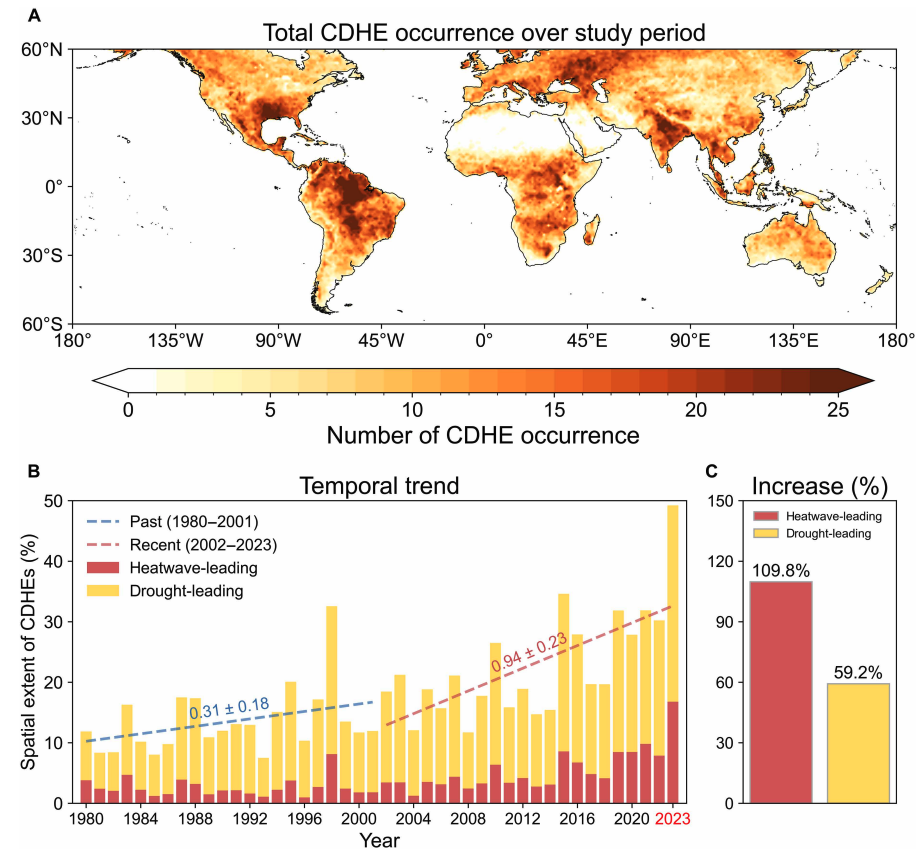
The research finds that the area of land affected by CDHEs has “increased substantially” since the early 2000s.
Heatwave-led events have been the main contributor to this increase, the study says, with their spatial extent rising 110% between 1980-2001 and 2002-23, compared to a 59% increase for drought-led events.
The map below shows the global distribution of CDHEs over 1980-2023. The charts show the percentage of the land surface affected by a heatwave-led CDHE (red) or a drought-led CDHE (yellow) in a given year (left) and relative increase in each CDHE type (right).
The study finds that CDHEs have occurred most frequently in northern South America, the southern US, eastern Europe, central Africa and south Asia.
Threshold passed
The authors explain that the increase in heatwave-led CDHEs is related to rising global temperatures, but that this does not tell the whole story.
In the earlier 22-year period of 1980-2001, the study finds that the spatial extent of heatwave-led CDHEs rises by 1.6% per 1C of global temperature rise. For the more-recent period of 2022-23, this increases “nearly eightfold” to 13.1%.
The change suggests that the rapid increase in the heatwave-led CDHEs occurred after the global average temperature “surpasse[d] a certain temperature threshold”, the paper says.
This threshold is an absolute global average temperature of 14.3C, the authors estimate (based on an 11-year average), which the world passed around the year 2000.
Investigating the recent surge in heatwave-leading CDHEs further, the researchers find a “regime shift” in land-atmosphere dynamics “toward a persistently intensified state after the late 1990s”.
In other words, the way that drier soils drive higher surface temperatures, and vice versa, is becoming stronger, resulting in more heatwave-led compound events.
Daily data
The research has some advantages over other previous studies, Yeh says. For instance, the new work uses daily estimations of CDHEs, compared to monthly data used in past research. This is “important for capturing the detailed occurrence” of these events, says Yeh.
He adds that another advantage of their study is that it distinguishes the sequence of droughts and heatwaves, which allows them to “better understand the differences” in the characteristics of CDHEs.
Dr Meryem Tanarhte is a climate scientist at the University Hassan II in Morocco, and Dr Ruth Cerezo Mota is a climatologist and a researcher at the National Autonomous University of Mexico. Both scientists, who were not involved in the study, agree that the daily estimations give a clearer picture of how CDHEs are changing.
Cerezo-Mota adds that another major contribution of the study is its global focus. She tells Carbon Brief that in some regions, such as Mexico and Africa, there is a lack of studies on CDHEs:
“Not because the events do not occur, but perhaps because [these regions] do not have all the data or the expertise to do so.”
However, she notes that the reanalysis data used by the study does have limitations with how it represents rainfall in some parts of the world.
Compound impacts
The study notes that if CDHEs continue to intensify – particularly events where heatwaves are the precursors – they could drive declining crop productivity, increased wildfire frequency and severe public health crises.
These impacts could be “much more rapid and severe as global warming continues”, Yeh tells Carbon Brief.
Tanarhte notes that these events can be forecasted up to 10 days ahead in many regions. Furthermore, she says, the strongest impacts can be prevented “through preparedness and adaptation”, including through “water management for agriculture, heatwave mitigation measures and wildfire mitigation”.
The study recommends reassessing current risk management strategies for these compound events. It also suggests incorporating the sequences of drought and heatwaves into compound event analysis frameworks “to enhance climate risk management”.
Cerezo-Mota says that it is clear that the world needs to be prepared for the increased occurrence of these events. She tells Carbon Brief:
“These [risk assessments and strategies] need to be carried out at the local level to understand the complexities of each region.”