

Last week, more than 260 researchers convened in Milan to discuss the opportunities, challenges and risks involved in scaling “carbon dioxide removal” (CDR) to help curb climate change.
The conference – held on the campus of the Politecnico di Milano – is the fourth in a series, with previous editions held in Oxford, UK in 2024, and Gothenburg, Sweden in 2018 and 2022.
A broad range of academics – from forests, oceans and soils experts through to social and political scientists – discussed the co-benefits and trade-offs involved in drawing down CO2 from the atmosphere at scale, as well as the ways policy could drive CDR deployment.
Dr Soheil Shayegh, director of the industrial and planetary carbon cycle programme at the Euro-Mediterranean Center on Climate Change (CMCC), told Carbon Brief the idea behind the conference was to “bring scientists together to convey a message to policymakers about where the technology stands”.
He continued: “We should be very clear that there still are huge uncertainties about the effectiveness of lots of this CDR technology – are they marketable or not? But what is clear for us is the need for CDR.”
Dr Morgan Edwards, the lead author of the recently published “state of CDR report”, told delegates that meeting the Paris Agreement’s 1.5C goal by the end of this century would require CDR to “scale up rapidly” from 2.2bn tonnes of CO2 (GtCO2 per year) today to 8.8GtCO2 by 2050.
She added: “We need to see an upscaling in ambition over the next few years to get on a track consistent with these long-term scenarios.”
Below, Carbon Brief summarises the key talking points at the conference.
Overshoot
The removal of carbon from the atmosphere is seen as crucial to compensate for the emissions from human activities that are difficult to decarbonise – for instance, those generated in aviation and agriculture.
This, scientists have emphasised, must come in addition to steep emissions cuts.
CDR has another role, which is as a mechanism to return average global warming to 1.5C above pre-industrial levels, in the likely event that the Paris Agreement’s temperature target is exceeded.
The Milan conference comes after 2024 was the first single year to breach the 1.5C target and as scientists have projected that the Paris Agreement’s 1.5C target – typically interpreted in terms of a 20-year average – could be exceeded by the end of this decade.
Prof Sabine Fuss, head of research department at the Potsdam Institute for Climate Impact Research (PIK) told Carbon Brief the likely breach of the 1.5C limit means the CDR research agenda was getting “even bigger” as the world would need to contend with “even larger scales” of CDR. She added:
“Some of the things that we were worrying about already in a net-zero context are getting even more pertinent. Also, [we need to think about] what will happen under climate change. A lot of [CDR approaches] may not be super resilient if we’re facing higher temperatures and more disturbances. Think about forests.”
Prof Massimo Tavoni, scientific director of the RFF-CMCC European Institute on Economics and the Environment, described the prospect of returning temperatures to 1.5C with CDR as the “biggest Earth restoration project ever”.
Speaking in the plenary, Tavoni said the concepts of “overshoot” and “CDR” were “closely connected, but not the same thing”.
Broadly speaking, there have been three “phases” of overshoot research, Tavoni said:
- 1995 to 2005: a period where overshoot was not “seriously considered”, he argued. It was during this period that researchers first explored scenarios that would “now be classified as overshoot pathways” and “set out CO2 removal as a mechanism” for stabilising the climate, he said.
- 2005 to 2015: the age when “overshoot was discovered”, according to Tavoni. At this time, he said, “[climate] ambition was rising and emissions were also rising, which led to the incorporation of CDR in the models”.
- 2015 to the present day: an “age of reckoning” where overshoot has become “formally entangled” in the scenarios created by the climate community due to the “absolute need for overshoot and CDR to achieve [temperature] targets in the face of growing CO2 concentration”.
Tavoni noted that all of the new emissions scenarios set out ahead of the seventh phase of the Coupled Model Intercomparison Project (CMIP7) – unveiled in April – exceeded the 1.5C limit.
(CMIP is a global initiative that coordinates the work of dozens of climate modelling centres around the world, recommending a common set of model experiments that can collectively shed light on the climate and how it could change.)
Half of the CMIP7 scenarios, Tavoni said, first “overshoot” the 1.5C goal and then “return back”.
The indicative global temperature rise under these seven scenarios is shown in the chart on the right below.
(For more on CMIP7 and the emissions scenarios, see Carbon Brief’s recent guest post).
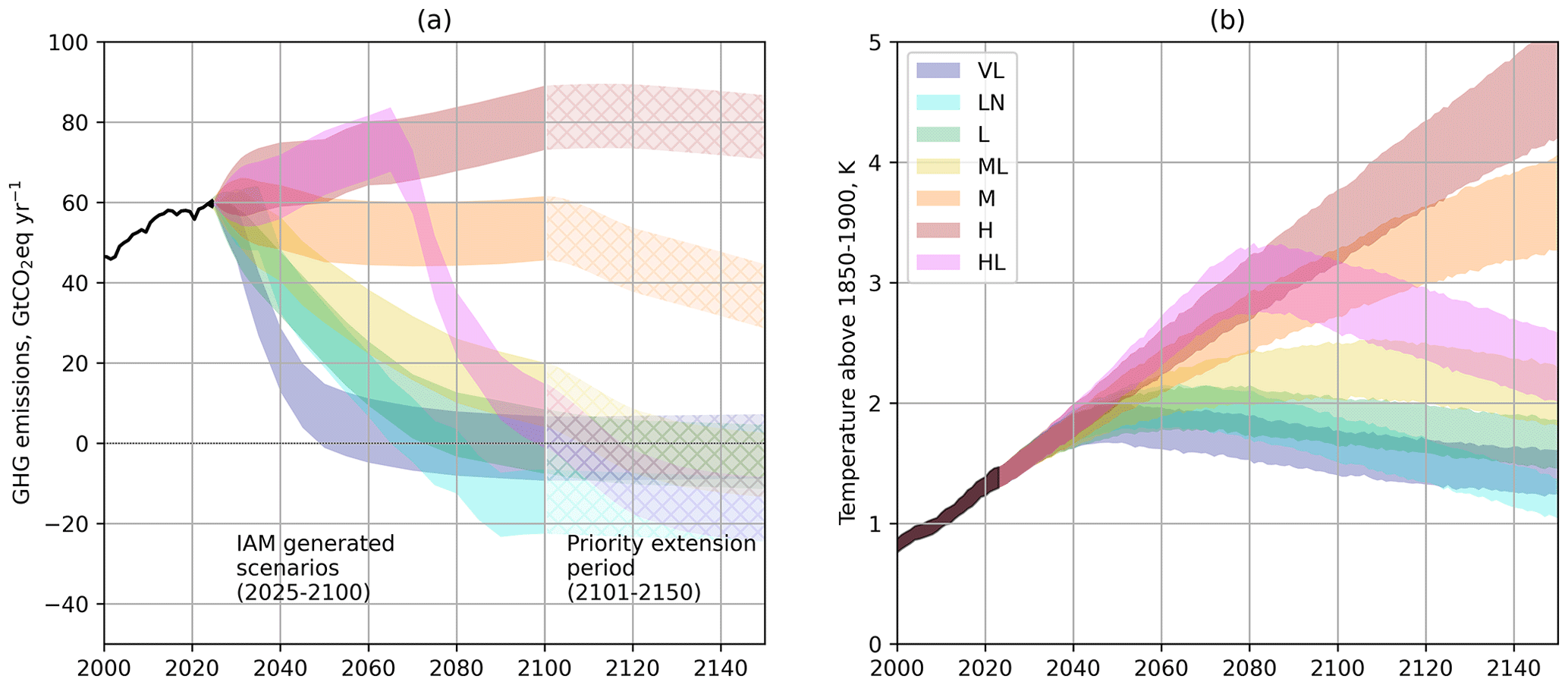
Tavoni noted that there was no “significant relation” across the scenario database between the cumulative CDR levels a scenario assumes and the level of temperature overshoot it would likely cause.
This, he said, is because “many other factors” contribute to CDR uptake, including the policy environment, progress on emissions reduction in different countries and decisions about what types of emissions might constitute “hard-to-abate” or “residual”. He added:
“You can have scenarios with no ‘negative emissions’, but still a lot of CDR for compensating residual emissions.”
A number of sessions at the conference looked at Earth-system response to overshoot pathways with large-scale CDR.
For example, CMCC’s Dr Momme Butenschön presented research looking at how the oceans would respond to “global net-negative emissions” – a hypothetical situation where more carbon is being removed from the atmosphere than is being added through emissions.
He explained that model runs to 2100 show that a decline in global surface temperature would fail to reduce temperatures in the upper layer of the ocean for at least 30-40 years. Ocean temperatures would “stay flat” during this period due to the ocean’s inertia, he said.
The response to negative emissions further down in the ocean would be even slower, he explained to Carbon Brief:
“If you go to the mesopelagic zone – the twilight zone 200-1,000 metres beneath the surface – the ocean will continue to warm and then, after some years, it will flatten out again. [Its temperature] will not go down.
“And, if you go to the deeper ocean, everything – acidification, deoxygenation, warming – they all continue on their path. So the deep ocean doesn’t even realise you are doing negative emissions.”
The researchers behind the project – named RESCUE – have asked for an extension to run the models up to 2300 so they can better understand what the “long-term reaction” of the ocean to negative emissions technologies would be.
Forests
Speaking in a plenary session, Dr Edwards – assistant professor at the University of Wisconsin and lead author of the 2026 state of CDR report – explained that the “vast majority of CDR that is happening today is so-called ‘conventional’ CDR – so, primarily removal of CO2 from forests”.
Edwards was summarising some of the findings of the latest “state of CDR” report, which says that, at present, 99.9% of existing CDR is “conventional”, land-based techniques such as tree-planting.
The world’s forests currently remove 2.2GtCO2 per year, equivalent to around 5% of gross global CO2 emissions, according to the report. It also notes that “high ambition climate scenarios” will require all forms of CDR to reach a median value of 3.9GtCO2 by 2035 and 8.8GtCO2 by 2050.
Edwards said that conventional CDR methods “tend to be well established and have relatively high readiness levels”. Typically, they also have lower costs – “in some cases less than $10 per tonne of CO2” – than “novel” methods.
Experts pointed out repeatedly throughout the conference that CDR methods would need to be diversified for CDR to achieve levels required to meet climate goals, given land-use constraints and concerns around the permanence of carbon stored in forests.
CMCC’s Shayegh said the world would need a “portfolio” of solutions, given the “big trade-offs” involved in different CDR approaches. He explained:
“For forests, for example, to get the scale you need, you have to have lots of managed land for CDR, which means interfering with agriculture. So you will compete with food and biofuel – and it’s not a very easy or efficient way of creating jobs.”
In a research session, Dr Clemens Schwingshackl from LMU Munich noted that CDR from afforestation and reforestation compensated for about 6% of human fossil-fuel emissions between 2014-23.
However, he said that there was “large uncertainty” in calculations of forest-based CDR. Current bookkeeping models and national greenhouse gas inventories – two key methods for estimating levels of forest-based CDR – have uncertainty rates of 20% and 30%, respectively.
“Missing processes” in bookkeeping models include the impact of disturbances on forests, such as fire, as well as information about the effectiveness of afforestation and reforestation projects, he said.
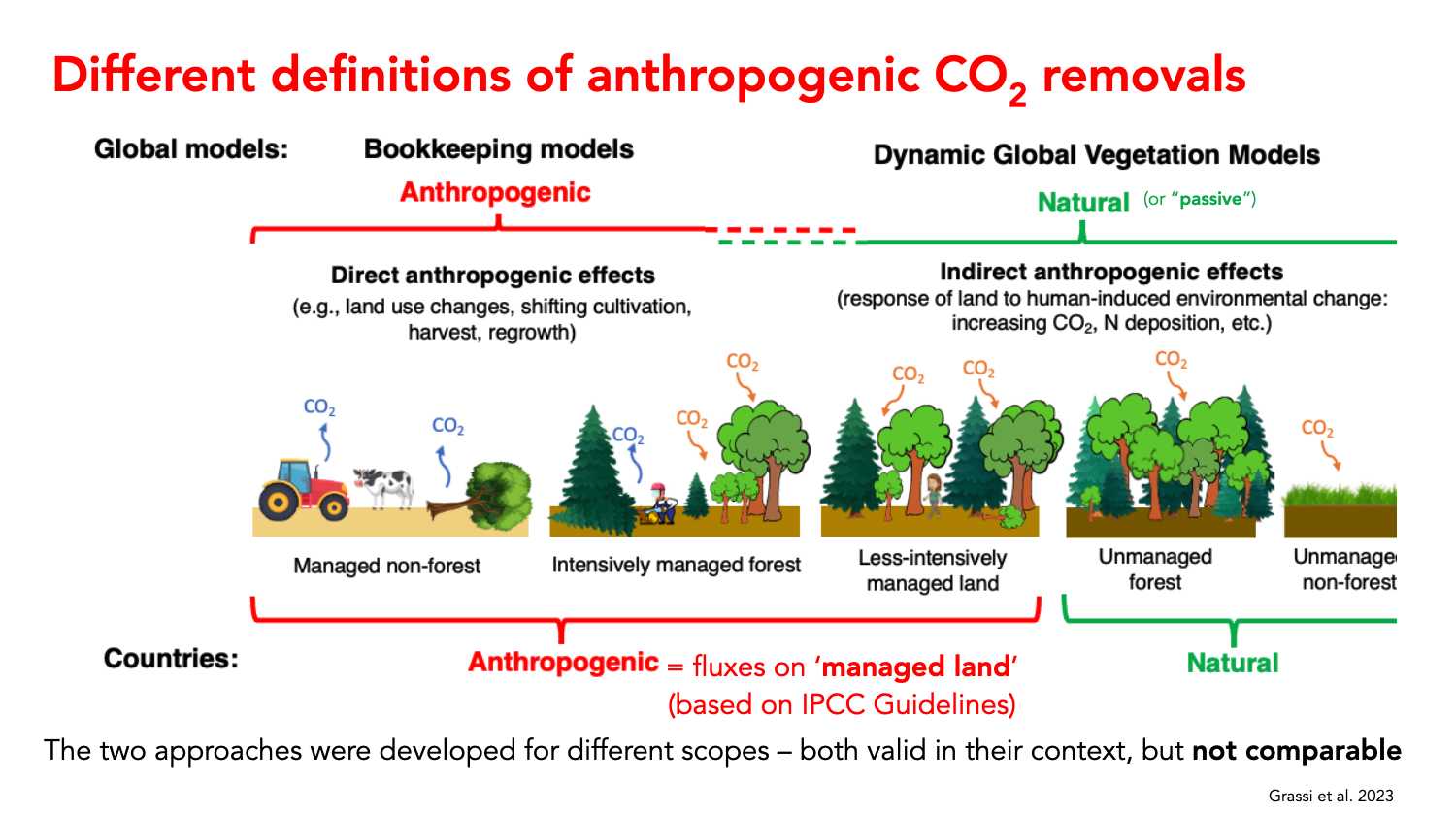
Dr Giacomo Grassi, scientific officer at the European Commission’s Joint Research Centre, noted the differences in the ways “conventional” CDR levels are calculated by countries, the “state of CDR” report and by the Intergovernmental Panel on Climate Change (IPCC).
CDR, he said, “excludes” CO2 uptake that is not directly caused by human activities. However, separating direct human effects on land from indirect human-caused effects – such as the impacts of climate change – cannot be achieved through observations alone and instead relies on models and model assumptions. He explained:
“Because national greenhouse gas inventories typically rely on observations, they include a broader [human-caused] land carbon sink than what is counted as CDR. As a result, conventional land-based CDR cannot be fully tracked in these inventories.”
Grassi illustrated the different approaches to defining CDR by showing the graphic below.
Barbara Saget from the Paris School of Economics presented the findings of an exercise where researchers used a “dynamic social planner model” to understand the optimum timing and scaling of nature-based and technological CDR and the extent to which net-zero targets can rely on nature-based CDR.
The research showed that nature-based CDR was needed in the medium-term to offset hard-to-abate emissions and limit reliance on more expensive solutions.
However, the model results showed that, as forests grow, an increasing share of captured CO2 is used to compensate for carbon produced during forest disturbances, rather than human-caused greenhouse gas emissions. Furthermore, in the EU, the issue of tight land availability restricts the expansion of forest-based removals. She explained:
“This theoretical model shows that forests are not reliable in the long-run to offset the hard-to-abate emissions, first because of the release of emissions – this reversal risk – but also because of land constraints. So, we need to rely on technological CDR to compensate for these remaining emissions.”
Other forms of CDR
Other research sessions focused on the challenges, uncertainties and opportunities in scaling in other CDR techniques, sometimes referred to as “novel”, “engineered” or “technological” CDR.
In the opening plenary, Edwards noted that, despite making up less than 0.1% of current levels CDR, “novel” solutions were “growing rapidly”.
She added that “the major scale up of novel CDR that we might need to meet climate goals will likely require substantial cost reductions for these technologies”.
Ashwin Murphy, negative emissions fellow at the Sabin Center for Climate Change Law, explained the various international agreements governing “marine CDR” – a category that includes ocean alkalinity enhancement and direct ocean capture. He said:
“As much promise as marine CDR holds, it also holds the potential for harm, environmental, social and otherwise. The laws that apply to CDR as a whole are unclear, because there are older laws that have been taken out and forced into the CDR framework and that means that they often don’t fit right.
“When a CDR project takes place and for whatever reason there’s an issue – whether it’s environmental harm or otherwise – liability questions are complicated, and there’s not often a clear answer as to what happens next.”
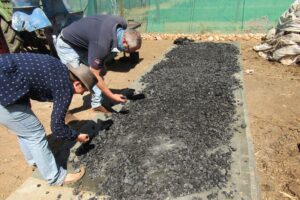
Oumaima Rhalem of Utrecht University described research which looked at the potential of biochar as a CDR technology. She said the findings show that biochar’s potential to tackle climate change depended on a region’s agricultural soils and biomass resources.
In the longer-run, however, she noted that carbon pricing would influence the geography of biochar deployment and would eventually shift biochar from an “agricultural technology” to a “carbon-removal technology”.
Dr Christian Rischer from the Kiel Institute presented findings of a literature review on the CDR potential of blue-carbon ecosystems, such as mangroves, salt marshes, sea grasses and macroalgae.
He said that “low ranges of estimates” suggest these ecosystems currently sequester around 270m tonnes of carbon per year and have a “mitigation potential” of up to 448m tonnes of carbon per year 2050.
Meanwhile, Dr Leon Stephan, a scientist at the Potsdam Institute for Climate Impact Research presented the results of a review of the scientific and “grey” literature – which includes reports, white papers and other evaluations – on monitoring, reporting and verification (MRV) of CDR up to 2023.
He noted an “exponential growth” in the MRV literature, with two-thirds of the 184 publications assessed focused on “conventional” CDR approaches, such as afforestation and deforestation. On the other hand, he said, marine CDR, DACCS and bioenergy and carbon capture and storage (BECCS) were “rarely studied” in the MRV literature. The analysis also showed that terminology and definitions were used inconsistently, he said.
The literature focused largely on the quantification of MRV, followed by monitoring and removal quality, he added, noting that there was “very little” on governance of solutions.
The researchers also conducted an analysis of 60 CDR certification methodologies used to issue credits for 11 CDR methods in the voluntary and compliance carbon markets.
IPCC CDR methodology report
The conference comes as the IPCC gears up to publish a methodology report on CDR technologies in 2027.
The report will be produced by the Task Force on National Greenhouse Gas Inventories, the group responsible for the internationally-agreed methodologies used for countries’ calculation of greenhouse gas emissions and removals.
The European Commission’s Grassi noted the report aims “to provide a consistent methodology that allows countries to report greenhouse gas emissions removal under the UNFCCC [UN Framework Convention on Climate Change]”.
Dr Oliver Geden, senior fellow at the German Institute for International and Security Affairs (SWP) and Working Group III vice-chair for the IPCC’s seventh assessment cycle, tells Carbon Brief the report will bring together experts on CDR methods, as well as specialists on compiling inventories.
He said the methodology report differed from previous climate inventory reports, given that many of the solutions it would be drawing up guidelines for do not yet exist at scale:
“If you look into the guidelines of established processes, like emissions from gasoline use…you don’t have to measure the emissions, you just have statistics about the activity and then you have an emissions factor. It’s an established process.
“The problem with the methodology report is that it is very unusual that you try to regulate things that are not really there yet…So, it can be problematic to come up with ‘standard removal factors’.”
Nevertheless, he said the report was a “start” and signalled that policymakers had started to take CDR beyond forestry seriously.
He added that it will “need to be reworked constantly because experience with what these methods deliver, and under which circumstances, may change”.
Policy
A significant tranche of the conference was focused on how policy could drive uptake of carbon removal solutions.
Speaking in a plenary, Geden presented a table from the “state of CDR” report, which sets out three types of policy that can drive uptake of CDR.
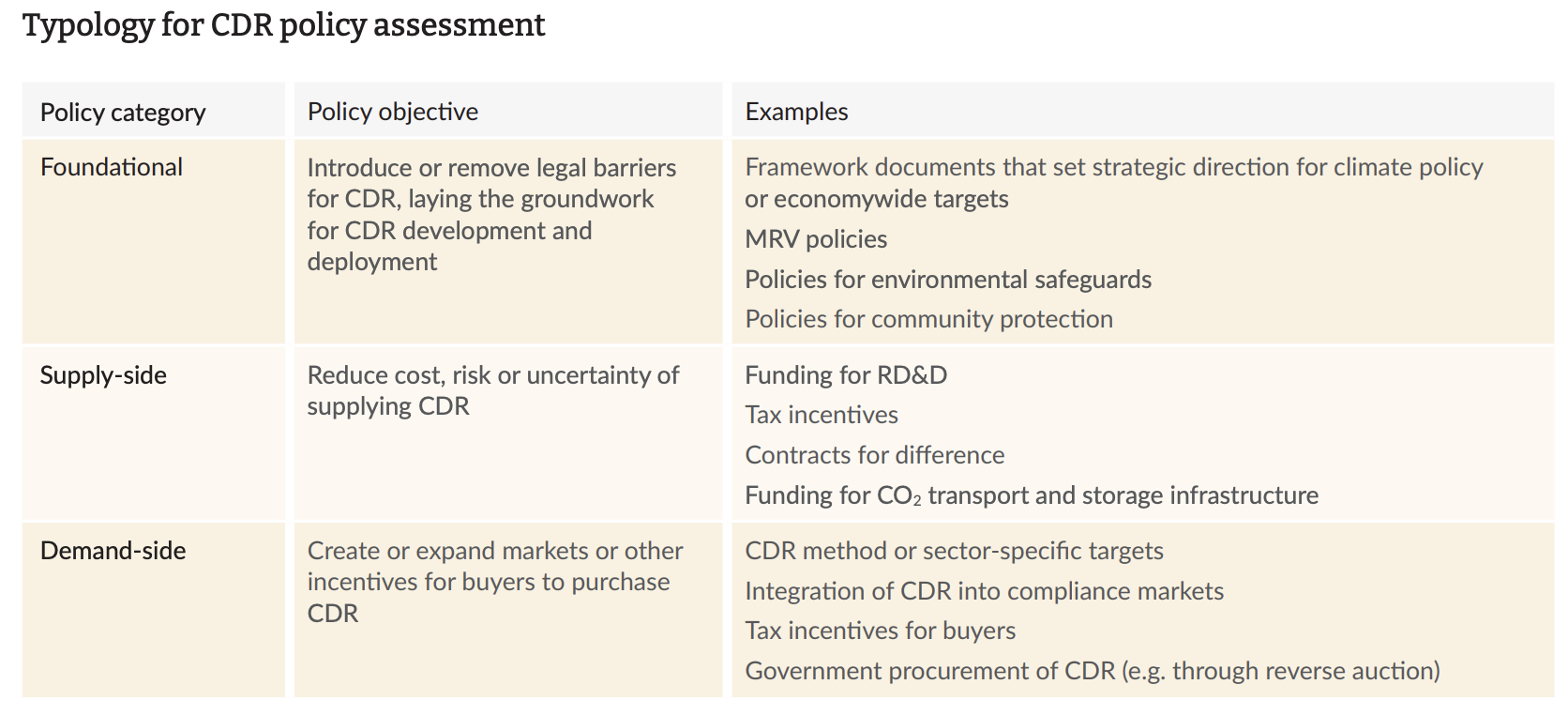
Geden said that, at present, there was a “lack of robust demand signals” for CDR. This includes measures such as binding targets, government procurement initiatives and tax incentives for buyers.
The state of CDR report notes that the 140 countries around the world that have announced net-zero targets – including virtually all of the world’s major emitters have “implicitly included a role for CDR in their climate plans”.
However, this does not always translate into measures specifically designed to scale up CDR. Only the EU has adopted a binding, quantified removals target into law – namely, the goal to reach 310m tonnes of CO2 equivalent (GtCO2e) of annual net removals in the land sector by 2030.
In general, conventional CDR is the main focus of policy, according to the state of CDR report, with various governments focusing on tree planting to absorb CO2 from the atmosphere.
Speaking in a plenary at the conference, Fabien Ramos, carbon removal lead at the European Commission, detailed the way the bloc was incorporating carbon removals into its policy, both through its headline carbon targets and via the EU emissions trading scheme (EU ETS).
Ramos said that “carbon removal would have a significant role in the ETS in the future”, noting that the EU will need “lots of carbon removal after 2030” to achieve its 2050 net-zero goal.
Geden told Carbon Brief that net-negative emissions would be the “next frontier for European countries to commit to” if overshoot scenarios were to be successfully realised:
“If you talk about exceeding 1.5C and returning, and you need net-negative [emissions] globally. You don’t get to net-negative globally if nobody even plans to go net-negative individually…Currently, only Denmark has a net-negative target right now. Others will have to follow.”
Lucia Dora Simonelli, from US-based non-profit Carbon Removal Standards Initiative, said it would be important to establish how to “weave” the carbon removal process into existing policies. She said:
“This is not about creating a new CDR policy. This is not about creating climate policy. It’s about truly leveraging existing policy infrastructure.”
PIK’s Fuss similarly told Carbon Brief that one of her key takeaways from the conference was the need to “expand the carbon lens and see what other opportunities we have to mainstream CDR into other policy agendas – so, looking at benefits, for instance, in terms of health or adaptation”.
Dr Steve Smith from the University of Oxford’s Smith School of Enterprise & Environment told Carbon Brief:
“If CDR is to scale to gigatonne levels – as indicated by nearly all global pathways to the Paris Agreement goals – then governments will likely need to introduce markets to create demand for CDR or obligations for it to happen.
“CDR is a public good – like our current waste management systems for sewage – and it’s highly unlikely to happen at that scale through voluntary action alone.”
Societal buy-in
A number of delegates pointed to the need to build societal demand and acceptance for CDR technologies.
Dr Livia Fritz from the University of Geneva presented results of a survey of more than 10,000 people in six countries, focused on three CDR approaches: DACCS, BECCS and enhanced rock weathering. Each respondent was assigned one technology and asked to weigh in on five imagined scenarios of how the solutions would be implemented.
The exercise found that support for CDR hinges on taking “procedural and distributive” fairness “seriously” and opening up planning processes to public and expert scrutiny, she said. It also found that benefit-sharing, as well as not-for-profit arrangements “consistently increase” public support for CDR across all countries and technologies.
Speaking in a plenary, Dr Holly Buck from the University of Buffalo discussed the cultural shift required to enable overshoot scenarios. She explained that a national survey exploring US public opinion about decarbonisation and climate policies – including CDR – had revealed that many members of the US public see the concept of a return to 1.5C from above as “fantastical and implausible”. She said:
“Its not just about social support or acceptance or licence. This sort of industry really requires an active demand or desire for it. It’s not enough to just tolerate [CDR]. It’s not going to work unless there’s a wish that’s felt.”


The post Experts: Why carbon removal needs a ‘major scale up’ to return warming to 1.5C appeared first on Carbon Brief.
Experts: Why carbon removal needs a ‘major scale up’ to return warming to 1.5C

For the first time, new-energy vehicles (NEVs) made up 67% of new car sales in China in September, according to the latest data from the China Passenger Car Association (CPCA).
The figures show that NEVs, which include battery electric cars and plug-in hybrids, captured a record share of sales, even though fewer were sold than last year.
This is because sales of combustion-engine cars are falling steeply, a trend that the CPCA has attributed to rising petrol prices following the start of the Hormuz crisis.
Indeed, sales of fuel-only cars were down 31% year-on-year in the first nine months of 2026, with plug-in hybrid sales down 26% – whereas battery EV sales were only down 4%.
One analyst tells Carbon Brief that China’s rapidly