Ocean Acidification
30 Days at Sea, 30 Ways to Make Potatoes

By Joelle Habib (Laboratoire d’Océanographie Villefranche)
When you go on a scientific cruise, you always think about the instruments you’re going to deploy, the great data you’re going to acquire, or the experiments you’ll conduct. What you almost always forget is the small thing that isn’t actually small at all: food. And how are you going to eat it!
For those not familiar with scientific cruises: once you’re on board, most of your time goes to the science. You don’t really have time for food or food preparation. But there are always hidden heroes preparing your breakfast, lunch, and dinner, and, most importantly, the dessert for the dessert break. Today, instead of shedding light on the science, we’re going to talk about people, starting with the two chefs our lives basically depend on.
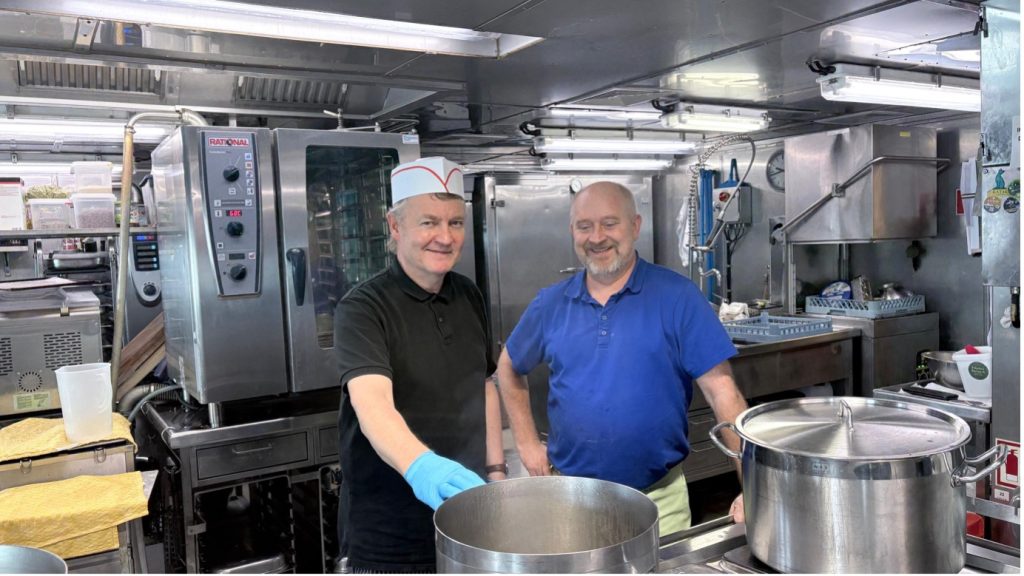
Rainer Götze and Peter Wernitz are the chefs of the last METEOR cruise. Rainer has been cooking on this ship for over 23 years, while Peter has been doing it for 13. Together they cook for 60 people on board, seamen and scientists alike. You’re probably wondering, like I was, how they pull it off. I had the chance to talk to them, and here are some of the ship’s secrets.
Let’s start with the planning. They don’t prepare the whole month’s menu before going on board, they plan it day by day. That said, a few dishes are practically law: fish on Tuesday and Friday, stew on Saturday (the stews are good, but it’s still my least favorite food day), and roasted meat on Sunday. Ice cream shows up for dessert on Sunday and Thursday lunches. And no matter the day, there’s always a vegetarian option on the table, nobody on board goes without something to eat.
So, all this cooking, but how many ingredients does it actually take? Let’s start with numbers. Every morning for breakfast there’s a choice of eggs (scrambled, boiled, fried…), pancakes, and more. So how many eggs are on this ship? For a one-month cruise, there are 3,000 eggs in storage, and the cooks go through around 90 of them a day. They also bake fresh bread every single day, about 3kg of flour goes into roughly 60 loaves. Coffee breaks happen all day, every day, there’s about 60kg of coffee on board. And since we’re on a German ship, and Germans do love their potatoes, there are 300kg of potatoes stored in a refrigerated, dark room so they don’t go bad.
You might be wondering why I’m talking so much about potatoes. Well, my dear reader, lunch has plenty of variety, but the one constant is potatoes. We’re on day 20 of the cruise, and I think we’ve worked through most of the varieties by now: fried, baked, soufflé, mashed, boiled and more still to come.
Another question I had was what happens if one of them gets sick. Rainer is a tough seaman who doesn’t get seasick anymore; Peter still does, occasionally. But either way, they’re always there, cooking through good conditions and bad. People generally love the food, though the chefs did tell me the one thing that never goes down well is old-school dishes like veal liver. (I can confirm.)
I think the message I’m trying to convey here is: a scientific cruise wouldn’t really be possible without Peter and Rainer. Science at sea is not only the science, but it’s also the work and effort of everyone on board. Especially the chefs!