

There’s been a lot of chatter about Roadmaps in Belem. The WWF and Greenpeace have led a call for a roadmap to end deforestation. Currently, 45 countries have indicated support. More than 80 countries have called for a roadmap to phase out fossil fuels. Additionally, there are four other roadmaps on finance from developed to developing countries. Climate Action Network wonders, “Roadmap or mazes? Will those lead us somewhere, or will we be even more lost with so many of them?!”
Brazil’s TFFF plan has raised $5.5bn — far below even Brazil’s reduced target of $10bn by next year. Norway, Brazil, Indonesia, Portugal, France, and the Netherlands have all committed to pay into the fund, while Germany has said it will announce its contribution soon. The UK and China, on the other hand, do not plan to pay in.
Away from COP30 negotiations, talks continued over the COP31 host, with Türkiye and Australia striking a compromise: Türkiye will host the conference, and Australia’s climate change and energy Minister, Chris Bowen, as COP president, will chair the talks.
UN Secretary General, António Guterres, returned to Belém on Thursday to urge the world’s nations to find compromises in the final hours of COP30 and deliver a deal to accelerate climate action: “We are down to the wire and the world is watching… The world must pursue a just, orderly, and equitable transition away from fossil fuels.”
On Tuesday, COP30 hosts Brazil produced a first draft of an agreement between nations at the UN climate talks after negotiations on the sticking points stretched late into the night. The nine-page “Global Mutirao” document – a reference to an Indigenous concept of uniting toward a common goal – came after Brazil on Monday urged delegates to work day and night to produce an agreement by midweek.
Over the next few days, negotiations intensified. On Friday morning, the Presidency published its new mutirão text that contains no mention of a phase-out of fossil fuels. At least 29 nations threatened to block any draft without this phase-out and then rejected the text. The letter states, “We cannot support an outcome that does not include a roadmap [on fossil fuels].” Countries that signed the letter in favor of the fossil fuel phase-out include: Austria, Belgium, Chile, Colombia, Costa Rica, Croatia, Czechia, Estonia, Finland, France, Germany, Guatemala, Honduras, Iceland, Ireland, Liechtenstein, Luxembourg, the Marshall Islands, Mexico, Monaco, the Netherlands, Panama, Palau, Slovenia, Spain, Sweden, Switzerland, the UK and Vanuatu. Another bloc of around 80 countries, that includes Saudi Arabia, Russia and some other petrostates, as well as some countries dependent on consuming fossil fuels is negotiating against the fossil fuel phase out roadmap.
Colombia and the Netherlands also announced that they will co-host the First International Conference on the Just Transition Away from Fossil Fuels in Santa Marta, Colombia, in April next year.
The climate talks are now likely to continue into the weekend. The European Union’s commissioner for climate, Wopke Hoekstra, warned there was a risk of no agreement being reached, and expressed dismay at the current text saying there was no science, no mention of a transition for fossil fuels, no global stocktake.
No UN climate conference has finished on time since 2003.

Aside from the fossil fuel debate, other issues also remain to be resolved, including a response to the fact that countries’ national climate plans are too weak to limit global heating to 1.5C above preindustrial levels as set out in the 2015 Paris agreement, and questions of finance, trade and transparency, and how much cash developing countries will receive to help them adapt to the impacts of the climate crisis.
The issue of gender has become contentious and has been lifted by the COP30 Presidency from technical negotiations to a higher political level with ministers. Conservative nations — from the Vatican to Iran — are pushing to narrow the definition of gender at COP30 to exclude trans and non-binary people, which threatens to increase the difficulty of already torturous negotiations. The effort uses footnotes in key texts to attach country-specific interpretations. Paraguay, Argentina, Iran, Indonesia, Malaysia, as well as the Vatican have so far entered footnotes into the draft Gender Action Plan (GAP) meant to guide work for the next decade. Similar footnotes have also appeared in a text related to the “just transition” — the framework to shift to environmentally sustainable economies without leaving workers and communities behind.
Outside the negotiating rooms, civil society groups have complained about the “militarization” of the COP30 venue, which is now guarded by heavily armed officers in riot gear following UNFCCC chief Simon Stiell’s complaints earlier. Indigenous activists say they feel particularly targeted.
The Global Afro Descendants Climate Justice Collaborative is calling for Afro-Descendant peoples to be recognized as a formal constituency within the UNFCCC. Their petition states, “For generations, Afro-Descendant and African communities have been at the heart of global struggles for equity, justice, and renewal. We are the descendants of those who cultivated, resisted, and rebuilt. We have carried the wisdom of sustainable living, the memory of displacement, and the spirit of resilience that continues to sustain our planet.” Read the full letter here. Meanwhile, the European Union, the United Kingdom, and Australia are explicitly opposing the inclusion of references to people of African descent in the Gender Action Plan, acting to silence and delegitimize legitimate and historically grounded demands.
“Simple message about COP30,” said Dr. Sam Grant, “This is a place of virulent anti-blackness.”
While a formal constituency is yet to be established, the Global Afrodescendant Climate Justice Collaborative announced Friday that for the first time, people of African descent appear in UNFCCC COP decisions and are referenced across multiple strands of negotiating texts. The texts are not finalized. “Nonetheless we are calling it a win to have people of African descent in the draft decisions,” said Mariama Williams of the GACJC.
Youth activists, more than 30,000 young people from over 100 countries, held a series of Youth-Led Forums and outlined calls for “full, fast, fair fossil phase-out,” institutionalizing intergenerational equity, moves toward peace, climate finance centered on justice, and adaptation “as a moral and political priority”.
The People’s Plenary was scheduled on Thursday, a space where civil society at COP comes together to make clear what their expectations and demands are of the negotiations, as we near the close. But a fire broke out in the Blue Zone, and the venue was evacuated. The fire has been contained with limited damage, and no serious injuries have been reported. Hosts report the fire was electrical.
There are more than 300 industrial agriculture lobbyists at COP30. According to DeSmog, the number of lobbyists representing the interests of industrial cattle farming, commodity grains, and pesticides is up 14 percent over last year’s summit in Baku — and is larger than the delegation of the world’s 10th largest economy, Canada, which brought 220 delegates to COP30 in Belém. Agriculture is responsible for 25 – 30% of global emissions.
We will continue to follow negotiations and hope to share the final agreements in our final window into COP30 Digest, scheduled to be released on December 3. Stay tuned.
Photo credit: Kiara Worth
The post Your Summary of Negotiations: Nov. 22 appeared first on Climate Generation.

Next week, diplomats from around the world will descend on Yerevan, Armenia, to negotiate a series of decisions under the UN Convention on Biological Diversity (CBD).
Between 19 and 30 October, 196 parties will gather to hammer out the precise wording of the dozens of legal texts that make up the decisions under the Conference of the Parties (COP) to the CBD.
This year’s summit is particularly significant, as it marks the halfway point between the agreement of the Kunming-Montreal Global Biodiversity Framework and the deadline for achieving its targets.
The CBD has found that countries are currently not on track to meet 22 out of the framework’s 23 targets.
During the fortnight, delegates will also be negotiating decisions relating to the two supplemental protocols to the CBD: the Cartagena Protocol, which covers biosafety; and the Nagoya Protocol, which covers access and benefit-sharing for the use of genetic resources.
(The Cartagena and Nagoya Protocols, which are each governed by a “meeting of the parties”, or “MOP”, have fewer parties than the CBD as a whole, with 173 and 141, respectively.)
Carbon Brief is tracking the progress of countries towards consensus on dozens of negotiating texts using the interactive table below.
The tracker includes texts from the COP, as well as the MOPs for the Cartagena and Nagoya protocols. It also includes draft decisions from the most recent subsidiary body meetings, as these form the starting point for the negotiations in Yerevan.
The CBD has three subsidiary bodies: the subsidiary body on scientific, technical and technological advice (SBSTTA), the subsidiary body on implementation (SBI) and the subsidiary body on article 8(j) and other provisions (SB8J).
SB8J focuses on issues related to the Indigenous peoples and local communities. It was established at COP16 in Cali, Colombia, in 2024.
The first two columns of the interactive tracker list the topic of each agenda item and the relevant body, with subsequent columns including dates, page counts and links to the original documents.
The table is searchable and can be sorted using the arrows in the header.
Areas of disagreement in UN draft texts are denoted by square brackets. Counting the brackets in a particular iteration of a text therefore gives a sense of how far parties are from reaching consensus.
The bracket column is colour-coded, with dark green indicating a low number of brackets and red indicating a high number of brackets remaining.
Texts can also present parties with choices using “options” or alternatives (“alt”), which are counted together in the sixth column of the table.
The key discussions in Yerevan will centre around two agenda items in particular. The first is the global review, which will assess progress towards the GBF and make recommendations for accelerating action.
The second is finance, which can be separated into two parts: resource mobilisation and the financial mechanism. On resource mobilisation, biodiverse global south countries are likely to push for an increased amount of international finance for conservation.
Disagreement over the creation of the financial mechanism led to the suspension of COP16 in Cali in October 2024, as parties failed to find agreement on the mobilisation of finance before the end of the summit.
Global south countries want the establishment of a separate financial mechanism under the control of the CBD; global north countries largely prefer to maintain the existing mechanism, which sits under the Global Environment Facility.
At the resumed session of COP16 in Rome in early 2025, countries agreed on a roadmap that would lead to the establishment of a permanent mechanism.
related
Analysis: Lula presidency saved at least 20,000km2 of Brazilian Amazon since 2022
Why land-use emissions have fallen by a third this century – in six charts

Analysis: 84% of nations miss deadline to identify ‘nature-harming’ subsidies by 2025
UK withdraws millions in funding from world’s second-largest rainforest in Congo
The post Interactive: Tracking negotiating texts at the COP17 biodiversity summit appeared first on Carbon Brief.
Interactive: Tracking negotiating texts at the COP17 biodiversity summit
A beacon of love
On an outer island of Fiji, two thousand nautical miles from Sydney, is a shining light of hope and resilience for our troubled world.
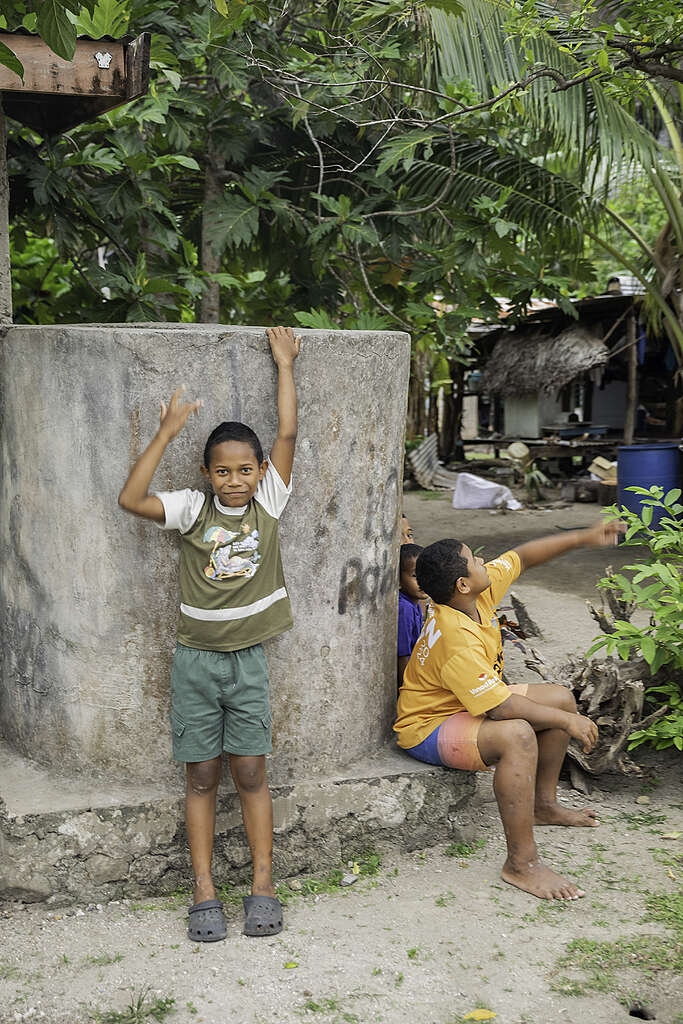
The island of Kioa is home to a Tuvaluan community who migrated from their atoll of Vaitupu in the late 1940s. It is a land of warm hearts, big smiles, and deep cultural roots; a place where the sound of a conch still summons the island together, where islanders paddle out to fish in carved outrigger canoes, and healthy happy children walk barefoot to school.
Here, culture is life. Kioans live sustainably through their traditional knowledge and practices. The island is alive with song, dance and the rhythms of a life tied to the tides, the winds, and the seasons.
Facing the future
Greenpeace has been lucky to have a relationship with Kioa for a number of years now, and we are continually learning from this remarkable community.
Last week, as part of our Voyaging Oceania project, we returned to the island. Our purpose was twofold —- to carry messages from the island to leaders gathering in Nadi this week for the Pacific Pre-COP, and to support the Kioa community in their efforts to improve water security for the island.
Unlike Tuvalu itself, with its eight atolls, Kioa is a mountainous, forested and richly fertile island. It will remain habitable far into the future. Kioans did not initially migrate from Vaitupu due to climate change, but the move was prophetic. They now have a lifeboat.
However, even Kioa faces challenges on our rapidly warming planet, in particular when it comes to water. Climate change is shifting once reliable rainfall patterns. On top of this, the island is already feeling the effect of this year’s intensifying El Niño event, which for Fiji means reduced rainfall and prolonged dry spells.
Right now, fresh water has to be carefully rationed, and is only available for a few hours a day. During last week’s visit aboard our campaigning ship Oceania, Greenpeace was privileged to work with the Kioa community on a new solar-powered water distribution project for the island.
Designed and led by the island, the project involves using a solar pump to move water from a reliable source to a storage tank and then using gravity to distribute the water around the village.
It was a lesson in how local knowledge and ingenuity can be the backbone of today’s climate solutions. To build a dam around the source, the local community knew the exact spot where they could gather gravel at low tide to mix with the cement. They took only what was needed, knowing that all resources must be carefully conserved. Kioa has no roads and no machinery, and it was an all-of-island effort to carry the materials up to the project site, including many heavy bags of sand and rock.
Such projects truly bring to life the vision of a resilient, locally-led, fossil fuel free Pacific.