

Andreas Sieber is the associate director of global policy and campaigns at 350.org.
It is no accident that the COP30 presidency convenes consultations on Thursday, a day after the UN Climate Summit. Wednesday’s speeches offered proof that, even amid geopolitical upheaval, the Paris Agreement still drives momentum. At the same time, the hard truth was clear well before the summit: the pledges do not add up.
COP30’s credibility rests on how it confronts this ambition gap. Attempts to spin COP30 as a success without such a response seem hollow. If COP30 must respond to this ambition gap, a cover decision emerges as the most credible path forward.
COP30 brings the ambition cycle of the Global Stocktake (GST), launched at COP28, to a close. The ambition gap is often framed through the temperature threshold, but it runs deeper, encompassing adaptation, loss and damage, and finance, all of which are falling dangerously short.
Countries trail COP30 clash over global response to shortfall in national climate plans
A cover decision is surely not the only marker of success: the Belém Action Mechanism on Just Transition, an ambitious Baku-to-Belém roadmap, and a Global Goal on Adaptation are just a few among other high-stakes deliverables. But it is one decisive piece of the puzzle.
Breaking through entrenched negotiations
Why do we need one in the first place? Anyone who sat through the UAE Dialogue or Mitigation Work Programme earlier this year, will have more than serious doubts that these rooms can overcome their entrenched dynamics to deliver adequate outcomes, let alone allow the broader dealmaking required.
That is why a cover decision emerges as the most credible way to confront the ambition gap head-on – and here it is the Brazilian presidency that holds the pen.
A cover decision is no magic bullet to solve negotiation challenges, but it offers the best-placed procedural vehicle to balance different elements of the ambition package, allowing a race to the top instead of zero-sum trade-offs.
-
China unveils underwhelming emissions-cutting target for 2035
Experts say China’s new 2035 goal to cut emissions by 7-10% from “peak levels” does not fully reflect its expansion of clean energy on the ground -
At climate summit, UN chief urges countries to go “much further, much faster” on NDCs
With about 120 leaders and ministers speaking in New York, the pressure is on for stronger climate action plans to rein in global warming, with the world off track to meet Paris Agreement goals -
Nigeria gives fossil gas a bigger role as “transition fuel” in climate plan
Officials say the country needs time and money to ramp up renewables, but critics say betting on gas is a risky strategy that could prolong the “oil curse”


At the last COP, we saw mitigation pitted against finance, and without real commitments – especially credible new finance from wealthy countries – that history risks repeating itself. Process alone is no guarantee of success, but a misguided process is a recipe for failure. It’s also noteworthy that the COP29 presidency, due to a lack of political will or misguided strategy, refused to engage with the idea of a cover decision.
Instead of discussing several crunch issues across different rooms, a cover decision can bring topics together in the same room and the same text.
What should a cover decision include
A cover decision can anchor critical finance outcomes that otherwise lack a formal home, from the Baku-to-Belém roadmap to a meaningful scale-up in adaptation finance, with tripling as the obvious first step.
This is not about creating a procedural parking lot; it is about giving key outcomes real political and procedural weight. Linking the roadmap’s $1.3 trillion mobilisation goal for 2035 to concrete donor commitments through a cover decision would turn aspiration into accountability.
Responding to the ambition gap will also require initiatives that target the sectors driving the crisis. This could mean establishing a dedicated working group on phasing out fossil fuels, anchored in equity and 1.5°C consistent timelines, with a mandate that connects its work to COP31 under the incoming Presidency.
Brazil’s environment minister suggests roadmap to end fossil fuels at COP30
It could also mean reinforcing and expanding the COP29 Grids Initiative, this time with concrete public finance commitments attached. Both initiatives could be launched through presidential declarations and then captured and formalised within a cover decision.
Finally, a cover decision must also speak beyond the negotiating halls. It should respond with grave concern to the latest NDC synthesis report, and it should build on messages from the landmark ICJ advisory opinion and the leaders’ summit to signal that the world’s governments understand the urgency of the moment.
Instruments of real progress
Critics may dismiss cover decisions as the epitome of empty words: procedural theatre about brackets and commas, offering conversation to those who are excited about “the process”, conversation rather than consequences. At times, cover decisions can be sprawling, jargon-laden texts that feel detached from real-world impact, such as in 2019. Yet history shows they can also be instruments of real progress.
It was a cover decision in Durban in 2011 that launched the Ad Hoc Working Group (ADP), the negotiating track that ultimately delivered the Paris Agreement.
Since then, their character has evolved. With the Paris rulebook now in place, cover decisions have increasingly driven forward momentum.

In Glasgow, a cover decision broke new ground by naming a fossil fuel for the first time, calling for the “phase down” of coal. However imperfect – singling out coal was very convenient for European countries and the United States at the time – this opened the door to COP28’s landmark outcome: a collective commitment to transition away from all fossil fuels and to triple renewable energy.
One could argue that the COP28 Global Stocktake decision was not technically a cover decision, but in practice it served as one. And in Egypt, a cover decision launched both the Just Transition Work Programme and the loss and damage fund, breakthroughs that continue to shape the process today. As we look ahead to COP30, where the Belém Action Mechanism on Just Transition is on the table, history suggests that a strong cover decision could again prove decisive.
COP30 and the Brazilian presidency will be remembered for whether (and how) it responds to the ambition gap in this decisive decade. A strong cover decision remains the most credible tool to anchor that response.
The post Why COP30 needs a cover decision to succeed appeared first on Climate Home News.

Continue Reading
Three countries have been named by the Paris Agreement’s compliance committee for failing to submit a nationally determined contribution (NDC) and repeatedly snubbing offers of help with their climate plans.
After months of internal debate over whether to identify serial non-responders, the Paris Agreement’s Implementation and Compliance Committee (PAICC) named the three countries which have failed to engage with it over their NDCs on Friday.
It named Democratic Republic of Congo, Senegal and North Korea in a footnote of its annual report, adding that it decided to name them “with a view to facilitating engagement”, adding that representatives of the three nations had been invited to its meeting in early 2027 “with the purpose of identifying any challenges and constraints”.
“The Committee noted the importance of Parties engaging with the Committee in a timely manner, while noting that some delays may be due to the national capabilities and circumstances of the Parties”, the report said.
-
Under US pressure, World Bank says it will back gas “where appropriate”
The US wants the World Bank to expand its gas support while climate campaigners are pushing for it to end – its head spoke this week of limited backing for the fossil fuel -
IPCC scientists vow to press on with climate reports despite political deadlock
After governments again failed to agree a timeline, nearly 120 IPCC authors pledged to complete their assessment on time and with full scientific rigour -
Paris Agreement committee snubbed over missing NDC climate plans
Many governments have still not submitted a nationally determined contribution to the UN, breaching a key requirement of the Paris Agreement

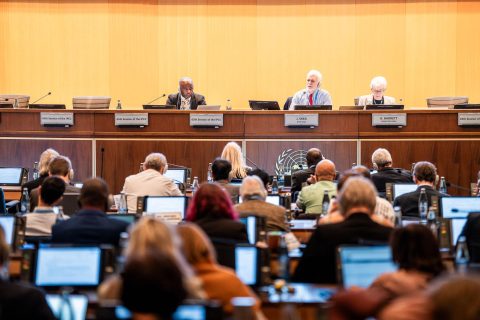

In July, PAICC said 12 countries had ignored its repeated attempts to discuss why they had not published an NDC as required every five years under the 2015 Paris accord.
Members of the committee had been divided over whether to name them, but at a September meeting decided to do so in their annual report to the annual climate COP summit.
By the time the report was published on Friday, only Congo, Senegal and North Korea “had not communicated an NDC or submitted a [Biennial Transparency Report] and had not yet responded to any of the Committee’s notifications, despite several reminders issued by the Committee in this regard”.
Rainforest and renewable energy ambitions
The silence from Congo and Senegal is notable because the former is home to much of the Congo Basin rainforest while the latter has sought billions of dollars in climate finance to support its renewable energy ambitions.
After Brazil, Congo has more rainforest than any country in the world. This forest, and the country’s peatlands, absorb huge amounts of greenhouse gas but are fast being lost to expanding farmland, charcoal production, logging and mining.
Senegal signed a Just Energy Transition Partnership with Canada and wealthy European nations in 2023, to help it meet its renewable energy targets under the-then government of Macky Sall. It was chair of the Least Developed Countries group between January 2022 and December 2023.

Tejas Rao, who is researching the PAICC as part of a doctoral thesis at Cambridge University, said the governments of the three countries should engage with the committee.
“Engagement costs these governments very little and the committee has shown it will listen,” he said.
“Silence leaves the committee with no basis to help, and it leaves the [governments] exposed to the narrative that they are simply disengaged,” he told Climate Home News.
Paris Agreement requirement
The 2015 Paris Agreement requires all parties to publish an NDC every five years outlining their emissions reduction targets, with each plan meant to be more ambitious than the country’s last NDC.
The latest set – the third round of plans, with new targets for 2035 – was due in February 2025. While most countries missed this deadline, all but around 30 – mostly small emitters but including Egypt, Vietnam and Argentina – have now submitted them.
Over the year, the PAICC – which is made up of government climate officials from developed and developing countries – has been communicating with governments that have not submitted NDCs and trying to overcome barriers to them doing so.
Some nations have cited exceptional circumstances as the reason for not submitting an NDC, a process that requires a significant amount of work in tracking emissions and consulting on how to curb them across the economy. For example, a letter from a Sudanese official to the PAICC, seen by Climate Home News, said that the country’s civil war had led to the suspension of its NDC preparation.
-
IPCC scientists vow to press on with climate reports despite political deadlock
After governments again failed to agree a timeline, nearly 120 IPCC authors pledged to complete their assessment on time and with full scientific rigour -
Under US pressure, World Bank says it will back gas “where appropriate”
The US wants the World Bank to expand its gas support while climate campaigners are pushing for it to end – its head spoke this week of limited backing for the fossil fuel -
Who shapes climate science? The equity question facing the IPCC
Early completion of the next global climate science assessment reports risks excluding research from the Global South, which is key to ensuring the findings are fair
The US and Iran are not signed up to the Paris Agreement and so do not have active NDCs, nor does Taiwan, which is not a UN member state.
Rao said that because the PAICC is “facilitative and non-punitive”, naming the countries “is meant to open a door, not close one – the invited consultation is the point”.
“In recent months, governments that explained their constraints, whether capacity, finance or domestic process, have been met with follow-up and support rather than sanction, and the number of silent governments has fallen sharply,” Rao said.
The post Paris Agreement committee names three countries snubbing it over NDCs appeared first on Climate Home News.
Paris Agreement committee names three countries snubbing it over NDCs