

Lawmakers in Ghana are weighing up whether to greenlight one of Africa’s largest lithium mines after civil society groups urged them to do more to ensure that the project benefits the country and supports green development.
Ghana granted Australian miner Atlantic Lithium a lease to open the country’s first lithium mine in the hope of capitalising on the EV-driven boom for the silvery metal, which is used to manufacture batteries for electric cars and other clean tech products.
But as the deal awaited ratification by parliament in December, the government withdrew the agreement after campaigners and analysts in Ghana warned that the terms risked shortchanging the West African nation at a time when it is seeking to benefit from the scramble for battery minerals.
Atlantic Lithium, which had earlier raised concerns that falling lithium prices were affecting the viability of the project, has since put forward a revised agreement. This new deal would see it pay higher royalties to the government when lithium prices rise, as they have since the start of this year. Lawmakers are expected to review the new terms of the contract for the much-delayed project this month.
Like other resource-rich African nations, Ghana, the continent’s largest gold producer, is seeking a bigger share of mining revenues to spur development and benefit local people.
-
Outdated geological data limits Africa’s push to benefit from its mineral wealth
As companies flock to Africa to secure minerals for the energy transition, unreliable and century-old mapping risks stifling investment -
At ‘Davos of mining’, Saudi Arabia shapes new narrative on minerals
Over 100 countries attended the Future Minerals Forum in Riyadh, putting the Kingdom at the heart of discussions on minerals for the energy transition -
South Africa’s platinum mine dumps get a second look as clean energy lifts demand
Mining firms say extracting minerals from tailings is a sustainable way to boost global supplies, but local communities want to see benefits this time around


Experts told Climate Home News the negotiations with Atlantic Lithium highlighted the difficulties for governments to negotiate preferential terms with mining companies, on which they depend for revenues and expertise.
“Lithium is Ghana’s first green mineral and will set the benchmark for future critical mineral agreements,” opposition lawmaker Kwaku Ampratwum-Sarpong, a member of the committee on lands and natural resources, told local media in December. “Weak deals now risk setting a poor precedent for the country.”
Ghana’s lithium potential
Atlantic Lithium says the Ewoyaa project could produce 3.6 million tonnes of lithium spodumene concentrates over the mine’s 12-year lifespan – turning Ghana into one of Africa’s top lithium producers and a significant new supply source for the EV battery industry outside of established producers in Australia, Chile and China.
The lithium is expected to be exported to the US and further refined for use in EV batteries. Atlantic Lithium financed the exploration of the mining site by forward-selling Ghana’s lithium resources to Elevra, a North American lithium producer which has a supply agreement with Tesla.
Atlantic Lithium previously obtained a concession to cut the royalty rate it would pay Ghana from the mandated 10% to 5%. The company argued that the adjustment was necessary to make the project viable after lithium prices had plummeted by more than 80% since 2023.
The company’s move sparked a public outcry. Policy think-tanks that analysed the agreement described it as “colonial” and warned that parliament risked “repeating history’s mistakes” if it approved the deal. The Natural Resource Governance Institute challenged Atlantic Lithium’s claims about its revised profitability and urged the government to scrutinise the assumptions made by the company.
In light of the criticism, the government withdrew the deal in December.
“When governments depend on mining projects to project a sense of economic progress, they stop negotiating for value and start negotiating out of fear,” Bright Simons, of the Accra-based IMANI Centre for Policy and Education, told Climate Home News.

A balancing act
Atlantic Lithium has since put forward a revised agreement based on a proposal by the minister for lands and natural resources, Emmanuel Armah-Kofi Buah, to establish a sliding scale for royalty rates based on lithium prices.
The scale would start at 5% when lithium spodumene prices are below $1,500 per tonne and rise to 12% when prices exceed $3,000 per tonne. Lithium prices are currently at a two-year high and climbed above $2,000 at the start of the year, as analysts forecast stronger demand growth.
Henry Wilkinson, Atlantic Lithium’s communications manager, told Climate Home News the revised agreement was aligned with current legislation and would “ensure that value is generated for Ghana and Ghanaians”.
The government, he said, should find “the appropriate balance” between attracting foreign investment and retaining value from its nascent lithium industry.
“If the government sets fiscal terms that are deemed unattractive for companies looking to advance projects in Ghana, the country risks missing out on securing a position within the value chain; particularly with other countries, such as Mali, Zimbabwe, Nigeria and South Africa all moving ahead with their lithium production ambitions,” he added.
Fear of missing out
But this new approach hasn’t convinced everyone. For Simons, of the IMANI think-tank, the revised agreement still falls short of Ghana’s interests.
“African youth are tired of being told all the time that Africa is rich underground when the signs of destitution are so stark above ground,” he told Climate Home News.
“The narrative that the critical minerals rush is about building the next phase of the global economy has created a massive new wave of anxiety that the continent will miss out yet again. It feels like [a] determined betrayal.”
-
Nigeria’s push to cash in on lithium rush gets off to a rocky start
The West African nation wants to supply refined lithium to the EV battery industry to diversify its economy away from oil – but early processing efforts are facing challenges -
Ending poverty and gangs: How Zambia seeks to cash in on the global drive for EVs
Zambia is wooing international investors to develop its copper resources but communities dependent on illegal mining want a better deal -
Lithium boom: Zimbabwe looks to China to secure a place in the EV battery supply chain
Chinese investors have flocked to Zimbabwe to secure lithium supplies, promising local development. But analysts warn Zimbabwe needs more robust governance for communities to reap the benefits


Atlantic Lithium will allocate 1% of the project’s revenues to a community fund that will finance development projects in the local area. But the protracted negotiations have left people living near the mining site in limbo.
Farming communities say Atlantic Lithium told them to stop planting crops three years ago because they would need to be resettled ahead of the mine opening. While they await a decision on the mine, no one has yet received compensation for the loss of earnings, the Ghanaian NGO Friends of the Nation told Climate Home News. The community representatives in the negotiations with Atlantic Lithium receive stipends from the company, the NGO added, which it says poses a conflict of interest.
Atlantic Lithium said that the delays have been “beyond the company’s control”.
Unequal bargaining power
For Marisa Lourenço, a South Africa-based risk consultant, African governments are too reliant on foreign expertise for extracting their mineral resources and this often limits their bargaining power.
“The broad absence of local beneficiation means that African governments can do very little with their resources and this keeps them reliant on the terms put forward by foreign mining companies,” she said.
In Ghana, the mining industry is the largest tax-paying sector in the country. And the initial agreement to develop the Ewoyaa mine was based on a feasibility study carried out by Atlantic Lithium, said Patrick Stephenson, Ghana country manager at the Natural Resource Governance Institute.
Stephenson told Climate Home News that delays to the ratification of the project’s mining lease show that the government needs to rely on its own data and analysis to inform decisions “rather than on company-determined interests and priorities”.
That could include the creation of a state‑led minerals analytical unit capable of conducting its own profitability modelling, price benchmarking, feasibility studies and project valuation, he added.
The post West Africa’s first lithium mine awaits go-ahead as Ghana seeks better deal appeared first on Climate Home News.
West Africa’s first lithium mine awaits go-ahead as Ghana seeks better deal

Scientists have vowed to keep working on the next flagship set of reports for the Intergovernmental Panel on Climate Change (IPCC), after a political row over the timeline for their release saw its latest session suspended on Friday evening without agreement.
During the weekend, government officials and scientists alike expressed disappointment over the inability to reach a compromise before some delegates from developing countries and small island states had to leave the week-long meeting in Ethiopia to catch flights home.
The disagreement – which has persisted since early 2024 – turns on whether the three key parts of the AR7 assessment should all be published before the conclusion of the UN’s next Global Stocktake of global climate action, which is due to be completed in late 2028.
The IPCC issued a statement after the close of the session, saying that “key agenda items” – the timelines for the three AR7 reports, as well as the IPCC budget – remain open and under discussion. It said the IPCC’s plenary session and its deliberations on the pending agenda “will resume at the earliest opportunity”, giving no further details of when.
IPCC Chair Jim Skea told delegates in closing remarks that recent months had been some of the most turbulent for the climate science panel and that, if there were stronger words than “profound disappointment” he would use them, according to a summary published by the Earth Negotiators Bulletin (ENB). IPCC discussions happen behind closed doors.
IPCC scientists remained committed
In an open letter, issued on Monday, a group of nearly 120 scientists – from a total of 664 AR7 authors – said they “stand committed to continue working to deliver the AR7 reports in a manner that is rigorous, timely and inclusive, in line with our mandate to be policy-relevant”.
“An assessment that arrives after the decisions it is meant to inform cannot serve its purpose,” they emphasised. “The second Global Stocktake in 2028 is such a decision point, and the world should not have to face it without the IPCCʼs latest assessment.”
Europe, small islands and the least developed countries, plus many Latin American and developed nations, want the IPCC to meet this deadline, arguing that the findings from the UN climate science body are irreplaceable in the UN climate policy-making process.
However, around a dozen developing countries plus Russia have argued that the reports should come later in order to allow for greater research input from the Global South – something that, in their view, would make the findings fairer. They also claim that a shorter timeline would put excessive pressure on experts.
-
Who shapes climate science? The equity question facing the IPCC
Early completion of the next global climate science assessment reports risks excluding research from the Global South, which is key to ensuring the findings are fair -
Governments that support climate science must stand firm against naysayers
The IPCC is meeting to decide the timing of its next major report, as some countries try to delay it and weaken the case for faster emissions cuts


The most vocal of this group at last week’s meeting were India and Saudi Arabia, according to the ENB summary and a developed country diplomat. Critics see this push for a longer timeline as an excuse to deprive government decision-makers of the latest science and ease pressure on emerging economies to raise their ambition, particularly on cutting emissions.
Commenting on last week’s meeting, France’s ambassador for climate negotiations Benoît Faraco said a broad coalition of developed and developing countries from all five continents, “united in their support for science and the timeline proposed by scientists”, had withstood pressure “from a few countries” seeking to slow down the process of adopting the IPCC reports.
He added that France would not back down and would “continue to fight tirelessly for science, protect the integrity of information, and convince our partners that without the best available scientific data, we will be less effective in tackling climate change and protecting our populations”.
Inclusivity proposal stalled
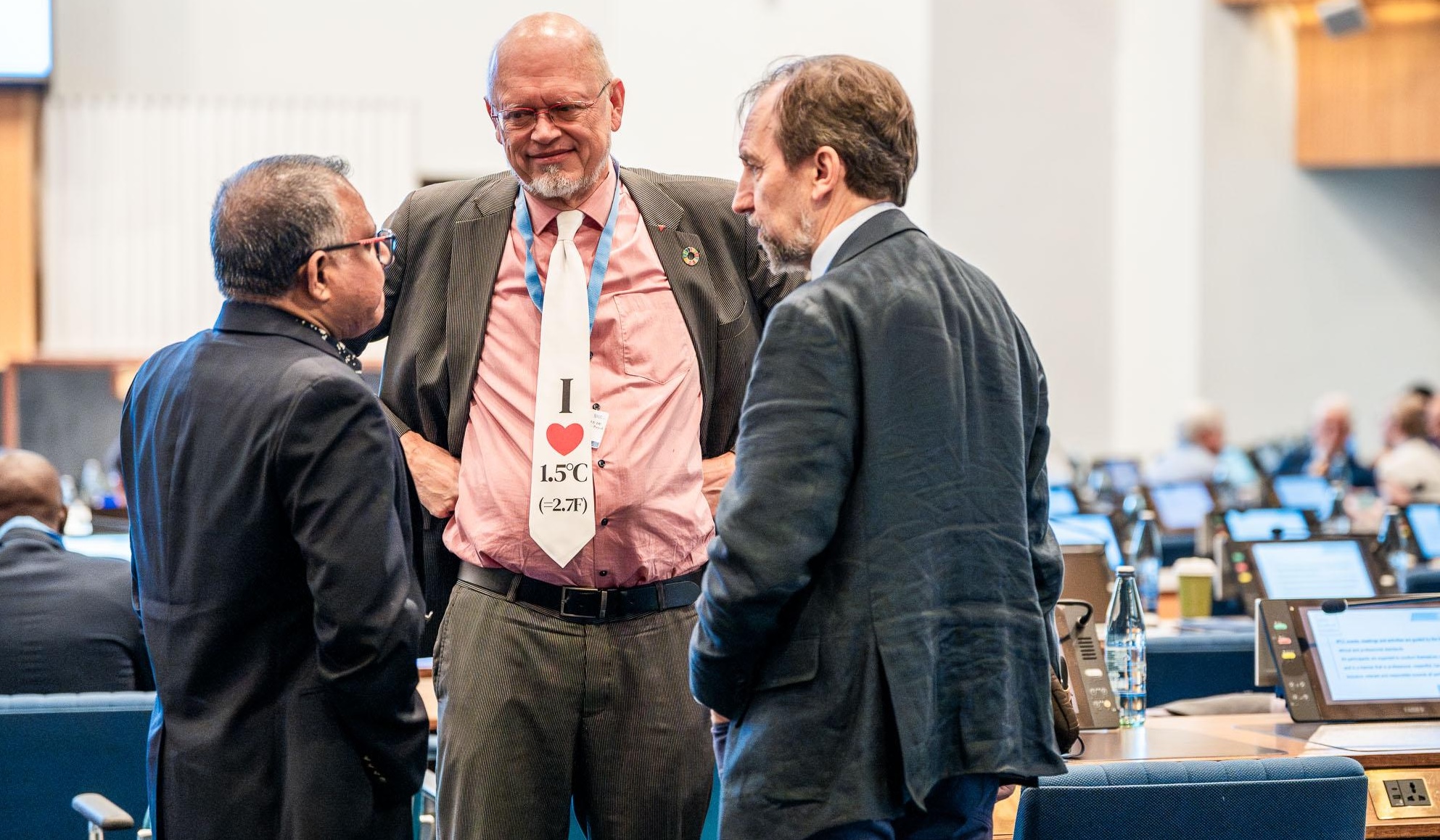
In a bid to unlock a solution for the AR7 timeline, countries discussed ways to improve the inclusivity of the IPCC’s work. One option put on the table was for the IPCC to expand its funding for delegates from developing countries to attend some or all of its sessions from one to two participants, according to the ENB summary and a delegate speaking to Climate Home News.
That would increase the costs for the IPCC to complete AR7 by up to a quarter, according to an assessment shared by the secretariat. The panel’s budget is under severe strain and its officials have warned that, without additional voluntary contributions, it risks running out of money before it can deliver on this assessment cycle.
Climate Home News understands that some of the IPCC’s traditional donors – which mainly include European countries, Japan and Australia – indicated a willingness to support funding for an additional developing country participant. But without an agreement over the budget or the timeline for the reports, that option was ultimately not adopted.
‘Disappointed and worried’
The three reports are managed by working groups that collate and draw overall findings from the latest scientific studies and data on the physical effects of global warming around the world, how to adapt to it, and pathways for cutting planet-heating emissions in order to meet the temperature goals of the Paris Agreement.
Winston Chow, an urban climate professor at Singapore Management University who co-chairs Working Group II on adaptation, wrote in a LinkedIn post that he was “disappointed and worried” for the IPCC authors who have worked “extraordinarily hard” to assess the relevant climate science over the past two years.
He said he shared their concern that “the rigour, time and goodwill they’ve invested are now being put at risk by the Panel’s stalemate”.
As science comes under attack at UN talks, climate movement splits over how to respond
For Working Group II, a meeting for 250 experts writing that report is scheduled for January 2027, followed by the approval of a special report on cities and climate change in Singapore next March.
But because the IPCC’s budget has not been confirmed due to uncertainty about the AR7 schedule, travel support for those researchers is at risk, wrote Chow. “If they cannot participate, our assessments will lose vital expertise, perspectives and scientific breadth, and the collective effort of our authors will be undermined,” he warned.
Scientific work continues
Despite the political holdups, he – together with French climate scientist Robert Vautard, co-chair of Working Group 1 – agreed with IPCC head Skea who told the IPCC’s closing session on Friday: “The engine room of the IPCC is working, and it’s healthy.”
Vautard commented in a separate post on LinkedIn after it ended: “The boat is at full steam.” Working groups I and II are due to start revising the first drafts of their reports, while Working Group III on reducing emissions is finalising its first draft which will be out soon, he wrote.
“The most exciting two years of the cycle are ahead, for the authors. The momentum in the engine room is here and now. Trust the engine room!” he added.
The IPCC and some scientists report that progress has been made towards achieving an equitable balance of authors from the Global North and the Global South.
The group of researchers who signed the open letter on Monday noted that “inclusivity is at the heart of how we work”, with author teams bringing together experts from developed and developing countries with diverse backgrounds and at different stages of their careers.
Plea to overcome political differences
The signatories include several scientists from some of the countries opposed to the alignment of all IPCC reports with the Global Stocktake.
“We are committed to an assessment in which the knowledge, experience and priorities of every region are fully reflected, a commitment we share with the leadership of the IPCC.
Equity is built into how our assessment is being drafted,” they added.
They appealed to governments that make up the IPCC “to overcome their political differences and work together as we do as a global scientific community, so that we can deliver the IPCC reports the world needs to hear”.
In a statement published on Monday, IPCC chair Skea said reaching consensus on the schedule for the reports is “vital”. He added that the assessments provide authoritative scientific evidence to inform national climate policies, strengthen adaptation and resilience and support access to climate finance, as well as helping communicate the scale of the climate crisis and the urgency of efforts to tackle it.
The post IPCC scientists vow to press on with climate reports despite political deadlock appeared first on Climate Home News.
IPCC scientists vow to press on with climate reports despite political deadlock