

As rising seas submerge growing swathes of land, countries that lose territory should still keep their national boundaries, sovereign rights and UN membership, according to a political declaration adopted at the UN General Assembly in New York on Thursday.
The declaration, which was championed by climate-vulnerable small island states, affirms “the presumption in favour of continued statehood” in the face of sea level rise fuelled by climate change, and urges countries to work together to assist communities affected by encroaching oceans.
Speaking at a high-level UN meeting to address the existential threats posed by sea level rise, Cabo Verde’s Prime Minister Francisco Carvalho, one of the initiative’s co-facilitators along with Australia, said the adoption of the text by consensus sends “a message of hope”.
“This declaration has a very special meaning. For us, sea level rise is neither a distant threat nor a theoretical concern,” he said, adding that rising seas put at risk key infrastructure, water resources and economic growth in small island states.
In the Pacific, sea levels have risen at twice the global rate, dramatically increasing coastal flooding events from two to 20 a year in the Republic of the Marshall Islands, and from zero to 102 events per year in American Samoa, according to the World Meteorological Organization (WMO).
Surangel Whipps Jr., president of the Pacific island of Palau, said the summit in New York represents a “moment of international solidarity”, and highlighted that small island states will remain permanent members of the UN.
-
Push for cooking to be part of COP31’s electrification agenda
The President of Kenya and the British climate envoy said Africa should use the global electrification push to roll out clean cooking -
Germany unveils plan to end use of fossil fuels in energy sector by 2045
Germany became the third country to publish a roadmap to phase out fossil fuels after France and the Netherlands, as the UN chief calls on all governments to follow -
UN Climate Summit: UN chief says world has tools to end fossil fuel age
At the UN Secretary-General’s climate summit in New York, countries shared their energy transition plans while Nepal and island nations advocated for more international support


Declaration recognises statehood
An advisory opinion by the world’s top maritime court, the International Tribunal on the Law of the Sea (ITLOS), first upheld in 2024 that countries do not have to shrink their maritime borders even if they lose land territory due to sea level rise. This was reiterated by the International Court of Justice in last year’s landmark ruling on the climate obligations of states.
The new declaration endorsed by all governments at the UN General Assembly stresses that sea level rise “is not a distant scenario but a real and lived experience for many”, and notes that international law must be implemented in global responses to rising seas.
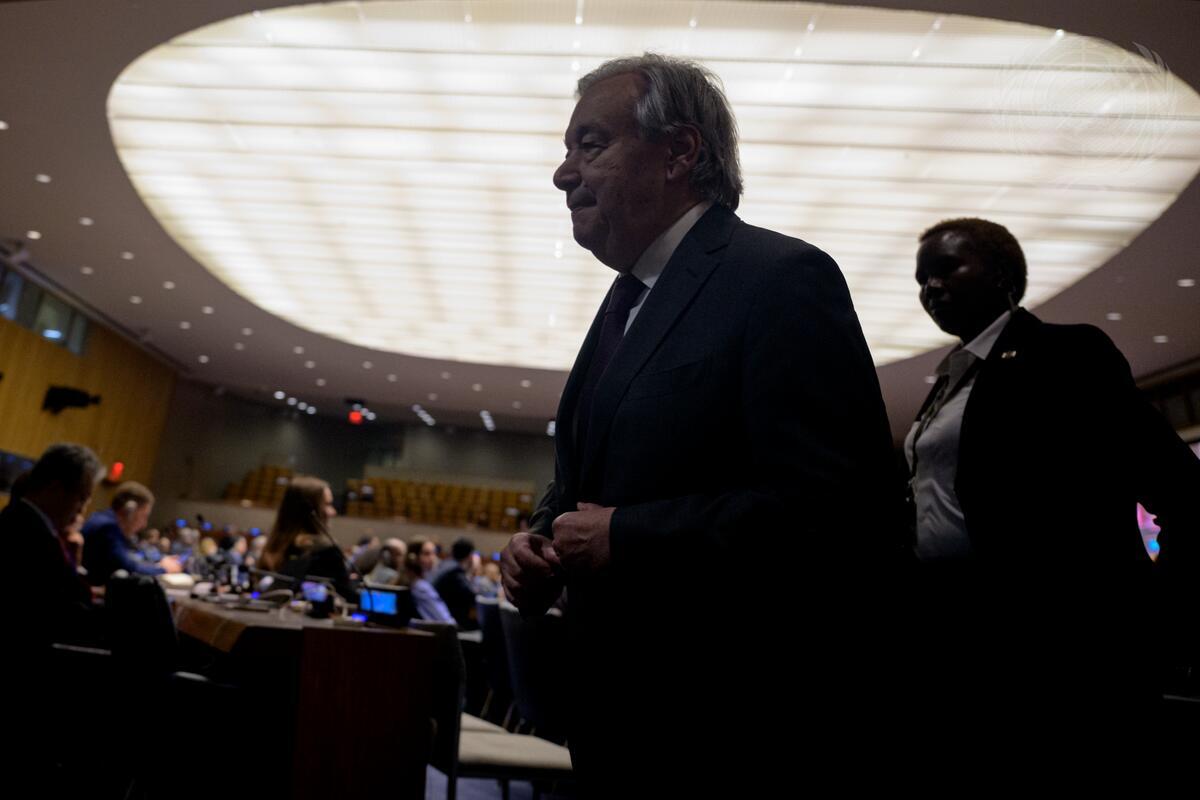
UN Secretary-General António Guterres said the “milestone must now be translated into action”, adding that the declaration should encourage an “ongoing dialogue” at the “highest possible level” leading to practical outcomes. Pacific islands have proposed an international treaty on sea level rise that would provide more legal certainty.
“Those on the frontlines must be front and centre on every decision. We cannot allow countries and cultures to vanish beneath the waves,” he said. “The SOS has gone out. The world must answer.”
At regional summit, Pacific islands ask for COP31 support for clean energy and finance
Goodwin Friday, prime minister of St. Vincent and the Grenadines, said measures to protect vulnerable states will require adequate finance. “Investing in resilience now is more cost-effective than paying the far greater price for loss and damage later,” he added.
Championed by Australia’s COP31 co-presidency, Pacific islands have sought to put adaptation to sea level rise and ocean conservation at the top of the political agenda by inviting world leaders to attend the pre-COP31 summit co-hosted by Fiji and Tuvalu in October.
Tuvalu will also host the second global fossil fuel phase-out summit in April 2027, after around 60 governments met this year in Santa Marta, Colombia, to discuss ending their dependence on coal, oil and gas.
“Our coastlines, our reefs and our communities are living with the consequences of fossil fuel dependence every day, and our people have earned the right to help shape the way forward,” Lynda Tabuya, Fiji’s climate minister, said in a statement announcing details of the conference.
Ocean monitoring gets a boost in New York
Amid record-breaking marine heat and seas rising at unprecedented speed, governments in New York announced new commitments to protect the world’s ocean, as efforts to bolster marine ecosystems and coastal communities rise up the political agenda.
On Wednesday, the EU and Canada announced more funding for a new Europe-led ocean monitoring system called OceanEye, launched in the aftermath of a failed attempt by the Trump administration to dismantle the largest existing network of deep-sea observatories.
During an event at UN headquarters in New York, EU President Ursula von der Leyen and Canadian Prime Minister Mark Carney announced around $163 million in new funding for the initiative, with the EU pledging €92 million ($105m) on top of existing seed funding and Canada pledging C$82 million (US$58m) over five years.
According to an EU statement, while OceanEye will collaborate with the Global Ocean Observing System, that network “remains vulnerable to financial shortfalls and geopolitical disruptions”. A group of 30 countries from Europe, Africa and the Americas joined an international initiative in support of OceanEye, including large coastal nations like Brazil, Namibia and Mexico.
Von der Leyen said OceanEye “can make us the leading ocean data provider in a matter of years”, including by launching new satellites and installing new observatories in the deep ocean. “From outer space to the deepest ocean, our funding helps us keep watch beneath the waves,” she added.
Carney said the initiative would help protect Canada’s Arctic region with real-time monitoring operating year-round. “We can’t protect what we can’t see,” he said, also highlighting that Canada had expanded conservation of its ocean territory from 1% a decade ago to 15% now.
In New York, a group of 19 countries said they are either developing or implementing plans to sustainably manage all of their ocean territory, with 12 new nations joining the initiative. In a joint communiqué, they called on more countries to sign up ahead of COP31.
Warnings of El Niño-fuelled extreme heat
Scientists and world leaders have raised the alarm over this year’s record-breaking marine temperatures, which have persisted above historical peaks for more than 100 days as the naturally occurring El Niño phenomenon intensifies in the Pacific.
Extreme ocean heat could become a threat to coastal ecosystems and communities, experts fear. Water temperatures 1.5C above normal levels have also rapidly fuelled a strong hurricane in the Pacific in recent days.
Despite scientific calls for additional ocean conservation efforts, a report launched this week in New York warned that efforts to protect ocean ecosystems are lagging behind, with only 10% of the global ocean covered by conservation areas and just 3.5% designated as “effectively protected”.
The post Threatened by rising seas, small islands secure right to keep their statehood appeared first on Climate Home News.
Threatened by rising seas, small islands secure right to keep their statehood

Muhammad Zulfikar Rakhmat is director of the China-Indonesia Desk at the Center of Economic and Law Studies (CELIOS). Bhima Yudhistira Adhinegara is executive director of CELIOS.
Indonesia bills its plans to mix wood with coal at dozens of power plants as a way to cut electricity generation emissions as the country transitions towards clean energy. But look closer, and the biomass co-firing plan could do far more harm than good.
Biomass co-firing involves mixing a small amount of wood or other plant matter, usually wood chips or wood pellets, into the coal that a power plant burns.
State electricity company PLN wants to use it at 52 coal-fired plants across the Southeast Asian nation – a target set out in its national electricity supply business plan and tied to Indonesia’s pledge, under its Nationally Determined Contribution to the Paris Agreement, to raise renewables to 23% of the energy mix. PLN originally aimed to secure 10.2 million tonnes of biomass a year by 2025; that target has already slipped to 2031, as the country struggles to line up enough supply.
Most plants only mix in a small amount of wood, often between 1% and 5% of the fuel load, meaning they do not even have to change machinery. In truth, it lets coal plants keep doing what they have always done, just with a little wood added to the mix.
That presents two big problems.
-
SE Asia speeds up plan for connected clean power grid after oil shock
Countries are redoubling efforts to link their grids to bolster energy security and reduce their dependence on fossil fuels – but many challenges remain -
China keeps Indonesia’s battery dream afloat but future less certain
Chinese capital and technology turned Indonesia into the world’s top nickel supplier, but its dependence on China and the rise of nickel-free batteries could upset its battery ecosystem plans -
Southeast Asia’s fragile grids threaten billions in clean energy investment
Renewables developers need reliable electricity infrastructure and stable policies to help the region meet climate goals and surging demand for power


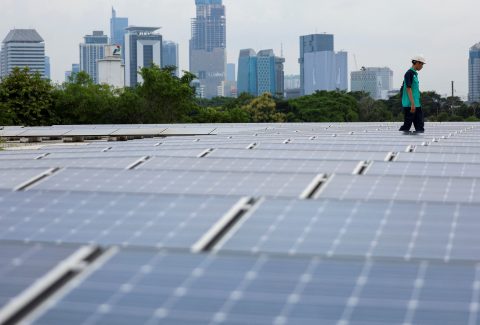
Firstly, creating additional demand for wood would put further deforestation pressure on the country’s thick and biodiverse tropical forests, already at risk from mining and palm oil plantations.
Secondly, by making old coal plants look a little greener on paper, the plan could hand them a reason to keep operating well beyond when they would otherwise be retired, meaning the fleet keeps emitting for longer than a genuine phase-out would allow.
This is not a real climate solution. It is coal wearing a green mask.
A threat to forests
To meet its co-firing mandate, Indonesia would need more than 10 million tonnes of wood pellets every year, an area of forest equivalent to 3.27 million football fields, according to a 2024 assessment by a group of NGOs.
The same report warned this could push deforestation as high as 2.1 million hectares a year, and found that a 10% cut in coal use through co-firing could threaten 10 million hectares of untouched forest in the areas where wood is collected. At Indonesia’s biggest power plants alone, switching just 10% of coal to wood could clear an area of forest roughly 35 times the size of Jakarta.
PLN and the forestry companies that supply it insist the wood comes from dedicated “energy plantation forests” – land set aside to grow fast-growing trees for fuel, not from clearing natural forest. But the same assessment found that of the 1.2 million hectares already designated for these plantations, more than 400,000 hectares still contain undisturbed tropical forest, which will come under growing pressure as demand rises. The claim that this wood comes from already-degraded land does not hold up to scrutiny.
Advocates of co-firing say wood is a clean fuel because trees can grow back. But when old natural forests are cleared to make way for fast-growing forestry plantations to grow trees for fuel, they release carbon that took decades or centuries to build up.
One study, by the Centre for Research on Energy and Clean Air (CREA), estimated that co-firing with just 10% wood across 52 power plants could create up to 26.5 million tonnes of carbon dioxide-equivalent emissions each year, once the clearing of land and the production of wood pellets are counted.
Wood pellets for export
Government rules have made this easier, not harder. Companies that already hold industrial timber plantation permits can convert them into energy plantations, giving them a ready-made legal route into the wood pellet business without applying for new forest land.
Indroyono Soesilo, chairman of the Indonesian Forestry Entrepreneurs Association (APHI), has publicly called on the government for tax breaks and relief from state forestry levies in exchange for making that switch.
Research by Trend Asia found that the push into energy plantations for biomass is dominated not by small or informal loggers but by large companies already notorious for deforestation, including APP Group, Korindo Group, Barito Pacific and Wilmar International. In short, some of the same companies long associated with clearing forests are being given an easier path and a green label to keep doing it.
-
COP30 roadmap to end deforestation will invite countries to draft domestic plans
After promising at COP30 to produce a voluntary global roadmap to stop forest loss by 2030, Brazil provided an update on the consultations this week -
Big banks’ lending to coal backers undermines Indonesia’s green plans
Foreign banks involved in Indonesia’s $20-billion Just Energy Transition Partnership have also funded companies working on coal power expansion, a TBIJ and Climate Home News investigation reveals -
Indonesia and Vietnam set for surge in coal use this decade despite transition deals
Rising demand in Southeast Asia and India is expected to prevent coal use from falling significantly this decade, the International Energy Agency predicts


Much of this wood does not even stay in Indonesia. Japan and South Korea have bought more than 99% of Indonesia’s wood pellet exports since 2021, using them to meet their own clean energy targets.
Perhaps the biggest risk in Indonesia’s co-firing plan is what it could do to the coal fleet itself. Mixing in a small amount of wood does not require a plant to shut down or upgrade. It simply gives the plant a reason to keep running, dressed up as progress. Every year a coal plant stays open because of a paper-thin green label is a year that real clean energy, such as solar and wind, is pushed further down the road.
None of this means biomass is always bad. Using leftover farm waste or city waste to make power can make sense.
But the scale of Indonesia’s co-firing plan cannot be met by leftovers alone, which is exactly why forests are being pulled into the supply chain. The countries and banks funding Indonesia’s energy transition, along with Japan and South Korea, should stop counting co-firing as a climate win.
Real progress means closing coal plants, not feeding them wood.
The post Coal in a green mask: Indonesia’s co-firing plan will harm, not help, the climate appeared first on Climate Home News.
Coal in a green mask: Indonesia’s co-firing plan will harm, not help, the climate
Climate Change
Loss and damage fund agrees $20m for Nepal but rich nations warn it should not set precedent
The board of the UN’s Fund for Responding to Loss and Damage agreed on Thursday to set aside $20 million to help Nepal recover from the devastating climate-driven flood it suffered in August.
At an extraordinary online meeting, board members unanimously invited Nepal’s government to submit a proposal for how to use the money, which will be considered at a future board meeting.
The board’s co-chair Camila Minerva Rodriguez described the decision as “truly historic” as it is the first time the new fund has allocated any money since it was set up three years ago. It is expected to approve its first set of projects at its next board meeting in December.
Maheshwar Dhakal, a senior official at Nepal’s climate ministry, told the meeting the decision was “a powerful expression of humanity, compassion, solidarity and hope” and, for the flood victims, a “recognition of their suffering, respect for their dignity and hope that they are not alone in their darkest hour”.
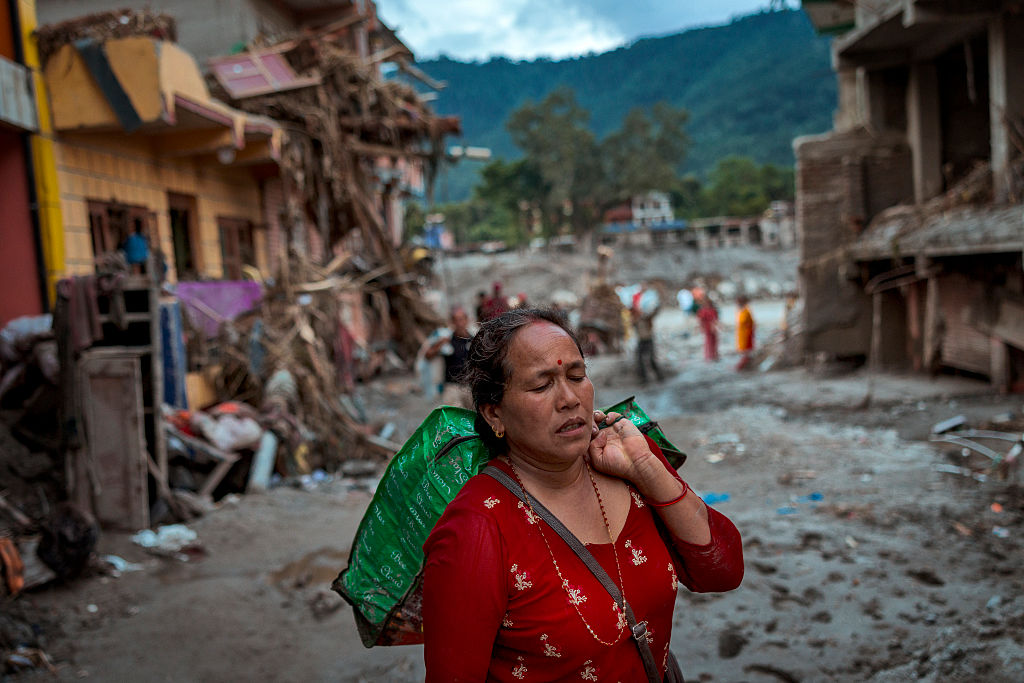
While board members were united in approving the $20 million, plus $1.6 million of administrative costs, representatives of developed and developed countries were divided over the extent to which the decision should set a precedent for the fund’s long-term way of operating.
Germany and Czechia’s board members said it should not set a “precedent” while Japan’s representative said the decision is “truly exceptional” and that the fund’s support must be “in accordance with established rule and procedure”.
Learning the lessons?
Responding, Pakistan’s Ali Sheikh said the lessons from the Nepal case should “feed the long-term model and its work on rapid disbursement” of funds.
He added that he had heard Jan Dusik, Czechia’s board member saying that “we are open for learning but not in setting precedent”. “Please do not define the boundaries for learning,” he emphasised.
Sheikh complained that the decision approved by the board – the result of negotiations between a group of four developed and four developing-country representatives – was narrower than developing countries had hoped for.
“We are saying it is a one-time and Nepal-only window, a sentiment against which many developed countries have raised their voice,” he said, adding there had been no time to review the decision.
Walter Schuldt from Ecuador echoed Sheikh, saying “we should not put limits on lesson learning”. He said the decision, which he was involved in negotiating through “intense exchanges”, tells the fund’s staff to assess the lessons learned.
The fund is currently in a start-up phase and the board will debate its long-term model – including whether and how to rapidly disburse funds in response to climate-driven disasters – at its next board meeting in the Philippines in Decem