

Six months after a landmark treaty to protect the high seas entered into force in January, a group of West African nations is calling for the Eastern Atlantic to be included in the first wave of marine protected areas established under the agreement.
The area known as the Convergence Zone of the Canary and Guinea Currents stretches from Cape Verde and Senegal in the north, to Nigeria and São Tomé and Príncipe in the south, forming a key migration corridor and nursery for hundreds of marine species.
At the 11th Our Ocean Conference in the Kenyan coastal resort of Mombasa this week, Senegalese Minister of the Environment and Ecological Transition Aliou Gori Diouf said this new marine protected area would contribute to a global goal to protect at least 30% of the planet’s ecosystems by 2030.
“West Africa is asserting its leadership by demonstrating that ocean protection and sustainable
development go hand in hand,” Diouf said in a statement.
-
Offshore oil and gas expansion threatens key marine ecosystems, report warns
Sea life in countries like Kenya is under threat from planned new oil and gas production, analysis by environmental groups has found -
Coral reefs are not doomed – but policy must catch up with the science
A new study shows some reefs still have a meaningful chance to survive and recover from climate impacts – provided they are protected


To complement the push, the governments of The Gambia, Mauritania, Guinea Bissau and Senegal announced the creation of a joint regional marine protected area (MPA) “to preserve the resources essential to the livelihood” of their communities.
They added that the regional initiative will require global collaboration, as the countries face “massive challenges” from ocean heating as well as illegal fishing and marine pollution “leading to a reduction in biodiversity and lower economic opportunities for fishing-dependent communities”.
The High Seas Treaty – known formally as the agreement on Biodiversity Beyond National Jurisdiction (BBNJ) – entered into force this January just two years after its signing. So far, 90 countries have ratified it, and it is set to host its first conference of the parties (COP) in January 2027 in New York.
Warming threat
The ocean has absorbed 90% of the excess heat trapped in the Earth’s atmosphere, and is a massive carbon sink, trapping 30% of global carbon dioxide emissions. Yet despite covering nearly half of the planet’s surface, only 1% of the high seas are fully protected.
Unless this is stepped up, scientists warn that rapid ocean heating could threaten key species and ecosystems, as well as the communities that depend on them. One 2025 study estimated that fish levels have fallen by 7.2% for every tenth of a degree of global warming.
Big fishing nations secure last-minute seat to write rules on deep sea conservation
Speaking at a plenary in Mombasa, Rebecca Hubbard, director of the advocacy group High Seas Alliance, said governments face the challenge of turning “this promise into real action in the water”.
“It is now urgent for governments to work together to propose the first set of high-seas marine protected areas. This is the only way we can achieve 30% protection of our ocean by 2030. We need the high seas,” said the conservation scientist.
Scientific body to review proposals
Olivier Poivre d’Arvor, France’s special envoy for last year’s UN ocean conference, told the Mombasa gathering that the oceans COP1 will be a “powerful symbol”, as it will be the first major conference opened by the yet-to-be-elected new UN secretary-general.
Other areas under consideration for the first generation of high-seas MPAs include the Salas y Gómez and Nazca ridges – an underwater mountain range rich stretching 3,000 km off the coast of Chile in the South Pacific, the “thermal dome” off the coast of Costa Rica in the Central Pacific, and the Walvis ridge near Namibia in the Southern Atlantic.
Chile and Costa Rica have also announced plans to propose these protected areas in the lead-up to the first High Seas Treaty summit. Before selecting the first conservation areas, governments at the BBNJ meeting must establish a scientific body to review the proposals.
Currently, the only MPA in the high seas is the South Orkney Islands in Antarctica, created in 2009 and managed by the Commission for the Conservation of Antarctic Marine Living Resources.
The post West African nations target Eastern Atlantic for early high seas protection appeared first on Climate Home News.
West African nations target Eastern Atlantic for early high seas protection

For the first time, new-energy vehicles (NEVs) made up 67% of new car sales in China in September, according to the latest data from the China Passenger Car Association (CPCA).
The figures show that NEVs, which include battery electric cars and plug-in hybrids, captured a record share of sales, even though fewer were sold than last year.
This is because sales of combustion-engine cars are falling steeply, a trend that the CPCA has attributed to rising petrol prices following the start of the Hormuz crisis.
Indeed, sales of fuel-only cars were down 31% year-on-year in the first nine months of 2026, with plug-in hybrid sales down 26% – whereas battery EV sales were only down 4%.
One analyst tells Carbon Brief that China’s rapidly growing EV fleet has offset demand for 143m barrels of oil since the start of the Hormuz crisis.
Another says that the crisis is “reinforcing China’s electrification of road transport”.
Meanwhile, amid slowing domestic sales, Chinese carmakers’ exports of NEVs more than doubled [in 2026 to date / in September] from a year earlier.
NEV record
A record two out of every three cars sold in September in China were NEVs, according to CPCA data, as shown in the figure below.
(NEVs predominantly include battery electric vehicles – BEVs – and plug-in hybrids – PHEVs. BEVs only run on electricity, whereas PHEVs also have a combustion engine.)
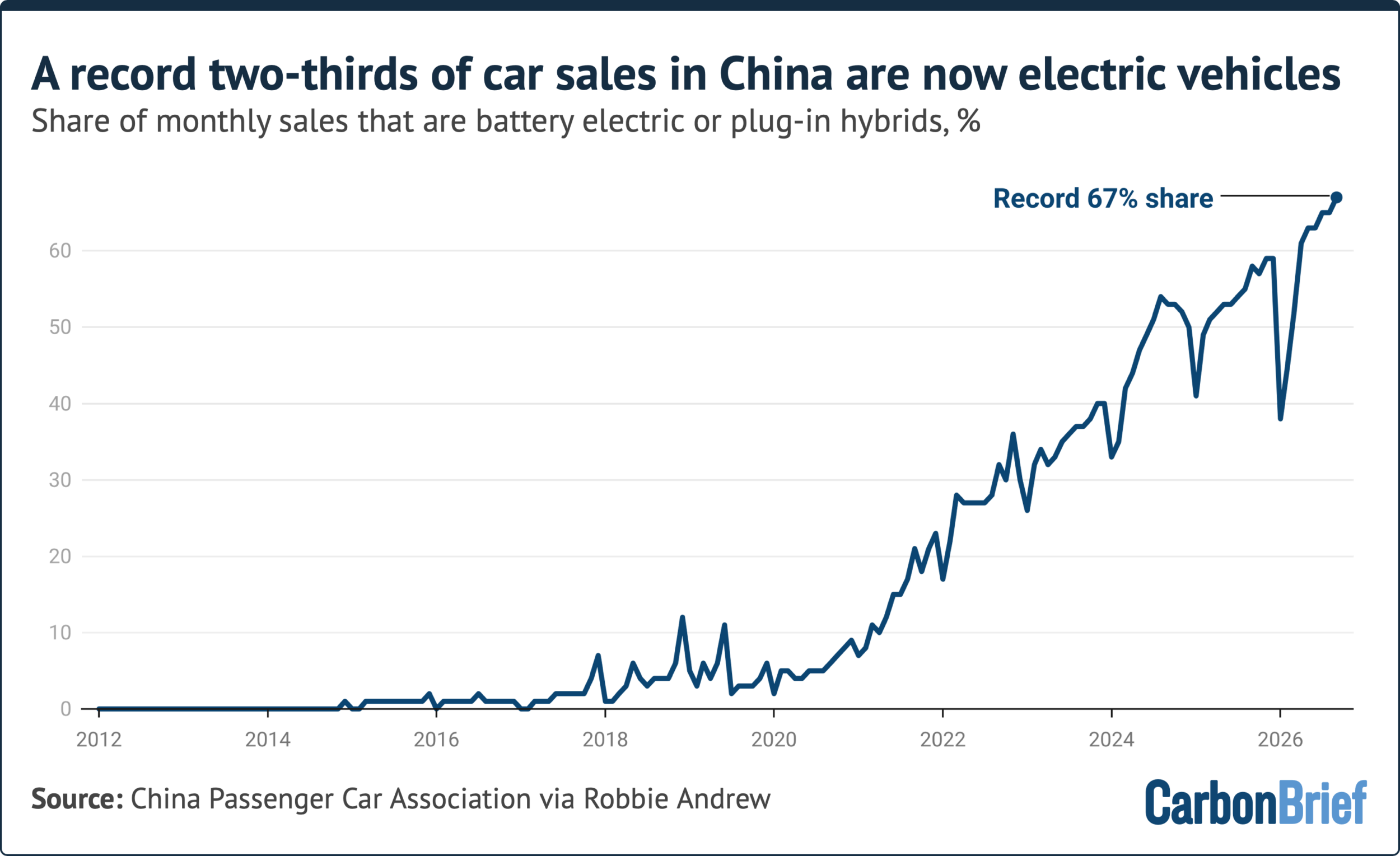
This marks a rapid rise for NEVs from just 6% of new car sales in 2020 up to 58% in 2026 to date – and a record 67% in the month of September.
This year, NEVs’ share of sales has also bounced back from a low of 39% in January, after the full purchase tax exemption that had been in place for more than a decade came to an end in December 2025.
The gain in NEV share in 2026 has come amid a slowdown across the wider domestic passenger-car market, which has hit sales of combustion-engine vehicles particularly hard.
This September, passenger-car retail sales across all categories declined, with overall sales volumes falling 28% year-on-year.
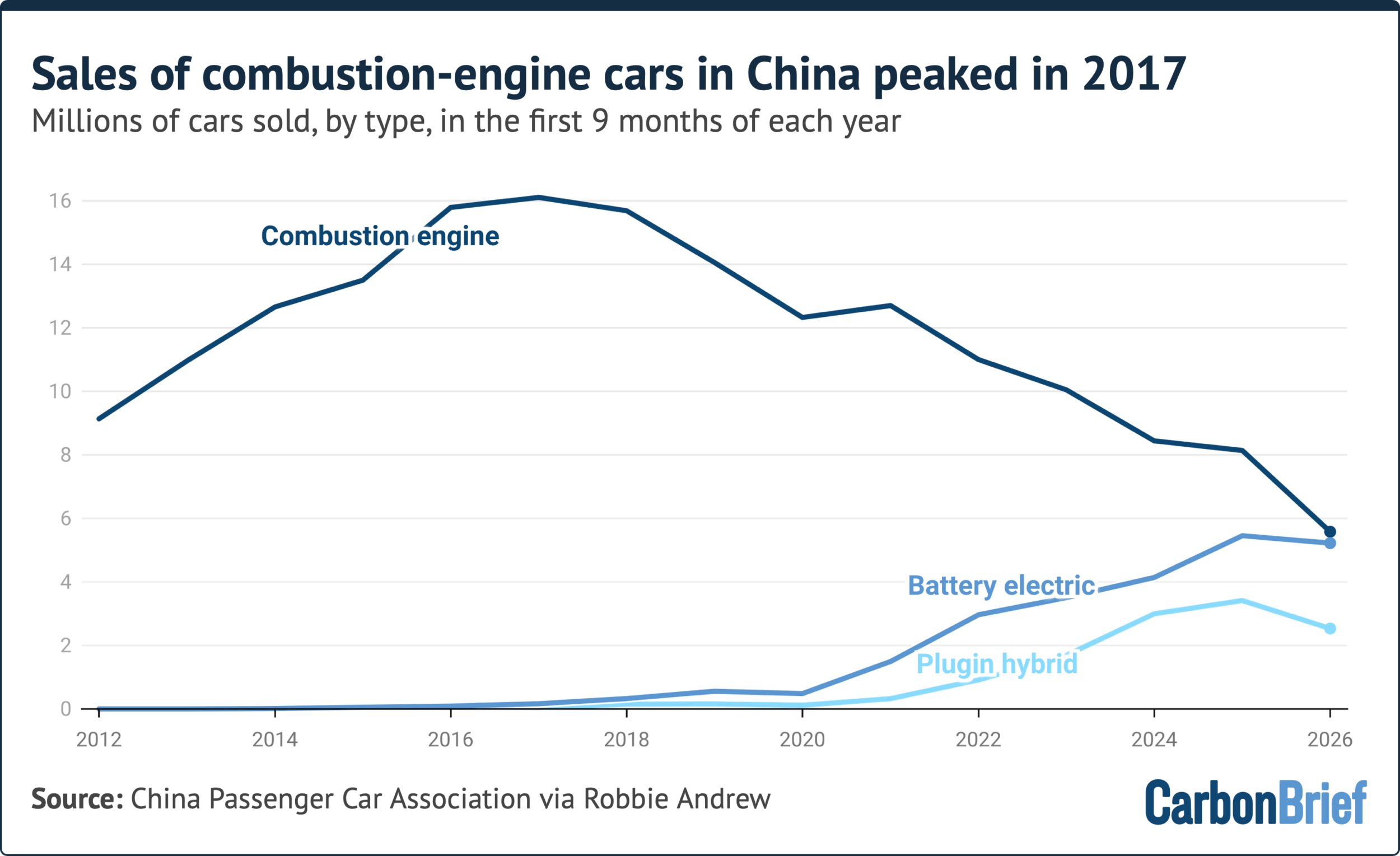
The contraction was led by combustion-engine vehicles, which saw sales fall 43% year-on-year in September and 31% in 2026 to date.
However, sales of PHEVs also fell by 36% year-on-year in September and by 26% in 2026 to date. By comparison, BEVs performed better, although sales still declined 8.5% from a year earlier in September and 4% in 2026 to date.
As a result, NEV sales overall fell by 17% in September and 13% in 2026 to date.
While the market changes in 2026 to date were particularly dramatic, they reflect a broad continuation of trends seen over the past decade.
Indeed, sales of combustion-engine cars in China peaked in 2017 and they have been declining ever since, shown in the figure below.
Impact of Hormuz
Part of the reason for the advance of NEVs in 2026, said Chinese technology news outlet OFweek, was petrol cars “giving up market share” as they were outperformed by electric alternatives.
Cui Dongshu, secretary-general of the CPCA, cited higher petrol prices as an explanation for September’s weak combustion-car sales, in comments to financial news outlet National Business Daily.
Imports of oil into China in January-September have fallen 15% compared to 2025, equivalent to 470m barrels, as ongoing conflict tightened supply and drove up prices.
China’s passenger-car NEV fleet has displaced 143m barrels of oil so far during the strait of Hormuz crisis, Euan Graham, senior energy analyst at thinktank Ember, tells Carbon Brief.
EVs “accounted for 12% of the decrease in China’s oil use post-Hormuz”, according to an estimate provided to thinktank the Brookings Institute by an unnamed analyst.
Erica Downs, a senior research scholar at Columbia University’s Center on Global Energy Policy, tells Carbon Brief that the strait of Hormuz crisis and higher oil prices are “reinforcing China’s electrification of road transport”.
She says the “world’s largest oil supply disruption” vindicates China’s early bet on EVs, which was partly driven by concerns about oil-supply security.
NEV demand down
Nevertheless, NEV sales have fallen year-on-year, albeit at a slower rate than overall car sales. The growth in NEV market share has also been decelerating.
Zhang Yichao, a partner at consulting firm AlixPartners, tells Carbon Brief that NEVs benefit from government trade-in policies and a “strong pipeline” of new models, particularly those involving innovation.
He says these factors help explain why NEVs sales have fallen at a slower rate to their combustion-car counterparts.
Cui told the state-run China National Radio that the fall for NEVs and for cars overall in September 2026, is also due to a high baseline of sales from the same month in 2025, as well as changes to trade-in policies and disruptions from the holiday period.
Other factors, says consulting firm Wood Mackenzie, are the weakened demand due to “demand pull-forward” in 2025 caused by the end of subsidies, as well as “tighter financing conditions”.
Zhang tells Carbon Brief he does not “see much more room ahead” for further growth in NEVs’ market share.
He adds that, in his view, their share in China is unlikely to exceed 80%, as some premium-market segments and specific use cases will continue to require combustion-engine vehicles.
Exports surge
Meanwhile, while domestic NEV retail sales fell 17% in September 2026, exports more than doubled, increasing 164% year-on-year, according to the CPCA.
This extends the decline in domestic sales and very strong growth in exports seen across 2026 to date, as shown in the figure below.
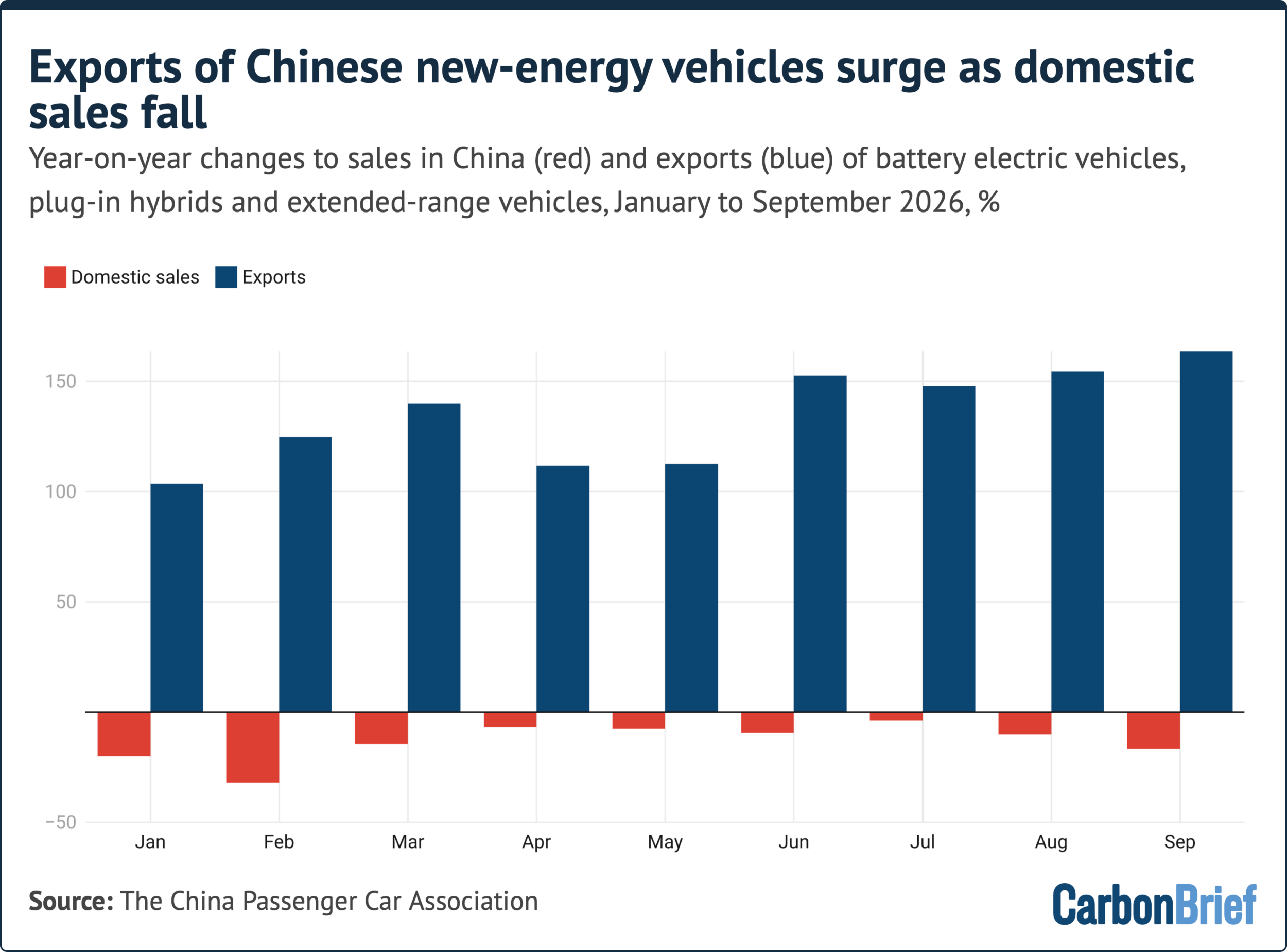
In September, 1,084,000 NEVs were sold domestically in China, while 558,000 NEVs were exported.
Exports are becoming increasingly important to Chinese carmakers, in the face of weaker domestic demand and cut-throat industrial competition.
The CPCA says exports have become “a core priority” for some carmakers.
However, the surge in exports from China has created concern in the EU, which has placed tariffs on imports of EVs from China and recently agreed plans to cut imports of hybrids.