
Connect with us

Published

on

In today’s dynamic manufacturing world, energy is more than just a utility; it’s the spark that keeps production running. Industrial facilities, powered by massive engines and heavy machinery, often operate 24/7, driving output but also consuming enormous amounts of electricity.

The issues? Soaring energy costs and a growing environmental footprint.

Sometimes it’s like a cycle that often feels impossible to break, but what if your facility could draw energy from a cleaner, more reliable, and cost-effective energy source?

Yes, you heard it right, and that’s where solar power comes in!

As electricity prices continue to rise and corporate sustainability goals become more pressing, manufacturers are rethinking how they power their commercial operations.

Therefore, solar energy is emerging as a game-changing solution, offering reliability, long-term savings, and a sustainable path forward for the Australian manufacturing industry.

In this blog, we’ll explore how manufacturers are successfully implementing solar power, featuring real-world case studies from Cyanergy that highlight both the business advantages and environmental impact.

So, let’s explore how solar energy can help your manufacturing facility reduce costs and enhance efficiency, achieving long-term sustainability.

Why Solar Energy Is Essential for Modern Manufacturing Facilities?

In Australia, manufacturing facilities typically have large roof or yard footprints, significant and relatively
stable electrical loads, including lighting, motors, HVAC, and other machinery. So, the energy used every day is
enormous.

By harnessing the sun’s energy, factories can significantly cut operating
costs
, reduce carbon emissions, and gain greater control over long-term energy stability.

Beyond the environmental benefits, solar power also strengthens a company’s competitive edge and brand reputation in
an increasingly eco-conscious market.

Here we’ve penned down the importance of solar power in the manufacturing industry:

  1. Energy cost mitigation 
  2. So, how solar energy reduces manufacturing costs in Australia?

    With electricity prices rising and energy market volatility increasing, incorporating solar energy offers a
    way to
    reduce grid dependency and lower utility costs in the long term.

  3. Ensure Operational Continuity & Resilience
  4. Solar panel systems, when paired
    with
    battery storage, can help smooth peak energy demand, reduce grid dependence, and improve functioning
    time.

  5. Promote Sustainability and Brand Value
  6. In larger industries, many manufacturers are under pressure from customers, regulators, investors, and
    internal
    stakeholders to reduce
    their carbon footprint
    .

    Solar helps them to achieve energy freedom, powering businesses with a sustainable energy source.

  7. Increase Asset value & ROI
  8. Solar systems, when sized appropriately and properly optimised, can deliver payback in a few years and
    continue to
    provide savings thereafter.

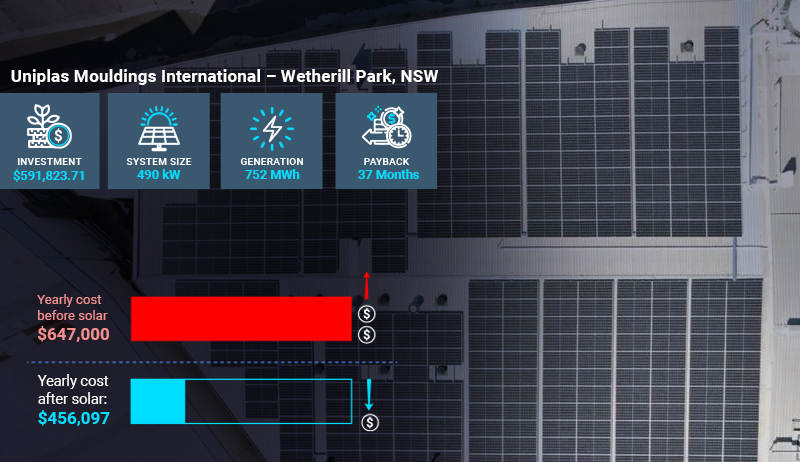
According to Cyanergy’s capability statement, we delivered a 490
kW system
that generated 752 MWh for a manufacturing client, with a 37-month payback period.

This shows that industrial-scale solar can deliver real, practical results for manufacturers.

Now, let’s examine solar power solutions for manufacturing facilities, case studies, and best practices to ensure a
clear understanding.

Case Studies from Cyanergy: Real-World Manufacturing Success in Australia!

In this part of the blog, we have selected three examples from Cyanergy to illustrate how manufacturing facilities are utilising solar energy.

These are not generic installations; these are production-oriented businesses taking real steps across different states of Australia.

1. Uniplas Mouldings International – Wetherill Park, NSW

Project Overview

  • System size: 490 kW solar system installed in staged phases
  • Investment: AUD $591,823.71.
  • Annual generation: 752 MWh
  • Yearly energy costs before solar: approximately $647,000.
  • After solar: $456K, which is approximately 55% of the previous
  • Payback period: 37 months

Why it matters

For Uniplas, a large industrial manufacturer, the solar system not only significantly reduces their operating energy
costs, but the payback of just over 3 years means that the return on investment is also attractive for the
business.

The staged approach also allowed them to access multiple subsidies and implement the project rapidly; for example,
the first stage of 200 kW was completed in four weeks.

This clearly shows how manufacturing operations can incorporate
solar
without any significant disruption.

2. AC Laser – Thomastown, VIC

Project Overview

  • System size: 99.45 kW
  • Annual generation: 141.75 MWh
  • Annual electricity cost before solar: $79,000.
  • After solar: $38,160, a reduction of more than 50%
  • Payback period: 26 months

Why it matters

This is a smaller-scale manufacturing facility compared to Uniplas, yet the results are impressive: a more than 50%
cost reduction and a shorter payback period.

This shows that not only large-scale commercial properties but also mid-sized manufacturing operations can benefit
from solar, not just large ones.

Insights Gained from the Case

  • Don’t wait until your business is huge, as size is scalable.
  • The solar system’s size aligned well with the manufacturing load, saving thousands of dollars.
  • Rapid ROI shows manufacturing facilities can justify solar as a capital investment for their business.

3. Specialised (Cycling-Industry manufacturer) – Port Melbourne, VIC

Project Overview

  • System size: 39.6 kW
  • Annual generation: 47.32 MWh
  • Electricity cost before solar: $26,720; after solar: $17,770
  • Payback period: 45 months

Why it matters

Although smaller, this project depicts that solar energy is a viable option for manufacturing across various sizes
and sectors, even in facilities with a relatively small carbon footprint.

The case emphasises sustainability as a business value and how solar can support brand positioning as well as cost
savings.

Major Takeaways

  • Solar supports both cost and branding sustainability
    goals
    .

  • Even medium-sized systems can provide meaningful savings.
  • The ROI
    generated
    must be viewed in terms of both financial and reputational benefits for any
    business, whether it’s large or small.

Is Now the Right Time for Manufacturers to Transition to Solar Energy?

After knowing the numerous benefits of solar solutions, you may be tempted to go solar. However, transitioning from
traditional energy sources to solar energy comes with a cost. 

From government
incentives
to long-term cost savings, the financial case for solar energy is compelling.

Still wondering, is it time for businesses to go solar? Here’s why you should act now:

  • Electricity prices continue to rise in many markets, strengthening the return on investment for solar
    energy.

  • Many governments and utilities offer incentives, favourable tariffs, or rebates
    for industrial solar projects.

  • Day by day, the pressure for sustainability reporting and corporate social responsibility (CSR) is
    intensifying. Manufacturing facilities with high energy loads are often subject to inspection.

  • Technology costs have fallen recently, making solar panels and inverters
    more affordable than ever and reducing payback time.

  • With the right sizing and execution, the solar system becomes a long-term asset that pays for itself,
    releasing capital for other manufacturing investments.

Best Practices for Manufacturing Facilities Considering Solar

Solar can be a powerful game-changer for manufacturing companies and large commercial buildings when implemented correctly.

But that doesn’t mean it’s as easy as flipping the switch.

Therefore, before investing in Solar power, ensure you understand every step that leads to real savings and sustainable success for your business.

1. Conduct a detailed energy assessment & align solar to load

Before installation, it is essential to understand your manufacturing facility’s energy usage patterns, including the peak usage limit, daily load curves, and seasonal variations.

The better the match between system size, orientation, and actual usage, the higher the yield and the quicker the payback.

At Cyanergy, we provide a customised design based on site analysis.

2. Use staging or modular deployment

If you have a large manufacturing site, you may benefit from staging the solar solution in phases.

For example, in Uniplas’s case, the installation was divided into three stages. This enables access to multiple subsidies, enhances cash flow, and mitigates the risk of disruption.

3. Optimise your system size & measure consumption rate

Over-sizing or under-sizing can both cause significant loss in a business. Therefore, the design should minimise waste and maximise the use of solar energy on-site.

As in AC Laser’s mid-sized facility, a 99 kW system fits their load and delivers huge savings.

4. Check your rooftop or plant infrastructure

Is your rooftop compatible with solar panel installation?

For manufacturing facilities, factors such as roof strength, shading, orientation, structural constraints, and maintenance access are crucial.

Ensure the facility can support panels, inverters, wiring, and monitoring systems without compromising building aesthetics.

5. Perform regular monitoring & performance tracking

Everything requires a certain amount of care and maintenance to function properly over time. The story is the same for a solar panel system.

Real-time monitoring allows you to spot performance issues, shading effects, degradation, and inverter downtime.

Cyanergy emphasises continuous monitoring post-installation.

6. Research on financial modelling & payback analysis

When going for solar, always calculate realistic payback periods, ensure system cost fits within capital budgets,

You should also check the available incentives, tax benefits, payback time, and how to stack several rebates for maximum savings.

For example, many Cyanergy projects offer a 2–4 year payback, with several solar rebates that can be combined with the VEU Rebate.

7. Align with sustainability and your brand strategy

In manufacturing factories, incorporating solar energy can be a substantial component of a broader sustainability strategy. Why?

Solar reduces your dependency on harmful fossil fuels, cutting greenhouse gas emissions.

It positions your brand and promotes your business, demonstrating corporate responsibility and improving stakeholder perception.

8. Maintenance & lifecycle planning

Solar systems require periodic maintenance, inverter replacements, cleaning, and monitoring.

So, manufacturing facilities should incorporate service arrangements into their design. Plan for system longevity, degradation, and eventual replacement or upgrade to ensure optimal performance.

9. Consider adding Battery storage

Even though optional, integrating battery storage or demand management can enhance value by enabling peak shaving, reducing demand charges, and storing excess energy for nighttime use or during grid outages.

10. Engage stakeholders and minimise disruption

In manufacturing, you can’t easily stop production. Plan your solar installation during low-production periods, coordinate with your team, and prioritise safety to minimise downtime.

Final Notes: Ready To Take The Next Step?

For manufacturing facilities, solar power isn’t just about being eco-friendly; it’s a smart business move for Australians. Cyanergy’s case studies showed that even large manufacturers can achieve paybacks of 2–4 years, reduce costs, lower emissions, and enhance brand value.

With proper planning, energy assessment, correct system sizing, phased installation, and active monitoring, solar can deliver lasting benefits.

So, if rising energy bills or sustainability goals are on your radar, it’s time to view solar energy as an innovative manufacturing solution, apart from just a renewable energy source.

Reach out to Cyanergy, conduct an energy audit, and engage a solar specialist with manufacturing experience today. Cyanergy is here to help!

Your Solution Is Just a Click Away

The post Understanding Commercial Heat Pump Warranties with Cyanergy  appeared first on Cyanergy.

Understanding Commercial Heat Pump Warranties with Cyanergy 

Continue Reading

Renewable Energy

Court Keeps GE on Vineyard Wind, France Plans Huge Wind Farm

Published

on

Weather Guard Lightning Tech

Court Keeps GE on Vineyard Wind, France Plans Huge Wind Farm

Allen covers GE Vernova ordered to stay on Vineyard Wind, TotalEnergies filing for France’s largest renewable project, Spain’s repowering grants, and Dajin’s Hong Kong stock debut.

Sign up now for Uptime Tech News, our weekly newsletter on all things wind technology. This episode is sponsored by Weather Guard Lightning Tech. Learn more about Weather Guard’s StrikeTape Wind Turbine LPS retrofit. Follow the show on YouTubeLinkedin and visit Weather Guard on the web. And subscribe to Rosemary’s “Engineering with Rosie” YouTube channel here. Have a question we can answer on the show? Email us!

Good Monday.

Wind energy made news this week from Boston courtrooms…

to the coast of Normandy …

to the stock exchange floors of Hong Kong.

Let us start in Massachusetts.

A Boston judge has once again told GE VERNOVA it cannot walk away from VINEYARD WIND.

To understand why GE VERNOVA wants out…

you have to look at the money.

VINEYARD WIND owes GE VERNOVA three hundred and sixty million dollars

on a one-point-two-billion-dollar turbine supply contract.

VINEYARD WIND is withholding that payment.

GE VERNOVA says it has the contractual right to walk when it is not paid.

In February, they sent VINEYARD WIND a termination notice.

VINEYARD WIND sued.

In April, Judge PETER KRUPP issued an injunction ordering GE to stay.

GE VERNOVA came back and asked the judge to reconsider.

Vernova pointed to statements from state officials and VINEYARD WIND’s own parent company describing the eight-hundred-and-six-megawatt project as essentially complete.

If the project is done, GE argued, there is no harm in letting us leave.

Judge KRUPP did not buy it.

Here is why this matters so much to the Commonwealth of Massachusetts.

VINEYARD WIND is the largest offshore wind project in New England.

It is owned jointly by Spain’s IBERDROLA

and Denmark’s COPENHAGEN INFRASTRUCTURE PARTNERS.

It began initial operations just this past February…

after the developer won a separate court fight to keep federal construction permits intact.

Sixty-two turbines.

A four-point-five-billion-dollar investment.

The anchor project for offshore wind in the entire region.

The judge found that GE VERNOVA’s proprietary expertise

is still needed to bring those turbines to full operational capacity.

Pull GE’s more than two hundred employees and subcontractors off the job…

and the project’s financing structure could collapse.

Massachusetts Governor MAURA HEALEY has weighed in publicly.

The state has too much riding on this project to let it unravel in court.

GE VERNOVA still has its appeal of the April injunction pending.

But for now… the turbines keep turning.

Now let us cross the Atlantic.

Off the coast of Normandy, France…

TOTALENERGIES has filed for government authorization

of a massive offshore wind farm called CENTRE MANCHE ENERGIES.

This will be France’s largest renewable energy project… ever.

One-point-five gigawatts of offshore wind.

Located more than forty kilometers off the Normandy coast.

Four-point-five billion euros in investment.

Up to twenty-five hundred construction jobs over three years.

Once running, the wind farm will generate

roughly six terawatt-hours of clean electricity per year…

enough to power more than one million French homes.

TOTALENERGIES was awarded this project by the French government

eight months ago.

Filing for authorization is the next milestone on the path to construction.

Meanwhile… across the Pyrenees in Spain…

The Spanish government has awarded grants for eighty wind repowering projects

totaling two-point-four gigawatts of capacity.

With Nearly four hundred and sixty million euros in subsidies.

The goal: replace older turbines with more efficient technology by twenty-thirty.

The names on the award list read like a who’s who of European wind energy.

IBERDROLA… STATKRAFT… EDP…

ENEL GREEN POWER… NATURGY…

RWE … and others.

IBERDROLA alone picked up four hundred megawatts of new capacity.

And this repowering wave is not just replacing old machines.

Some projects are swapping out turbines that were once the industry standard…

one-point-five and two-megawatt machines…

for the far more powerful equipment available today.

The industry is not just building forward.

It is rebuilding smarter.

And finally… a story from the other side of the world.

A Chinese manufacturer of offshore wind foundations and towers

called DAJIN HEAVY INDUSTRY

made its debut on the Hong Kong Stock Exchange this past Friday.

The share sale raised up to eight hundred and forty-seven million dollars.

DAJIN claims a notable distinction:

it says it ranked as Europe’s largest offshore wind foundation supplier

by monopile sales value in the first half of twenty twenty-five.

The company plans to use more than half the proceeds

to expand its deep-sea wind power services…

and one-fifth to build an assembly facility in Europe.

As we know wind energy is continues to push forward.

On every front.

And that is the state of the wind industry for the eighth of June, twenty twenty-six.

Join us for the Uptime Wind Energy Podcast.

Court Keeps GE on Vineyard Wind, France Plans Huge Wind Farm

Continue Reading

Renewable Energy

Is There a Line that Trump Cannot Cross? — “Your Elections Are Rigged!!”

Published

on

When Trump comes after a TV journalist with psychotic aggression like this, the world wants to know how far his criminal insanity can go without someone putting a stop to it.

It may be true that his approval ratings have ceased to matter to him personally, but don’t they matter to Republicans in congress?  Don’t their constituents, even the complete idiots, have some sort of limit?

Is There a Line that Trump Cannot Cross? — “Your Elections Are Rigged!!”

Continue Reading

Renewable Energy

Trump on Domestic Issues

Published

on

Oh. Well, if a professional liar says that something about Trump is “an objective fact,” I guess it must be true.

lol

Trump on Domestic Issues

Continue Reading

Trending

Copyright © 2022 BreakingClimateChange.com