Solar can be a powerful game-changer for manufacturing companies and large commercial buildings when implemented correctly.
But that doesn’t mean it’s as easy as flipping the switch.
Therefore, before investing in Solar power, ensure you understand every step that leads to real savings and sustainable success for your business.
1. Conduct a detailed energy assessment & align solar to load
Before installation, it is essential to understand your manufacturing facility’s energy usage patterns, including the peak usage limit, daily load curves, and seasonal variations.
The better the match between system size, orientation, and actual usage, the higher the yield and the quicker the payback.
At Cyanergy, we provide a customised design based on site analysis.
2. Use staging or modular deployment
If you have a large manufacturing site, you may benefit from staging the solar solution in phases.
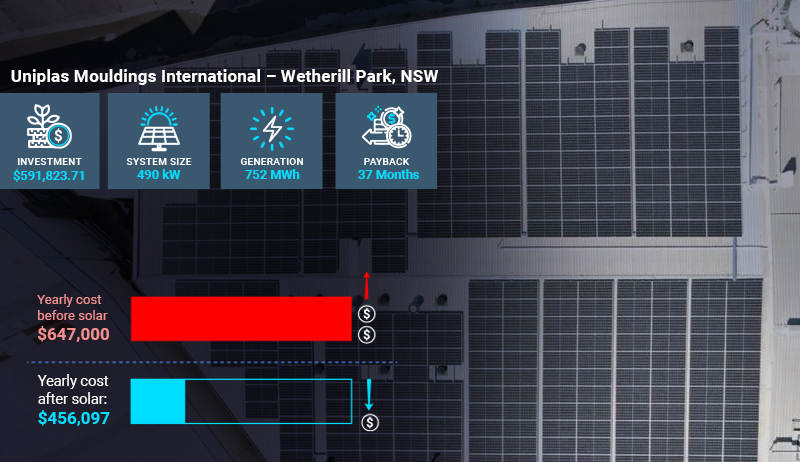
For example, in Uniplas’s case, the installation was divided into three stages. This enables access to multiple subsidies, enhances cash flow, and mitigates the risk of disruption.
3. Optimise your system size & measure consumption rate
Over-sizing or under-sizing can both cause significant loss in a business. Therefore, the design should minimise waste and maximise the use of solar energy on-site.
As in AC Laser’s mid-sized facility, a 99 kW system fits their load and delivers huge savings.
4. Check your rooftop or plant infrastructure
Is your rooftop compatible with solar panel installation?
For manufacturing facilities, factors such as roof strength, shading, orientation, structural constraints, and maintenance access are crucial.
Ensure the facility can support panels, inverters, wiring, and monitoring systems without compromising building aesthetics.
5. Perform regular monitoring & performance tracking
Everything requires a certain amount of care and maintenance to function properly over time. The story is the same for a solar panel system.
Real-time monitoring allows you to spot performance issues, shading effects, degradation, and inverter downtime.
Cyanergy emphasises continuous monitoring post-installation.
6. Research on financial modelling & payback analysis
When going for solar, always calculate realistic payback periods, ensure system cost fits within capital budgets,
You should also check the available incentives, tax benefits, payback time, and how to stack several rebates for maximum savings.
For example, many Cyanergy projects offer a 2–4 year payback, with several solar rebates that can be combined with the VEU Rebate.
7. Align with sustainability and your brand strategy
In manufacturing factories, incorporating solar energy can be a substantial component of a broader sustainability strategy. Why?
Solar reduces your dependency on harmful fossil fuels, cutting greenhouse gas emissions.
It positions your brand and promotes your business, demonstrating corporate responsibility and improving stakeholder perception.
8. Maintenance & lifecycle planning
Solar systems require periodic maintenance, inverter replacements, cleaning, and monitoring.
So, manufacturing facilities should incorporate service arrangements into their design. Plan for system longevity, degradation, and eventual replacement or upgrade to ensure optimal performance.
9. Consider adding Battery storage
Even though optional, integrating battery storage or demand management can enhance value by enabling peak shaving, reducing demand charges, and storing excess energy for nighttime use or during grid outages.
10. Engage stakeholders and minimise disruption
In manufacturing, you can’t easily stop production. Plan your solar installation during low-production periods, coordinate with your team, and prioritise safety to minimise downtime.