

Helen Phillips’ book, ‘Hum’, is set in a dystopian near future, in a city suffering the effects of climate breakdown and with dire air quality. Robots (the Hums) press advertising messages during conversations, meetings and even as they carry out medical procedures.
The Hums are vehicles for these ad messages, which are often for products like cosmetics, sweets or anything that might be relevant during interactions with humans. This advertising is poorly disguised, and merges with sentiments that lean towards concerns of well-being, convincing people how much better off they’ll be if they make a purchase.
While the novel is futuristic, the insidious way advertising permeates daily life is resonant of how adverts show up in our world today. And these ads are directly contributing to the worsening future climate Phillips describes in her book.
-
As fires burn and temperatures soar, it’s time to imagine a world beyond GDP
Environmental destruction, like clear-cutting a forest, can boost gross domestic product but it reduces a country’s real wealth

Already by the summer of 2026, Europe had seen a 57% increase in wildfires in just four years with western Europe recording the hottest ever June and July on record. We’re facing droughts and floods, as well as predicted hikes in food costs or even chronic food shortages – and that’s before the expected additional effects of a strong El Niño later this year.
Frequent flying and bigger burgers
A portion of this climate breakdown is fuelled by over-consumption in richer countries, particularly of products that are high carbon – for which advertising can take some of the blame. Research shows that adverts drive citizens to consume about a third more goods and services in general, over and above what they might have purchased.
Yet despite a clear link between promoting high-carbon behaviours and climate breakdown, little advertising regulation exists in the UK. Take frequent flying for instance, one of the most carbon-intensive activities we can partake in.
EasyJet’s latest ad campaign is called “Drop Everything”. It encourages consumers to book cheap flights departing within the next 48 hours for presumably short or weekend getaways. Rather than promoting a specific destination, “Drop Everything” promotes a mindset that encourages indiscriminate consumption of flying. The ads were shown on billboards with clever creative slogans, as well as on digital media and through influencer campaigns.
Overall, flight numbers are increasing. The UK Civil Aviation Authority reported the highest number of UK passengers in the first quarter of 2026 (more than 61 million, breaking previous records for travel between January and March). It seems we’re still not joining the dots between flying and a worsening climate.
And how about meat consumption? Scientists advocate for less meat-eating, especially beef which has the highest carbon footprint of nearly all foods. Yet adverts from McDonald’s proliferate, helping make it one of the highest-volume sellers of fast-food chain beef burgers. In 2024, the outdoor advertising budget for McDonald’s UK rose to £86 million, an increase of 71% on previous years.

Small share for sustainability
While over half of UK ad professionals feel increasingly queasy about their profession and its effects on the climate crisis, the people running the show – the UK trade bodies – prefer to focus on the growth advertising brings.
In the first three months of 2026, they stated that UK advertising spend increased by 9.3%, reaching a total of £11.7 billion for that quarter, fuelling consumption and market growth.
But how many of those adverts actually promote low carbon goods and services? Kantar’s Sustainable Ads Tracker shows the percentage of ads featuring sustainability messaging in 2026 is around 4.3%. That’s woefully low, and much of this is made up of messaging that promotes recycling.
Additionally, the ad industry continues to happily produce adverts for the large oil and gas corporations that are fuelling climate breakdown. These adverts only narrowly pass the Advertising Standards Authorities’ advertising codes, allowing the continued greenwashing of the world’s most polluting brands.
There is essentially no leadership from the UK trade bodies, likely because they are directly funded by the brands and advertisers themselves. They are essentially ‘ad shushing’ – pushing for indiscriminate growth and directing attention to their sustainability awards, while confusingly denying that adverts drive higher consumption overall.
Let’s ‘un-shush’
Where does this leave us as we are subjected to hundreds, if not thousands, of persuasive advertising messages every day that support high-carbon lifestyles? Most ad professionals are unable to push back against this agenda at work, often due to the threat of job loss. The advertising trade bodies won’t take the lead as they work in service to big brands and advertisers.
NGOs urge Brazil to prevent fossil fuel capture of COP30 climate summit
So, who can push for the changes we need? Members of the public.
Through pressuring our city officials and governments, we can force through restrictions, such as the watershed bans on unhealthy foods on TV before 9pm in the UK. Through supporting the efforts of organisations such as Ad Free Cities and others, we can help achieve bans on outdoor advertising for fossil fuels, aviation, meat and even single-use plastics in cities and regions such as Amsterdam, The Hague, Edinburgh, Florence, Uppsala and many more.
If we’re serious about climate change and stopping big global brands pushing their high-carbon products onto us, then advertising restrictions are one of the best ways to achieve this. If we don’t want a world like the one Phillips describes in her book, we need to make our voices heard above the advertising noise.
The post Pushing the climate crisis: How advertising fuels high-carbon lifestyles appeared first on Climate Home News.
Pushing the climate crisis: How advertising fuels high-carbon lifestyles

For the first time, new-energy vehicles (NEVs) made up 67% of new car sales in China in September, according to the latest data from the China Passenger Car Association (CPCA).
The figures show that NEVs, which include battery electric cars and plug-in hybrids, captured a record share of sales, even though fewer were sold than last year.
This is because sales of combustion-engine cars are falling steeply, a trend that the CPCA has attributed to rising petrol prices following the start of the Hormuz crisis.
Indeed, sales of fuel-only cars were down 31% year-on-year in the first nine months of 2026, with plug-in hybrid sales down 26% – whereas battery EV sales were only down 4%.
One analyst tells Carbon Brief that China’s rapidly growing EV fleet has offset demand for 143m barrels of oil since the start of the Hormuz crisis.
Another says that the crisis is “reinforcing China’s electrification of road transport”.
Meanwhile, amid slowing domestic sales, Chinese carmakers’ exports of NEVs more than doubled [in 2026 to date / in September] from a year earlier.
NEV record
A record two out of every three cars sold in September in China were NEVs, according to CPCA data, as shown in the figure below.
(NEVs predominantly include battery electric vehicles – BEVs – and plug-in hybrids – PHEVs. BEVs only run on electricity, whereas PHEVs also have a combustion engine.)
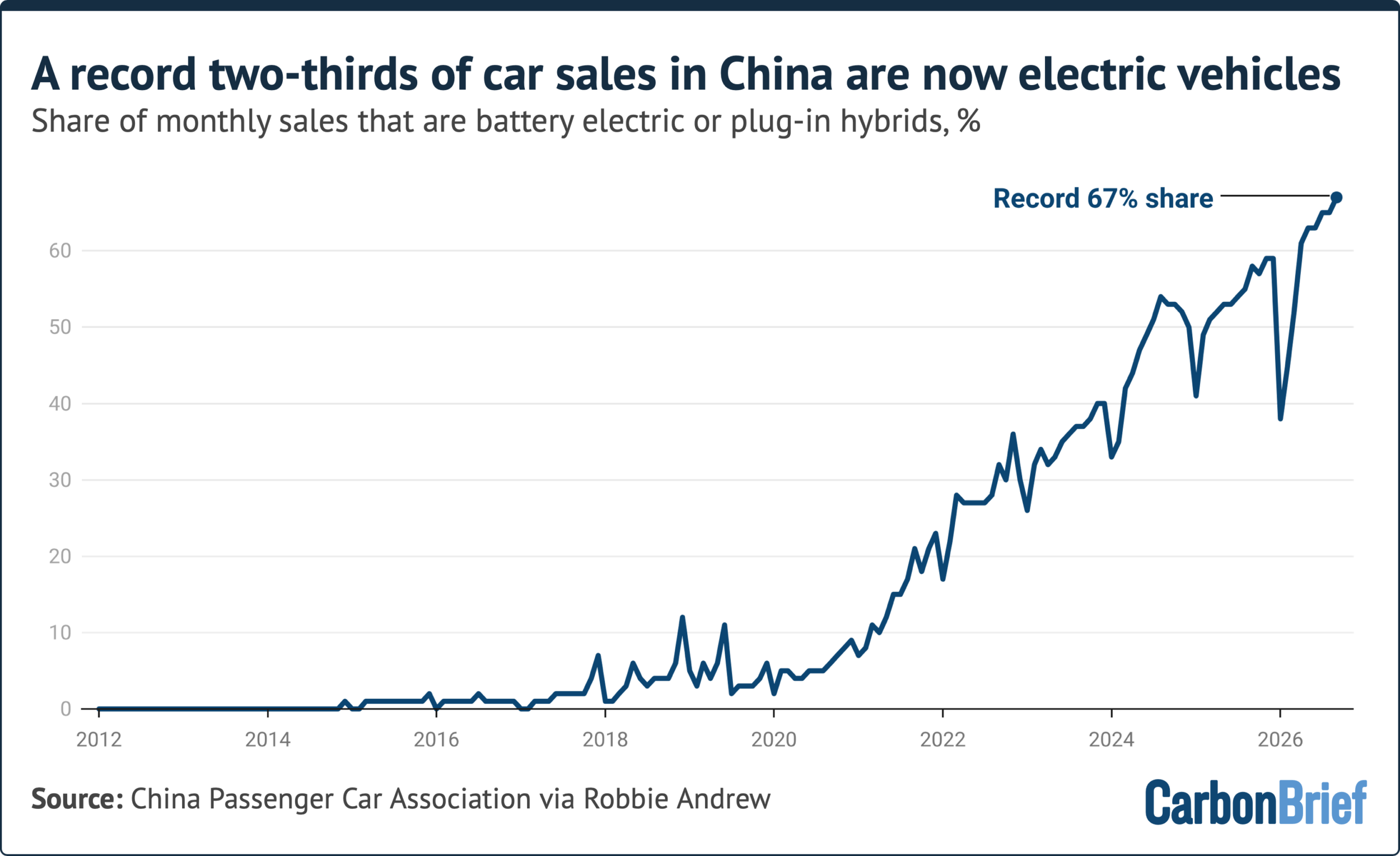
This marks a rapid rise for NEVs from just 6% of new car sales in 2020 up to 58% in 2026 to date – and a record 67% in the month of September.
This year, NEVs’ share of sales has also bounced back from a low of 39% in January, after the full purchase tax exemption that had been in place for more than a decade came to an end in December 2025.
The gain in NEV share in 2026 has come amid a slowdown across the wider domestic passenger-car market, which has hit sales of combustion-engine vehicles particularly hard.
This September, passenger-car retail sales across all categories declined, with overall sales volumes falling 28% year-on-year.
The contraction was led by combustion-engine vehicles, which saw sales fall 43% year-on-year in September and 31% in 2026 to date.
However, sales of PHEVs also fell by 36% year-on-year in September and by 26% in 2026 to date. By comparison, BEVs performed better, although sales still declined 8.5% from a year earlier in September and 4% in 2026 to date.
As a result, NEV sales overall fell by 17% in September and 13% in 2026 to date.
While the market changes in 2026 to date were particularly dramatic, they reflect a broad continuation of trends seen over the past decade.
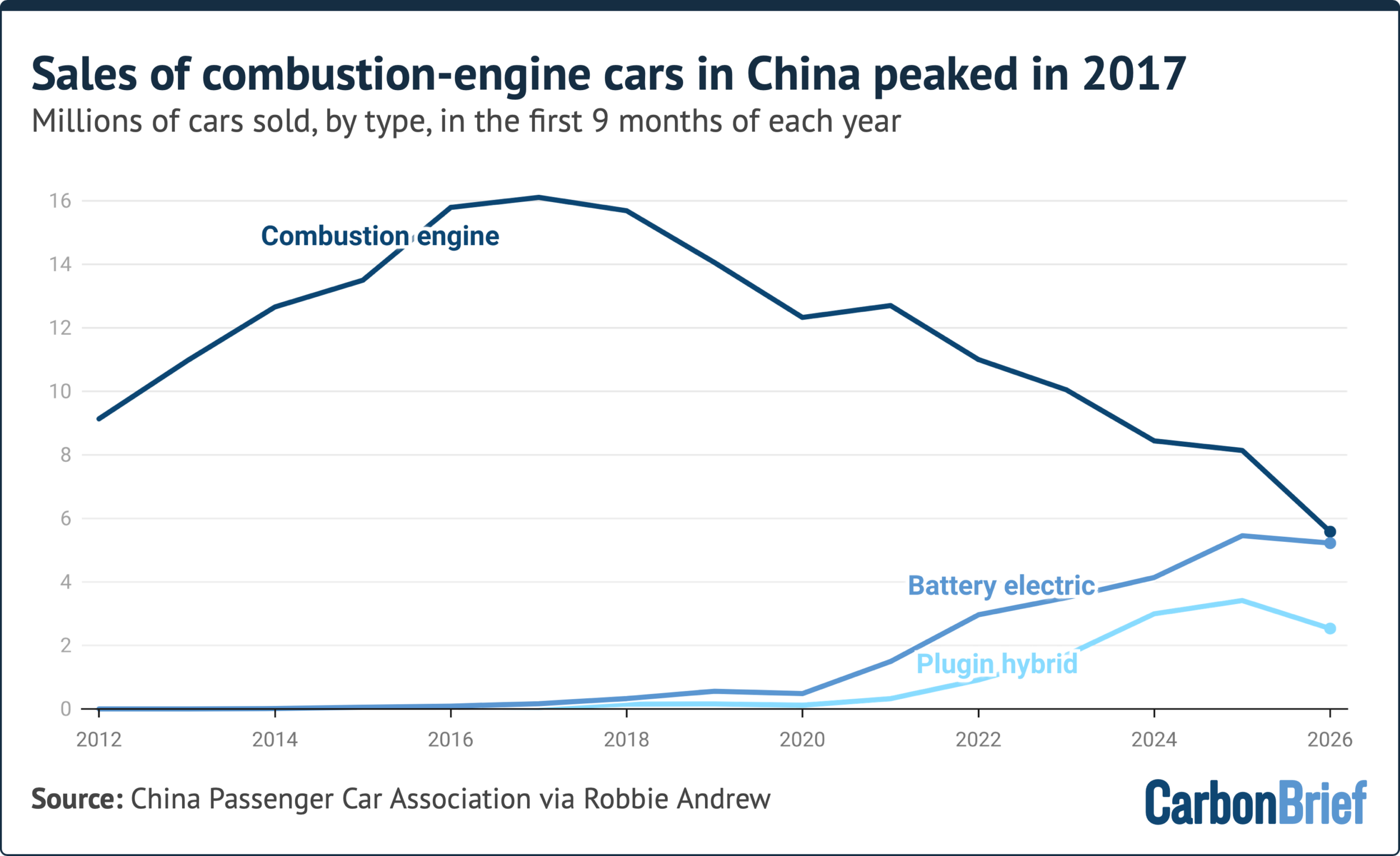
Indeed, sales of combustion-engine cars in China peaked in 2017 and they have been declining ever since, shown in the figure below.
Impact of Hormuz
Part of the reason for the advance of NEVs in 2026, said Chinese technology news outlet OFweek, was petrol cars “giving up market share” as they were outperformed by electric alternatives.
Cui Dongshu, secretary-general of the CPCA, cited higher petrol prices as an explanation for September’s weak combustion-car sales, in comments to financial news outlet National Business Daily.
Imports of oil into China in January-September have fallen 15% compared to 2025, equivalent to 470m barrels, as ongoing conflict tightened supply and drove up prices.
China’s passenger-car NEV fleet has displaced 143m barrels of oil so far during the strait of Hormuz crisis, Euan Graham, senior energy analyst at thinktank Ember, tells Carbon Brief.
EVs “accounted for 12% of the decrease in China’s oil use post-Hormuz”, according to an estimate provided to thinktank the Brookings Institute by an unnamed analyst.
Erica Downs, a senior research scholar at Columbia University’s Center on Global Energy Policy, tells Carbon Brief that the strait of Hormuz crisis and higher oil prices are “reinforcing China’s electrification of road transport”.
She says the “world’s largest oil supply disruption” vindicates China’s early bet on EVs, which was partly driven by concerns about oil-supply security.
NEV demand down
Nevertheless, NEV sales have fallen year-on-year, albeit at a slower rate than overall car sales. The growth in NEV market share has also been decelerating.
Zhang Yichao, a partner at consulting firm AlixPartners, tells Carbon Brief that NEVs benefit from government trade-in policies and a “strong pipeline” of new models, particularly those involving innovation.
He says these factors help explain why NEVs sales have fallen at a slower rate