

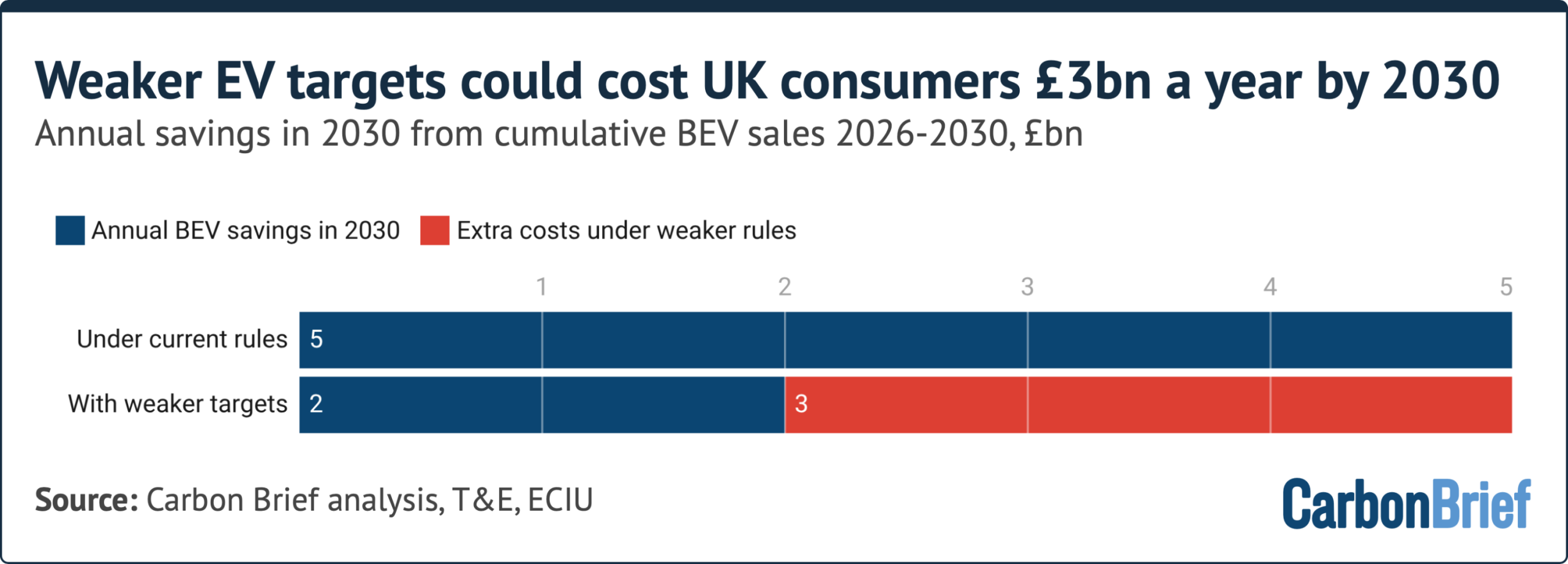
An upcoming UK government consultation on weakening targets for electric vehicles (EVs) could cost consumers as much as £3bn a year by 2030, according to Carbon Brief analysis.
It could require the UK to import an extra 17m barrels of oil in 2030, raising expected net imports by 8%, as well as adding 2.5% to national emissions that year, the analysis shows.
After years of fierce lobbying by parts of the car industry – and despite the significant savings on offer for EV drivers – media reports suggest that EV targets could be “watered down”.
Under current rules, battery EVs – BEVs, those which run only on electricity – must make up a rising share of new car sales in the UK.
This policy, known as the “zero-emission vehicles” (ZEV) mandate, was introduced by the previous Conservative government and sets a goal for 33% BEV sales in 2026, rising to 80% in 2030.
(Carmakers are able to use “flexibilities” to help meet their targets, which reduces the effective target under the ZEV mandate to an estimated 25% of sales in 2026.)
Now, the government under new Labour prime minister Andy Burnham is reported to be considering a cut in the BEV target for 2030 to just 50% of new car sales, alongside options for 60% or 70%.
Carbon Brief understands that a consultation on weakening the ZEV mandate is being reviewed by the prime minister’s office in Number 10, ahead of being formally released.
If the mandate is weakened to 50% by 2030 – and if carmakers make more use of “flexibilities” – there could be up to 3m fewer BEVs on UK roads by 2030, according to the NGO T&E.
Previous Carbon Brief analysis found that BEVs are around £1,100 cheaper to run per year than a petrol car, thanks to far lower fuel costs.
Overall, BEVs are more than £1,000 per year cheaper to own than either petrol cars or plug-in hybrids (PHEVs, which can run on petrol or electricity).
This is according to analysis of the “total cost of ownership” by the Energy and Climate Intelligence Unit (ECIU), including purchase price, fuel costs, insurance and proposed pay-per-mile charges.
In total, Carbon Brief analysis shows that UK drivers could be hit with an extra £3bn in annual ownership costs by 2030, if the ZEV mandate is weakened, as shown below.
A weaker ZEV mandate could “put billions of pounds of committed investments at risk”, reports BusinessGreen, including in the EV charging network and battery supply chains.
Industry group Energy UK says that the mandate is “working in the way it was designed to work” and that it is the “single biggest driver of emissions reductions” in government climate plans.
However, Carbon Brief analysis shows that a weaker ZEV mandate could result in an extra 7.4m tonnes of carbon dioxide emissions (MtCO2) in 2030. This would add the equivalent of 2.5% to national emissions in 2030, under the UK’s international climate goal for that year.
In addition, a weaker ZEV mandate could result in the UK needing to import an extra 17m barrels of oil in 2030, equivalent to 8% of projected net imports that year.
Energy UK says that shifting to EVs will help to reduce household energy bills “for everyone”. This is not only through direct cost-of-ownership savings for EV drivers, but also by spreading the costs of upgrading the electricity system across a wider user base.
Car industry group the Society of Motor Manufacturers and Traders claims that its members are spending “blilions…on discounts, finance incentives and marketing support” and that “natural” EV demand is below the level required to meet the current ZEV mandate. Its claims are disputed.
related
Q&A: Does the world need ‘carbon capture and storage’ to reach net-zero?

UK withdraws millions in funding from world’s second-largest rainforest in Congo

28 quotes from new UK leader Andy Burnham on climate, net-zero and fossil fuels

Analysis: UK newspapers have already printed 63 editorials in 2026 backing North Sea drilling
The post Analysis: Weaker EV targets could cost UK consumers £3bn a year by 2030 appeared first on Carbon Brief.
Analysis: Weaker EV targets could cost UK consumers £3bn a year by 2030

For the first time, new-energy vehicles (NEVs) made up 67% of new car sales in China in September, according to the latest data from the China Passenger Car Association (CPCA).
The figures show that NEVs, which include battery electric cars and plug-in hybrids, captured a record share of sales, even though fewer were sold than last year.
This is because sales of combustion-engine cars are falling steeply, a trend that the CPCA has attributed to rising petrol prices following the start of the Hormuz crisis.
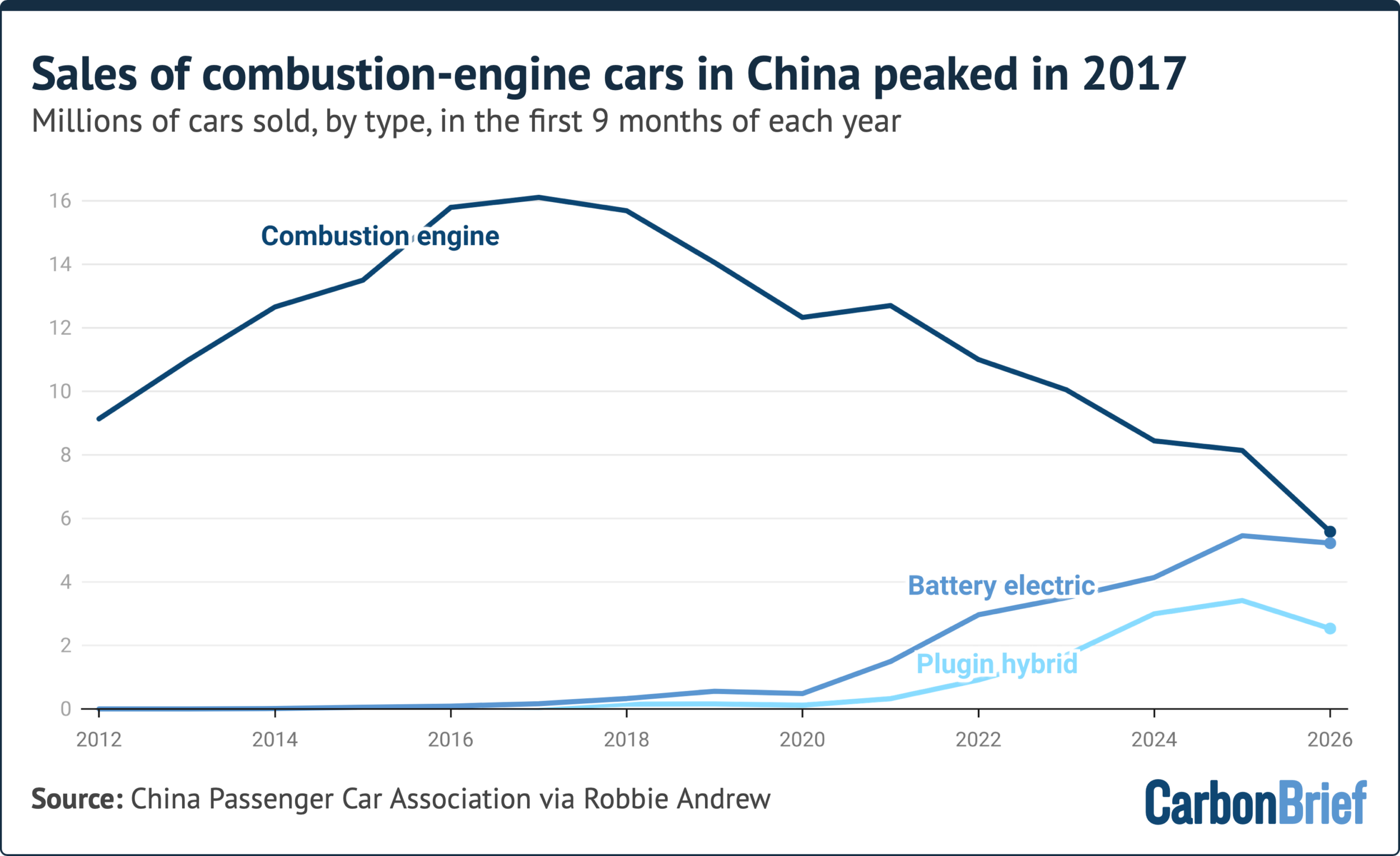
Indeed, sales of fuel-only cars were down 31% year-on-year in the first nine months of 2026, with plug-in hybrid sales down 26% – whereas battery EV sales were only down 4%.
One analyst tells Carbon Brief that China’s rapidly growing EV fleet has offset demand for 143m barrels of oil since the start of the Hormuz crisis.
Another says that the crisis is “reinforcing China’s electrification of road transport”.
Meanwhile, amid slowing domestic sales, Chinese carmakers’ exports of NEVs more than doubled [in 2026 to date / in September] from a year earlier.
NEV record
A record two out of every three cars sold in September in China were NEVs, according to CPCA data, as shown in the figure below.
(NEVs predominantly include battery electric vehicles – BEVs – and plug-in hybrids – PHEVs. BEVs only run on electricity, whereas PHEVs also have a combustion engine.)
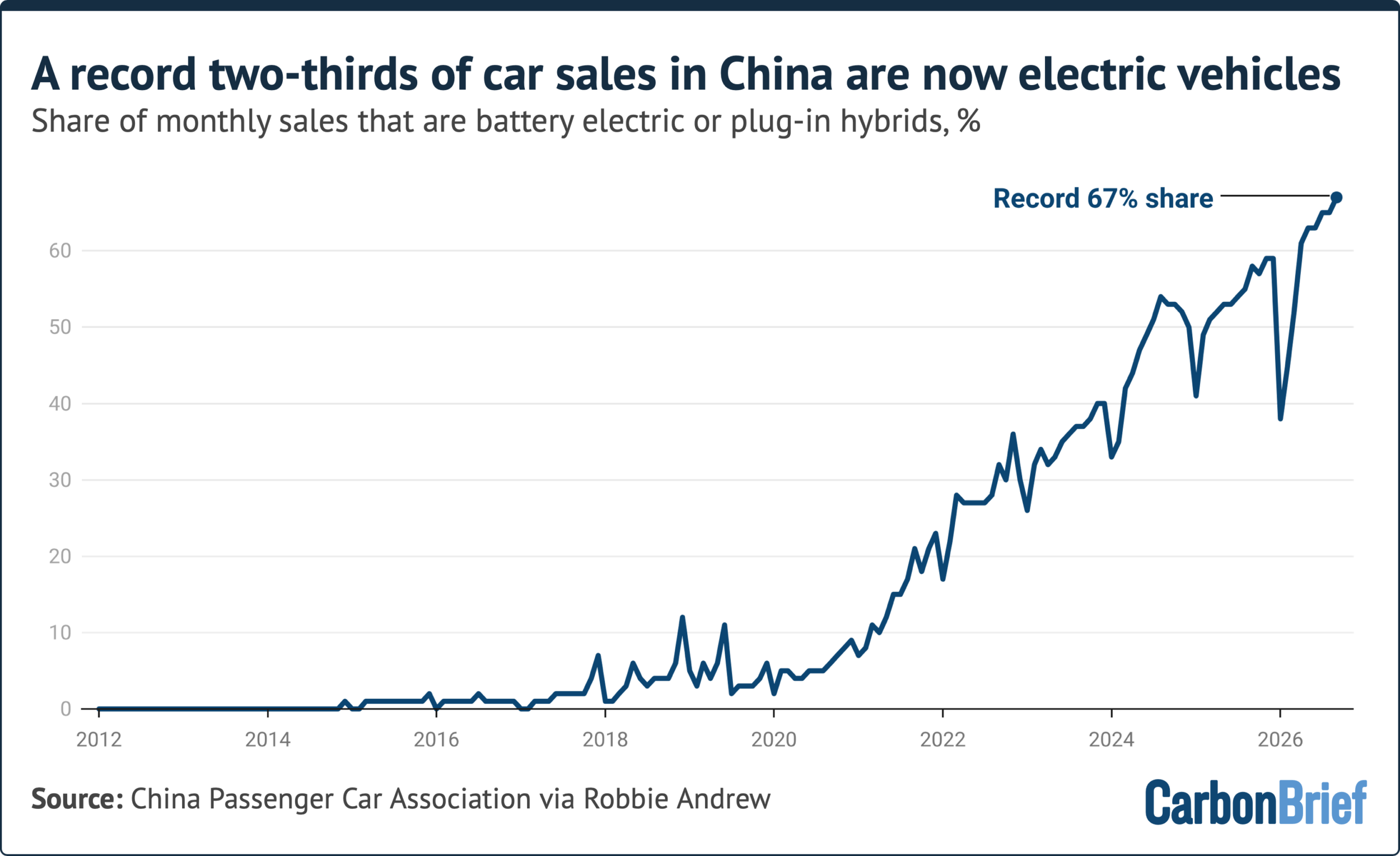
This marks a rapid rise for NEVs from just 6% of new car sales in 2020 up to 58% in 2026 to date – and a record 67% in the month of September.
This year, NEVs’ share of sales has also bounced back from a low of 39% in January, after the full purchase tax exemption that had been in place for more than a decade came to an end in December 2025.
The gain in NEV share in 2026 has come amid a slowdown across the wider domestic passenger-car market, which has hit sales of combustion-engine vehicles particularly hard.
This September, passenger-car retail sales across all categories declined, with overall sales volumes falling 28% year-on-year.
The contraction was led by combustion-engine vehicles, which saw sales fall 43% year-on-year in September and 31% in 2026 to date.
However, sales of PHEVs also fell by 36% year-on-year in September and by 26% in 2026 to date. By comparison, BEVs performed better, although sales still declined 8.5% from a year earlier in September and 4% in 2026 to date.
As a result, NEV sales overall fell by 17% in September and 13% in 2026 to date.
While the market changes in 2026 to date were particularly dramatic, they reflect a broad continuation of trends seen over the past decade.
Indeed, sales of combustion-engine cars in China peaked in 2017 and they have been declining ever since, shown in the figure below.
Impact of Hormuz
Part of the reason for the advance of NEVs in 2026, said Chinese technology news outlet OFweek, was petrol cars “giving up market share” as they were outperformed by electric alternatives.
Cui Dongshu, secretary-general of the CPCA, cited higher petrol prices as an explanation for September’s weak combustion-car sales, in comments to financial news outlet National Business Daily.
Imports of oil into China in January-September have fallen 15% compared to 2025, equivalent to 470m barrels, as ongoing conflict tightened supply and drove up prices.
China’s passenger-car NEV fleet has displaced 143m barrels of oil so far during the strait of Hormuz crisis, Euan Graham, senior energy analyst at thinktank Ember, tells Carbon Brief.
EVs “accounted for 12% of the decrease in China’s oil use post-Hormuz”, according to an estimate provided to thinktank the Brookings Institute by an unnamed analyst.