

Layers of red dust coat South Africa’s Saldanha Bay, a legacy of the one billion-plus tonnes of iron ore exported from what was once a quiet coastal fishing town in the 1970s. Now the government wants to turn this area into the “oil and gas hub of South Africa”, but opposition from local communities and civil society could force a change of plan.
Since 2014 South Africa has developed a strategy for taking “full advantage” of its marine resources, known as Operation Phakisa. It has resulted in the mapping of more than 95% of the country’s nearly 3,000-kilometre coastline for offshore oil and gas exploration.
The plan seeks to “drill 30 exploration wells in 10 years”, which it estimates could lead to the production of an average of 370,000 barrels of oil and gas per day over 20 years, with Saldanha Bay earmarked as a key logistics hub. It also aims to develop other marine sectors like aquaculture, maritime transport and ocean tourism.
However, two major court cases against the government and oil giants Shell and TotalEnergies have challenged those plans, as coastal residents, allied with national civil society groups, have pushed back against oil concessions held by the multinationals, arguing they were not consulted, and that towns like Saldanha Bay could face social and environmental harms from the fossil fuel extraction.
-
Santa Marta coalition tested as co-chair Colombia turns back to fossil fuels
Despite a leadership gap, outgoing environment minister Irene Vélez Torres says the anti-fossil fuel coalition can “live without Colombia” -
China’s coal power rebounds as record clean energy goes to waste
Long-term contracts guarantee coal plants buyers regardless of demand, crowding out renewables, report finds


Melissa Groenink-Groves, programme manager at legal nonprofit Natural Justice, said the cases in South Africa could set a precedent for the whole region. “When communities win in the courts, the successes serve as inspiration for other communities to advocate [for] their rights in their own contexts,” she explained.
She added that the legal challenges to Operation Phakisa also develop climate litigation in the African context, and could impact how environmental impact assessments are conducted going forward.
Globally, as the oil and gas industry sets its sights on the ocean, with over 85% of new discoveries in 2024 made offshore, scientists and activists warn it could threaten marine life and coastal communities, and weaken the ocean’s ability to trap excess heat from the atmosphere, fuelling planetary warming further.

Taking oil companies to court
About 300 kilometres north of Saldanha Bay, the Aukotowa Fisheries Cooperative, backed by nonprofits The Green Connection and Natural Justice, has taken TotalEnergies to court over its plans to drill for oil and gas in a 30,000-square-kilometre block off South Africa’s west coast.
The oil exploration block is in a biodiverse marine area bordering Namibia and South Africa known as the Orange Basin, which is a “highly relevant” sanctuary for endangered species, according to Nelson Mandela University’s Institute for Coastal and Marine Research.
Among other grievances, the cooperative maintains that the company’s environmental impact assessment was flawed, failing to consider the project’s contribution to climate change, and that the government “placed the profits of a multinational corporation above the livelihoods of vulnerable coastal communities”. The Western Cape High Court concluded hearings in late March and is expected to deliver a ruling later this year.
Walter Steenkamp, chairperson of the Aukotowa Cooperative, is concerned that the oil and gas drilling will lead to increased inequality, asking “for whom is the development? Definitely not for us.”
In a written statement, TotalEnergies told Climate Home News that it “is a responsible operator fully committed to complying with all applicable South African legislation”.
Southeast Asia’s fragile grids threaten billions in clean energy investment
Communities and climate impacts at stake
On the other side of the country, along South Africa’s eastern coastline, community-based nonprofit Sustaining the Wild Coast and partner organisations challenged Shell and Impact Africa’s exploration permit, arguing that the firms had failed to consult impacted communities – a legal requirement under South African law.
Co-plaintiff Sinegugu Zukulu also said in 2022 that “oil and gas will lead to more emissions, and in the face of climate change, this is wholly irresponsible”.
Following two rulings against the companies by lower courts, the case is now before South Africa’s highest Constitutional Court, which has reserved judgment since September 2025. A ruling against the companies would be final, effectively ending the exploration permit.
Legal expert Groenink-Groves said oil exploration applications under Operation Phakisa have been “granted largely without properly assessing the devastating impact an oil spill could have on small-scale fishers, the risks of drilling in ultra-deep waters, [and] without accounting for climate change impacts associated with oil and gas exploitation”.
She added that exploration applications have often failed to consider coastal management laws and in some cases, cross-border and regional environmental risks.
Shell and South Africa’s Department of Mineral and Petroleum Resources did not respond to written requests for comment.
South Africa’s offshore oil ambitions
Fishers around South Africa, many of whom have for generations relied on marine resources for survival, say the country’s offshore oil and gas push is sacrificing their livelihoods for profit.
“Why do they want to destroy our heritage? We can’t afford to say yes to oil and gas because the ocean is our source of life,” said Carmelita Mostert, a member of advocacy group Coastal Links and third-generation Saldanha Bay fisher.
Yet with unemployment above 30%, alongside high levels of poverty and wealth inequality, the government sees Operation Phakisa as a vehicle for socioeconomic development.
South Africa’s Minister of Mineral and Petroleum Resources Gwede Mantashe has described the court cases as “anti-development”, and claimed that the environmental organisations are funded by the CIA.
Sifiso Dladla, a campaigner with human rights organisation groundWork, argued that the close relationship between the government and the fossil fuel industry – including its 3% contribution to gross tax revenue – limits the potential success of movements pushing for an inclusive energy system. Politicians “need money to win elections. Mining companies need the government to protect them,” he said.
Patrick Bond, a political economist and sociology professor at the University of Johannesburg, said Operation Phakisa only makes economic sense if its social and environmental harms are ignored, adding that “if a genuine social cost of carbon analysis were done in any African fossil fuel project, there would be few – if any – able to justify the projects economically”.
At a global scale, Bond said oil multinationals have the financial backing of European governments – including France’s $2.8 billion stake in TotalEnergies – which can help make local resistance more effective where it has international allies to amplify the messages.
For Saldanha Bay fisher Mostert, the fight is about protecting the livelihoods of coastal communities. “It is my hope that we can stand strong and protest,” she said. “If oil and gas is not allowed, our lives will be much easier and better – but if oil and gas goes ahead we will be in absolute agony.”
The post South Africa’s offshore oil push meets grassroots resistance in court appeared first on Climate Home News.
South Africa’s offshore oil push meets grassroots resistance in court

For the first time, new-energy vehicles (NEVs) made up 67% of new car sales in China in September, according to the latest data from the China Passenger Car Association (CPCA).
The figures show that NEVs, which include battery electric cars and plug-in hybrids, captured a record share of sales, even though fewer were sold than last year.
This is because sales of combustion-engine cars are falling steeply, a trend that the CPCA has attributed to rising petrol prices following the start of the Hormuz crisis.
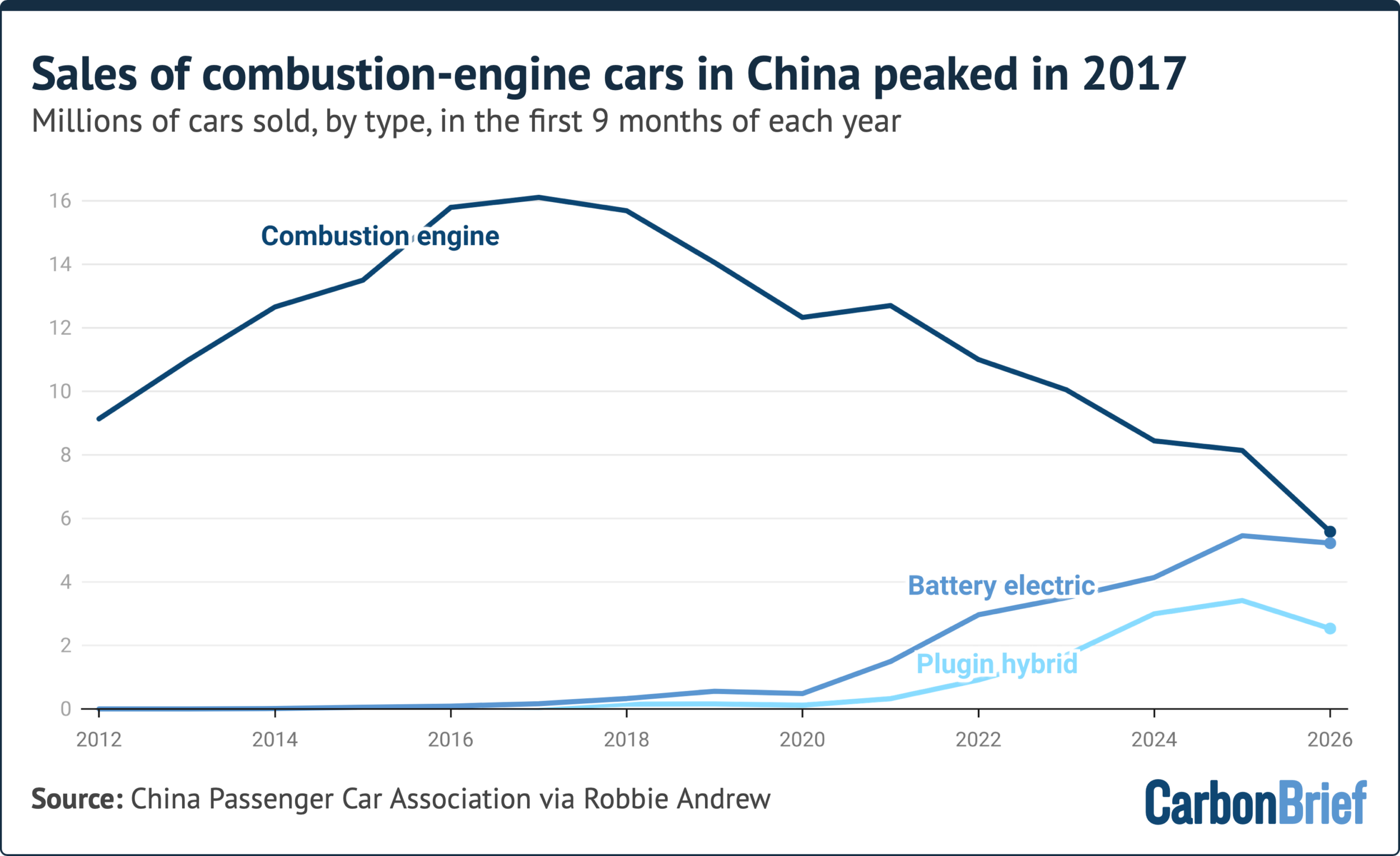
Indeed, sales of fuel-only cars were down 31% year-on-year in the first nine months of 2026, with plug-in hybrid sales down 26% – whereas battery EV sales were only down 4%.
One analyst tells Carbon Brief that China’s rapidly growing EV fleet has offset demand for 143m barrels of oil since the start of the Hormuz crisis.
Another says that the crisis is “reinforcing China’s electrification of road transport”.
Meanwhile, amid slowing domestic sales, Chinese carmakers’ exports of NEVs more than doubled [in 2026 to date / in September] from a year earlier.
NEV record
A record two out of every three cars sold in September in China were NEVs, according to CPCA data, as shown in the figure below.
(NEVs predominantly include battery electric vehicles – BEVs – and plug-in hybrids – PHEVs. BEVs only run on electricity, whereas PHEVs also have a combustion engine.)
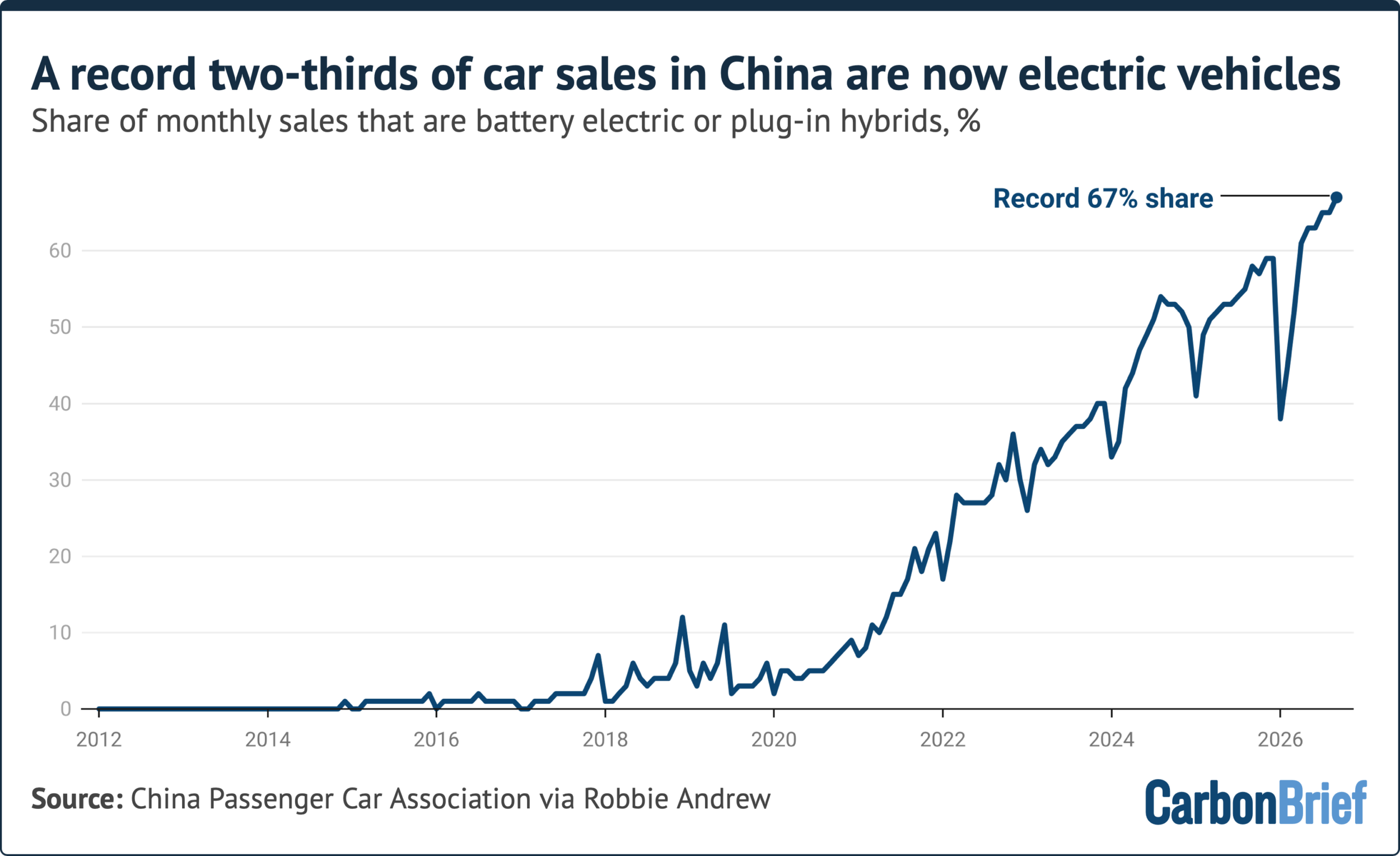
This marks a rapid rise for NEVs from just 6% of new car sales in 2020 up to 58% in 2026 to date – and a record 67% in the month of September.
This year, NEVs’ share of sales has also bounced back from a low of 39% in January, after the full purchase tax exemption that had been in place for more than a decade came to an end in December 2025.
The gain in NEV share in 2026 has come amid a slowdown across the wider domestic passenger-car market, which has hit sales of combustion-engine vehicles particularly hard.
This September, passenger-car retail sales across all categories declined, with overall sales volumes falling 28% year-on-year.
The contraction was led by combustion-engine vehicles, which saw sales fall 43% year-on-year in September and 31% in 2026 to date.
However, sales of PHEVs also fell by 36% year-on-year in September and by 26% in 2026 to date. By comparison, BEVs performed better, although sales still declined 8.5% from a year earlier in September and 4% in 2026 to date.
As a result, NEV sales overall fell by 17% in September and 13% in 2026 to date.
While the market changes in 2026 to date were particularly dramatic, they reflect a broad continuation of trends seen over the past decade.
Indeed, sales of combustion-engine cars in China peaked in 2017 and they have been declining ever since, shown in the figure below.
Impact of Hormuz
Part of the reason for the advance of NEVs in 2026, said Chinese technology news outlet OFweek, was petrol cars “giving up market share” as they were outperformed by electric alternatives.
Cui Dongshu, secretary-general of the CPCA, cited higher petrol prices as an explanation for September’s weak combustion-car sales, in comments to financial news outlet National Business Daily.
Imports of oil into China in January-September have fallen 15% compared to 2025, equivalent to 470m barrels, as ongoing conflict tightened supply and drove up prices.
China’s passenger-car NEV fleet has displaced 143m barrels of oil so far during the strait of Hormuz crisis, Euan Graham, senior energy analyst at thinktank Ember, tells Carbon Brief.
EVs “accounted for 12% of the decrease in China’s oil use post-Hormuz”, according to an estimate provided to thinktank the Brookings Institute by an unnamed analyst.