

A new draft text to revive deadlocked UN plastics treaty talks does not include specific measures on managing runaway plastic production, a growing source of greenhouse gas emissions, drawing criticism from some countries and campaigners that ambition for the global pact is shrinking.
After diplomats met in Nairobi early in July for the first time since negotiations fell apart a year ago, Chilean ambassador Julio Cordano, who is chairing the talks, released a first document last weekend, setting out elements of a possible treaty to tackle plastic pollution.
Cordano stressed this is an “informal reference document” rather than a negotiated text. But its structure is similar to a draft treaty and closely resembles the previous version rejected by governments during the last round of formal negotiations in Geneva.
The new text recognises the world’s “unsustainable” levels of plastic production and consumption, both of which are projected to nearly triple by 2060. But it contains no measures to stem that growth, critics say, pointing to what they see as a broader weakening of ambition.
They argue the document is increasingly aligned with the demands of fossil fuel-producing countries, including Gulf states, the US and Russia, which have pushed for the treaty to focus on managing plastic waste rather than limiting production.
“When you leave the countries that have the most vested interests in delaying meaningful action to shape the agenda, you end up with a text that does nothing to end plastic pollution,” said David Azoulay, environmental health programme director at the Center for International Environmental Law (CIEL).
France disappointed with production omission
“We’ve gone backwards rather than forwards,” Christina Dixon, a campaigner at the Environmental Investigation Agency (EIA), told Climate Home News. “A text that was rejected by the majority of countries in Geneva as being too weak and not ambitious enough has been repackaged one year later with some key elements removed and put out as a kind of sign of progress.”
A French diplomatic source told Climate Home News it was “disappointing” that the text lacked any concrete provisions on tackling “unsustainable” levels of plastics production and consumption. That is despite a majority of countries repeatedly advocating for curbs and scientists saying the world cannot put an end to plastic pollution without tackling the issue at source, they added.
-
South Africa’s offshore oil push meets grassroots resistance in court
Two court cases against oil majors TotalEnergies and Shell could derail South Africa’s plan to expand offshore fossil fuels -
UN bid to keep 1.5C alive exposes deepening divisions over fossil fuels
Vulnerable island nations and the poorest countries want the Belém Mission to 1.5 to drive fossil fuel phase-out, while Arab states call for more investment in oil and gas


Governments across Europe, Latin America, Africa and the Pacific islands have previously called for efforts to limit the manufacturing of plastics to “sustainable levels”, but their efforts have been frustrated by strong and persistent opposition from a small group of fossil fuel producers, who see plastics as a growing market for oil and gas.
Weakening of production ambition
Cordano told Climate Home News that the “concept” of sustainable production is still reflected in different parts of the new document.
But measures aimed at achieving that objective have progressively weakened over time. Initial versions of the draft treaty, dating back to 2024, included a standalone article with the option of setting a global target to reduce the production and consumption of primary plastics.
That disappeared from successive drafts published in Geneva last year. The last version nevertheless said data on plastic production could be considered in future assessments of whether the treaty was meeting its objectives. Observers saw this as an important provision that could have strengthened the pact over time and potentially kept the door open for a global production target.
The new text only mentions “sustainable production” in the preamble and includes an article saying that countries could improve the design of plastic products in order to contribute to “sustainable production”.
“There’s a war of attrition element,” said Dennis Clare, a negotiator for the Pacific island nation of Micronesia. “The countries that want to do less are dragging out discussions and gradually pressuring the more ambitious to compromise towards a lower common denominator.”
Little space for thorny discussions
Countries have twice failed to agree on a global plastics treaty at what were meant to be final rounds of negotiations in December 2024 and August 2025. After being selected as the new chair earlier this year, Cordano has been working to steer the process back on track through a series of informal meetings, hoping diplomats can find common ground ahead of the next formal negotiations scheduled for early 2027.
But he has been criticised for sidelining discussions on some of the thorniest issues. Cordano kept plastic production off the official agenda for the Nairobi meeting a few weeks ago. He said beforehand that countries could bring any issue to the table, but production did not feature in the summary of discussions subsequently published by the chair.
Clare said discussions on fundamental elements of the treaty, including production, had been “constrained” and that there was little space for them in Nairobi.
Cordano told Climate Home News the Nairobi talks had provided space both for “reaffirming positions and expressing new ideas”, adding that countries “remain free to raise all issues they consider important”.
Informal talks between negotiators are held behind closed doors and neither the media nor external observers can take part.

Campaigners have accused the chair of making political calculations to reach an agreement at any cost. “He has clearly identified that the only way to achieve an agreement by consensus is to do away with the more complex elements of the treaty like those that deal with sustainable production and consumption of plastics,” the EIA’s Dixon said.
Cordano said he continues to be guided by countries as “they develop their own exchanges and continue working towards possible landing zones”.
Push for more ambition
Governments will debate the new text at another meeting of chief negotiators in Bangkok, Thailand, at the end of September, and a new version of the document is expected after that meeting.
The French diplomatic source said the current text should not be viewed as “an end-product”, but as a starting point that “can and should be improved”.
France, together with the EU and members of the High Ambition Coalition (HAC), will continue pushing for stronger provisions, including measures to address plastic production, the source said.
China’s coal power rebounds as record clean energy goes to waste
The HAC group includes over 70 countries, primarily from across Europe, Latin America, Africa and the Pacific.
Micronesian negotiator Clare said countries on the frontline of the plastics crisis may decide to reject a really weak treaty that puts the burden on them to clean up somebody else’s waste, while producers can keep churning out plastics unrestrained.
“If the treaty does not include essential elements of the solution, even an initial, apparent diplomatic success – an agreement – can come to be seen over time as an environmental failure,” Clare warned.
The post “We’ve gone backwards” – new plastics treaty text dims hopes for production curbs appeared first on Climate Home News.
“We’ve gone backwards” – new plastics treaty text dims hopes for production curbs

For the first time, new-energy vehicles (NEVs) made up 67% of new car sales in China in September, according to the latest data from the China Passenger Car Association (CPCA).
The figures show that NEVs, which include battery electric cars and plug-in hybrids, captured a record share of sales, even though fewer were sold than last year.
This is because sales of combustion-engine cars are falling steeply, a trend that the CPCA has attributed to rising petrol prices following the start of the Hormuz crisis.
Indeed, sales of fuel-only cars were down 31% year-on-year in the first nine months of 2026, with plug-in hybrid sales down 26% – whereas battery EV sales were only down 4%.
One analyst tells Carbon Brief that China’s rapidly growing EV fleet has offset demand for 143m barrels of oil since the start of the Hormuz crisis.
Another says that the crisis is “reinforcing China’s electrification of road transport”.
Meanwhile, amid slowing domestic sales, Chinese carmakers’ exports of NEVs more than doubled [in 2026 to date / in September] from a year earlier.
NEV record
A record two out of every three cars sold in September in China were NEVs, according to CPCA data, as shown in the figure below.
(NEVs predominantly include battery electric vehicles – BEVs – and plug-in hybrids – PHEVs. BEVs only run on electricity, whereas PHEVs also have a combustion engine.)
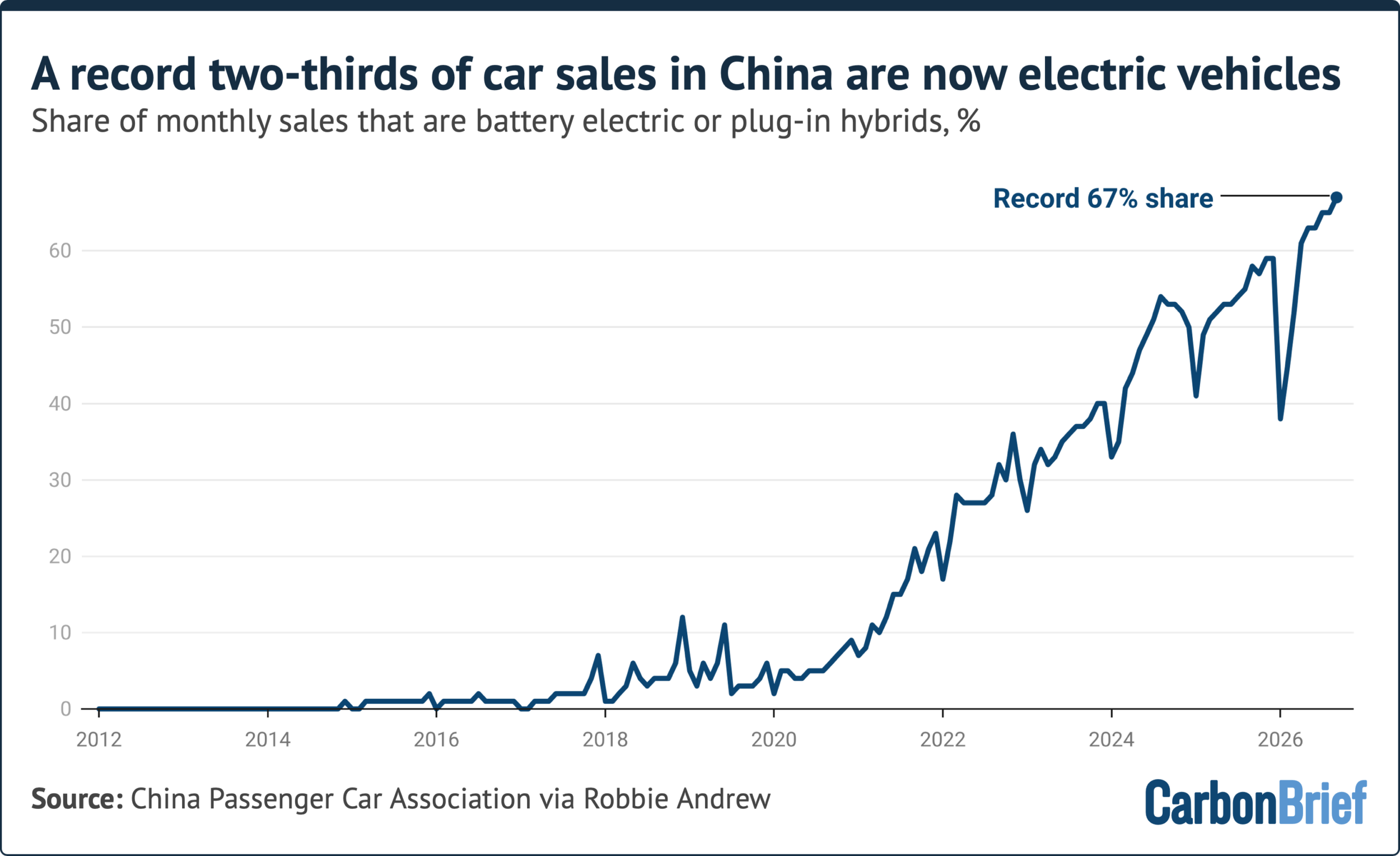
This marks a rapid rise for NEVs from just 6% of new car sales in 2020 up to 58% in 2026 to date – and a record 67% in the month of September.
This year, NEVs’ share of sales has also bounced back from a low of 39% in January, after the full purchase tax exemption that had been in place for more than a decade came to an end in December 2025.
The gain in NEV share in 2026 has come amid a slowdown across the wider domestic passenger-car market, which has hit sales of combustion-engine vehicles particularly hard.
This September, passenger-car retail sales across all categories declined, with overall sales volumes falling 28% year-on-year.
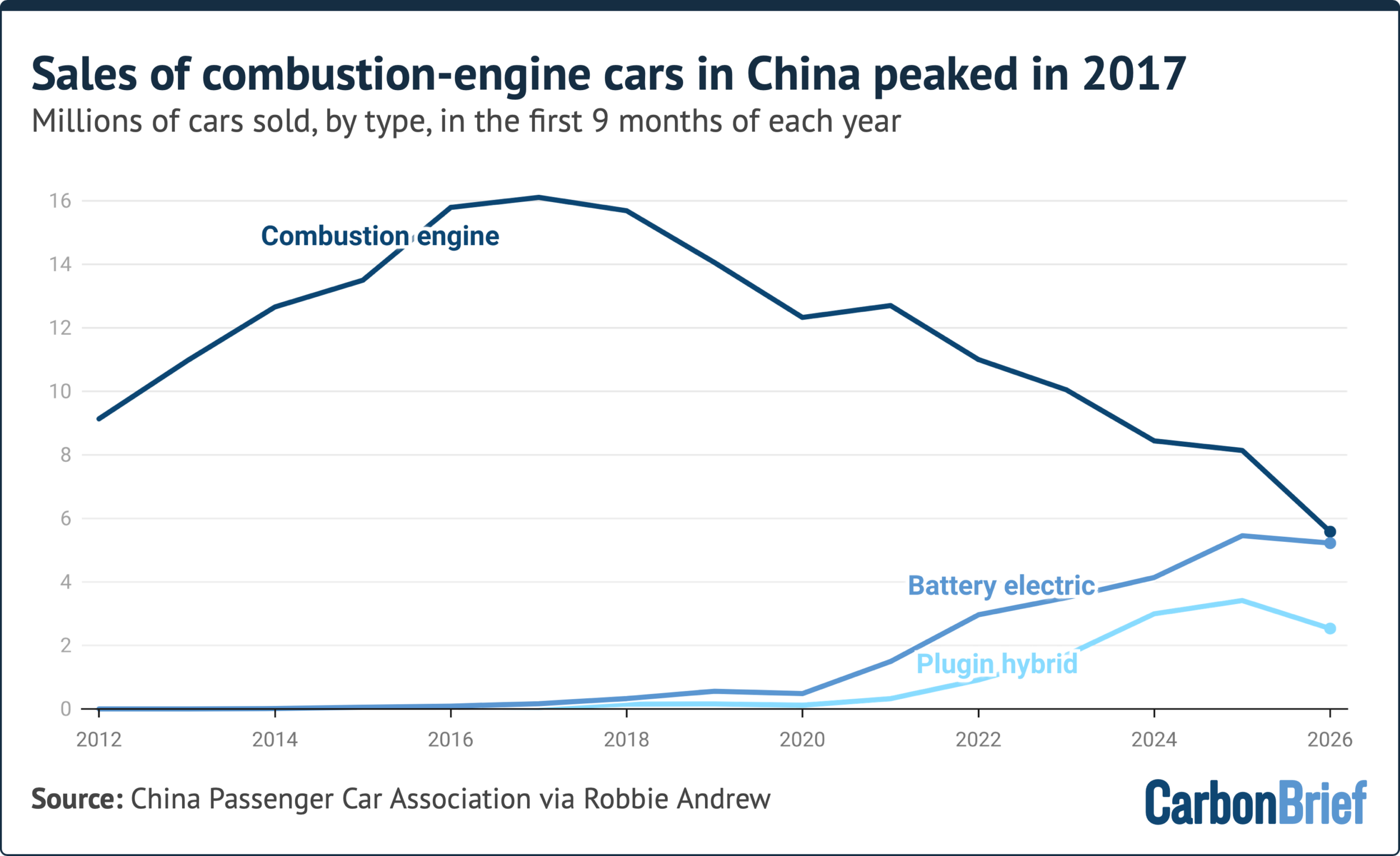
The contraction was led by combustion-engine vehicles, which saw sales fall 43% year-on-year in September and 31% in 2026 to date.
However, sales of PHEVs also fell by 36% year-on-year in September and by 26% in 2026 to date. By comparison, BEVs performed better, although sales still declined 8.5% from a year earlier in September and 4% in 2026 to date.
As a result, NEV sales overall fell by 17% in September and 13% in 2026 to date.
While the market changes in 2026 to date were particularly dramatic, they reflect a broad continuation of trends seen over the past decade.
Indeed, sales of combustion-engine cars in China peaked in 2017 and they have been declining ever since, shown in the figure below.
Impact of Hormuz
Part of the reason for the advance of NEVs in 2026, said Chinese technology news outlet OFweek, was petrol cars “giving up market share” as they were outperformed by electric alternatives.
Cui Dongshu, secretary-general of the CPCA, cited higher petrol prices as an explanation for September’s weak combustion-car sales, in comments to financial news outlet National Business Daily.
Imports of oil into China in January-September have fallen 15% compared to 2025, equivalent to 470m barrels, as ongoing conflict tightened supply and drove up prices.
China’s passenger-car NEV fleet has displaced 143m barrels of oil so far during the strait of Hormuz crisis, Euan Graham, senior energy analyst at thinktank Ember, tells Carbon Brief.
EVs “accounted for 12% of the decrease in China’s oil use post-Hormuz”, according to an estimate provided to thinktank the Brookings Institute by an unnamed analyst.