


In the lead-up to COP29, several major announcements on carbon markets are anticipated. These will likely include updates on Article 6 cooperation, enhanced compliance mechanisms, and new developments in voluntary carbon markets (VCM).
A report by the Allied Offsets on carbon markets outlines the evolving landscape and its implications for companies and policymakers. Here are our major takeaways from the report.
What is Article 6 All About?
Article 6 of the Paris Agreement allows countries to meet their climate targets by working together through carbon markets (Articles 6.2 and 6.4) and other non-market approaches (Article 6.8).
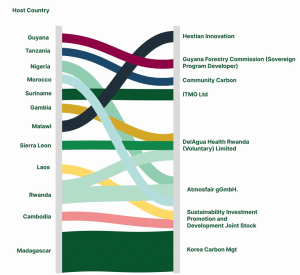
Article 6.2 facilitates international cooperative approaches, with 91 agreements currently in progress. Leading nations like Japan, Singapore, and Switzerland have spearheaded these efforts, with many deals at either the Memorandum of Understanding (MOU) stage (61%) or finalized bilateral agreements (22%).
- Among host countries, Cambodia is at the forefront, with the highest emission reductions (56.75 million tons of CO2 equivalent) authorized through various initiatives.
Rwanda has taken unique steps. It mandates that 10% of its mitigation outcomes go to domestic use, 2% contribute to global emissions mitigation, and 5% fund adaptation initiatives. Similarly, Malawi reserves 10% of its outcomes for national use.
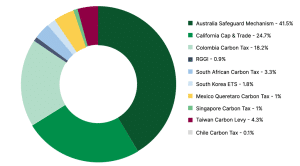
The compliance market saw new additions to its eligible credit schemes, including Singapore’s carbon tax and Taiwan’s carbon levy.
The report highlights the eligibility of voluntary carbon credits in the compliance market. Over 829 million unretired voluntary credits can now be used in 12 different compliance schemes worldwide. Colombia stands out for its market liquidity. Meanwhile, Taiwan and Singapore have set stringent criteria for using international carbon credits domestically.
Singapore’s tax, set at S$25 ($18) per ton for 2024-2025, allows corporations to offset up to 5% of taxable emissions with International Carbon Credits (ICCs). However, the credits must adhere to seven key principles to maintain high environmental standards.
Taiwan’s Ministry of Environment has laid out foundational regulations for a carbon fee system that permits certain industries to offset up to 5% of emissions using internationally recognized credits.
Navigating Convergence of Voluntary and Compliance Carbon Markets
As of the latest update, there are 348,414,639 eligible carbon credits from 3,343 projects across 11 different schemes in the market that are available for domestic carbon pricing instruments. A significant portion of these credits (17%) and projects (36%) comes from Australia’s Safeguard Mechanism, with 2,339 projects participating.
Among international market mechanisms, CORSIA-eligible credits have the highest trading activity, involving 119 brokers. In contrast, the highest number of unique brokers for compliance-eligible credits tied to domestic carbon pricing instruments is seen with Taiwan’s carbon levy (57 brokers) and California’s (47 brokers).
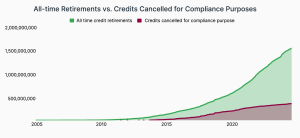
The line between voluntary and compliance markets is blurring as an increasing share of voluntary credits are retired for compliance. Presently, 28% of the VCM’s all-time credit retirements have been used for compliance purposes.
Colombia, South Korea, and South Africa are at the forefront of this shift. More entities turn to VCM credits to meet their national and regional emissions targets.
Of the VCM’s 1.6 billion all-time retirements and cancellations, 23% (367 million tons of CO2 equivalent) have been directed toward compliance under national carbon pricing systems. For example, Colombia, South Africa, and parts of Mexico (like Querétaro) are notable users of offsets under national carbon taxes.
Larger markets such as Brazil, China, and India are integrating carbon offsets into emissions trading systems. Plus, many countries are expected to include carbon removals in these systems starting in 2025.
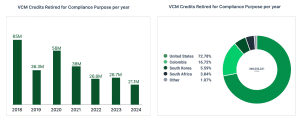
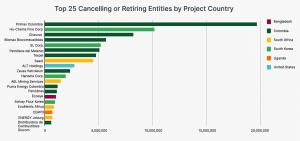
The U.S. leads in carbon credit cancellations, with over 267 million credits retired within California and Washington’s offset programs. Colombia follows closely with 61 million credits canceled.
South Korea and South Africa have also demonstrated significant activity in compliance offset markets. South Korea’s compliance program (KOP) canceled 20.5 million credits, while South Africa’s Carbon Offset Administration System canceled 15.2 million.
Expanding Role of Compliance-VCM Intermediaries
An increasing number of intermediaries are key in bridging the VCM and compliance markets. Since 2019, there’s been a 137% surge in entities actively involved in credit cancellation or retirement for compliance. South Africa, Colombia, and South Korea leading the trend.
Companies like Primax Colombia, Chevron, and Biomax in Colombia, are prominent participants in compliance-retired credits. Hu Chems Fine Corp in South Korea, and Sasol and AEL Mining Services in South Africa are also part of the top 25 canceling entities.
Compliance Market Gains Momentum For National Commitments
Interest in Article 6-based cooperation has expanded among nations aiming to fulfill their Nationally Determined Contributions (NDCs). These cooperative approaches enable countries to count cross-border carbon credits toward their climate targets.
Through initiatives under Articles 6.2 and 6.4, countries and companies alike can partake in carbon reduction activities beyond their borders, accelerating global emissions mitigation.
In 2024, other large countries like Brazil and India made strides in integrating avoidance and reduction credits in emissions trading schemes. This highlights a trend toward including more diverse offset types.
By 2025, countries like Japan, the UK, and the EU are anticipated to focus on incorporating removals. The EU is taking steps through regulations like the Carbon Removals and Carbon Farming Regulation (CRCF).
Ultimately, the report shows that the carbon market landscape is evolving rapidly, shaped by new cooperative agreements and compliance mechanisms. Most notably, it reveals the growing role of voluntary carbon market credits for regulatory compliance purposes.
The post U.S. Retires Over 267 Million Carbon Credits Amid Push for Voluntary and Compliance Market Integration appeared first on Carbon Credits.

EU carbon credit claims changed on 27 September 2026, the day the Directive (EU) 2024/825 began to apply across the European Union. The change is narrow. It changes how a company can talk about the credits it buys. A product can no longer be called neutral on the strength of compensation alone; however, every specific, evidenced statement about what a company measured, reduced, and funded stays fully available.

The post Promoting Improved Cooking Practices in Nigeria appeared first on Terrapass.


Ming Yang Eyes 33 MW Turbine, Greenvolt Delays FID
‘A strong start’: WA’s transition to renewable energy powerhouse aided by Premier’s announcement
WA EPA warned Woodside of ‘serious, significant and irreversible’ harms to Scott Reef from gas plans, new documents reveal
-
Climate Change1 year ago
Guest post: Why China is still building new coal – and when it might stop
-

 Greenhouse Gases2 years ago
嘉宾来稿:满足中国增长的用电需求 光伏加储能“比新建煤电更实惠”
-
Greenhouse Gases1 year ago
Guest post: Why China is still building new coal – and when it might stop
-

 Climate Change2 years ago
嘉宾来稿:满足中国增长的用电需求 光伏加储能“比新建煤电更实惠”
-

 Renewable Energy1 year ago
Sending Progressive Philanthropist George Soros to Prison?
-
Climate Change2 years ago
Bill Discounting Climate Change in Florida’s Energy Policy Awaits DeSantis’ Approval
-
Greenhouse Gases1 year ago
嘉宾来稿:探究火山喷发如何影响气候预测
-

 Climate Change2 years ago
Analysis: China’s CO2 falls 1% in Q2 2024 in first quarterly drop since Covid-19