

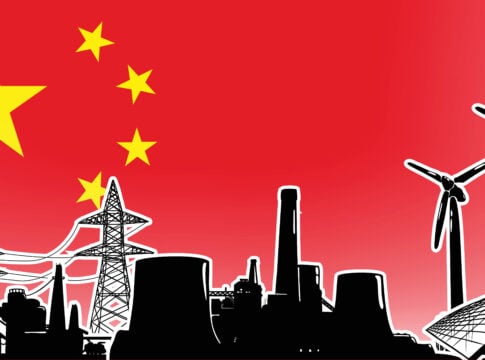
China is rapidly changing the global energy landscape. In just a few years, the country has boosted its renewable and nuclear energy capacity. This growth not only surpasses much of the world but also sets the stage for future industrial growth.
China’s focus on clean energy is making it the top choice for the digital age. This comes as AI, robotics, and large data centers use huge amounts of power.
Recent charts show clear momentum: China’s solar output now exceeds U.S. nuclear generation. Also, its nuclear expansion is the largest globally. These developments are not accidental. They come from careful planning, state funding, and a choice to lead in clean energy and related industries.
China’s Solar Boom Surpasses U.S. Nuclear
China’s solar industry has experienced an explosive rise. In early 2025, monthly solar generation surged past 125 terawatt-hours (TWh)—a more than fivefold increase since 2018. For perspective, this figure is now higher than the steady 65–75 TWh per month produced by the entire U.S. nuclear fleet.
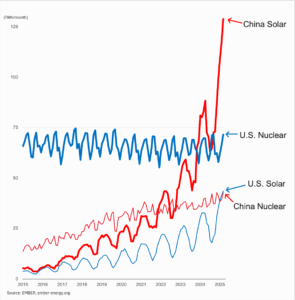
This is a symbolic turning point. For decades, nuclear power was the gold standard for large-scale, carbon-free electricity. Today, China’s solar farms produce more clean power on a monthly basis than America’s entire nuclear sector. The gap is expected to widen, as China continues adding record-breaking solar capacity each year.
Solar growth has been so steep that it is no longer just about meeting household or industrial demand. China is producing extra electricity. This allows it to power energy-demanding technologies like AI, cloud services, and electric vehicles. This “overbuilding” strategy ensures that when demand spikes, the grid has capacity ready.
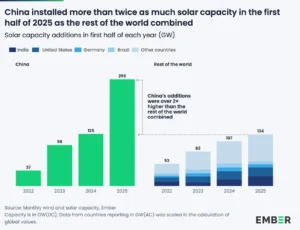
In the first half of 2025, China’s solar installations more than doubled from a year earlier. This surge meant China added over twice the solar capacity of all other countries combined. The country now accounts for 67% of global installations, up from 54% in the same period of 2024.
- RELATED: Renewable Energy Investment Reaches Record High as China Operates World’s Biggest Solar Farm
Two Strategies, Two Futures: Beijing vs. Washington
A side-by-side comparison of energy goals shows just how far apart the two countries are in their approaches.
- Solar and Wind Capacity (2025): China is on track for 1,400 GW, while the U.S. will reach only about 350 GW.
- New Additions in 2025: China plans to add 212 GW of solar and 51 GW of wind, compared to less than 100 GW combined in the U.S.
- Mega Projects: China is developing multi-gigawatt solar bases in deserts and multiple 100+ GW wind farms. The U.S.’s largest solar project—Gemini in Nevada—is just 690 MW, or less than 0.7 GW.
- Offshore Wind: China already has 42.7 GW installed, compared with the U.S.’s Empire Wind project (816 MW phase 1, with a potential expansion to 2.1 GW).
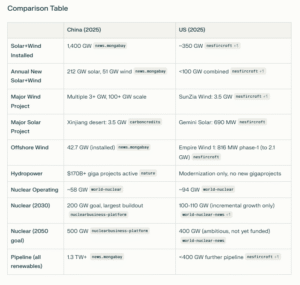
The comparison reveals a structural difference. China views clean energy as national infrastructure, central to its industrial policy. The U.S., meanwhile, relies more heavily on market incentives and tax credits, which can shift with each administration.
Nuclear Power: The Long Game
China’s clean energy dominance is not limited to solar and wind. Nuclear power is becoming a core pillar of its long-term strategy.
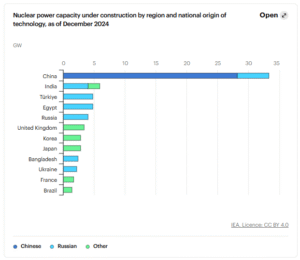
As of 2025, China operates about 58 GW of nuclear power capacity, compared to 94 GW in the United States. At first glance, this seems like a smaller footprint, but the forward-looking numbers tell a different story.
China has more than 30 GW of nuclear capacity under construction, representing over half of the world’s current nuclear buildout. By comparison, U.S. nuclear growth is limited to incremental projects, with little in the way of large-scale expansion.
Looking ahead:
- 2030 Goal: China is targeting 200 GW of nuclear, while U.S. projections range from 100–110 GW.
- 2050 Vision: China aims for 500 GW of nuclear capacity, compared to the U.S.’s ambitious but unfunded target of 400 GW.
Nuclear offers China two critical advantages. First, it provides reliable baseload electricity, balancing out the intermittency of solar and wind. It also provides a secure, carbon-free power supply. This is crucial for industries that need constant electricity, like AI supercomputing, semiconductor fabs, and robotics manufacturing.
Mega Projects That Redraw the Energy Map
China’s energy expansion is not just about adding capacity; it’s about reshaping the global map of mega energy projects. Some of the most ambitious include:
- Xinjiang Desert Solar Farm:
A 3.5 GW solar base, one of the largest in the world, leveraging the region’s vast open land and high sunlight exposure. - Hundred-Gigawatt Wind Clusters:
Multiple projects, each scaling over 100 GW, dwarf anything currently planned in other countries. - Hydropower Expansion:
With over $170 billion invested, China is pursuing new gigaprojects, unlike the U.S., which is focused only on modernizing existing dams.
These projects are not built in isolation. They connect to ultra-high-voltage transmission lines, ensuring that clean electricity from remote areas flows to coastal cities, industrial parks, and increasingly, to massive data centers.
Energy and AI: The Hidden Race Behind Algorithms
The global AI race is about algorithms and chips as well as energy. Training large-scale AI models requires massive amounts of electricity. Data centers using these systems now consume power like small countries. By the end of this decade, their demand is set to triple.
China’s decision to overbuild renewables and expand nuclear capacity is directly linked to this future. By ensuring a surplus of clean, low-cost energy, China is preparing to host the next generation of AI clusters, robotics hubs, and cloud infrastructure.
U.S. Policy Uncertainty: A Strategic Weakness
While China pushes ahead, U.S. clean energy growth faces obstacles. Policy shifts and partisan battles have slowed momentum. Proposals to roll back tax credits or defund renewable energy research could reduce investor confidence and stall growth.
As one observer, Laurie Garrett, noted:
“By blocking and de-funding alternative energy R&D and tax incentives for use of solar, wind, nuclear and other renewables, Trump is handing the future on a gold platter to China.”
This concern is not just about climate. It’s about competitiveness. If the U.S. can’t boost energy capacity to meet growing AI and industrial needs, it may lose its leadership in key sectors. These sectors will shape global influence in the coming decades.

Clean Energy as the New Industrial Edge
China’s renewable and nuclear surge is reshaping the balance of global power. With solar generation now surpassing U.S. nuclear, nuclear projects expanding faster than anywhere else, and gigaprojects rising across deserts, mountains, and coastlines, China is ensuring it has the energy backbone for the AI-driven future.
The U.S. still retains advantages in innovation, advanced nuclear designs, and private-sector dynamism. But without consistent policy support and accelerated project deployment, it risks falling behind.
Countries that control abundant, affordable, and carbon-free electricity will lead in AI, robotics, electric vehicles, and the digital economy. China seems determined to be that country.
The post The AI Energy War: How China’s Solar and Nuclear Outshine the U.S. appeared first on Carbon Credits.

EU carbon credit claims changed on 27 September 2026, the day the Directive (EU) 2024/825 began to apply across the European Union. The change is narrow. It changes how a company can talk about the credits it buys. A product can no longer be called neutral on the strength of compensation alone; however, every specific, evidenced statement about what a company measured, reduced, and funded stays fully available.

The post Promoting Improved Cooking Practices in Nigeria appeared first on Terrapass.



-
Climate Change1 year ago
Guest post: Why China is still building new coal – and when it might stop
-

 Greenhouse Gases2 years ago
嘉宾来稿:满足中国增长的用电需求 光伏加储能“比新建煤电更实惠”
-
Greenhouse Gases1 year ago
Guest post: Why China is still building new coal – and when it might stop
-

 Climate Change2 years ago
嘉宾来稿:满足中国增长的用电需求 光伏加储能“比新建煤电更实惠”
-

 Renewable Energy12 months ago
Sending Progressive Philanthropist George Soros to Prison?
-
Climate Change2 years ago
Bill Discounting Climate Change in Florida’s Energy Policy Awaits DeSantis’ Approval
-
Greenhouse Gases1 year ago
嘉宾来稿:探究火山喷发如何影响气候预测
-

 Climate Change2 years ago
Analysis: China’s CO2 falls 1% in Q2 2024 in first quarterly drop since Covid-19