


Netflix (NASDAQ: NFLX) has taken another step in its climate strategy by signing a long-term carbon credit deal with the American Forest Foundation (AFF). The agreement backs tree planting and forest restoration in the U.S. South. It also boosts Netflix’s efforts to reduce emissions throughout its operations.
The deal shows a shift in the voluntary carbon market(VCM). Companies now want high-quality, verifiable credits that offer social and environmental benefits.
Building Forests, Supporting Landowners
Through AFF’s Family Forests program, Netflix will help convert farmland into new forests. The partnership follows a milestone-based financing model. Netflix gives partial funding as acres are planted and trees grow. The rest is paid once the carbon credits are verified.
The project already covers about 2,500 acres with 1.4 million trees planted and has directed $2 million in payments to landowners. By 2032, AFF aims to expand the program to 75,000 acres, generating an estimated 4.8 million carbon credits. These credits represent millions of tonnes of carbon dioxide captured and stored in forests over decades.
This program helps rural economies by creating new income for family landowners. It also supports biodiversity, water quality, and soil restoration. In a carbon market under increasing scrutiny, such local, transparent projects align with the Core Carbon Principles set by the Integrity Council for Voluntary Carbon Markets.
More Than Tree Planting: The Power of ARR
ARR projects help restore degraded land and increase forest cover. They lock away carbon and support biodiversity.
These projects represent one of the fastest-growing forest carbon project types in the VCM, with 346 registered ARR projects having issued over 150 million tons of CO2 credits. By 2030, ARR issuances could reach 100 million tons annually. This makes them the second largest project subtype within the VCM.
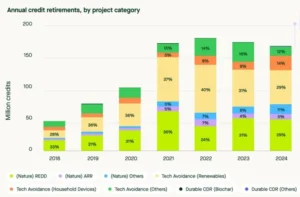
Studies suggest reforesting suitable areas worldwide could remove up to 3–10 gigatons of CO₂ annually by 2050. In the U.S., ARR projects have captured tens of millions of tonnes of CO₂e. Companies like Microsoft, Apple, and Netflix are increasingly investing in forest-based credits, which boosts momentum.
ARR also provides co-benefits such as cleaner water, soil restoration, and community engagement. For Netflix, this deal is key to its net-zero and ESG strategy.
Net-Zero on Screen: Inside Netflix’s ESG Strategy
Netflix has sharpened its climate strategy, with updated emissions data from its 2024 ESG report providing a clearer picture of its environmental footprint. The company reported total greenhouse gas (GHG) emissions of 1,037,226 metric tons of CO₂e in 2024, measured under the market-based method. This figure includes:
-
Scope 1: 50,488 tCO₂e (direct emissions from facilities, vehicles, and equipment).
-
Scope 2: 0 tCO₂e (purchased electricity, reported as zero under market-based accounting due to renewable energy sourcing).
-
Scope 3: 986,738 tCO₂e (upstream and downstream emissions, largely from cloud services, content production, and supply chains).
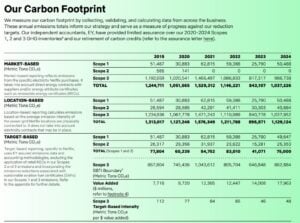
This marked a 23% increase from 2023, when emissions totaled 843,107 tCO₂e. Much of the rise was attributed to higher production activity and expanded content delivery across global markets.
Netflix shares a second set of emissions figures. These come from its Science-Based Targets initiative (SBTi). This framework has stricter rules for counting emissions. Under this method, Scope 1 and 2 totaled 75,000 tCO₂e in 2024, while Scope 3 reached 862,884 tCO₂e. These metrics form the baseline for Netflix’s near-term reduction goals.
-
Netflix confirmed its Science-Based Target. It aims for a 46% cut in Scope 1 and 2 emissions by 2030, using 2019 as a baseline. Also, it plans a 27.5% reduction in Scope 3 emissions by 2030.
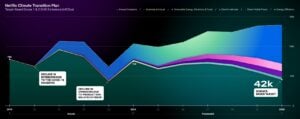
To get there, Netflix is pursuing a “reduce, retain, and remove” strategy. The focus includes:
-
Reduce: Cutting energy use in production, optimizing streaming efficiency, and working with cloud providers to source renewables.
-
Retain: Using renewable energy credits to ensure 100% renewable electricity, which it already reports under Scope 2.
-
Remove: Investing in natural climate solutions and verified carbon removal projects to offset residual emissions.
Netflix has funded reforestation and forest management projects. These efforts align with its new deal with the American Forest Foundation. It is also piloting partnerships to support carbon removal technologies.
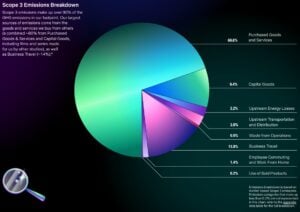
The streaming giant tracks emissions intensity, measured as tCO₂e per revenue unit. This helps ensure that climate progress matches business growth. The company notes that reducing Scope 3 remains its biggest challenge, as these emissions account for more than 95% of its total footprint.
Carbon Credits in Action: Positioning Ahead of Demand
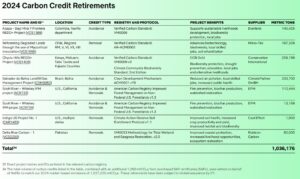
Netflix also relies on carbon credits as part of its “retain and remove” strategy to reach its net-zero target. In 2024, the company purchased and retired 1,036,176 metric tons of CO₂ equivalent in high-quality carbon credits.
These credits came from various nature projects like reforestation, better forest management, and mangrove restoration. They also include tech-based methods that capture and store carbon. Netflix uses these credits after cutting operational emissions. They focus on projects that offer clear carbon removal and help the community.
The VCM has grown into a multibillion-dollar sector. In 2024, its value was about $2.5 billion. By 2030, it could jump to $20–45 billion. This will depend on corporate demand and regulatory support.
Nature-based solutions, such as forestry, make up 40–60% of traded credits. Carbon prices usually fall between $15 and $25 per tonne of CO₂.
High-quality credits linked to recent vintages usually have strong verification. They often include co-benefits like biodiversity or community development, which can raise their prices. In contrast, older credits or less verifiable renewable energy offsets are valued much lower, sometimes under $10 per tonne.
Netflix’s decision to invest in AFF’s afforestation projects reflects this market reality. By securing 4.8 million future credits, the company positions itself ahead of growing demand and potential supply shortages. It also signals confidence in domestic forestry as a reliable and socially beneficial source of removals.
American Forest Foundation’s Nature-Based Solutions
The American Forest Foundation is dedicated to supporting family forest owners across the United States. Small private forests make up nearly 39% of U.S. forestland, yet many landowners face barriers to managing them for climate benefits.
AFF’s programs, including the Family Forest Carbon Program (FFCP) and the Fields & Forests initiative, help landowners adopt sustainable practices like reforestation, forest management, and climate-smart planting. These efforts improve carbon sequestration, wildlife habitat, and rural economies.
With this expanded support, AFF is positioned to accelerate enrollment and ensure forestry-based carbon credits deliver real, lasting climate impact. This raises important questions about how the partnership shapes both landowner participation and the integrity of carbon credits.
AFF provided insights in an exclusive interview with the CarbonCredits team.
Q: “How does the partnership with Netflix change the scale and speed at which AFF can expand its Family Forests program, and what impact do you expect this will have on U.S. landowners over the next decade?”
A: Netflix’s investment will catalyze and launch the first 6,000 acres of Fields & Forests, and their funding will support essential research & development, outreach, and practice improvements, helping us scale to 75,000 acres enrolled over the next decade.
Additionally, Netflix’s long-term investment helps Fields & Forests build trust with landowners, a critical component in meeting our long-term enrollment goals. Engaging and building relationships with small-acreage landowners takes time, and one question landowners often have is whether the program will be there for the long haul.
Landowners enrolled in Field & Forests are making a major decision that will impact them and their heirs for decades, and they want to know that we are dependable partners in the long-term. This deal provides landowners with that assurance.
Q. “Given growing scrutiny of forestry-based offsets, what measures is AFF taking with Netflix to ensure these carbon credits remain high-integrity, permanent, and resilient against risks like wildfires or pests?”
A: AFF has been working for years, alongside a number of partners, to improve the way that the impacts of forest carbon projects are measured, and to ensure that the atmosphere feels a difference from this work.
We helped develop the use of dynamic baselines in forest carbon accounting, leading to the creation of VM 0047, used in Fields & Forests and now the established gold standard for ARR projects. The dynamic baseline compares the carbon sequestered on land enrolled in a program to highly comparable unenrolled forests, isolating the program as the key intervention that can be credited with creating the carbon benefit.
A Blueprint for Corporate Action
Netflix’s partnership with AFF shows how corporations can combine climate commitments with community benefits. By investing in U.S. forests, the company addresses both carbon reduction and rural economic development. This dual focus could serve as a model for future offset deals, more so as stakeholders want more impact from corporate ESG strategies.
If AFF meets its targets, the program will capture millions of tonnes of CO₂ and set a standard for high-quality nature-based credits. For Netflix, the credits will support its net-zero goal while strengthening its ESG narrative for investors and subscribers. Its recent step in the evolving carbon market highlights the value of long-term partnerships. These collaborations can provide climate credibility and help withstand supply challenges and growing expectations.
The post Netflix (NFLX Stock) Partners with American Forest Foundation on Carbon Credits: A Step Toward Its Net-Zero Goal appeared first on Carbon Credits.

EU carbon credit claims changed on 27 September 2026, the day the Directive (EU) 2024/825 began to apply across the European Union. The change is narrow. It changes how a company can talk about the credits it buys. A product can no longer be called neutral on the strength of compensation alone; however, every specific, evidenced statement about what a company measured, reduced, and funded stays fully available.

The post Promoting Improved Cooking Practices in Nigeria appeared first on Terrapass.



-
Climate Change1 year ago
Guest post: Why China is still building new coal – and when it might stop
-

 Greenhouse Gases2 years ago
嘉宾来稿:满足中国增长的用电需求 光伏加储能“比新建煤电更实惠”
-
Greenhouse Gases1 year ago
Guest post: Why China is still building new coal – and when it might stop
-

 Climate Change2 years ago
嘉宾来稿:满足中国增长的用电需求 光伏加储能“比新建煤电更实惠”
-

 Renewable Energy12 months ago
Sending Progressive Philanthropist George Soros to Prison?
-
Climate Change2 years ago
Bill Discounting Climate Change in Florida’s Energy Policy Awaits DeSantis’ Approval
-
Greenhouse Gases1 year ago
嘉宾来稿:探究火山喷发如何影响气候预测
-

 Climate Change2 years ago
Analysis: China’s CO2 falls 1% in Q2 2024 in first quarterly drop since Covid-19