

Proposals to build coal-fired plants in China reached a record high in 2025, finds a new study.
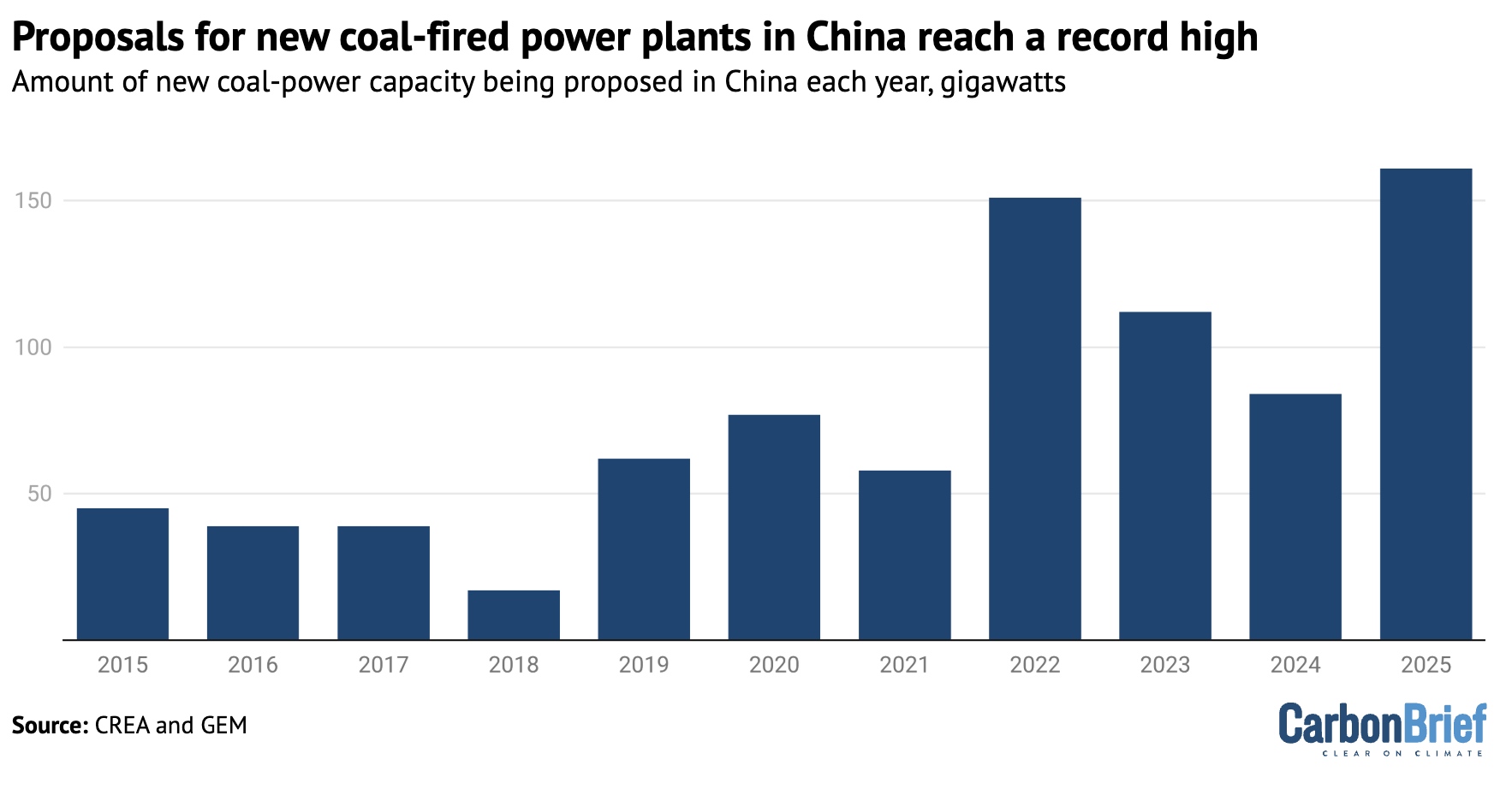
The report, released by the Centre for Research on Energy and Clean Air (CREA) and Global Energy Monitor (GEM), says that, in 2025, developers submitted new or reactivated proposals to build a total of 161 gigawatts (GW) of new coal-fired power plants.
The new proposals come even as China’s buildout of renewable energy pushed down coal-power generation and carbon dioxide (CO2) emissions in 2025, meaning many coal plants are already running at just half of their maximum capacity.
The co-authors argue that while clean-energy growth may limit emissions from coal power in the short term, the surge in proposals could lock in new coal assets, “weaken…incentives” for power-system reform and help keep coal capacity online in spite of China’s climate goals.
The high rate of new proposals, the study says, likely reflects a “rush by the coal industry stakeholders” to develop projects before an expected tightening of climate policy in the next five years.
In addition, “misaligned” payment mechanisms are encouraging developers to propose large-scale coal units, which – if developed – could impact the transition of the coal sector from playing the central role in electricity generation to flexibly supporting a system built on clean power.
Significant additions pushing down running hours
The report finds that the amount of new coal-fired power proposals by Chinese developers, including reactivated applications, hit a new peak in 2025, at 161GW. This is equal to 13% of the coal capacity currently online in China.
The country is continuing to add significant coal-power capacity, with a record 95GW added to the grid last year and another 291GW in the pipeline – meaning units that have been proposed, are actively under construction or have already been permitted.
Moreover, around two-thirds of coal-power capacity proposed in China since 2014 has either been commissioned – meaning it has been completed and started operating – or remains in the pipeline, Christine Shearer, report co-author and research analyst at thinktank Global Energy Monitor, tells Carbon Brief.
She adds that this is the “reverse of what we see outside China, where roughly two-thirds of proposed coal capacity never makes it to construction”.
Coal remains a significant part of China’s power mix, making the nation’s electricity sector one of the world’s largest emitters. Indeed, the power sector emitted more than 5.6bn tonnes of carbon dioxide (GtCO2) in 2024 – meaning that if it were its own country, it would have the highest emissions of any country except China itself.
But emissions from the power sector have been flat or falling since March 2024, according to analysis for Carbon Brief by CREA lead analyst Lauri Myllyvirta.
This is largely due to China’s rapid installation of renewable power, which is covering nearly all of new electricity demand and pushing coal generation into decline in 2025.
Some parts of the coal-power pipeline are reflecting this shift. In 2025, construction began on 83GW of new coal capacity – down from 98GW in 2024.
In addition, new permitting fell to a four-year low, at 45GW, which could point to tighter controls on coal-plant approvals in the future, says the report.
The chart below shows the amount of new coal-power capacity being proposed in China each year, in GW.
The shift from new power demand being met by coal to being met by renewable energy means any “additional coal power capacity would face structurally low utilisation”, the report says, referring to the number of hours that plants are able to operate each year.
This reduces coal-plant earnings needed to cover the cost of investment and makes instances of “stranded [coal] assets and compensation pressures” more likely.
A previous analysis for Carbon Brief finds that “larger additions of coal capacity are often followed by falling utilisation” – meaning that the construction of new coal plants does not necessarily increase emissions.
Utilisation rates for coal-fired power plants have hovered around 51% since 2025, according to the CREA and GEM report.
Shearer argues that while low utilisation rates would “dampen the immediate impact on annual CO2 emissions”, in the long-term the buildout “locks capital into fossil fuels” and “weakens incentives to build the cleaner forms of flexibility” needed for a renewables-centred system.
Low utilisation has also not led to coal plant capacity being retired in any notable way, the report notes, with generators instead supported by the coal “capacity payment” mechanism and extending the life of older units.
Delayed retirement of older coal plants causes “persistent overcapacity” and adds to calls for further compensation and policy support, the report says.
Coal generation has “no room to expand” under China’s international climate pledge for 2030, it adds, with utilisation rates for coal units likely to fall to 42% if renewables continue to meet all additional demand and if all of the plants currently under construction or permitted are brought online.
Crunch-time for coal
The surge in new proposals reflects a “rush” by the coal industry to ensure their projects are approved before the policy environment tightens, according to the report.
China is expected to introduce absolute emissions targets over the next five years. While these are expected to be aspirational for the first five years – alongside binding targets for carbon intensity, the emissions per unit of GDP – from 2030 they will be binding.
The current five-year period until 2030 will also likely see most of China’s energy-intensive industries pulled into the scope of its national carbon market.
In the power sector, government officials have said that coal is expected to shift from playing a major role in power supply to supporting “flexibility” operations.
This would require coal plants to shift between varying load levels and respond quickly to changes in demand and other system needs.
However, the report finds, the approvals for coal power “continue to reflect expectations of high operating hours”, instead of flexible operations.
For many of these proposals, planned annual utilisation was stated to be more than 4,800 hours, or 55% of hours in the year. This is greater than the 4,685 utilisation hours (53%) logged in 2023, the year in which the most coal power was generated over the past decade, according to data shared by the report authors with Carbon Brief.
In addition, the report says that many of the new coal-power proposals in 2025 were for “large-scale units”, each representing at least 1GW of power, as shown in the figure below.
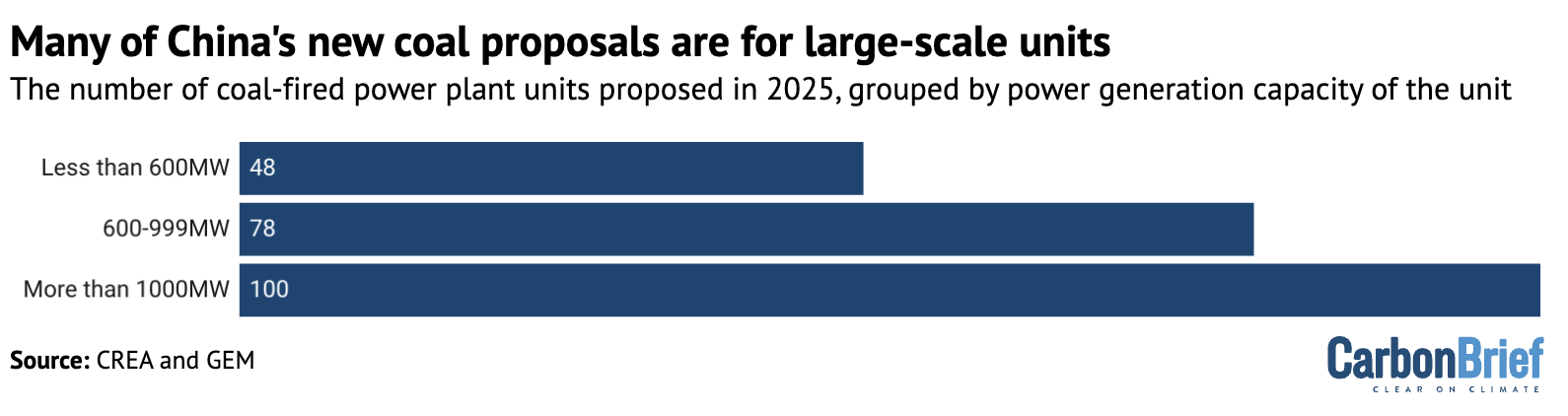
These larger units are designed for “stable, continuous operation” and are “poorly suited to the type of flexibility increasingly required in a power system dominated by wind and solar”, says the report.
This suggests that “project developers still anticipated base-load style operation”, it adds, “sitting uneasily” with the fact of higher clean-energy generation and falling coal plant utilisation.
Reliance on sales and subsidies
This persistence in developing large-scale units could be explained by the financial incentives that govern the coal-power industry.
Coal power plants are cheap to build but risk low profits and high costs, with many current operators already facing losses at recent utilisation rates.
In 2024, the government established a capacity payment mechanism for coal-fired power plants. This mechanism rewards developers for adding “seldom-utilised, backup” capacity to the grid.
These capacity payments, as well as regulated pricing and implicit government backing “can make plants viable on paper even if utilisation and operating margins are weak”, Shearer tells Carbon Brief, which may explain the continued appetite for new coal from developers.
More than 100bn yuan ($14bn) in capacity payments were made to coal plants in 2024, although it has not yet had a discernable impact on utilisation.
Large-scale units, the report says, are “particularly well positioned” to benefit from the policy, as it rewards maximising capacity and does not favour plants that are more suited for flexible operations.
(The Chinese government recently announced plans to adjust the mechanism, confirming that in some cases capacity payments could be more than the initial expected threshold of 50% of a benchmark coal plant’s total fixed costs.)
Meanwhile, the report adds that coal-fired power plants continue to earn most of their revenue from selling electricity, with only 5% of total income coming from capacity payments.
As such, these “misaligned incentives” encourage producing power and installing significant new capacity, despite the government’s aim to shift coal to a supporting role in the system.
Shearer tells Carbon Brief that a better approach to flexibility would be to “adopt technology-neutral flexibility standards”, rather than focusing on “flexible coal”, which would mean coal would have to “compete directly with storage, demand response, grid upgrades and other clean options”. She adds:
“The risk of coal-specific flexibility policies is that they lock in capacity rather than solve the underlying system need.”



The post ‘Rush’ for new coal in China hits record high in 2025 as climate deadline looms appeared first on Carbon Brief.
‘Rush’ for new coal in China hits record high in 2025 as climate deadline looms

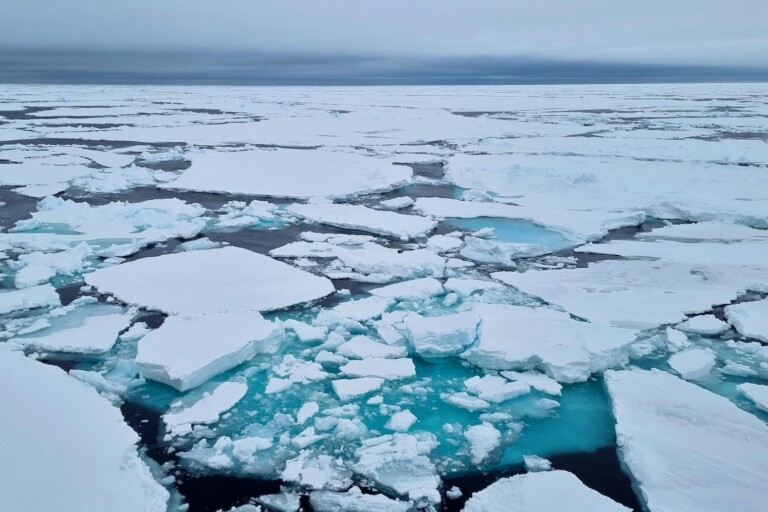
Antarctic sea ice has recorded its third-smallest winter peak extent since satellite records began 48 years ago, new data reveals.
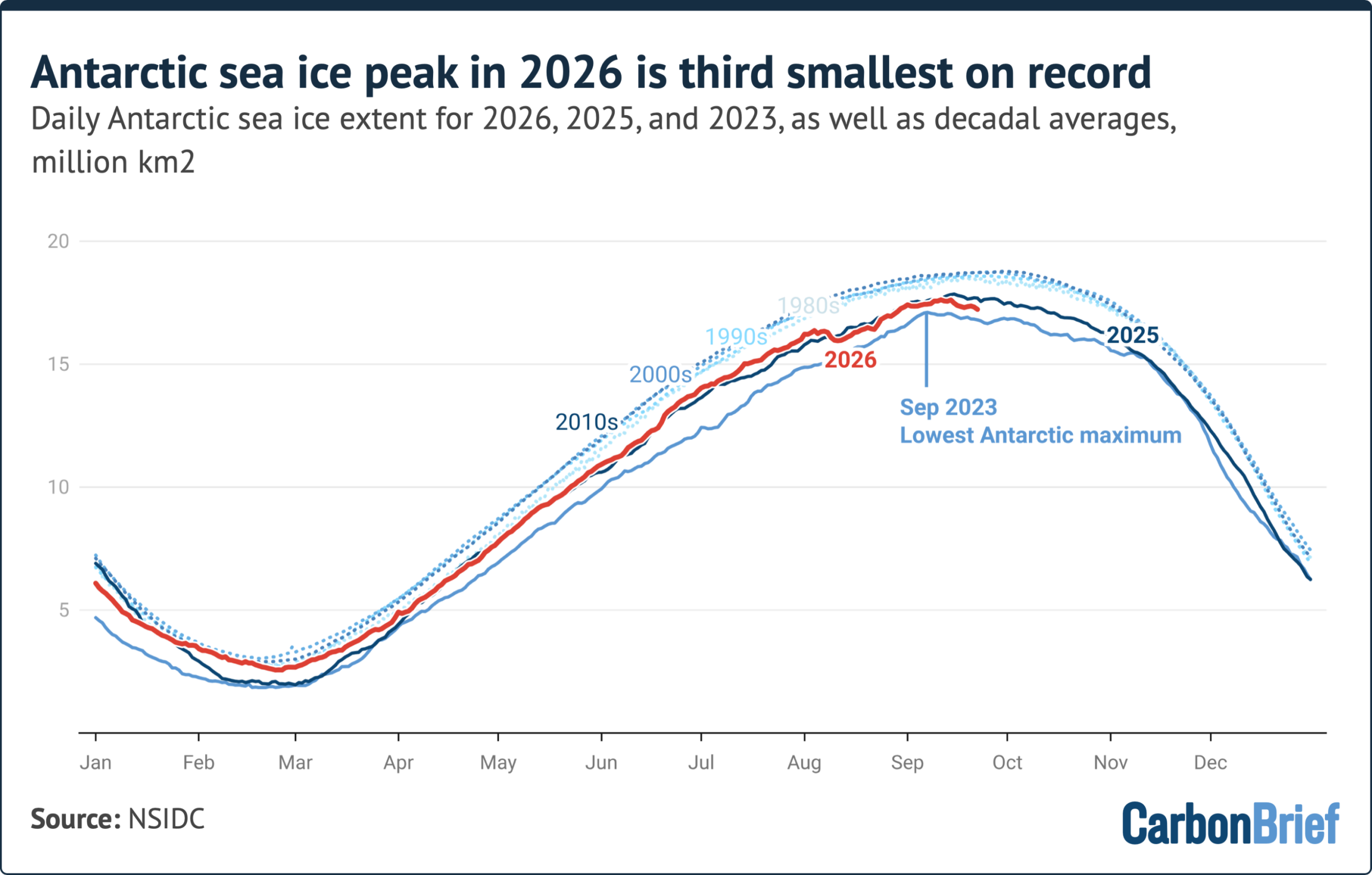
Provisional data from the US National Snow and Ice Data Center (NSIDC) shows that Antarctic sea ice hit its annual winter peak on 14 September, with an extent of 17.59m square kilometres (km2).
The organisation notes that the data is still preliminary, adding that “large fluctuations in extent are typical of Antarctic sea ice near the seasonal maximum”.
One expert tells Carbon Brief that it is “concerning to see these low values persisting”, but says that scientists need more time to determine whether this represents a “structural shift” in Antarctic sea ice extent.
Meanwhile, at the Earth’s other pole, Arctic sea ice reached its annual minimum on 12 September, ranking as the joint-10th lowest in the satellite record.
The NSIDC notes that the last 20 years have seen the lowest 20 Arctic sea ice extents in the satellite record.
Antarctic peak
Dr Lettie Roach, a polar climate scientist at the Alfred Wegener Institute in Germany, tells Carbon Brief that this year’s Antarctic sea ice maximum was “well below average for the season”. She warns that, “after several decades of stable or increasing winter Antarctic sea ice conditions, it is concerning to see these low values persisting”.
She adds:
“Compared with the Arctic, it’s less clear how recent changes in Antarctic sea ice are attributable to human-caused warming vs natural variability. We need more years of observations to better understand whether this is truly a structural shift.”
Dr Clare Eayrs, a postdoctoral researcher at the Korea Polar Research Institute (KOPRI), tells Carbon Brief that, since recording a “near-average February minimum” extent, Antarctic sea ice has “returned to unusually low winter coverage”.
She notes that Antarctic sea ice extent in July and August this year were the fifth and fourth lowest on record, respectively, adding that “all five of the lowest July extents have occurred since 2022 and all four of the lowest August extents since 2023”.
The chart below shows Antarctic sea ice extent in 2025 (dark blue) and 2026 (red) so far. For comparison, the chart shows decadal averages (dotted lines) as well as 2023 (mid blue), the year of the smallest winter sea-ice maximum on record.
Eayrs tells Carbon Brief that the regional pattern of Antarctic sea ice cover “changed substantially during the growth season”.
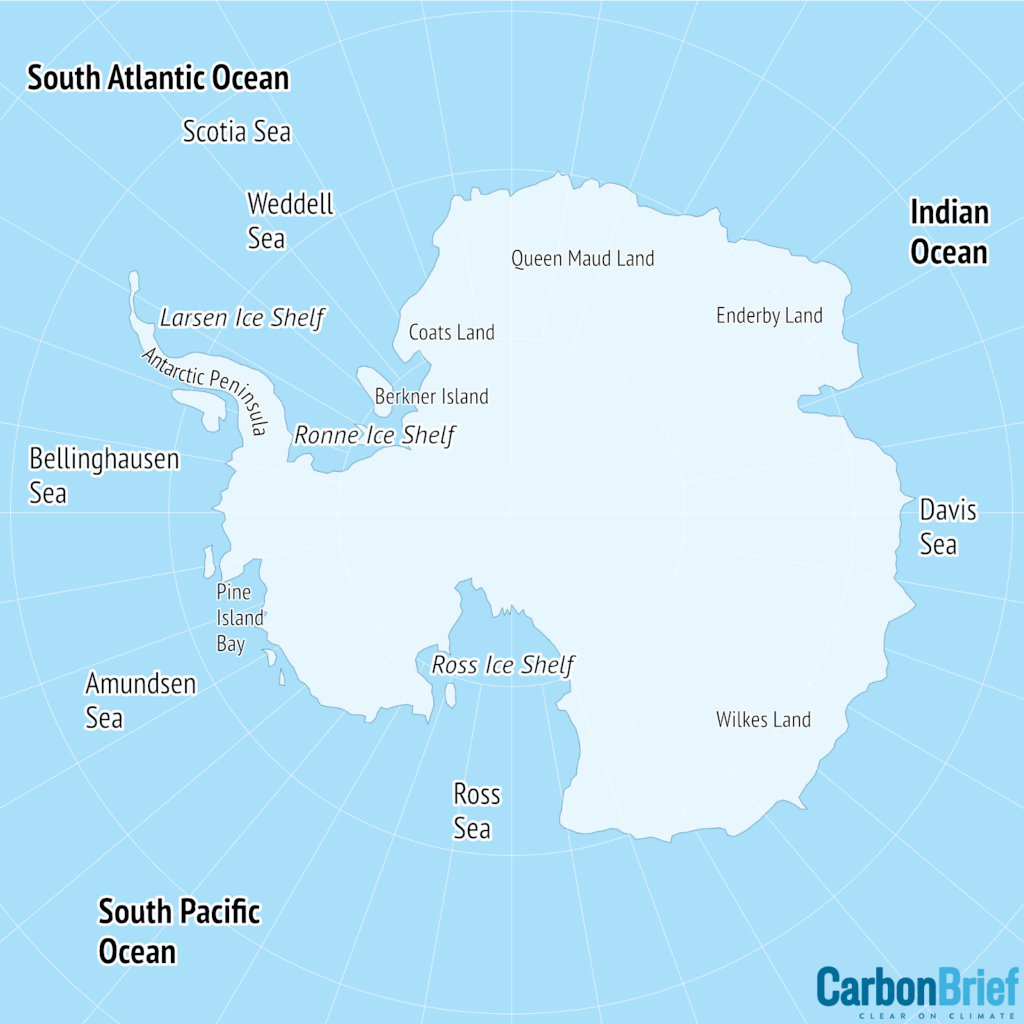
For example, she says that “in April, the Bellingshausen Sea remained almost entirely ice-free, while the neighbouring Amundsen Sea had more ice than usual”.
However, by late August, changes in atmospheric pressure and wind meant that “the Bellingshausen deficit had largely recovered, while ice was unusually scarce in the Amundsen Sea and across much of East Antarctica”.
Arctic minimum
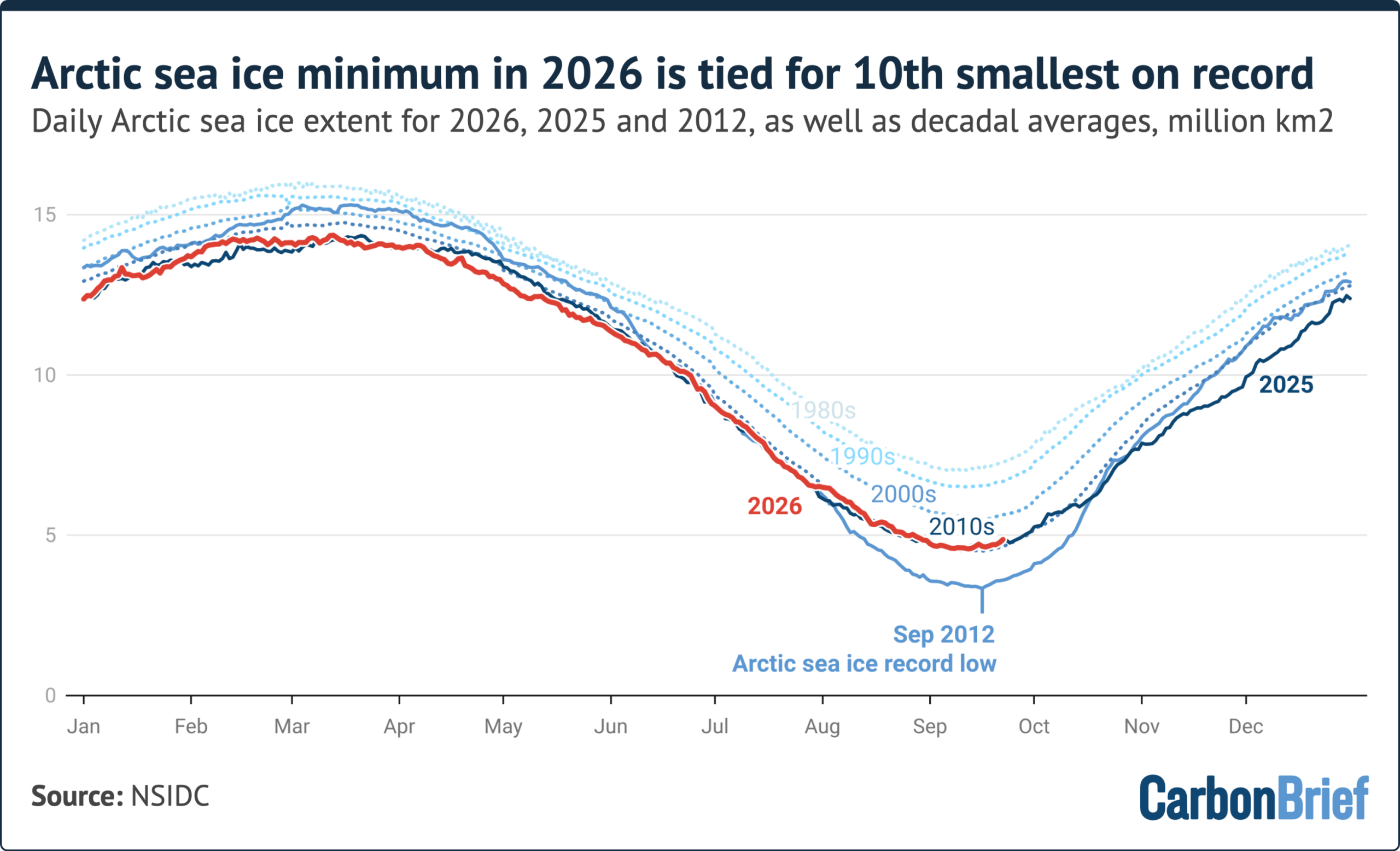
Meanwhile, the Arctic recorded its minimum summer sea ice extent on 12 September. At 4.60m km2, this year ties with 2025, 2010 and 2008 as the 10th-lowest sea ice extent on record.
The chart below shows Arctic sea ice extent in 2025 (dark blue) and 2026 (red) so far. For comparison, the chart shows decadal averages (dotted lines) as well as 2012 (mid blue), the year of the smallest summer sea-ice minimum on record.
Roach tells Carbon Brief that although this minimum is not “record setting”, it is still “lower than any sea ice minimum before 2007”. She adds:
“Human-caused climate change has reduced Arctic sea ice cover and thickness, so the region is fundamentally different compared to a few decades ago.”
Scientists have been tracking Arctic sea ice thickness using a reanalysis produced called the Pan-Arctic Ice Ocean Modeling and Assimilation System (PIOMAS) since 1979.
In March 2026, the National Oceanographic and Atmospheric Administration (NOAA) terminated a global dataset of air pressure that scientists relied upon to produce PIOMAS, forcing both datasets to stop publishing updates.
The PIOMAS website says it will take “considerable effort and time” to find alternative data to use in their reanalysis. It adds that “we don’t yet have a good sense if that’s possible with available funds and if so, when we will be able to resume production of a new PIOMAS timeseries”.
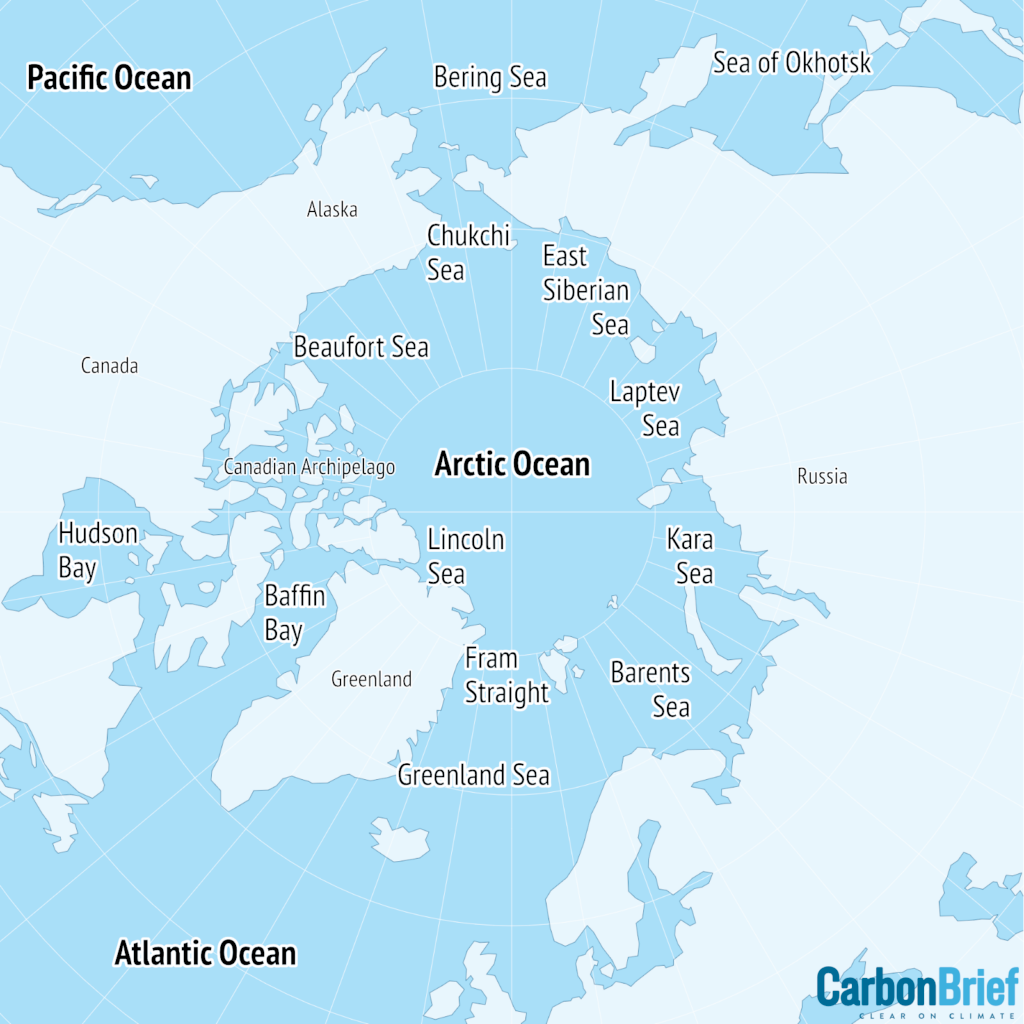
Roach also notes that August saw record-breaking heat sweep across much of the world, explaining that high temperatures “extended into Arctic coastal regions, close to regions with substantial sea ice loss – particularly the Barents-Kara and East Siberian seas”.
Dr Zack Labe, a scientist at Climate Central, tells Carbon Brief that the absence of a new record does not mean that ice cover is becoming more “resilient”. He says:
“Local weather patterns across the Arctic play a really important role in year-to-year sea-ice extent, even as the long-term trend is clearly downward.”
Labe tells Carbon Brief that weather in the Arctic this summer was “influenced mainly by lower pressure toward the central Arctic, which brought cloudier and cooler conditions that limited surface melt and delayed the start of the melt season”.
He explains that this “was most obvious across parts of the Beaufort and Chukchi seas, where the melt season didn’t really kick off until after early July, which was more than two weeks later than normal”.
In contrast, he says, the Atlantic side of the Arctic “had a much more extreme summer”, with sea ice in the Barents Sea recording its “earliest melt-out on record”.
This was partly due to “unusually warm air and ocean temperatures”, Labe says. He notes, for example, that parts of western Siberia saw unusually persistent temperatures more than 5C above the 1981-2010 average for much of the summer, which extended out over the Kara Sea and contributed to substantial ice melt in this area”.
Labe tells Carbon Brief that, going forward, scientists need “more data and observations of other sea-ice metrics, like ice thickness, which may give us better insight into the overall condition of the ice pack, especially during years like 2026 when it is very fragmented”.
(In March 2026, Arctic sea ice reached its peak extent for this winter, clocking in as the joint-smallest in a satellite record going back almost half a century.)
Related
Guest post: Climate change has caused one-fifth of Pine Island glacier retreat
‘Very alarming’ winter sees Arctic sea ice hit record-low for second year running
Q&A: How Trump is threatening climate science in Earth’s polar regions
Limiting warming to 2C is ‘crucial’ to protect pristine Antarctic Peninsula
The post ‘Concerning’ low sea ice persists as Antarctic hits third-lowest winter peak appeared first on Carbon Brief.
‘Concerning’ low sea ice persists as Antarctic hits third-lowest winter peak
Participants at COP31 in Antalya will have a “duty” not to interfere in Türkiye’s internal affairs under the country’s hosting deal with the UN, reviving a clause dropped for last year’s climate summit in Brazil that human rights groups warn could put activists at risk.
Türkiye has faced growing criticism from human rights groups over the jailing of opposition figures, journalists and activists and imposed a blanket protest ban around July’s summit of the NATO military alliance in Ankara.
The contested provision is included in the binding agreement between the UN climate secretariat and the Turkish government that sets out responsibilities over logistical arrangements and details participants’ rights and obligations.
The document, signed in June but only made public on Wednesday, gives accredited COP31 attendees immunity from legal action over what they say, write or do in connection with the conference. Climate Home News understands that this safeguard can be applied to what takes place both inside and, in certain circumstances, outside of the UN-controlled COP “Blue Zone”. For the first time, this protection explicitly continues after the summit ends.

But participants enjoying these “privileges and immunities” also have a duty to respect Türkiye’s laws and regulations and not to interfere in its internal affairs, the agreement states. Rights groups fear its wide-ranging formulation could be used to discourage criticism of the host government.
Climate Home News understands that whether an action is covered by the immunity or infringes on the host’s internal affairs would be evaluated on a case-by-case basis, with close coordination between the country’s authorities and the UN climate change body.
A separate provision states that immunity shall be waived where the UN believes it would “impede the course of justice”.
‘Chilling effect’
Those same provisions featured in the host country agreements for COP28 in the United Arab Emirates and COP29 in Azerbaijan, both regarded as authoritarian regimes, before being dropped for COP30 in Brazil.
Ann Harrison, climate justice policy advisor at Amnesty International, said it is “extremely disappointing” that the COP31 agreement re-introduced clauses that could “hinder the ability of human rights defenders and civil society organisations to conduct their work safely”.
COP31 electrification pledge leaves out clean power commitment
She added the provisions could have a “wider chilling effect” on rights to freedom of expression and peaceful assembly, given concerns over the human rights situation in Türkiye, including laws that “have shrunk civic space” and their “abusive” implementation by authorities.
The UN climate change body declined to comment.
Rights groups have documented blanket protest bans, unlawful use of force by the police and prosecutions of journalists, human rights defenders and lawyers across Türkiye in the last year.
Arrests and protest bans
Last July, environmental activist Esra Işık was sentenced to more than two years for “resisting” a public official over what Amnesty International described as a peaceful protest against an urgent expropriation order linked to the expansion of coal mining in south-western Türkiye. She is appealing the conviction.
Ahead of a summit of the NATO alliance in the capital Ankara in July, authorities put in place a 13-day blanket ban on demonstrations, citing “national security”, and arrested over 200 people. Human Rights Watch said the crackdown showed Türkiye’s “ruthless intolerance of freedom of speech and assembly”.
Earlier this month, Turkish police detained dozens of people as part of what rights groups described as the government’s widening crackdown on LGBTQ+ activists and venues.
Questioned by media as to how he would guarantee the right to protest at COP31, Kurum said earlier in September that his team would “try to meet” any request they receive from civil society and give them “a free space to express themselves”.
“Don’t worry, thinking you will not be able to voice your opinions or really share your thoughts,” he said in an attempt to reassure campaigners, adding that he had put former deputy environment minister Mehmet Birpinar in charge of liaising with civil society.
Civic space needed
Camilla Pollera, human rights and climate change campaigner at the Center for International Environmental Law (CIEL), said meaningful participation at COP31 is fundamental to the legitimacy of climate action.
“At a climate summit, civil society participation necessarily includes being present, speaking out, scrutinising governments’ decisions and climate policies, and advocating for communities most vulnerable to climate change,” she added.

At last year’s COP30 summit, thousands of Indigenous people and climate activists peacefully marched through the Amazonian city of Belém in the first major demonstration outside the UN venue in four years. Smaller-scale demonstrations were largely confined to the “Blue Zone” at COP27 in Egypt, COP28 in the UAE and COP29 in Azerbaijan.
In two other separate incidents in Belém, members of the Munduruku tribe blocked access to the conference centre for hours, demanding an end to development projects in their ancestral land, and protesters stormed through the venue clashing with UN security officials.
The COP31 hosting agreement keeps some of the safeguards previously hailed by civil society groups. The government and the UN secretariat commit to upholding “the fundamental human rights” of all participants in the agreement’s preamble.
Under the deal, Türkiye also needs to ensure that security personnel follow “the highest ethical and professional standards and are expected to behave with integrity and respect”.
The post COP31 attendees told not to interfere in Türkiye’s “internal affairs” appeared first on Climate Home News.
COP31 attendees told not to interfere in Türkiye’s “internal affairs”
As rising seas submerge growing swathes of land, countries that lose territory should still keep their national boundaries, sovereign rights and UN membership, according to a political declaration adopted at the UN General Assembly in New York on Thursday.
The declaration, which was championed by climate-vulnerable small island states, affirms “the presumption in favour of continued statehood” in the face of sea level rise fuelled by climate change, and urges countries to work together to assist communities affected by encroaching oceans.
Speaking at a high-level UN meeting to address the existential threats posed by sea level rise, Cabo Verde’s Prime Minister Francisco Carvalho, one of the initiative’s co-facilitators along with Australia, said the adoption of the text by consensus sends “a message of hope”.
“This declaration has a very special meaning. For us, sea level rise is neither a distant threat nor a theoretical concern,” he said, adding that rising seas put at risk key infrastructure, water resources and economic growth in small island states.
In the Pacific, sea levels have risen at twice the global rate, dramatically increasing coastal flooding events from two to 20 a year in the Republic of the Marshall Islands, and from zero to 102 events per year in American Samoa, according to the World Meteorological Organization (WMO).
Surangel Whipps Jr., president of the Pacific island of Palau, said the summit in New York represents a “moment of international solidarity”, and highlighted that small island states will remain permanent members of the UN.
-
Push for cooking to be part of COP31’s electrification agenda
The President of Kenya and the British climate envoy said Africa should use the global electrification push to roll out clean cooking -
Germany unveils plan to end use of fossil fuels in energy sector by 2045
Germany became the third country to publish a roadmap to phase out fossil fuels after France and the Netherlands, as the UN chief calls on all governments to follow -
UN Climate Summit: UN chief says world has tools to end fossil fuel age
At the UN Secretary-General’s climate summit in New York, countries shared their energy transition plans while Nepal and island nations advocated for more international support


Declaration recognises statehood
An advisory opinion by the world’s top maritime court, the International Tribunal on the Law of the Sea (ITLOS), first upheld in 2024 that countries do not have to shrink their maritime borders even if they lose land territory due to sea level rise. This was reiterated by the International Court of Justice in last year’s landmark ruling on the climate obligations of states.
The new declaration endorsed by all governments at the UN General Assembly stresses that sea level rise “is not a distant scenario but a real and lived experience for many”, and notes that international law must be implemented in global responses to rising seas.
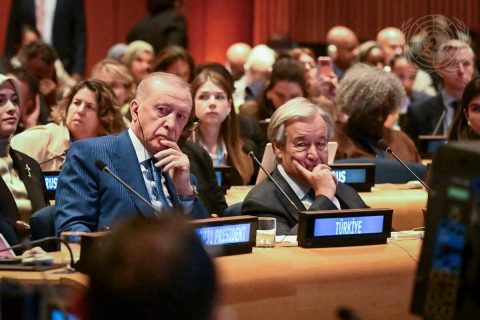
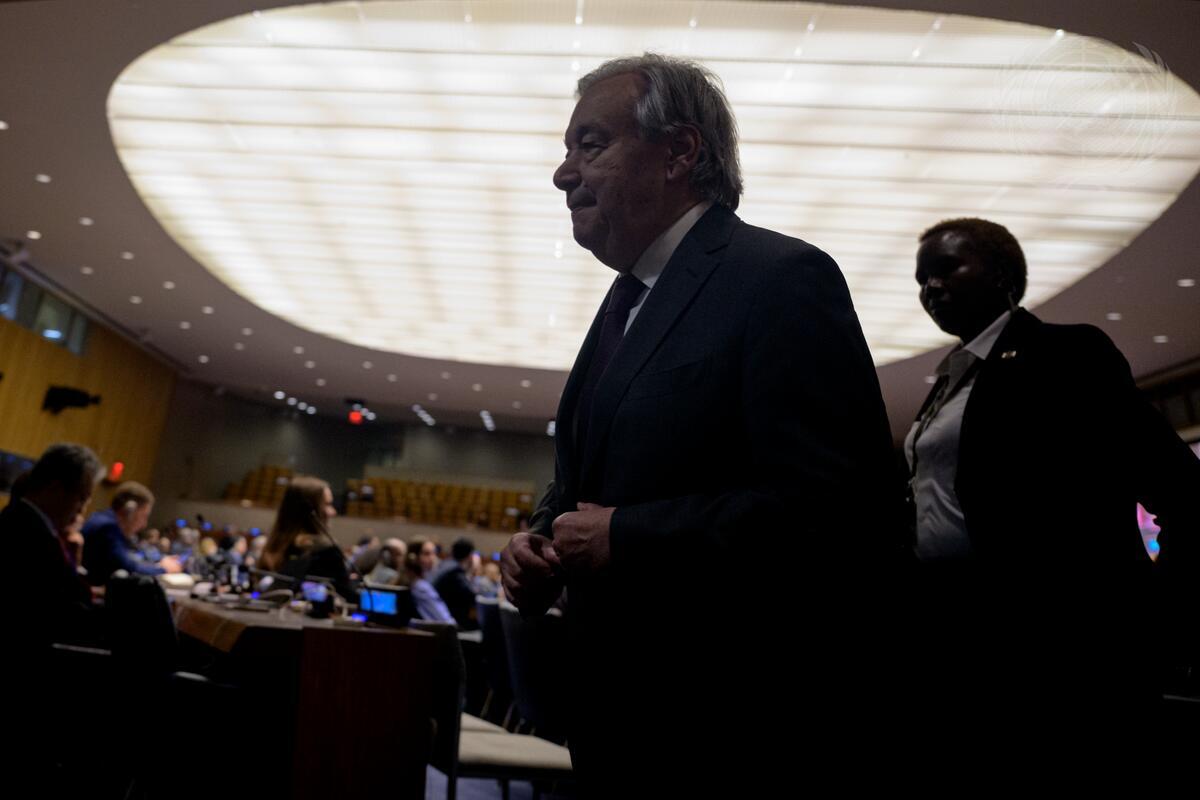
UN Secretary-General António Guterres said the “milestone must now be translated into action”, adding that the declaration should encourage an “ongoing dialogue” at the “highest possible level” leading to practical outcomes. Pacific islands have proposed an international treaty on sea level rise that would provide more legal certainty.
“Those on the frontlines must be front and centre on every decision. We cannot allow countries and cultures to vanish beneath the waves,” he said. “The SOS has gone out. The world must answer.”
At regional summit, Pacific islands ask for COP31 support for clean energy and finance
Goodwin Friday, prime minister of St. Vincent and the Grenadines, said measures to protect vulnerable states will require adequate finance. “Investing in resilience now is more cost-effective than paying the far greater price for loss and damage later,” he added.
Championed by Australia’s COP31 co-presidency, Pacific islands have sought to put adaptation to sea level rise and ocean conservation at the top of the political agenda by inviting world leaders to attend the pre-COP31 summit co-hosted by Fiji and Tuvalu in October.
Tuvalu will also host the second global fossil fuel phase-out summit in April 2027, after around 60 governments met this year in Santa Marta, Colombia, to discuss ending their dependence on coal, oil and gas.
“Our coastlines, our reefs and our communities are living with the consequences of fossil fuel dependence every day, and our people have earned the right to help shape the way forward,” Lynda Tabuya, Fiji’s climate minister, said in a statement announcing details of the conference.
Ocean monitoring gets a boost in New York
Amid record-breaking marine heat and seas rising at unprecedented speed, governments in New York announced new commitments to protect the world’s ocean, as efforts to bolster marine ecosystems and coastal communities rise up the political agenda.
On Wednesday, the EU and Canada announced more funding for a new Europe-led ocean monitoring system called OceanEye, launched in the aftermath of a failed attempt by the Trump administration to dismantle the largest existing network of deep-sea observatories.
During an event at UN headquarters in New York, EU President Ursula von der Leyen and Canadian Prime Minister Mark Carney announced around $163 million in new funding for the initiative, with the EU pledging €92 million ($105m) on top of existing seed funding and Canada pledging C$82 million (US$58m) over five years.
According to an EU statement, while OceanEye will collaborate with the Global Ocean Observing System, that network “remains vulnerable to financial shortfalls and geopolitical disruptions”. A group of 30 countries from Europe, Africa and the Americas joined an international initiative in support of OceanEye, including large coastal nations like Brazil, Namibia and Mexico.
Von der Leyen said OceanEye “can make us the leading ocean data provider in a matter of years”, including by launching new satellites and installing new observatories in the deep ocean. “From outer space to the deepest ocean, our funding helps us keep watch beneath the waves,” she added.
Carney said the initiative would help protect Canada’s Arctic region with real-time monitoring operating year-round. “We can’t protect what we can’t see,” he said, also highlighting that Canada had expanded conservation of its ocean territory from 1% a decade ago to 15% now.
In New York, a group of 19 countries said they are either developing or implementing plans to sustainably manage all of their ocean territory, with 12 new nations joining the initiative. In a joint communiqué, they called on more countries to sign up ahead of COP31.
Warnings of El Niño-fuelled extreme heat
Scientists and world leaders have raised the alarm over this year’s record-breaking marine temperatures, which have persisted above historical peaks for more than 100 days as the naturally occurring El Niño phenomenon intensifies in the Pacific.
Extreme ocean heat could become a threat to coastal ecosystems and communities, experts fear. Water temperatures 1.5C above normal levels have also rapidly fuelled a strong hurricane in the Pacific in recent days.
Despite scientific calls for additional ocean conservation efforts, a report launched this week in New York warned that efforts to protect ocean ecosystems are lagging behind, with only 10% of the global ocean covered by conservation areas and just 3.5% designated as “effectively protected”.
The post Threatened by rising seas, small islands secure right to keep their statehood appeared first on Climate Home News.
Threatened by rising seas, small islands secure right to keep their statehood



-

 Greenhouse Gases2 years ago
嘉宾来稿:满足中国增长的用电需求 光伏加储能“比新建煤电更实惠”
-
Climate Change1 year ago
Guest post: Why China is still building new coal – and when it might stop
-
Greenhouse Gases1 year ago
Guest post: Why China is still building new coal – and when it might stop
-

 Climate Change2 years ago
嘉宾来稿:满足中国增长的用电需求 光伏加储能“比新建煤电更实惠”
-

 Renewable Energy11 months ago
Sending Progressive Philanthropist George Soros to Prison?
-
Climate Change2 years ago
Bill Discounting Climate Change in Florida’s Energy Policy Awaits DeSantis’ Approval
-
Greenhouse Gases1 year ago
嘉宾来稿:探究火山喷发如何影响气候预测
-

 Climate Change2 years ago
Analysis: China’s CO2 falls 1% in Q2 2024 in first quarterly drop since Covid-19