



- What timeline options were delegates debating?
- How did the timeline discussions unfold?
- What were the main points of disagreement?
- Why is the IPCC in a ‘serious funding crisis’?
- How have scientists reacted?
- What other issues remain unresolved?
- How are the IPCC AR7 reports progressing?
- How might the IPCC use AI and enhance gender inclusivity?

Carbon credits generated from renewable energy projects have failed to obtain a new quality label from a key oversight body, casting fresh doubt on popular emissions offsets favoured by multinational companies like Audi, Shell and Total.
The Integrity Council for the Voluntary Carbon Market (ICVCM) announced on Tuesday that eight renewable energy methodologies, which cover about a third of the carbon credits available on the voluntary market, cannot use its “Core Carbon Principles” (CCP) seal of approval.
The ICVCM, an independent watchdog, aims to address widespread concerns over the quality of carbon credits after many projects have been accused of overstating their climate and societal benefits. It is assessing groups of offsetting projects to determine whether they comply with the CCP criteria, which are designed to identify and encourage high-integrity carbon credits that meet requirements on governance, emissions reduction and sustainable development.
The body said existing standards are not strict enough on judging whether renewable energy projects need the funding generated by selling carbon offsets in order to go ahead – a concept known as “additionality”. But it emphasised that renewables like solar, wind and hydropower are key to tackling climate change and carbon credits “still have a role to play” in financing them.
Sign up to get our weekly newsletter straight to your inbox, plus breaking news, investigations and extra bulletins from key events
Since the eight methodologies were designed as long as 20 years ago, the cost of renewables has collapsed, and their profitability in many parts of the world has rocketed, meaning they are more likely to make money without needing extra revenue from selling carbon offsets.
The ICVCM said that “for several years, carbon market experts have noted concerns about the additionality of many renewable energy activities and the difficulties in transparently demonstrating the additionality of these activities approved under existing methodologies”.
Major carbon-credit registries like Verra and Gold Standard stopped accepting new grid-connected projects in 2019, with the exception of those located in least-developed countries (LDCs).
But pre-existing renewable energy activities continue to generate a sizeable chunk of all the offsets available on the registries.
According to a recent analysis by Carbon Market Watch, over 280 million renewable energy credits are available in the voluntary carbon market. If companies and individuals used all those credits, that would compensate on paper for emissions equivalent to the amount of carbon dioxide Thailand released into the atmosphere last year.
Inigo Wyburd, a policy expert at Carbon Market Watch, called the ICVCM’s decision “a positive step”. “It sends a clear message to tackle the issue of the many low-quality credits still in circulation and undermining the market,” he told Climate Home.
Despite long being written off as largely worthless by climate experts, renewable energy credits are still popular among corporate buyers.
Fossil fuel majors like Shell and Total, automakers and cruise operators were among the biggest purchasers of renewable energy credits over the last 12 months, an analysis of Verra’s database shows.

In one transaction last year, German carmaker Audi used nearly 100,000 carbon credits generated in 2021 from an Indian solar project to claim that its handover of electric vehicles in Europe and the United States was “CO2 neutral” despite the emissions involved in producing them.
Japanese parcel delivery service Yamato Transport Company and public entities like Australia’s Brisbane City Council and Western Sydney University also relied on renewable offsets to claim carbon neutrality in 2023.
Because of earlier concerns about whether carbon offsets generated by renewable energy deliver the emissions reductions they claim, their price has been falling over the last two years.
According to data provider MSCI, the average price is just $2 per tonne of carbon dioxide equivalent reduced – less than half the price of offsets derived from projects aiming to protect forests, tackle methane emissions or promote energy efficiency. Renewable energy credits are likely to see further falls in price after the ICVCM’s rejection.
As first airline drops goal, are aviation’s 2030 targets achievable without carbon offsets?
But Amy Merrill, CEO of the ICVCM, left the door open to better renewables methodologies obtaining CCP approval. She called on carbon crediting programmes to develop methodologies “that better reflect the rapidly changing and variable circumstances around renewable energy deployment”.
“While renewable energy costs have fallen dramatically around the globe over the past decade,” she said, “they have not fallen evenly across all countries and high up-front expenses and other barriers mean that there are still many places where it is difficult to deploy renewable capacity.”
The cost of renewables is particularly high in remote rural parts of developing countries without access to the electricity grid, on islands with small populations and in areas where the authorities are hostile to renewable energy for ideological reasons, particularly in parts of the US. Methodologies enabling projects in these places would have the best case to get CCP approval, market experts told Climate Home.
IPCC’s input into key UN climate review at risk as countries clash over timeline
Verra has announced that it will revise some of its additionality requirements “to address the deficiencies noted by the ICVCM”.
The registry plans to submit its new rulebook to the watchdog and give existing projects the possibility of updating their quantification of credits accordingly. “This is part of our commitment to providing a path for all VCS [voluntary carbon standard] projects that wish pursue a path to CCP labelling,” Verra said in a statement.
A Gold Standard spokesperson said ICVCM’s rejection of the methodologies was “ambiguous and potentially harmful to high-quality renewable energy carbon credits on the market today” as different regions across the world still face various financial and technical barriers making carbon finance necessary.
They added that Gold Standard would consider the ICVCM assessment framework among other inputs in its next review of relevant methodologies.
The ICVCM’s negative assessment of existing renewable energy credits could also have repercussions for the new United Nations carbon mechanism currently under development.
Canada’s Olympics kit provider hit with greenwashing complaint in France
Renewable energy projects make up four-fifths of all projects seeking a transfer from the old Kyoto-era Clean Development Mechanism (CDM) into the new market system being set up under Article 6 of the Paris Agreement, Climate Home revealed last January.
The projects need formal authorisation to proceed from the countries where their activities are located.
Carbon Market Watch’s Wyburd said ICVCM’s rejection of the renewable energy methodologies “will hopefully send a few shock waves” to the countries having to make those decisions. “Given their profound shortcomings, these credits should not be given a new lease of life under the future UN mechanism,” he added.
At the same time, the ICVCM approved other methodologies to capture methane from landfills and to detect and repair methane leaks in the gas industry. That means 3.6% of unretired carbon credits have now been approved to use the CCP label.
Audi, Shell, Norwegian Cruise Lines, Western Sydney University and Aviva did not respond to a request for comment on the impact of the ICVCM’s renewables decision. Total declined to comment.
(Reporting by Joe Lo and Matteo Civillini, editing by Megan Rowling)
The post Renewable-energy carbon credits rejected by high-integrity scheme appeared first on Climate Home News.
Renewable-energy carbon credits rejected by high-integrity scheme
Continue Reading
Three countries have been named by the Paris Agreement’s compliance committee for failing to submit a nationally determined contribution (NDC) and repeatedly snubbing offers of help with their climate plans.
After months of internal debate over whether to identify serial non-responders, the Paris Agreement’s Implementation and Compliance Committee (PAICC) named the three countries which have failed to engage with it over their NDCs on Friday.
It named Democratic Republic of Congo, Senegal and North Korea in a footnote of its annual report, adding that it decided to name them “with a view to facilitating engagement”, adding that representatives of the three nations had been invited to its meeting in early 2027 “with the purpose of identifying any challenges and constraints”.
“The Committee noted the importance of Parties engaging with the Committee in a timely manner, while noting that some delays may be due to the national capabilities and circumstances of the Parties”, the report said.
-
Under US pressure, World Bank says it will back gas “where appropriate”
The US wants the World Bank to expand its gas support while climate campaigners are pushing for it to end – its head spoke this week of limited backing for the fossil fuel -
IPCC scientists vow to press on with climate reports despite political deadlock
After governments again failed to agree a timeline, nearly 120 IPCC authors pledged to complete their assessment on time and with full scientific rigour -
Paris Agreement committee snubbed over missing NDC climate plans
Many governments have still not submitted a nationally determined contribution to the UN, breaching a key requirement of the Paris Agreement
In July, PAICC said 12 countries had ignored its repeated attempts to discuss why they had not published an NDC as required every five years under the 2015 Paris accord.
Members of the committee had been divided over whether to name them, but at a September meeting decided to do so in their annual report to the annual climate COP summit.
By the time the report was published on Friday, only Congo, Senegal and North Korea “had not communicated an NDC or submitted a [Biennial Transparency Report] and had not yet responded to any of the Committee’s notifications, despite several reminders issued by the Committee in this regard”.
Rainforest and renewable energy ambitions
The silence from Congo and Senegal is notable because the former is home to much of the Congo Basin rainforest while the latter has sought billions of dollars in climate finance to support its renewable energy ambitions.
After Brazil, Congo has more rainforest than any country in the world. This forest, and the country’s peatlands, absorb huge amounts of greenhouse gas but are fast being lost to expanding farmland, charcoal production, logging and mining.
Senegal signed a Just Energy Transition Partnership with Canada and wealthy European nations in 2023, to help it meet its renewable energy targets under the-then government of Macky Sall. It was chair of the Least Developed Countries group between January 2022 and December 2023.

Tejas Rao, who is researching the PAICC as part of a doctoral thesis at Cambridge University, said the governments of the three countries should engage with the committee.
“Engagement costs these governments very little and the committee has shown it will listen,” he said.
“Silence leaves the committee with no basis to help, and it leaves the [governments] exposed to the narrative that they are simply disengaged,” he told Climate Home News.
Paris Agreement requirement
The 2015 Paris Agreement requires all parties to publish an NDC every five years outlining their emissions reduction targets, with each plan meant to be more ambitious than the country’s last NDC.
The latest set – the third round of plans, with new targets for 2035 – was due in February 2025. While most countries missed this deadline, all but around 30 – mostly small emitters but including Egypt, Vietnam and Argentina – have now submitted them.
Over the year, the PAICC – which is made up of government climate officials from developed and developing countries – has been communicating with governments that have not submitted NDCs and trying to overcome barriers to them doing so.
Some nations have cited exceptional circumstances as the reason for not submitting an NDC, a process that requires a significant amount of work in tracking emissions and consulting on how to curb them across the economy. For example, a letter from a Sudanese official to the PAICC, seen by Climate Home News, said that the country’s civil war had led to the suspension of its NDC preparation.
-
IPCC scientists vow to press on with climate reports despite political deadlock
After governments again failed to agree a timeline, nearly 120 IPCC authors pledged to complete their assessment on time and with full scientific rigour -
Under US pressure, World Bank says it will back gas “where appropriate”
The US wants the World Bank to expand its gas support while climate campaigners are pushing for it to end – its head spoke this week of limited backing for the fossil fuel -
Who shapes climate science? The equity question facing the IPCC
Early completion of the next global climate science assessment reports risks excluding research from the Global South, which is key to ensuring the findings are fair
The US and Iran are not signed up to the Paris Agreement and so do not have active NDCs, nor does Taiwan, which is not a UN member state.
Rao said that because the PAICC is “facilitative and non-punitive”, naming the countries “is meant to open a door, not close one – the invited consultation is the point”.
“In recent months, governments that explained their constraints, whether capacity, finance or domestic process, have been met with follow-up and support rather than sanction, and the number of silent governments has fallen sharply,” Rao said.
The post Paris Agreement committee names three countries snubbing it over NDCs appeared first on Climate Home News.
Paris Agreement committee names three countries snubbing it over NDCs
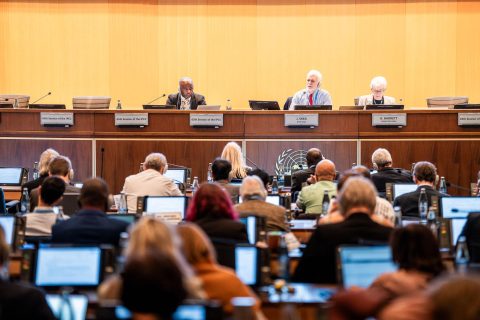
Countries have failed – for the sixth time running – to agree on the timeline for publishing the Intergovernmental Panel on Climate Change’s (IPCC) next set of influential reports.
The IPCC’s 65th session (IPCC-65) was seen by many to be the final opportunity for countries to agree on a schedule where its seventh assessment report (AR7) would be published in time for the UN’s second “global stocktake” of climate action.
Before last week’s meeting in Addis Ababa, Ethiopia, IPCC chair Prof Sir Jim Skea had warned that releasing the reports in time for t