

The “undervaluing” of nature by businesses is fuelling its decline and putting the global economy at risk, according to a major new report.
An assessment from the Intergovernmental Science-Policy Platform on Biodiversity and Ecosystem Services (IPBES) outlines more than 100 actions for measuring and reducing impacts on nature across business, government, financial institutions and civil society.
A co-chair of the assessment says that nature loss is one of the most “serious threats” to businesses, but the “twisted reality is that it often seems more profitable to businesses to degrade biodiversity than to protect it”.
The “business and biodiversity” report says that global “finance flows” of more than $7tn (£5.1tn) had “direct negative impacts on nature” in 2023.
The new findings were put together by 79 experts from around the world over the course of three years, in what IPBES described as a “fast-track” assessment.
IPBES is an independent body that gives scientific advice to policymakers about biodiversity and ecosystems.
This is the “first report of its kind” to provide guidance on how businesses can contribute to 2030 nature goals, says IPBES executive secretary Dr Luthando Dziba in a statement.
Below, Carbon Brief explains four key findings from the “summary for policymakers” (SPM), which outlines the main messages of the report.
The full report is due to be released in the coming months after final edits are made.
- Businesses both depend on, and harm, nature
- Current practices ‘do not support’ efforts to halt and reverse biodiversity loss
- Businesses can act now to address their impacts on nature
- Government policies can drive a ‘just and sustainable future’ for nature and people
1. Businesses both depend on, and harm, nature
Businesses of all sizes rely on nature in one way or another, says the report.
The SPM outlines that biodiversity provides many of the goods and services businesses need, such as raw materials from the environment or controlled water flows to reduce flooding during wet seasons and provide water in dry seasons.
Biodiversity also “underpins genetic diversity” that informs the development of products in many industries, including pharmaceuticals and cosmetics.
Individual businesses often do not address their impacts and dependencies on nature, “in part due to their lack of awareness”, the SPM says.
They also often do not have the data or knowledge to “quantify their impacts on dependencies on biodiversity and much of the relevant scientific literature is not written for a business audience”, the report claims. It adds:
“Lack of transparency across value chains, including of the risks and opportunities related to the sustainability of resource extraction, use, reuse and waste management, is a further barrier to action.”
The report says it is well established that businesses depend on biodiversity, but also that the actions of businesses “continue to drive declines in biodiversity and nature’s contributions to people”.
It adds that the size of a business “does not always reflect the magnitude of its impacts”, with companies in sectors such as agriculture, forestry, fishing, electricity, energy and mining having “relatively high” direct impacts on nature.
A “failure” to account for nature as the economy has expanded over the past two centuries has “led to its degradation and unprecedented rates of biodiversity loss”, the SPM says. It adds:
“The decline in biodiversity and nature’s contributions to people has become a critical systemic risk threatening the economy, financial stability and human wellbeing with implications for human rights.”
It is well established that nature loss as a result of “unsustainable use” threatens the “ability of businesses, local economies and whole sectors to function”, the report details.
These risks and others – such as extreme weather events and critical changes to Earth systems – are “among the highest-ranked global risks over the next 10 years”, it adds.
The SPM notes further that it is well established that risks around climate change and biodiversity loss “may interact to amplify social and economic impacts”.
These risks have “disproportionate impacts on developing countries whose economies are more reliant on biodiversity and have more limited technical and financial capacity to absorb shocks”, the report adds.
2. Current practices ‘do not support’ efforts to halt and reverse biodiversity loss
The SPM says that it is well established that current political and economic practices “perpetuate business as usual and do not support the transformative change required to halt and reverse biodiversity loss”.
These practices have “commonly ignored or undervalued biodiversity, creating tension between business actions and the conservation and sustainable use of biodiversity”, the report continues.
For example, the report says there is established but incomplete evidence that “time pressures on decision-making and timescales for investment returns and reporting by businesses – with an emphasis on quarterly earnings or annual reporting – are shorter than many ecological cycles”.
This prevents businesses from “adequately” considering nature loss in decision-making, says the SPM.
There is well established evidence that businesses fail to assign adequate value to “biodiversity and many of nature’s contributions to people, such as filtration of pollutants, climate regulation and pollination”, it continues.
As a result, “businesses bear little or no financial cost for negative impacts and may not generate revenue from positive impacts on biodiversity”, leading to “insufficient incentives for businesses to act to conserve, restore or sustainably use biodiversity”.
Prof Stephen Polasky, co-chair of the assessment and a professor of ecological and environmental economics at the University of Minnesota, said in a statement:
“The loss of biodiversity is among the most serious threats to business. Yet the twisted reality is that it often seems more profitable to businesses to degrade biodiversity than to protect it. Business as usual may once have seemed profitable in the short term, but impacts across multiple businesses can have cumulative effects, aggregating to global impacts, which can cross ecological tipping points.”
It is well established that policies from governments can “further accelerate biodiversity decline”, the SPM says.
It notes that, in 2023, global public and private financial spending with direct negative impacts on nature was estimated at $7.3tn.
This figure includes public subsidies that are harmful to nature (around $2.4tn) and private investment in high-impact sectors ($4.9tn), says the report.
Industries harmful to nature include fossil-fuel extraction, mining, deforestation and large-scale meat farming and fishing.
In contrast, just $220bn in public and private finance was directed to activities that contribute to protecting and sustainably using nature in 2023, adds the report.
(In recognition of the need to address public spending on activities that are destructive to nature, countries agreed to reduce biodiversity-harming subsidies by at least $500bn by 2030 as part of a global pact made in 2022.)
There are additional “barriers to action” facing businesses, ranging from challenging social norms to a lack of capacity, data or technology. These are summarised in the table below.
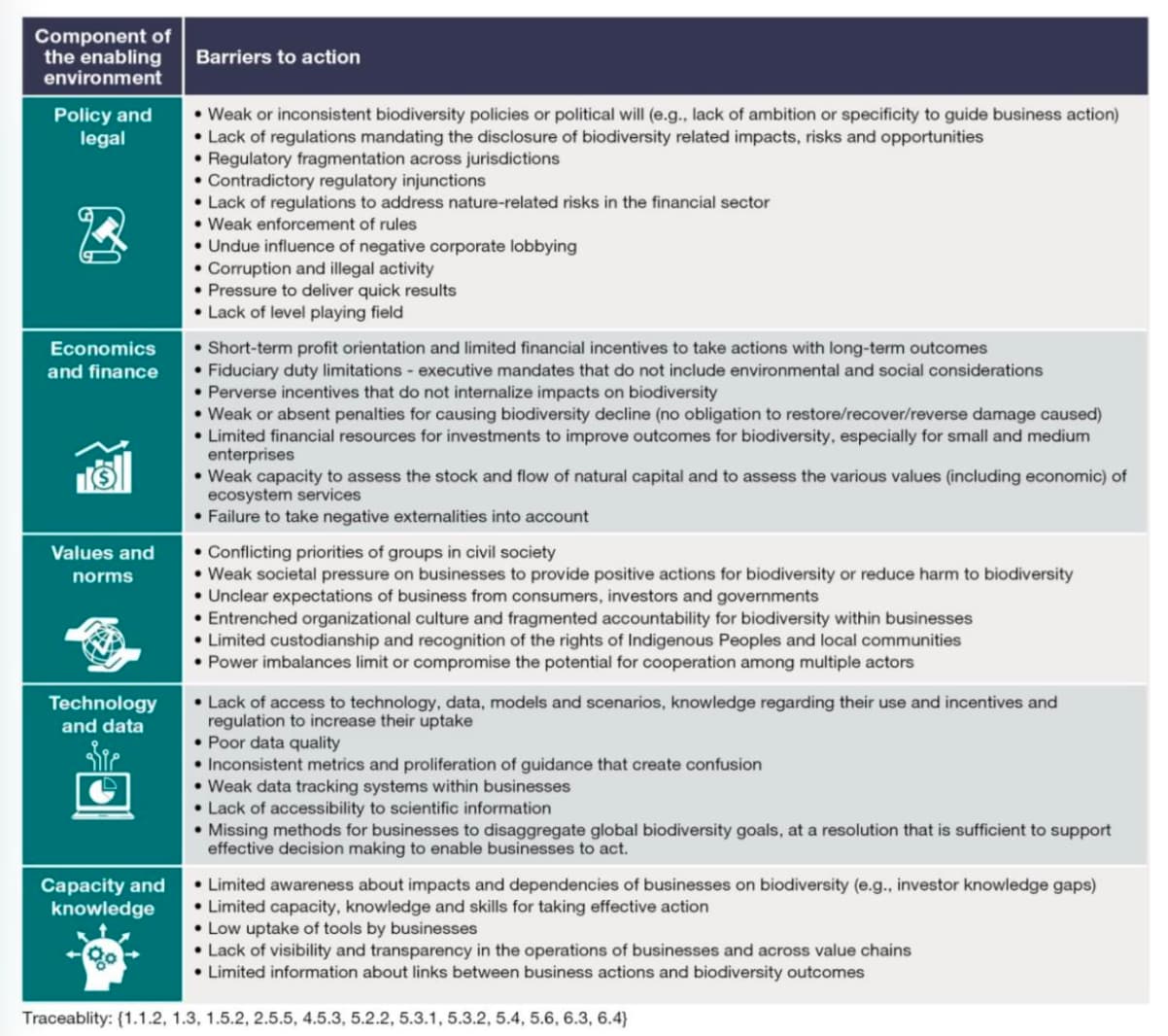
“These barriers do not affect all actors equally and may disproportionately affect small and medium-sized businesses and financial institutions in developing countries,” adds the report.
3. Businesses can act now to address their impacts on nature
The SPM says it is well established that the “transformative change” required to halt and reverse biodiversity loss requires action from “all businesses”.
However, the report continues that it is also well established that the current level of business action is “insufficient” to deliver this “transformative change”. This is, in part, because the “enabling environment is missing”, it says.
IPBES says all businesses have a responsibility to act, even if this responsibility is not shared “evenly”.
“Priority actions” that businesses should take differ depending on the size of the firm, the sector in which it operates in, as well as the company structure and its “relationship with biodiversity”, the report notes.
The exact actions businesses should pursue also depends on companies’ “degree of control and influence over stakeholders”, it says.
According to the report, firms can act across four “decision-making levels” – corporate, operations, value chain and portfolio – to measure and address impacts on biodiversity.
(“Corporate” refers to decisions focused on overarching strategy, governance and direction of the business; “operations” to day-to-day activities; “value chain” to the system and resources required to move a product or service from supplier to customer; and “portfolio” to investments and business assets).
The SPM sets out a series of examples for how businesses can act across all four levels. These are summarised in the table below.
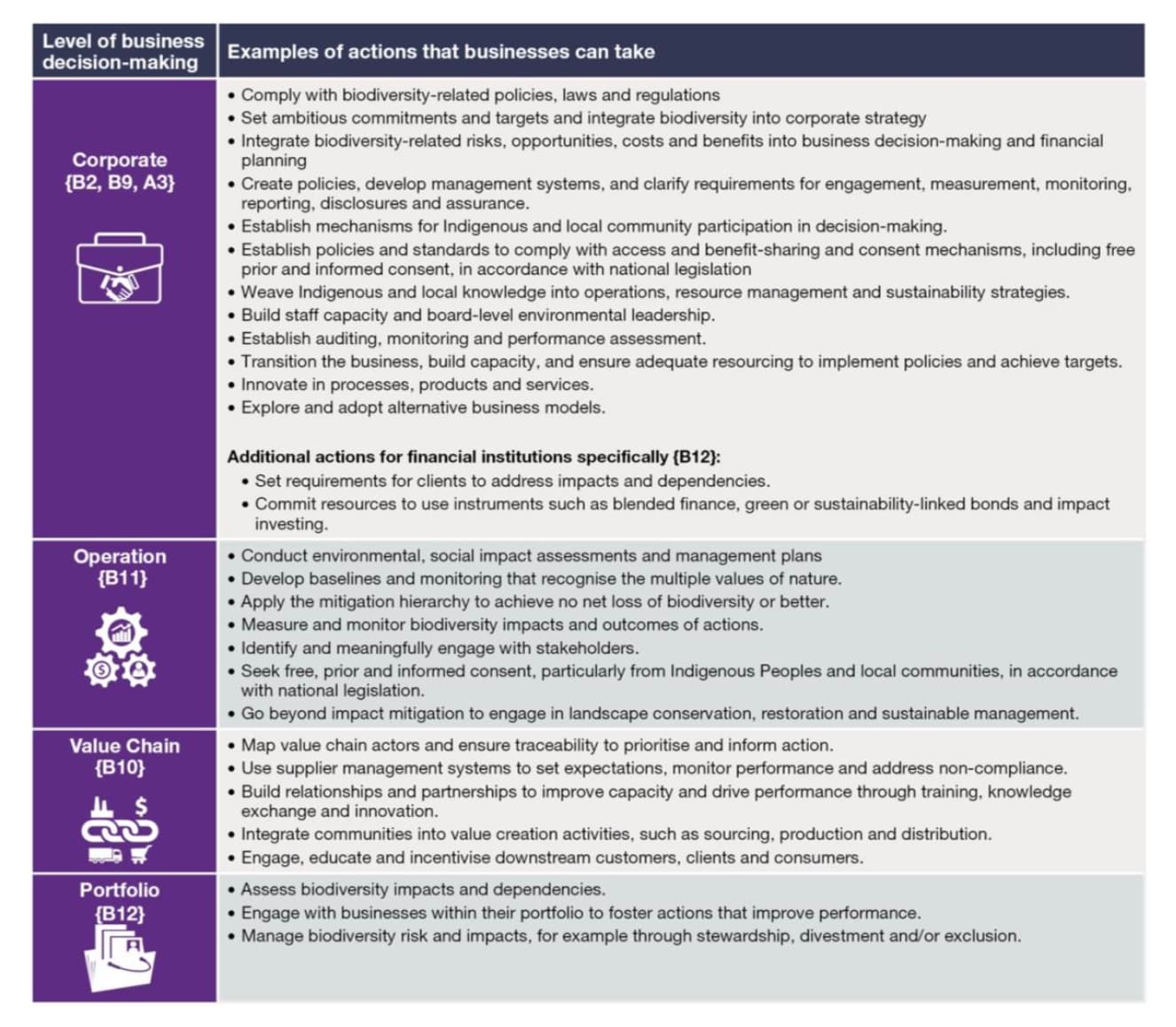
At a corporate level, the report notes that firms can establish ambitious governance and frameworks that can then have a ripple effect across the other levels, according to the report. This includes the integration of biodiversity commitments and targets into corporate strategy.
The SPM says that corporate biodiversity targets are “most effective” when they are aligned with “national and global biodiversity objectives” and “take into consideration a business’s impacts and dependencies on biodiversity and nature’s contributions to people”.
At an operations level, businesses should focus on ensuring that their operations are located and managed in a way that benefits biodiversity, IPBES says. Environmental and social impact assessments and management plans that are supported by “credible monitoring of both actions and biodiversity outcomes” can underpin this effort, the SPM notes.
It says it is well established that using the “mitigation hierarchy” framework can help businesses deliver “lasting outcomes on the ground”. (The framework guides users towards limiting as far as possible the negative impacts on biodiversity from development projects by first avoiding, then minimising, restoring and offsetting impacts.)
Next, the report notes there are actions businesses can take to drive change within its broader spheres of influence, including suppliers, retailers, consumers and peers within industry. This is important, the SPM notes, as significant impacts and dependencies on biodiversity and nature “accrue” across the lifecycle of products or services, especially those that rely on raw materials.
The report notes there is established but incomplete evidence that efforts to “map” company value chains and improve traceability by linking products and materials to suppliers, locations and impacts can help “identify risks and prioritise actions”.
While noting that “mapping” beyond direct suppliers “often remains challenging” for businesses, the report adds:
“Examples at the corporate and value chain levels exist, such as companies in the chocolate industry that have made advances in recording biodiversity dependencies to improve business decisions through full traceability of materials and improved supplier control mechanisms.”
Elsewhere, the SPM notes that there is also established but incomplete evidence that consumer-focused measures – such as product labelling, education and incentives – can “shape behaviour and improve transparency”. However, it cautions that the effectiveness of these strategies is “constrained by consumer scepticism, certification costs and business models reliant on unsustainable consumption”.
The SPM also highlights that, at a “portfolio” level, financial institutions can shift finance away from harmful activities – for instance, companies whose products drive deforestation – and towards business activities with positive impacts for biodiversity and nature.
Speaking to Carbon Brief, Matt Jones, co-chair of the report, explains the rationale behind including options for how businesses can address biodiversity impacts in the document:
“Businesses and governments in different countries are coming at this from a very different perspective. So we can’t present a set of really prescriptive ‘how tos’…but we can present a huge number of options for action that businesses, governments, financial institutions and civil society and other actors can all take.”
Elsewhere, the report says it is well established that “robust, transparent and credible reporting of actions and outcomes” is required to “inspire others”.
4. Government policies can drive a ‘just and sustainable future’ for nature and people
Both governments and financial institutions can set policies and create incentives to protect biodiversity and stem its decline, says the SPM.
According to the report, the types of policies that governments can put in place that have an influence over business include:
- Fiscal policies, such as subsidies and taxes.
- Land use or marine spatial planning and zoning, such as designating new national parks or areas protected for nature.
- Permitting for business activities that affect nature – for example, by requiring environmental impact assessments.
- Public procurement policy (rules for how governments purchase goods and services).
- Controls on advertising and the creation of standards to prevent “greenwashing”.
Governments can also promote action through paying for ecosystem services, creating environmental markets and through “multilateral benefit-sharing mechanisms”, which set out rules for ensuring profits from nature are shared equally, says the SPM.
It says this includes the Cali Fund, a fund that businesses can voluntarily pay into after reaping benefits from genetic resources found in biodiverse countries.
(The fund was agreed in 2024 with expectations that it could generate up to billions of dollars for conservation, but it has so far only attracted $1,000.)
Governments could also promote action by phasing out or reforming subsidies that are harmful for nature, as well as fostering positive incentives, according to the report.
Overall, governments can work with other actors to create an “enabling environment” to “incentivise actions that are beneficial for businesses, biodiversity and society for a just and sustainable future”, says the SPM. It adds:
“Creation of an enabling environment that provides incentives for the conservation and sustainable use of biodiversity and nature’s contributions to people could align what is profitable with what is good for biodiversity and society.
“Creating this enabling environment would result in businesses and financial institutions being positive agents of change in transforming to a just and sustainable economic system, by addressing their impacts on biodiversity loss, climate change and pollution, which are all interconnected.”
The post IPBES: Four key takeaways on how nature loss threatens the global economy appeared first on Carbon Brief.
IPBES: Four key takeaways on how nature loss threatens the global economy

Bhima Yudhistira Adhinegara is the Executive Director of the Center of Economic and Law Studies (CELIOS), an Indonesia-based economic think tank. Muhammad Zulfikar Rakhmat is the Director of the China-Indonesia desk at CELIOS.
Indonesia produces around 60% of the world’s nickel, a metal used to manufacture batteries for electric vehicles (EVs) – more than any other country in the world. But in 2026, the government sharply reduced how much of its nickel can be extracted from the ground.
Production quotas were reduced by around 40% this year compared to 2025. Weda Bay, the largest nickel mine on Earth, had its allowance cut by more than 70% and exhausted its full-year quota by the end of May, halting mining entirely; it cannot resume large-scale extraction until next year unless regulators grant an extension.
The policy has sparked a vivid debate in Indonesian policy circles: how can the country shift its strategy from a decade of mining vast quantities of cheap nickel to producing a high-value and low-carbon material that the rest of the world wants for EV batteries.
The cuts aren’t a silver bullet to clean up Indonesia’s nickel industry, whose smelters are powered by coal – the most polluting fossil fuels. But alongside stricter enforcement of environmental rules, it is one side of efforts to produce more sustainable nickel for a premium.
Restricting Indonesia’s nickel output
Production quotas were introduced to stop the collapse of nickel prices because of oversupply in the market. Prices had fallen more than 40% in 2023 alone and kept sliding as Indonesian supply kept growing, hitting a four-year low of around $13,900 a ton in late 2025.
Critics called the recent tightening of production quotas proof that Indonesia’s nickel strategy has failed, arguing that the industry shouldn’t need to throttle its own output to survive. But when assessed against what the policy was supposed to do – push up nickel prices – it has worked. Prices jumped to $20,000 a ton in May, the highest since 2024.
-
Big banks’ lending to coal backers undermines Indonesia’s green plans
Foreign banks involved in Indonesia’s $20-billion Just Energy Transition Partnership have also funded companies working on coal power expansion, a TBIJ and Climate Home News investigation reveals -
Southeast Asia’s fragile grids threaten billions in clean energy investment
Renewables developers need reliable electricity infrastructure and stable policies to help the region meet climate goals and surging demand for power

Chinese industry groups representing companies that have invested billions to mine and refine the country’s nickel were furious, warning Indonesia’s president Prabowo Subianto that the cuts put $50 billion worth of investment at risk. But much of that Chinese capital is sunk into smelters and processing plants built specifically to run on Indonesian ore, and cannot simply be moved elsewhere. That gives Jakarta more room to hold its ground than the warning suggests.
Stronger environmental enforcement
Since the start of the year, Indonesia’s forestry task force has seized more than four million hectares of land from mines and plantations operating illegally in protected forests, collecting over two trillion rupiah ($113 million) in fines.
This included 148 hectares seized from Weda Bay for lacking a forestry permit. The share of nickel produced from illegal small-scale mining also fell from about a quarter in 2022 to roughly 10% by 2024.
The crackdown responds to serious environmental damages in the nickel industry. On Obi Island, a waste pond collapsed after heavy rain in June 2025, flooding three villages and killing a resident. Internal company tests found chromium-6 – a carcinogen – in the water, in quantities far above the legal limit. The footprint of another mine near Raja Ampat, which is home to some of the world’s richest coral reefs, grew 60-fold in just eight years.

The market is responding to early cleanup efforts. Low-carbon nickel now sells for a real premium, roughly $18,800 to $19,300 a ton compared with $17,900 to $18,300 otherwise, as carmakers seek to source cleaner materials to comply with the European Union’s new emissions rules for imports.
In turn, this is incentivising the industry to do more to green its operations. Vale Indonesia’s smelter in South Sulawesi now runs almost entirely on hydropower, for example.
None of this addresses coal use, however. Major Indonesian nickel producers still emitted an estimated 15 million metric tons of greenhouse gases in 2023. Indonesia may be cracking down on illegal mining and rewarding cleaner producers but it is still running its mines on the dirtiest fuel available.
Unequal benefits
For Indonesia to truly benefit from producing cleaner and high-value nickel, it needs to reap the economic benefits too. Although the industry has boosted the country’s economic growth, the reality on the ground tells a different story.
Konawe in Southeast Sulawesi is home to a major smelting complex. Growth in the district jumped from 6% to 22% between 2015 and 2023, driven almost entirely by the nickel industry, according to a study by the Lowy Institute study. At the same time, poverty levels increased slightly and unemployment remained unchanged.
-
Nickel mining for electric vehicles is destroying lives in Indonesia
Indonesia’s abundant nickel reserves are crucial for a low carbon world. But extracting them is ruining local peoples’ lives and causing rampant deforestation -
Indonesia turns traditional Indigenous land into nickel industrial zone
Indonesia supplies the EV industry with critical battery materials but the sector’s rapid expansion is infringing the rights of Indigenous peoples -
Indonesia’s failing Just Energy Transition Partnership is a cautionary tale
The government has abandoned its plan to shut down a major coal plant, which was a key part of the deal, raising doubts about the donor-backed approach


In Halmahera, another epicentre of the nickel industry, spending by the poorest fifth grew just 5% between 2019 and 2022, compared with 28% for the wealthiest fifth, according to a separate study.
Part of the reason for this inequality is the system for transferring mining royalties to district authorities where the mines are located. In theory, they are entitled to the largest share. But in practice, payments are delayed, companies routinely dispute what they owe and royalties are pooled and distributed across a larger area.
The Natural Resource Governance Institute has found that decentralisation handed local governments power to approve new mines faster than they could build their capacity to manage them. Higher output raises national income on paper, but local governments remain constrained by fiscal rules and infrastructure costs that scale with mining.
None of this makes the 2026 quota cuts a mistake. Indonesia has every right to defend its pricing power over a resource it controls. But limiting extraction isn’t going to fix underlying issues around environmental enforcement and revenue-sharing. That requires rules that are consistently enforced, royalties that reach communities living by the mines, and a plan to wean smelters off coal.
The post Indonesia’s nickel production cuts are not enough to create a sustainable industry appeared first on Climate Home News.
Indonesia’s nickel production cuts are not enough to create a sustainable industry
Climate Change
Risk of “catastrophic” oil spill reaching Kimberley coast found in Woodside’s Scott Reef gas drilling plans
SYDNEY, Monday 24 August 2026 – New analysis of Woodside modelling released by Greenpeace Australia Pacific and Environs Kimberley has revealed the oil and gas corporation’s plans to drill at Scott Reef could cause an oil spill up to 30 times bigger than the 2009 Montara disaster, impacting the Kimberley coastline and reaching as far as Indonesia.
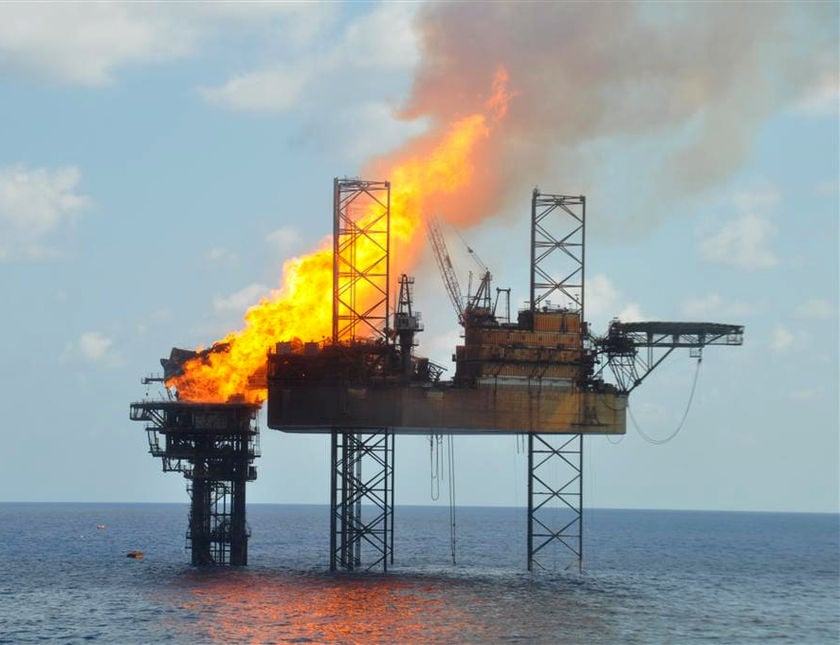
The new analysis details the “catastrophic” oil spill risk put to environmental regulators for approval by Woodside in its Browse to North West Shelf Project (Browse) plans, the worst-case scenario being a blowout directly below Scott Reef, polluting whale migratory pathways and covering isolated turtle nesting ground with oil condensate.
An FOI application (F348) revealed the federal environment department (DCCEEW) asked offshore oil and gas regulator NOPSEMA to look into the oil spill risk in 2025. NOPSEMA’s response to the application refused access to its report, and one document shows DCCEEW sought further advice this year.
Greenpeace and Environs Kimberley are calling on the Federal Government to publicly release the NOPSEMA report given the risk of an uncontrolled release of oil condensate from directly below Scott Reef.
Hannah Schuch, Senior Campaigner at Greenpeace Australia Pacific, said: “Woodside is aware that drilling at Scott Reef risks a massive oil spill that would have severe, far-reaching consequences. It appears environmental regulators are aware too.
“The state and federal governments need to take this risk from Woodside’s drilling plans seriously, as they could end up allowing the worst oil spill in Australian history.
“The pygmy blue whales that migrate up and down the WA coast with their newborns each year could be swimming and feeding in toxic, oil-slicked water. Woodside’s proposal to drill at Scott Reef is an environmental disaster waiting to happen, and the WA and federal governments have one surefire way to prevent catastrophe — reject Browse.”
Martin Prichard, Executive Director at Environs Kimberley, said: “A catastrophic oil spill by Woodside would be disastrous not just for marine life in the area but also for the Kimberley’s $500 million tourism industry.
“The state and federal governments will see five marine parks on the Kimberley coast included in the risk area of a catastrophic Woodside oil spill.
“The Montara oil spill was disastrous for West Timor with the toxic oil destroying seaweed farmers’ livelihoods. The Kimberley dodged a bullet with Montara, we were lucky the spill didn’t head our way. Myself and a crew flew over the Montara oil spill and followed it as far as we could. It was like a scene from a disaster movie.”
After the WA Environmental Protection Authority deemed Browse “unacceptable” due, in part, to oil spill risk, Woodside submitted a mitigation plan based on technology that has never been used “in anger”, a weakness stated in an independent expert review of the plan.
Professor Richard Steiner, independent oil spill expert, said: “A large offshore spill is impossible to effectively contain or recover. Historically, only 2-6% of total spill volume is recovered and the ecological injury from the release of toxic hydrocarbons in the sea can be severe, extensive, and long-term.
“Here in Alaska, government research concludes that several marine populations injured by the 1989 Exxon Valdez oil spill, including whales, fish, and seabirds, are still not recovering today, 37 years later. We should expect similar long-term ecological impacts in Western Australia if there were to be a major oil spill. The only sure way to avoid the risk of a catastrophic marine oil spill is to not develop oil and gas projects in marine environments.”
-ENDS-
Media contact
Emma Sangalli on emma.sangalli@greenpeace.org or 0431 513 465
What if Australia’s worst offshore oil spill hasn’t happened yet?
I’m terrified by the thought.
Our new report in partnership with Environs Kimberley analyses Woodside’s own oil spill modelling and it reveals a worst-case blowout at the corporation’s proposed Browse gas project at Scott Reef could be up to 30 times larger than the Montara oil spill – one of Australia’s worst environmental disasters to date.
Woodside’s own modelling warns that oil pollution could spread across Scott Reef, the Kimberley coast and beyond, with impacts Woodside itself describes as “severe”, “potentially irreversible” and “catastrophic”.
What’s at stake?
Scott Reef really is like nowhere else on Earth.
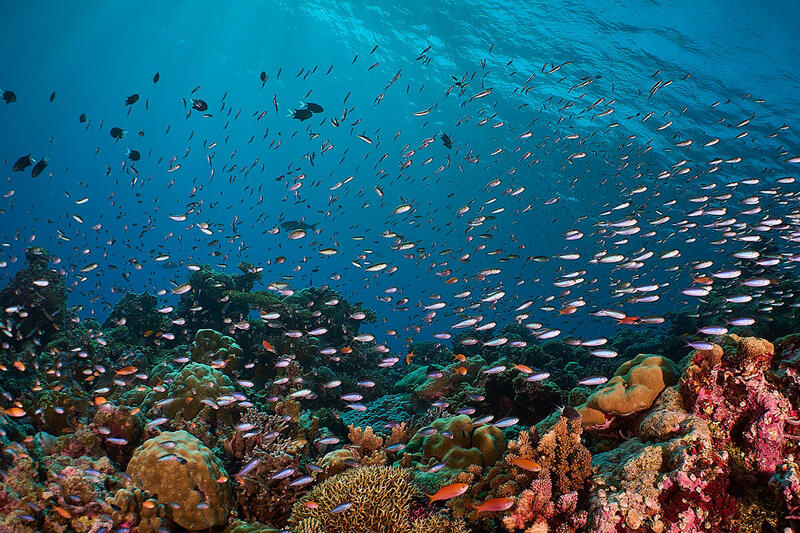
Scott Reef is Australia’s largest freestanding oceanic reef, a pristine marine ecosystem that has thrived for around 15 million years. About 270 kilometres off the Kimberley coast, it supports more than 2,000 marine species, including endangered pygmy blue whales, nesting green sea turtles, the endangered dusky sea snake and ancient corals.
Yet Woodside wants to drill up to 57 toxic wells around and underneath it, causing decades of deafening seismic blasting, light and noise pollution, shipping traffic and, of course, the risk of a ‘catastrophic’ oil spill.
What did Woodside’s modelling find?
Before Browse can be approved, Woodside is required to assess what could happen if something goes wrong. We analysed the corporation’s own environmental assessment documents, and the findings are deeply concerning.
Woodside’s modelling shows that the most severe Browse scenario would be the worst oil spill in Australian history, releasing up to 893,739 barrels of condensate into the Timor Sea. For context, the Montara oil spill released 30,000 barrels of oil.
A blowout of this scale could see oil spread hundreds of kilometres, reaching some of Australia’s most important marine environments, extending into Indonesian and Timor-Leste waters and even washing up along parts of the Kimberley coast. Entrained oil – oil mixed throughout the water column – is predicted to travel up to 863 kilometres from the spill site.
The modelling identifies potential impacts to at least nine marine parks, eight reefs and three Indigenous Protected Areas, as well as important habitats for endangered species, including pygmy blue whales, green sea turtles, seabirds and other marine life.
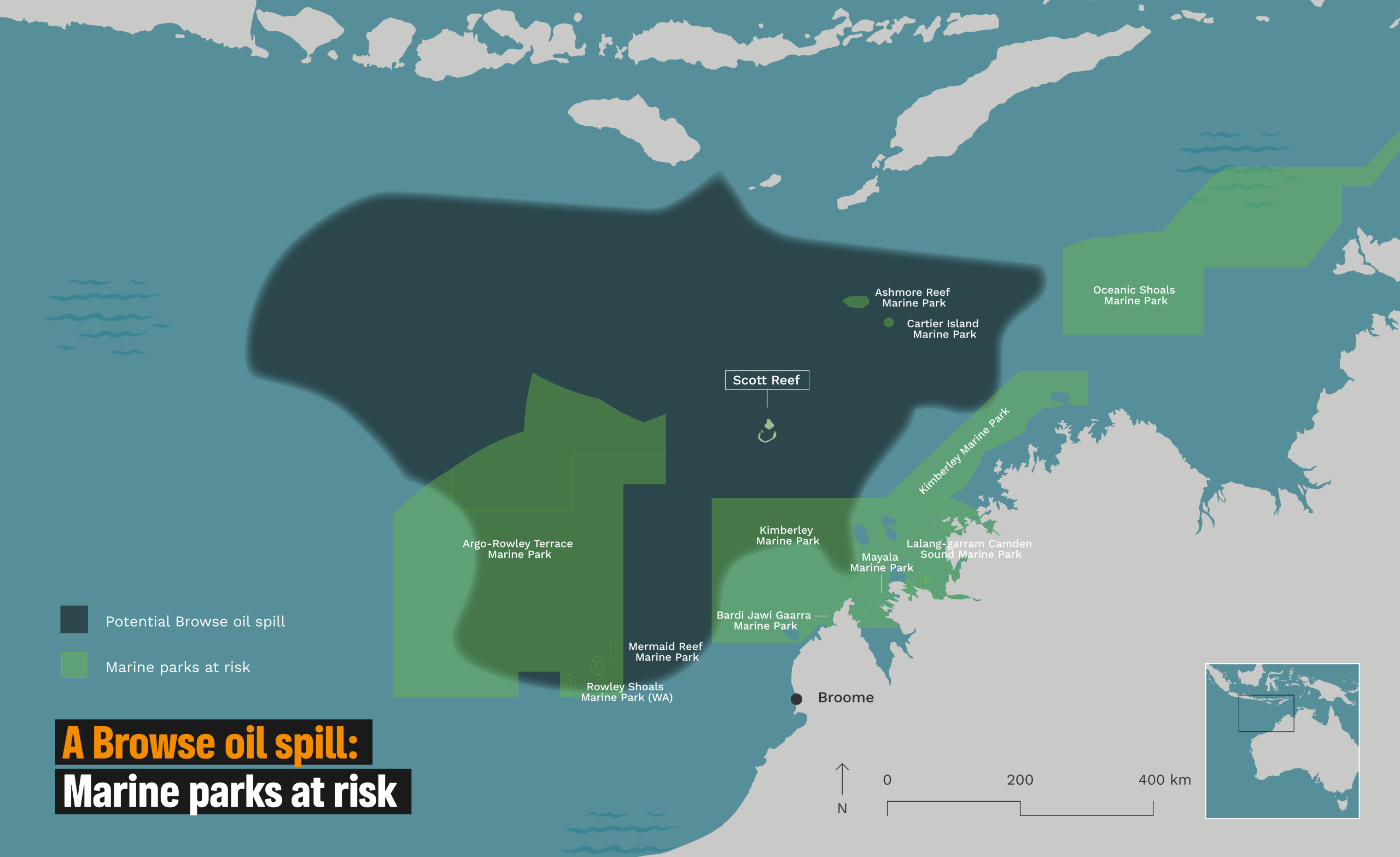
These aren’t just places on a map. They are globally significant marine ecosystems that support ancient coral reefs, endangered wildlife, tourism, fisheries and coastal communities. A spill of this scale wouldn’t simply affect one reef; it has the potential to impact an entire connected marine ecosystem.
Why this matters now
The most important thing is that Browse has not yet been approved. That means there is still time to stop Browse and the serious risks outlined in Woodside’s own modelling.
The science has been done. The risks have been modelled. The decision now rests with the Australian Government.
Governments are often forced to respond after environmental disasters happen. This is one of those rare moments where they have the opportunity to act before one does.
What you can do
Together, we still have the power to stop Woodside and save Scott Reef.
You can help by:
- Sending an email to Environment Minister Murray Watt and Prime Minister Anthony Albanese, calling on them to reject Browse.
- Sharing this story to help more Australians understand what’s at stake.
- Encouraging your friends and family to take action.
The more people who support saving Scott Reef, the harder it is for governments to approve Woodside’s drilling plans – Browse.
Together, we can ensure a reef that has existed for millions of years is known for its incredible biodiversity – not as the site of Australia’s worst oil spill.
Let’s save Scott Reef.
What if Australia’s worst offshore oil spill hasn’t happened yet?



-
Climate Change1 year ago
Guest post: Why China is still building new coal – and when it might stop
-
Greenhouse Gases1 year ago
Guest post: Why China is still building new coal – and when it might stop
-

 Greenhouse Gases2 years ago
嘉宾来稿:满足中国增长的用电需求 光伏加储能“比新建煤电更实惠”
-

 Climate Change2 years ago
嘉宾来稿:满足中国增长的用电需求 光伏加储能“比新建煤电更实惠”
-
Climate Change2 years ago
Bill Discounting Climate Change in Florida’s Energy Policy Awaits DeSantis’ Approval
-

 Renewable Energy10 months ago
Sending Progressive Philanthropist George Soros to Prison?
-
Greenhouse Gases1 year ago
嘉宾来稿:探究火山喷发如何影响气候预测
-

 Carbon Footprint2 years ago
US SEC’s Climate Disclosure Rules Spur Renewed Interest in Carbon Credits