Connect with us

Published

on

The number of global climate initiatives launched or run by China has been growing since 2009, a new study shows.

But whether this will translate into China taking up the mantle of climate leadership remains an “open question”, says Dr Sun Yixian, study co-author and professor of sustainability governance at the University of Bath.

Sun’s team has compiled a database tracking all global environmental initiatives established from the 1980s onwards that were launched or run by China.

These initiatives are either created by China or co-created with other governments, or have operations that are mainly managed by Chinese institutions.

They range from research cooperation and south-south climate funding to high-level policy signalling, such as joint statements on climate change.

In an interview with Carbon Brief, Sun discusses the key findings of the new “China’s Global Environmental Leadership” (CGEL) database.

He adds that it is not yet clear if the US withdrawal from the UN climate regime will change China’s role in global climate governance.

The conversation covers how the number of China-led initiatives has changed over time, what these projects look like and how China’s approach to climate “leadership” is changing.

The interview has been edited for length and clarity.

  • Sun on the types of climate initiatives: “There are all different kinds of initiatives – we have these typologies of governance functions, including sharing information and building platforms, or developing capacity – capacity building activities, which can be training delivered by China to other countries. Or also by providing funding, for example.”
  • On the rise in new climate initiatives: “From after 2009 and 2010, we’ve seen many initiatives – of course, more and more over the last 10 years, and even the last five years, from 2021…have been created.”
  • On the impact of the Trump administration: “The shift of the US under the second Trump administration will probably help Chinese initiatives get more traction from their international partners…Whether or not this will translate into new initiatives or strengthen existing initiatives, I think that’s an open question.” 
  • On a growing focus on multilateral programmes: “What we have seen is a very clear upward trend of transnational initiatives with a global scope. That means they operate in more than two continents. So, in that sense, what we can see is, actually, China is moving from this bilateral engagement model to more kind of global engagement and trying to project its influence at the global scale.” 
  • On a climate leadership ‘mindset’: “[Leading Chinese experts] said the government, and also people in China, are not ready to become a global leader. But, at the same time…in climate governance, but also in clean-energy supply chains – China is playing a leading role. So, I think the question is whether this…will translate into the understanding, or mindsets, of people, including policymakers or decision-makers in the country.” 
  • On the future of China’s climate engagement: “My read is that China is willing to share more knowledge, and technology as well, through its international global engagements…But, at the same time, I think, it is not a given. It depends on how countries can make arrangements with China, how they can also propose viable solutions in terms of absorbing Chinese technologies.”
  • On the future of multilateral climate negotiations: Multilateralism is a very important principle, championed in almost all the initiatives. That means China is not going to abandon multilateral processes. Also, we have done some work looking at the alignment of Chinese climate initiatives with existing UN institutions and frameworks, and we also see very close alignment. 

Carbon Brief: Thank you for joining us, Yixian. Your team has compiled a database of China’s “environmental leadership”. What do you mean by leadership and what did you find in relation to climate change?

Sun Yixian: Thanks Anika, it’s great to speak to Carbon Brief. Leadership is a very contested concept in social science, or especially in international relations. This is why we were very cautious when we thought about the name of this dataset, but we thought it was a good way to capture what we’re trying to do.

In this project, what we are trying to look at is China’s role in global environmental governance – China’s shifting role, especially from a more passive participant in global governance processes to play a more proactive role in developing or managing its own initiatives on transnational or cross-border environmental governance.

So, [this includes] different environmental issues, but, of course, we found that climate change is a very important issue area. By leading, we are using the concept of governance – in a sense that we are looking at the initiatives where Chinese actors claim some authority over other audiences towards certain public goods. So, it’s trying to provide public goods, in different ways. We have come up with a typology of different governance functions, trying to look at what specific activities Chinese actors are doing, or what kind of public goods Chinese actors are delivering, to the audiences of different initiatives.

And by audience we mean…international actors. So, that means we are not interested in what China is doing domestically, but beyond its borders.

CB: Could you explain what some of these climate initiatives look like in practice?

SY: This is very important, because it sounds very abstract if we just talk about leadership. In practical terms, there are all different kinds of initiatives – we have these typologies of governance functions, including sharing information and building platforms, or developing capacity – capacity building activities, which can be training delivered by China to other countries.

Or also by providing funding, for example, China has created this south-south climate fund. It can also include research collaboration or producing knowledge – mainly between research institutes.

It can be traditional leadership activities, in the sense of developing certain international regulatory frameworks or rules or standards – we call this rulemaking and standard-setting. It can also be pilot projects. China sometimes can start to work directly with some international partners to trial new ideas and new practices – what we call direct actions.

These are the different types of leadership activities that we look at and we actually code each initiative that meets the criteria of our database according to this topology, to try to look at what [the Chinese government] are looking at.

Some initiatives can do multiple things at the same time…One example is the Global Energy Interconnection Development and Cooperation Organization [GEIDCO]. [This was] initially created by the State Grid of China to try to promote clean energy and energy interconnections.

This initiative will deliver different types of activities, including building the capacity of some developing countries on energy and electricity grids, and also, for example, developing an international platform – they have annual international meeting and a lot of information-sharing activities, and engagement at UN meetings, including at COP side-events, and also directly engaging with some international organisations.

So, this is an example of the type of leadership initiative that has been included in our database.

CB: And would you say that there’s one particular type of activity that dominates, in terms of China’s climate leadership? Or is it very evenly split against all of the different types?

SY: This is also one of the main findings in our work. In the first paper we published to highlight the key patterns from the dataset, we highlighted that there’s a very uneven distribution in terms of what China tries to deliver or to promote, itself, internationally on environmental governance.

There have been a lot of initiatives focusing on sharing information and building platforms and this is the most dominant category – across all environmental issues, but the same pattern applies to climate change.

In the first article we published in the Earth Systems Governance journal, we looked at the whole dataset, but we are also developing a few studies, currently under review. One paper particularly looks at climate initiatives and it’s the same pattern: information-sharing and networking.

At the same time, the least frequent or popular type is the provision of funding – creating some financing programmes to directly give funding to international partners. I think this reflects China’s position on environmental or climate finance, especially internationally.
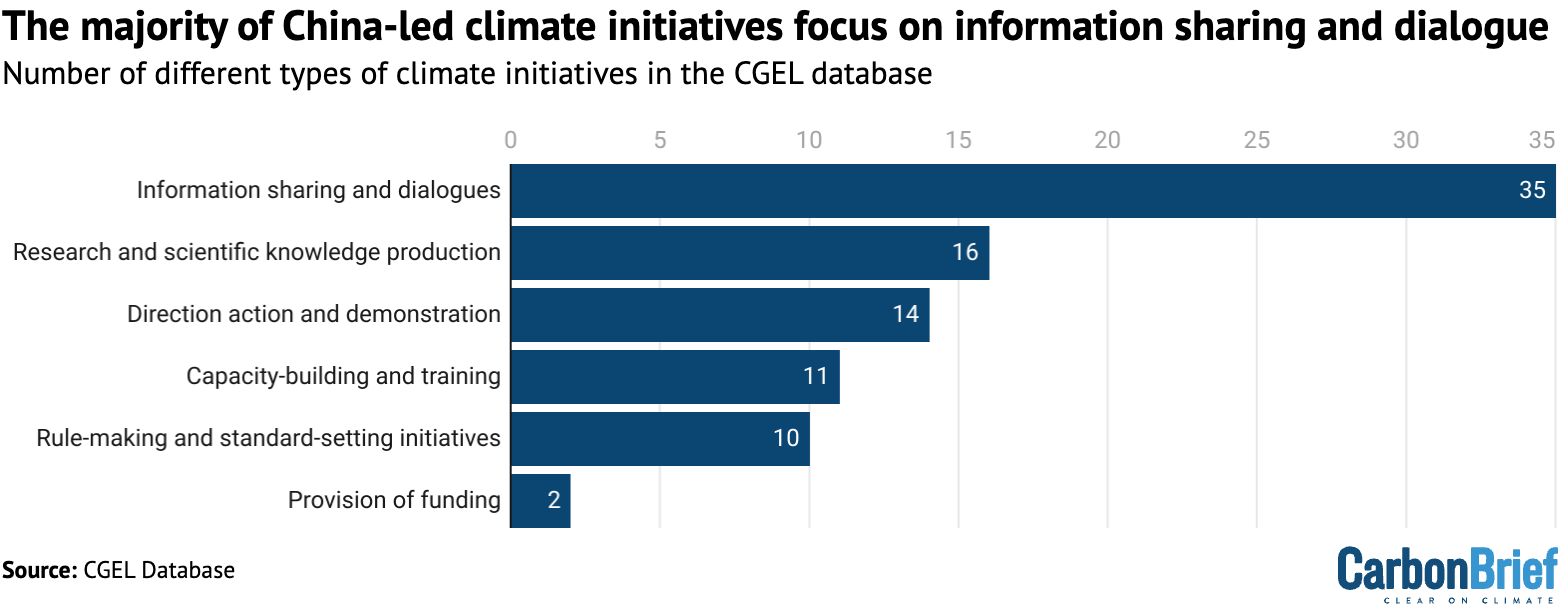
Chart showing that the majority of China-led climate initiatives focus on information sharing and dialogue
The number of different types of China-led climate initiatives established from 1991-2004. Source: CGEL database.

[China’s] not trying just to provide money, but really think about how to support other countries on more practical, more pragmatic terms. This is why I think that after information-sharing, what we have seen is capacity-building activities, which have also been quite frequently used by Chinese initiatives when collaborating with their international partners. This also explains China’s logic to teach [others] how to develop things, but not just giving money.

The other important category is research collaboration and knowledge production. This has been mainly led by research institutes in China, such as the Chinese Academy of Sciences, especially with a strong focus on scientific co-production.

But, lately, we have also seen more and more initiatives focused on sharing knowledge not just about science itself, but sometimes also on the social sciences side – the experiences of China as a whole. China’s experiences can also be learned from by other countries, especially in the global south.

These are just some examples, but the overall pattern is [a focus on] information-sharing, capacity building and knowledge production and not too much on provision of funding.

CB: You mentioned the GEIDCO example earlier. How much of a tangible impact would you say a lot of these initiatives have? Are they very high-level, strategic and quite abstract? Or do they kind of result in programmes on the ground?

SY: That’s a very interesting question – the answer is that it really varies. GEIDCO, as you mentioned, is a very high-level initiative. I think, initially, the idea of energy interconnection was proposed by President Xi himself. Now, of course, GEIDCO, with the backing of the State Grid, does a lot of high-level [national planning] and trans-national [grid network] planning work with developing countries.

But, at the same time, there are also a lot of grounded, locally focused initiatives. A lot, for example, are co-developed between China – especially supported by the Ministry of Ecology and Environment [MEE] – and UNEP [United Nations Environment Programme] in, for example, Africa and Southeast Asia. [This includes] some projects looking at climate adaptation and resilience. But these are more small-scale projects. 

So, in our database – and I welcome your readers to explore the database itself that you can see – there are a big variety of initiatives and their scope, their mission and their intended outcomes or impacts vary significantly.

But we are just providing this public resource. Hopefully, people can use it to further explore, for example, the question of the impact or outcome. At this stage, we’re not going to assess what has been delivered, but I think if we can take, for example, a case-study approach – trying to trace what has been done, what has been delivered – this could also be a very interesting research agenda.

CB: Is there a particular time from when China’s interest in engaging on climate change started, or has this been a very long-term process?

SY: In our database, we really wanted to capture the historical trend. That’s why we looked back from early on – [we focused on] from the beginning of this century, but also traced initiatives that had been created even earlier but became active in the 21st century.

So we can [see that,] already in the late 1980s or 90s, there were some initiatives in the area of climate change. But, most importantly, the majority of the initiatives were started after 2008, mainly in the 2010s. We can see a very clear upward trend. It was not shown directly in our recently published article, but it’s in the database and we have looked at the data and produced a graph for other studies we are currently developing.

Really, from after 2009 and 2010, we’ve seen many initiatives – of course, more and more over the last 10 years, and, even the last five years, from 2021, we still see more and more initiatives have been created.
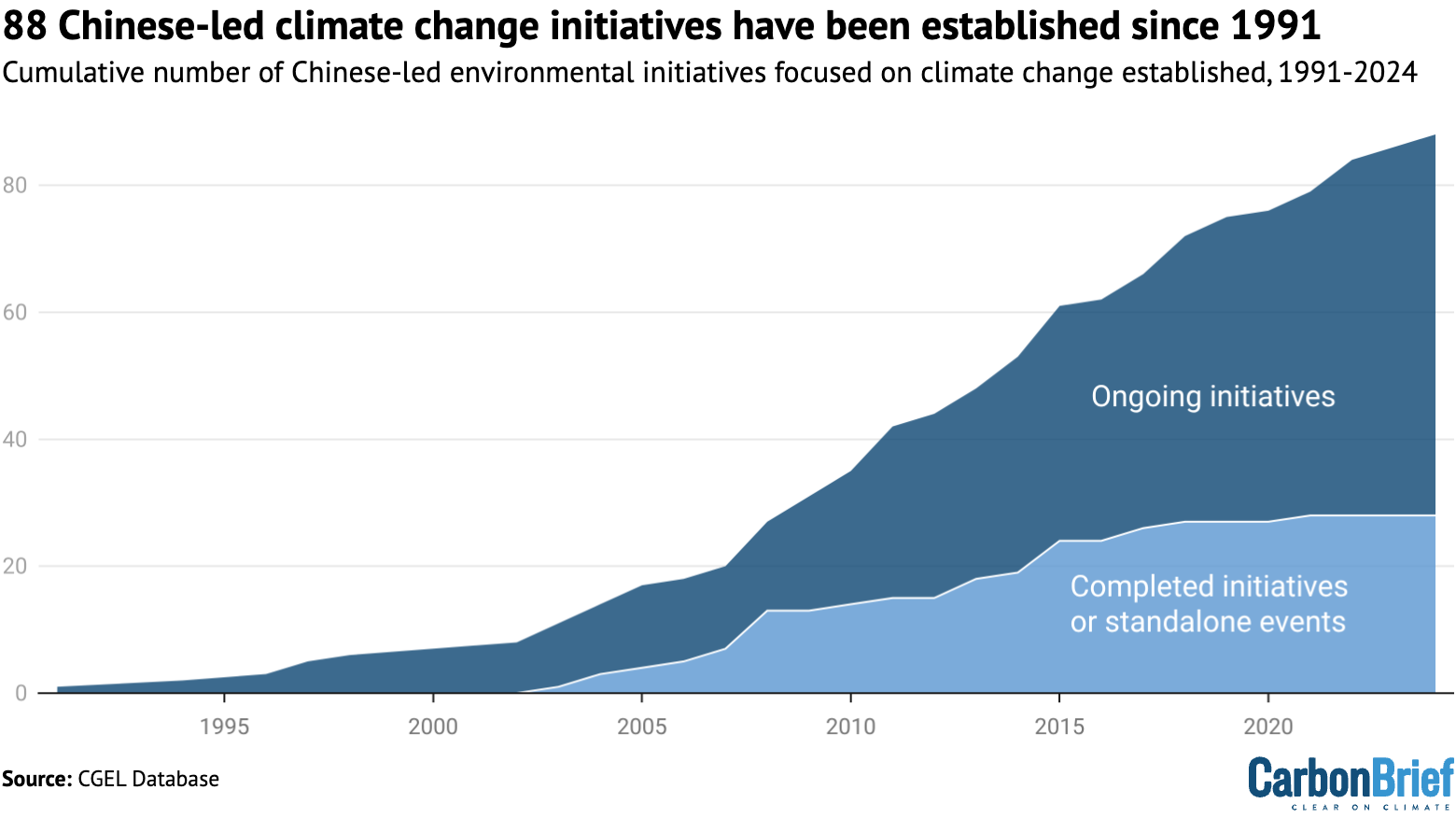
Chart showing that 88 Chinese-led climate change initiatives have been established since 1991
The number of new China-led international environmental initiatives focused on climate change established between 1991-2024. Source: CGEL database.

This timeframe corresponds to China’s shifting international role, to move from [being] a more regional power, a large developing country, to a global superpower, and trying to project its influence globally.

That also correlates with, for example, the belt and road initiative and lately the global development initiative – China is trying to also use climate change in this broader policy framework and trying to promote and support climate action in different parts of the world.

CB: The database stops at 2024 – just before the current administration withdrew the US from the Paris Agreement. Have you noticed any changes in China’s global climate engagements following this?

SY: I would say the trend is a continuous one, even with the withdrawal of the US from the Paris Agreement and lately from the UNFCCC. Because, as I mentioned earlier, over the past 10 years, we have seen this upward trend, with more and more new initiatives created by Chinese actors.

But I think the shift of the US under the second Trump administration will probably help Chinese initiatives get more traction from their international partners – or countries or actors that haven’t been engaged very closely with China – to work more closely with China.

Whether or not this will translate into new initiatives or strengthen existing initiatives, I think that’s an open question.

We really want to explore [this] further. Something I didn’t mention earlier is we are publishing this data set as version one, we want to keep updating on a regular basis. We hope we’ll have versions two or three out, maybe every two years. We’ll see how things go, but I think this is a very important question.

CB: Looking at how China is engaging with all of these different countries – as you mentioned, more and more potentially wanting to work with it following the US’s withdrawal – do you get the sense that the Chinese government prefers to engage with countries bilaterally, on a one-to-one basis, or are they also engaging at the regional and multilateral levels?

SY: This is a great question. This is also an important finding from our work, because the conventional understanding is that China prefers to engage with countries bilaterally.

But, if we look at our database, what we can see is that, actually, China has developed more and more transnational initiatives – meaning that it also involves non-state actors or [works] beyond the traditional multilateral processes and [develops initiatives] with a global scope.

If we look at the historical trends, initially – especially up to 2010 – there were a lot of bilateral initiatives. Most cases in our database are bilateral initiatives.

But, lately, I think this trend is shifting. Still, I think there are many more bilateral initiatives than multilateral and transnational initiatives.

How we differentiate leadership activities of Chinese [state] actors across different levels [affects the trend], but, lately, what we have seen is a very clear upward trend of transnational initiatives with a global scope. That means they operate in more than two continents.

So, in that sense, what we can see is, actually, China is moving from this bilateral engagement model to more kind of global engagement and trying to project its influence at the global scale.

I think this is also quite interesting, to understand how not only the government, but also lots of Chinese actors – including, for example, businesses and civil society actors – are trying to project and their footprint globally.

And also I think this reflects a shifting global role of China, in general. We can further explore what the implications of this phenomenon are. This is some ongoing research I’m doing – trying to understand how actors in different parts of the world react or perceive this changing rule of China and how such engagement between China and different countries shape, or reshape, the sustainability transition.

CB: You mentioned just then that there’s not just the Chinese government, but also civil society, businesses and other non-state actors. What role do you think these non-state organisations play in the country’s overall climate strategy and climate engagement?

SY: Let me start with the caveat that, first of all, as shown in our database, the government, or state actors, still play a very important role – especially central government agencies, for example, the MEE [Ministry of Ecology and Environment] or NDRC [National Development and Reform Commission].

But, at the same time, especially over the last 10 years, what we have seen is that non-state actors have become more active and engaged more, in various ways, in leading climate initiatives beyond China’s borders.

This means, sometimes, they collaborate with state actors to co-develop certain initiatives. Sometimes, they develop their own initiatives with, of course, some support from the state. One thing we need to bear in mind is, in China, it’s almost impossible to [avoid involving] the state. At least, you have to closely align with the strategy of the government.

But, at the same time, what we can see is the agency of these actors. They have developed or showed the ambition to develop certain initiatives, including, for example, standards in the critical mineral space, to provide guidelines to companies for their overseas activities.

Similarly, some civil society actors, [such as] research institutes, also want to claim their leadership in a global sphere, trying to showcase how they can lead certain activities and show how their expertise or their knowledge can support countries or actors in other parts of the world.

CB: On the standards-setting point, is that something where it might be led by one Chinese company with multiple partners – whether it be from one country or from various different countries in a region? Or is it a broad spectrum of Chinese companies coming together saying that we want to work with Chile, Zimbabwe etc, on mining standards? Is it very representative of the industry, or does it tend to be quite piecemeal?

SY: This is an inclusion criteria for the databases. We [only] look at the initiatives that are, to a large extent, institutionalised. It’s not that company’s claim that “we are doing this”. If we can’t track down any information or find any records then we cannot include things like that in our database.

That means we only tend to look at initiatives that are well-developed. These are often, for example, developed by national industry associations. They try to convene different companies together and try to collaborate with, or coordinate, different actors along supply chains and also across sectors or industries.

When they work with different international partners, this is also a question I think we need to further explore, using our data set to try to look at – sometimes I think it’s not easy for us to do everything! – but try to look at what kind of partners they select and how they get involved with partners in different countries or different regions.

But I think this probably requires some other methodologies to look at, or maybe zoom out to specific cases.

This is similar – I always want to use this as a comparison – when we started [seeing] this phenomenon in Europe or in North America, for example, where companies start to take climate actions, we didn’t really pay a lot of attention to how and who they work with, as long as they say: “We are trying to support global climate action.”

But, nowadays, when it comes to the question of China, people start to be interested in who they work with. But if we look at the narrative and discourse of these initiatives, they say as well: “We want to support actions around the world.”

They don’t always specify [the geographic scope of their standard-setting work], but if we further zoom into where they are working and why they work in specific areas or regions, this is also an interesting question – I think there is also a question of politics or political economy there. I would encourage researchers to use our dataset to further explore that kind of question.

CB: Zooming back out – the theme of the data set is environmental leadership, but – at least in global climate negotiations – Chinese officials have eschewed being called a climate leader. Your database seems to show an uptick in activity that could be defined as leadership. Would you say that China wants to be seen as a climate leader?

SY: This is a very strong claim, so I probably would not say [so] – also, it’s very subjective, depending on who you ask this question to and how people perceive it.

Let me frame me this way – let’s separate multilateral negotiation processes from what the country or different actors are doing. Of course, for leadership, another way to measure this is to see the performance itself.

But, in the end, I think we also tried to be very reflective when we developed this work to acknowledge the subjectivity of leadership and the relational nature of leadership. That means that, if you want to be a leader, others need to acknowledge your leadership or recognise this status.

But this is why I think it comes to an interesting question about what’s the role of China and how different actors perceive China’s role in today’s global climate governance.

In multilateral negotiation processes, we are entering into the implementation phase for the Paris Agreement. That means it is very difficult to create new agendas at this stage. [Instead the focus is] trying to see if countries can deliver what they have done.

Of course, I think there is a question of ambition in terms of updating your nationally determined contributions. So, there is an ambition question – there is a performance question.

If we want to see whether China is becoming a leader, we have to look at how fast, for example, China is accelerating its energy transition, trying to reduce – of course, some data shows China has already peaked its emissions – but maybe, how fast China can reduce its emissions.

Then, in terms of international engagement, what our data is trying to show is that China has become more proactive in that space. The question is also if this engagement translates into some progress in different parts of the world – if China is actually helping. We need more data to do this kind of impact assessment.

But, at the same time, I think the question of whether the Chinese government wants itself to be seen as a leader – this is also an interesting question. Depending on who they want to engage with, in different fora or on different platforms, the answer may be different.

I just want to quote, when I was in China a few months ago, we had some dialogues with leading Chinese experts. They said the government – and also people in China – are not ready to become a global leader. But, at the same time, I think, what China is doing or the role of the country – in climate governance, but also in clean-energy supply chains – China is playing a leading role.

So, I think the question is whether this physical change that has already happened will translate into the understanding, or mindsets, of people, including policymakers or decision-makers in the country.

I think this is a question that China needs to figure out, itself. Then, of course, there will be implications for China’s strategy for engaging with the rest of the world, especially on climate change.

CB: And what do you think China’s climate engagements will look like in 5-10 years from now?

SY: I think, from an energy-transition perspective – let me start from there – China is going to be, at the least, more proactive in promoting energy transition, because it aligns with China’s economic interests and, to a certain extent, its political interest as well, to support energy transitions around the world.

The key question is what role China can play in doing that. Of course, there is the question of trade, of tariffs. There is also the question of investment, intellectual property and technology transfer.

My read is that China is willing to share more knowledge, and technology as well, through its international global engagements, to support other countries. But, at the same time, I think, it is not a given. It depends on how countries can make arrangements with China, how they can also propose some viable solutions in terms of absorbing Chinese technologies.

What we have seen is a lot of countries, especially in the global south, have benefited already, or are in the process of benefiting from, affordable technologies produced by China.

But, at the same time, this is not sustainable – at least from an economic point of view – not a sustainable situation in the sense that these countries also need to find a way to move themselves upward in supply chains and try to absorb some technologies. How they can work with China [to achieve this] – that’s a very important question to me and also my team. We want to do more research in that area.

This is from the energy-transition perspective. But then, if we look at multilateral processes, I would say China is very committed to multilateralism. If we look at all the discourse, including the cases in our database – we have done some text analysis looking at the narrative discourse of the vision of these initiatives. Multilateralism is a very important principle, championed in almost all the initiatives. That means China is not going to abandon multilateral processes.

Also, we have done some work looking at the alignment of Chinese climate initiatives with existing UN institutions and frameworks, and we also see very close alignment.

So, I think this pattern will probably last. At the same time, because – depending on the other important countries’ climate policies, for example, the US – back to your question about the leadership in multilateral processes, how proactive and how ambitious China wants to be in taking on this leadership position in multilateral processes is still an open question.

This also depends on the concept of leadership in different cultures.

Whether China wants to take over the US to become the only superpower of a global system – I think this is probably very unlikely. China may want to figure out a slightly different model. Even if, physically, it’s one of the most, or the most, important or powerful countries in the world, how using how the country can use this position to support or guide the governance of global challenges, this is probably slightly different from the views or understanding of, for example, European and other global north countries.

The question is how China can propose a slightly different model – still in the current multilateral system – for governing global challenges, including climate change. This is really important. I don’t have an answer, so that’s why we will continue to look at this question and try to use our research to help people understand what role China can play in global climate governance.

CB: Thank you.

This interview was conducted by Anika Patel via Zoom on 1 July 2026.
The post Interview: Dr Sun Yixian on his new database tracking Chinese climate ‘leadership’ appeared first on Carbon Brief.

Interview: Dr Sun Yixian on his new database tracking Chinese climate ‘leadership’

Continue Reading

Climate Change

World falling short on 22 of 23 nature targets for 2030, says draft UN report

Published

on

The global goal to halt and reverse nature loss by 2030 “will not be achieved” unless action by countries “accelerates rapidly”, says a draft UN report.

Countries are falling short on 22 of the 23 targets for 2030 they set under the Kunming-Montreal Global Biodiversity Framework (GBF), the “Paris Agreement for nature”.

That is according to a draft version of a global report prepared by the UN Convention on Biological Diversity (CBD), published on 26 July.

The report will be finalised ahead of the next nature summit, COP17, taking place in Armenia in October of this year.

The second draft of the global report has undergone “peer review”, but will still be subject to “technical edits” before being formally published ahead of COP17.

The final version will inform a global review of countries’ progress towards meeting the world’s 2030 nature goals, which will take place in Armenia.

Below, Carbon Brief explains why the report has been produced and what it says about countries’ progress in areas such as restoring ecosystems and raising funds for biodiversity.

Article Contents

Global report

In Montreal, Canada, in 2022, nearly every country in the world agreed to the GBF. The overall “mission” of the framework is to halt and reverse biodiversity loss by 2030. Its “vision” is to bring the world into “harmony with nature” by 2050.

The GBF includes a list of 23 targets for 2030. They cover an expansive range of topics, from restoring ecosystems, to addressing pollution and providing developing nations with finance to help cover the costs of protecting nature.

As part of the GBF and its underlying documents, countries agreed to a schedule for monitoring their progress towards achieving the 2030 targets.

This included the preparation of a “global report” of progress coordinated by the CBD, which will inform a “global review” undertaken by countries at COP17.

The global report draws on countries’ national reports, which were due to be submitted to the UN in February of this year. It also draws on countries’ national nature plans, known as “national biodiversity strategies and action plans” (NBSAPS) and national targets, which were both due in 2024.

Not all countries have met the call to publish these documents and targets. According to the UN, 45% of countries published NBSAPs in time to be considered for the report, 83% had submitted at least one national target and 66% had produced their new national report.

The first draft of the global report was published on 29 June 2026. This draft was subject to a “peer review process”, which invited countries and observers, such as NGOs and businesses, to submit comments on all aspects of the report.

The second draft, which has been revised based on the peer review, was published on Sunday 26 July. (This was just ahead of COP17 preparatory talks being held in Nairobi from 27 July to 1 August.)

A final version of the global report will be formally published ahead of COP17, which will take place from 19-30 October.

Overall findings

The second draft of the global report says that the GBF has led to “unprecedented” interest in tackling biodiversity loss, but adds:

“However, unless collective implementation accelerates rapidly, the 2030 targets and mission will not be achieved.”

It says that countries have taken some action to address all 23 targets, but that “no target presents a fully positive picture”.

(The first draft has slightly softer language. It “concludes that the world is not yet on track to collectively meet the global ambitions that the parties to the convention set when they adopted the framework”.)

The report identifies “two distinct gaps in progress”, relating to ambition and implementation.

First, that the national targets and plans submitted by countries “do not yet fully reflect the scope and level of ambition” of the global targets in the GBF.

Second, countries are not taking sufficient action to achieve their targets, according to the report.

It adds that progress is “particularly lagging” for addressing the “indirect drivers of biodiversity loss”, such as harmful business practices and government subsidies promoting them.

In addition, countries are showing “consistent gaps” in making progress on taking action to protect “marine, coastal and inland water ecosystems”.

The report produces a “scorecard” assessing countries’ progress towards meeting each of the 23 targets of the GBF.

The scorecard includes an “overall score” of between 0 and 1 for each target. This is calculated by considering countries’ self-reported progress in their plans and targets, as well as an assessment of progress based on a set of agreed indicators.

The results are split into four categories: 0-0.25 is red, 0.25-0.5 is orange, 0.5-0.75 is yellow and 0.75-1 is green.

The report gives a “green” score for just one target, indicating overall positive progress. This is target 8, on “minimising” the impact of climate change on biodiversity, including through mitigation and adaptation.

Elsewhere, the draft says that countries have “reported gaps in the scale and timely provision” of “financial resources, capacity-building and development, technical and scientific cooperation, access to and transfer of technology, and knowledge sharing”. It adds:

“These barriers can result in uneven capacities and cause specific technical and financial constraints for all parties, but particularly for developing-country parties. It is likely these constraints are even more pressing for least developed countries and small island developing states.”

Protecting and restoring nature

Target 3 of the GBF is for countries to protect “30% of Earth’s land and sea for nature” by the end of the decade.

This commitment – referred to as “30 by 30” – is widely considered the flagship target of the agreement.

Target 3 of the Global Biodiversity Framework. Credit: UN CBD

The report says that countries are making “progress in expanding and managing protected areas, especially for marine and coastal areas”. But it adds that “current ambition and implementation remain insufficient to fully achieve all aspects of the target”.

It continues that, according to countries’ available national targets, “monitoring and reporting of some elements of the target remains low”. This includes “those relating to equitable governance of protected areas” and “recognition of Indigenous and local territories”.

The report adds that countries “face significant challenges in implementation, particularly related to lack of finance and capacity”.

(An investigation by Carbon Brief and the Guardian in 2025 revealed that more than half of nations that have submitted UN biodiversity plans do not commit to “30 by 30” within their borders.)

Another conservation measure included in the GBF is target 2, which aims to ensure that at least 30% of land and sea areas are under restoration by 2030.

Target 2 of the Global Biodiversity Framework. Credit: UN CBD

The report says that “restoration efforts are expanding”. However, it says that “current commitments to restore areas and implementation of those commitments remain below the level required” to achieve target 2.

It adds that countries’ national targets are “generally well aligned with target 2”, but that “addressing the effectiveness of restoration efforts is often absent”.

Moreover, the report adds that monitoring of progress is “constrained by inconsistent definitions and monitoring approaches for ecosystem degradation and restoration”.

Another “major barrier” is a lack of available finance for developing countries looking to restore ecosystems, it says.

Target 8 of the GBF is the only one to specifically address climate change, one of the major drivers of biodiversity loss.

It says countries should “minimise the impact of climate change” on biodiversity through mitigation and adaptation, including “nature-based solutions” and “ecosystem-based approaches”.

Target 8 of the Global Biodiversity Framework. Credit: UN CBD

Target 8 was the only one to achieve a “green” marking in the report’s scorecard of progress (see: Overall findings).

The report says that actions to make biodiversity more resilient against climate change are “progressing”. Yet “implementation remains constrained by data gaps, limited means of implementation and the need for stronger coherence between biodiversity, climate and disaster risk reduction planning”.

It continues that countries’ national targets “generally” show “good alignment” with target 8, across “all elements apart from efforts to minimise the impacts of ocean acidification”.

It adds that the deployment of nature-based solutions and ecosystem restoration is not yet at a “sufficient scale”.

Subsidies

Overall progress is “insufficient” on target 18, which calls on countries to identify subsidies and other incentives that are harmful for biodiversity by 2025, says the GBF report.

It also outlines that nations should “eliminate, phase out or reform” these subsidies in a “proportionate” way, reducing them by at least $500bn per year by 2030.

Countries should first target the “most harmful” incentives, while simultaneously scaling up positive incentives for nature, it adds.

Target 18 of the Global Biodiversity Framework. Credit: UN CBD (2022)

The report finds that countries have made some progress in assessing, compiling inventories and commissioning studies on harmful subsidies.

But issues remain, such as incomplete data and the lack of agreed definitions on which subsidies are deemed “harmful”.

Several national reports also note “entrenched interests and political barriers to subsidy reform”, says the report.

Only one-quarter of countries’ national targets that are “highly aligned” with target 18 are “on track” to be met, it finds. Most show “insufficient progress”.

It notes that 38% of countries have addressed the 2025 aim to identify harmful subsidies in their national targets “to some extent”.

Countries’ national reports do not “provide a sufficient basis to determine” whether this goal was met, says the report, but available evidence “suggests” that it was not.

Recent analysis by Carbon Brief found that just 16% of the 134 national reports submitted so far appear to meet the aim.

The report outlines that half of countries have set national targets addressing plans to eliminate, phase out or reform harmful incentives. Almost 60% mention scaling up positive incentives, it adds.

Just 27%, however, address the issue of reducing subsidies by at least $500bn annually by 2030. Also, only 5% set quantitative national targets to reduce subsidies.

There are two headline “indicators” to measure progress on target 18. The first shows that 30% of countries have outlined information on their nature-positive incentives.

The second indicator shows that 22 countries submitted the value of their biodiversity-harmful subsidies, which amounted to a total of $268bn spent on harmful subsidies over 2022 to 2025 – averaging $67bn each year.

Carbon Brief’s analysis had identified an estimated $270bn each year, based on a wider list of submissions from 32 countries. (More countries submitted national reports since the CBD’s deadline to be included in the global report in February.)

All of these figures remain well below the estimated trillions of US dollars spent annually.

The report notes that different methodologies could lead to global subsidy estimate “inconsistencies”, meaning that reported values are likely “underestimates”.

The amount of positive incentives in place is also likely underestimated, it adds.

The report says that harmful subsidies may have declined by around 20% in recent years, based on figures consistently reported by a minority of countries over 2022-24.

Despite this, the total value of subsidies “remains higher than the resources that parties reported mobilising for biodiversity”. (See: Mobilising finance.) 

Mobilising finance

Overall progress on raising biodiversity finance has been “insufficient”, according to the report.

Goal D of the GBF, shown below, states that countries must close a $700bn biodiversity gap by 2030 through ending harmful subsidies ($500bn per year) and mobilising resources from the global north to south ($200bn per year).

Goal D of the Global Biodiversity Framework refers to a $700bn biodiversity finance gap. Credit: UN CBD (2022)

This target aims to raise “at least $200bn per year” by 2030 from “all sources”, including domestic, international, public and private funding.

In all, countries reported raising a cumulative total of $186.4bn over four years, according to the report.

While it adds that it “is still too early to conclude”, the report states that the total finance mobilised so far “falls far short” of what is needed to close the biodiversity finance gap.

Target 19, shown below, states that developed countries and others should boost finance for nature to “at least $20bn” per year by 2025 and “at least $30bn” by 2030. This falls to developed countries and others that “voluntarily assume” the obligation of contributing.

However, the report suggests that the milestone of raising “at least $20bn per year by 2025” was “likely not achieved”.

Target 19 of the Global Biodiversity Framework. Credit: UN CBD (2022)

Between 2020 and 2023, reporting countries cumulatively raised just $17.7bn in international public funding for biodiversity, according to the report.

This amounts to an average of $4.4bn per year between 2020-23, with the total touching its highest at $5.2bn in 2023.

The report cautions that this figure “should be read as a minimum”, as it does not account for all potential flows of biodiversity finance.

Both estimates “fall below the $20bn milestone”, although the report adds that a “definitive assessment will only be possible” once data for 2024 and 2025 are included.

An earlier draft of the report included language noting that biodiversity-related “official development assistance” remains “well below the agreed 2025 milestone”. This was cut from the summary in this latest iteration of the report.

References to the OECD reporting a “shortfall in funding” and projecting “a decrease for 2024 and 2025” – suggesting the $20bn target was “unlikely to be met” – were also removed from the latest draft.

The chart below shows how international public funding for biodiversity has varied from 2020 to 2023, according to the report.

Bar chart showing that between 2020-23, countries provided $17.7bn in biodiversity finance, well below a "$20bn by 2025" target
The yearly sum of official development assistance provided by donor countries (blue) for biodiversity conservation (in billions) and the average share of national GDP (in %) represented by their national value (red). Source: UN CBD 2026

By comparison, domestic spending makes the largest cumulative contribution to biodiversity finance, at ($135.9bn) over the four years. However, spending has “declined” as a share of GDP. It also notes that spending varies “greatly”, from 0.1% to 2.7% of GDP.

According to the report, many countries highlighted that national budget allocations for biodiversity are “far too low” and that biodiversity “frequently loses out to competing development priorities”, including “defence, food security and infrastructure”.

At COP15 in Montreal, the EU and several other countries pushed for the inclusion of “all sources” of finance in the final text – including private finance and “innovative” schemes.

Private and “innovative” biodiversity finance – which spans a plethora of sources such biodiversity offsets and debt-for-nature swaps – was eventually included in target 19.

The report, however, notes that private finance “peaked in 2021 and fell afterwards” and “remains particularly undeveloped”, with a cumulative total of $32.7bn between 2020-23.

At the same time, the report notes that only 26% of all countries had reported data on private biodiversity finance, making it harder to assess funding declines in 2022 and 2023.

Genetic resources

The report finds there has been limited progress on sharing genetic biodiversity data.

”Digital sequence information” (DSI) refers to genetic data derived from biodiversity, which is often sourced from species in biodiversity-rich developing countries.

These countries have long called for an international mechanism to ensure that the benefits of DSI are shared fairly with the people living where the resources were “discovered”, including Indigenous communities.

At COP16, countries agreed to the first-ever global fund, called the Cali Fund, for companies profiting from genetic data to contribute to conservation goals on a voluntary basis.

However, experts have cautioned that much rests on whether countries develop strong national laws to support the COP16 agreement. This could include incentivising companies in their regions to contribute to the fund.

In the GBF, target 13 and goal C address elements of DSI, including the sharing of benefits from genetic resources and their digital derivatives.

Target 13 of the Global Biodiversity Framework. Credit: UN CBD (2022)

According to the report, 79% of countries submitted national targets that address legal, policy and administrative measures to enable benefit-sharing from DSI. Some 71% included measures to facilitate access to genetic resources.

The report finds that the “strongest progress” has been in developing laws and policies, which are now at an intermediate stage.

The “most fundamental regulatory barrier”, according to many countries cited, is the lack of a “dedicated” national framework to enable access to genetic resources and share benefits with communities.

This would involve enacting laws compatible with the GBF, setting up digital registries to catalogue and trace genetic resources, as well as implementing tracking systems to monitor how they are used. It would also include a financial mechanism to pay communities for the use of their traditional knowledge.

Goal C of the Global Biodiversity Framework covers benefit-sharing from genetic resources and DSI, as well as protection of traditional knowledge. Source: UN CBD, 2022
Goal C of the Global Biodiversity Framework covers benefit-sharing from genetic resources and DSI, as well as protection of traditional knowledge. Source: UN CBD (2022)

Progress in monitoring monetary and non-monetary benefits from DSI is “much weaker” and is “particularly limited” for measures related to the Cali fund.

According to the report, most parties have “no monitoring systems [for evaluating benefits from genetic resources] in place, or [are] still developing them”. It says they add that the benefits from genetic resources are hard to track “across borders and along value chains through to the final product”.

For those that have tracked benefits, it says that countries reported a cumulative $6.9m in receipts from the use of genetic resources between 2022 and 2025. It adds that “several parties reported that they had received no monetary benefits” to date.

Countries also reported more than 960 non-monetary benefits, ranging from technical training to research participation. The report cautions that these “fluctuated over time rather than increasing consistently, and cannot be seen as indicative of global benefit-sharing”.

In December 2025, Carbon Brief reported that the Cali fund had received only one contribution of $1,000 as an “icebreaker”. No other major companies have stepped up to fill the fund.

Meanwhile, the report states that the formal protection of traditional knowledge held by Indigenous peoples and local communities remained “underdeveloped”.

It says that a “significant number” of countries raised concerns about gaps in recognition of Indigenous peoples’ rights and dedicated registries to document their traditional knowledge.

The report says it is not yet possible to assess progress towards goal C:

“To date it is not possible to comment on whether benefits are being shared fairly and equitably nor on the role played by traditional knowledge and Indigenous peoples and local communities. Therefore, progress towards goal C cannot yet be assessed.”

Pollution

Target 7 of the GBF focuses on tackling pollution from pesticides, chemicals, plastic and other sources.

It calls for countries to reduce pollution risks and negative impacts “from all sources” to “levels that are not harmful” to biodiversity and ecosystems by 2030.

It also aims to reduce excess nutrients in the environment and overall risks from pesticides and hazardous chemicals by “at least half”.

The draft report finds that there is no significant change or insufficient progress on 60% of national targets categorised as being highly aligned with target 7. Only one-third of these national targets (35%) are on track to be achieved by 2030.

On average, it says countries have addressed around half of the various elements of target 7 “to some extent” in their national targets.

The most frequently-mentioned aspect of the target – addressed by 72% of countries – refers to reducing pollution from all sources by 2030.

One headline indicator related to target 7 focuses on the concentration of pesticides in the environment.

Just five countries out of 125 submitted estimates on this, according to the report. It says only one country has met the aim of halving the overall risk from pesticides on a national basis so far.

Measures to address plastic pollution are the most frequently reported actions by countries in relation to this target, including bans on single-use bags and straws.

A number of countries in Europe and Asia have also implemented measures to reduce nutrient losses from fertilisers and slurry.

A “major challenge” for countries in advancing pollution aims is “effectively and fairly considering and managing impacts on food security and livelihoods”, according to the report.

Several countries point to a lack of national funding to implement measures towards achieving this target.

Some developing countries also list poor wastewater-treatment infrastructure as a “persistent challenge” on this issue.

Invasive species

Invasive alien species refers to those that have moved to and become established in a region outside their natural habitat, as a result of human activities. This has negative impacts for local biodiversity and ecosystems.

Target 6 of the GBF calls for countries to, among other things, reduce the rates of introduction and establishment of invasive alien species by 50% by 2030.

The draft report says countries are “taking action” on this target, but progress is “difficult to assess”.

Two-thirds of national targets aligned with target 6 show “no significant progress or insufficient progress”, it finds. Fewer than one-third are on track to be achieved by 2030 and just 1% of these national targets have already been achieved.

But most countries have made progress in putting in place measures to manage invasive species – mostly focusing on reducing the introduction rate and impact of species.

Countries have addressed around half of the different elements of the invasive species target “to some extent” in their national targets, finds the report.

But fewer than one-third (30%) have set national targets that put a numeric goal on reducing invasive species.

Island biosecurity programmes and measures to intercept invasive species at country borders are among the actions countries have put in place to tackle the issue.

The report lists some barriers countries say stand in the way of achieving the target. These include a lack of baseline data from which to measure a 50% reduction rate, poor early-detection systems and a lack of funding for long-term reduction efforts.

Some countries also cite capacity and technical challenges in monitoring invasive species, according to the report.

They say many of these species “go unnoticed for years before impacts become apparent”, it adds, with countries arguing that setting a specific reduction target is “challenging”.

The post World falling short on 22 of 23 nature targets for 2030, says draft UN report appeared first on Carbon Brief.

World falling short on 22 of 23 nature targets for 2030, says draft UN report

Continue Reading

Climate Change

Climate change is driving a ‘shift’ in childhood malaria risk across Africa

Published

on

Rising temperatures are redistributing the risk of childhood malaria in sub-Saharan Africa, resulting in areas of “new risk” in the east and south of the continent, but also “relief hotspots” in western Africa.

This is according to a new study, published in Nature, which provides the “most comprehensive look to date at the impact of climate change on any infectious disease”.

The research finds that since the year 1900, climate change has resulted in one extra case of malaria for every 1,000 children in sub-Saharan Africa on average.

Over the 21st century, climate change is expected to drive down malaria rates across the continent on average, as temperatures rise above the optimum range for mosquitoes.

However, the authors emphasise that continent-wide averages hide more detailed local trends.

They find that cooler parts of Africa face an increase in malaria risk, as rising temperatures have made the regions more suitable for malaria-carrying mosquitoes, while warmer regions see a suppression in malaria cases.

The lead author tells Carbon Brief that this is the first study to use “attribution” – a field of climate science which uses models to compare conditions in a world with global warming to one without – to assess the impact of climate change on malaria.

The study also reveals that climate change is not the main driver of shifting malaria risk in Africa, with public health measures and government policy making a more significant impact.

The “most important” message from the study, according to another expert, is that to eliminate malaria entirely, “effective surveillance, prevention and treatment remain substantially more influential – and more actionable – than climate change alone”.

Childhood malaria

Malaria kills hundreds of thousands of people every year. The World Health Organization (WHO) estimates that 610,000 people died due to the disease in 2024.

The disease is transmitted to humans by bites from mosquitoes infected with the malaria parasite. Malaria spreads most rapidly in warm, wet regions, where the parasite-carrying mosquitoes can live and breed.

However, malaria is preventable. A total of 42 countries – mainly in Europe and the Americas – have eliminated the disease entirely through a combination of measures including insecticide use, draining the swamplands that provide breeding habitats for mosquitoes and improving basic healthcare services .Global mortality from malaria declined by 90% over the 20th century.

Today, the vast majority of malaria cases are recorded in Africa, which was home to 95% of malaria cases and deaths in 2024. Children under the age of five make up three-quarters of all African malaria deaths.

The malaria-causing parasite can be detected using a blood test. Over the last century, scientists, government officials and healthcare professionals have collected thousands of blood samples from people across sub-Saharan Africa and tested for the presence of the malaria parasite.

In 2017, scientists brought together more than 50,000 samples collected from sub-Saharan Africa over 1900-2016. This data provides a “snapshot” of the amount of malaria in the population in any year in the last century the study explains.

Dr Colin Carlson is an assistant professor of epidemiology at the Yale school of public health and lead author of the study. He tells Carbon Brief that malaria in Africa is “extraordinarily well documented”, as a result of academic interest and colonial rule in the continent.

The size and quality of the malaria dataset are “exceptionally rare”, Carlson says. He explains that the dataset stretches back to before the impacts of human-caused climate change were strongly felt, making it “extraordinarily” valuable for this analysis.

The chart below shows the percentage of children between two and 10 years old who tested positive for the malaria parasite over 1900-2016. Each dot indicates one blood test result and the pink vertical bars indicate periods of “successful malaria prevention intervention”, such as the 1955-69 global malaria eradication programme.

The percentage of children between two to 10 years old who tested positive for the parasite that causes malaria between 1990 and 2016. Source: Carlson et al. (2026)

Attribution

The authors use the blood test survey data to develop a statistical model separating out the climatic, social and economic factors that affect malaria, such as temperature, rainfall, economic development, healthcare and population changes. This allows the authors to isolate the effects of the climate on malaria.

They find that malaria prevalence in children peaks when average monthly temperatures reach 24.9C, dropping off in warmer and cooler climates.

Mosquitoes also need stagnant or slow-moving water in which to lay their eggs. The authors find that periods of drought tend to decrease malaria prevalence one-to-two months later, whereas floods increase prevalence two-to-three months later. However, they conclude that rainfall is “less important than temperature” in predicting malaria rates.

They then combine the statistical models with climate models, to simulate childhood malaria rates in a range of past and future climates.

First, the authors simulate malaria rates in the present day, by running the models using the climate of 2000-14. They then carry out the same analysis, using the climate of a hypothetical world without human-caused climate change.

By comparing the two, the authors were able to attribute the impact of climate change on malaria rates across Africa.

The link between climate change and malaria in Africa is complex and “surprisingly contentious”, according to the authors. For example, they write that “malaria resurgence in the east African highlands became a particular point of contention, with over a dozen studies arguing for or against climate change as a substantial driver”.

It adds:

“Today, malaria experts generally agree that climate change has contributed to elevational shifts in malaria epidemics and the geographical ranges of mosquito vectors. However, the cumulative effect of climate change on the burden of malaria is still an open question.”

Lead author Carlson says this paper is “one of the first impact attributions on infectious disease” and the first attribution study on climate change and malaria. He adds:

“I think it’s the most clarity we’ve had on the malaria question.”

Dr Teresa Yamana, an associate research scientist at Columbia University, who was not involved in the study, praises its “rigorous” methodology. She tells Carbon Brief that the work “demonstrates the potential of climate attribution methods to quantify the impacts of climate change on infectious diseases”.

Warming world

The findings show that “climate change isn’t just making malaria worse or better – it’s moving it, says study author Prof Tamma Carleton, an assistant professor at UC Berkeley:

“Whether a place sees elevated malaria risks or reduced burdens under climate change depends on how hot it is today. We see relief in the hotspots and new risk nearly everywhere else.”

For example, in the Ethiopian highlands, low temperatures – which are unsuitable for mosquitoes to live and breed – have historically limited the spread of malaria. However, the region has seen childhood malaria rates increase by more than eight cases per 1,000 children since the year 1900 as rising temperatures have allowed the insects to expand their habitat.

The authors also found a similar increase in malaria prevalence in cooler southern African countries.

In contrast, global warming is pushing average temperatures above the ideal range for mosquitoes in many hotter parts of Africa, driving down malaria rates. The authors find that in western Africa, climate change has caused a reduction of four malaria cases per 1,000 children per year by 2014, reducing prevalence by 1-2%.

Overall, climate change has resulted in one extra case of malaria for every 1,000 children in sub-Saharan Africa since the year 1900, the study says.

The authors also run their models for three future climate scenarios: low (SSP1-2.6), intermediate (SSP2-4.5) and very-high (SSP5-8.5) emissions pathways. Comparing these to the present-day model results shows how climate change could affect malaria cases over the coming century.

They find that the trends observed so far will largely continue into the future – meaning climate change will lower the prevalence of malaria in warm regions and increase the prevalence in cool regions.

The study concludes that under the intermediate scenario, which is broadly in line with current climate policies, warming will drive down childhood malaria cases by about three cases per 1,000 children in central Africa and 16 cases per 1,000 children in west Africa by the end of the century.

By contrast, cases could increase by around 20% over the same period in regions such as the Rift Valley and coastal southern Africa – a rise of 30 cases per 1,000 children.

The maps below show changes in childhood malaria prevalence due to climate change in today’s climate (left) and the climate of 2096-2100 under the intermediate scenario (right).

Red indicates an increase in malaria prevalence and blue indicates a decrease. Greyer colours indicate greater uncertainty in the model results. White indicates regions where no data was collected.

Carlson tells Carbon Brief that this is “the first study to really confidently answer the highland East Africa debate”.

Eradicating malaria

Healthcare workers, governments and scientists have been working to eliminate malaria for decades.

On average, the authors find that climate change will reduce the prevalence of malaria in sub-Saharan Africa, as temperatures rise above the optimum range for mosquitoes. This effect is more pronounced at higher warming levels.

Under the low emissions scenario, about 1 case per 1,000 children will be averted by the end of the century. Meanwhile under the highest emissions scenario, average prevalence falls by 20 cases per 1,000 children, marking a 9% reduction.

The graph below shows childhood malaria rates over 1990-2024 in the historical climate (blue) and in a world without climate change (grey). These estimates are shown relative to baseline prevalence across 1901-30.

After the year 2014, the plot shows projected future changes in malaria prevalence, relative to a 2015-20 baseline, in the low (purple), intermediate (pink) and high (green) scenarios.

Malaria prevalence in the historical climate (blue), historical climate without global warming (grey), low emissions scenario (purple), intermediate emissions scenario (pink) and very-high emissions scenario (green). Source: Carlson et al. (2026)

Carlson emphasises that this does not mean that climate change is “good news” for healthcare in sub-Saharan Africa. He explains that climate change will bring a wide range of negative health impacts that will strain healthcare systems, adding:

“A world that is too hot for malaria is not a good world for the health of children.”

He also notes that climate change is “not the primary driving factor of malaria dynamics”. For example, he notes that malaria prevalence fell over 2000-15, by about 16 percentage points, after the disease was identified as a “critical global target of the Millennium Development Goals”.

This reduction is 200 times greater than the increase seen so far because of climate change, Carlson says. He adds:

“It would not be tremendously hard both to keep malaria out of new places and to eliminate it where it is maybe going to get a little bit of an assist from climate change.”

Dr Adugna Woyessa is a senior researcher at the Ethiopian Public Health Institute and was not involved in the study. He has previously carried out research on malaria in eastern Africa.

Woyessa praises the study, telling Carbon Brief that the research could bring about a “paradigm shift” in efforts to eliminate malaria. He argues that the study is a “tool for engaging giant development partners”, adding that “future work will be needed to situate these global trends in local contexts”.

Dr Janey Messina is an associate professor in the school of geography and the environment at the University of Oxford and was also not involved in the study. She praises the paper’s “strong” method.

However, she cautions that the findings “should not be interpreted as forecasts of total future malaria burden”, because they only model the impact of climate change on malaria, while excluding “social, demographic and public-health determinants”, such as inequality, migration, conflict and changing access to malaria interventions.

She adds:

“One of the paper’s most important messages is this: effective surveillance, prevention and treatment remain substantially more influential – and more actionable – than climate change alone.”

Carlson, C. et al. (2026) The past and future impact of climate change on childhood malaria in Africa, Nature, doi:10.1038/s41586-026-10840-w

The post Climate change is driving a ‘shift’ in childhood malaria risk across Africa appeared first on Carbon Brief.

Climate change is driving a ‘shift’ in childhood malaria risk across Africa

Continue Reading

Climate Change

Q&A: What does China’s 15th ‘five-year plan’ for renewables mean for climate change?

Published

on

China has released its “15th five-year plan for the development of renewable energy”, outlining key targets and policies for the sector in 2026-2030.

A key focus of the plan is boosting renewable generation and consumption as a share of China’s overall energy mix.

It calls for continued capacity additions of wind and solar – albeit at lower levels than previous years – as well as hydropower, biomass and other clean-energy sources.

Specifically, China will aim to install 3,500 gigawatts (GW) of renewables capacity by 2030, 2,800GW will be wind and solar.

The country had previously pledged to install 1,200GW of wind and solar by 2030, a goal that China met six years early.

Another major theme is the provision of wind and solar supply that is “dependable” and “grid-friendly”.

Setting a target for “dependable output” from wind and solar could help to entrench their role as a provider of “energy security”, according to analysts.

The government also aims to boost renewables consumption by developing non-power uses of renewable energy, in sectors such as steel and chemicals.

Below, Carbon Brief examines the key targets and policies outlined in the five-year plan and what they mean for China’s energy transition.

Article Contents

Why are China’s five-year plans important?

Five-year plans are key to China’s political system. An overarching plan, covering all socioeconomic issues of importance to policy leaders, is published at the beginning of each five-year cycle.

The plan for the 15th five-year period (2026-2030) was published in March 2026.

It includes what the government considers to be the most important targets and policy signals for climate and energy. For example, binding targets for carbon intensity, the share of non-fossil energy in total energy consumption and total energy production capacity.

Following this overarching document, five-year plans focused on specific sectors or themes are then published over the course of the five-year plan period.

This year, the government has already published several five-year plans related to energy and climate change. One covers the development of the “new-type” energy sector more broadly. Another wraps climate goals together with other environmental targets under the “Beautiful China” programme.

By contrast, the renewables five-year plan focuses specifically on the development of hydropower, wind, solar, biomass, geothermal and wave energy.

It was published in late July by the National Development and Reform Commission (NDRC), the country’s top economic planning agency, and the National Energy Administration (NEA).

It covers topics including capacity and generation targets, as well as efforts to increase integration and reliability of wind and solar. It also has policies to encourage “non-power use” of renewable energy and ways to strengthen innovation of clean-energy technologies.

What overarching renewables targets are in the plan?

China will aim to install 3,500 gigawatts (GW) of renewables capacity by 2030, according to the five-year plan.

Of this, 2,800GW will be wind and solar – a pledge reiterated from China’s action plan for peaking carbon emissions, which was released earlier this month.

The goal more than doubles a previous 2030 target for wind and solar to reach 1,200GW, which China met six years early.

As of June 2026, the country has installed just under 2,000GW of wind and solar capacity, as well as 454GW of hydropower. Biomass, geothermal and wave energy hold very small shares of the overall energy mix.

As such, China would need to build 160GW of wind and solar each year – and just under 220GW of renewable capacity in total – to meet the targets.

The country installed 277GW of new solar alone in 2024 – and 315GW in 2025.

Bar chart titled “China aims for 3,500GW of renewables by 2030”, with the subtitle “China’s total installed capacity of renewable energy from 2016-2025, and its target for 2030, gigawatts”. The chart illustrates the growth of China’s solar, wind and hydro from 2016 to 2025, as well as targets for solar and wind, as well as overall renewables capacity, for 2030. Installed capacity rose from approximately 500GW in 2016 to over 2,200GW in 2025. Solar energy shows the fastest growth, particularly between 2022 and 2025, where it becomes the largest single contributor at over 1,200GW. Wind capacity increases steadily to around 600GW, and hydro capacity reaches over 400GW by 2025. As shown in the right-most bar, or 2030, China targets 3,500GW of total renewables capacity, composed of at least 2,800GW from solar and wind and 700GW from hydropower and other renewables, such as wave energy and biomass. Source: National Energy Administration, 15th five-year plan for the development of renewable energy. This text was produced with support from AI.
China’s total installed capacity of renewable energy from 2016-2025, and its target for 2030. Source: National Energy Administration, Carbon Brief.

A key part of meeting the targets will be the development of large-scale clean-energy bases in China’s northern regions. These will generate power to be exported elsewhere via ultra-high voltage lines. The plan also encourages greater “local consumption” and installations of distributed energy (see below).

The plan says that further research will be directed at increasing the renewable share of electricity generated by these large-scale energy bases to 100%.

A recent report by the thinktank Global Energy Monitor (GEM) finds that output from these bases “continues to be paired with coal-fired generation in the name of balancing and system flexibility”. It says that currently, coal generates 42% of the power transmitted to the rest of the country from these bases.

China will also add more hydropower, says the plan, with capacity rising from 448GW in 2025 to 570GW in 2030. Some 160GW of this will be pumped-storage hydropower.

Meanwhile, the plan sets a target for renewable power generation to reach 6,000 terawatt-hours (TWh), 4,000TWh of which would come from wind and solar.

This would be a 50% increase in five years as renewables generated just under 4,000TWh of electricity in 2025, according to the National Energy Administration.

By 2030, the plan says that total consumption of renewable energy will stand at 1.8bn tonnes of coal equivalent (Gtce).

This would be up from 1.2Gtce in 2025, which represented about one-fifth of China’s total energy consumption of 6.2Gtce that year.

The renewable targets in the plan are lower than those suggested in a recent study by high-profile Chinese scholars.

The study, from the department of energy and power engineering and the Institute of Climate Change and Sustainable Development at Tsinghua University in Beijing, assessed the “likelihood of China attaining its carbon peak” under different pathways.

It found that, in order to meet its climate commitments, China would need to either install more than 4,000GW of “non-fossil energy capacity” before 2030, or to “maintain a total energy consumption” below 6.5Gtce.

The table below outlines some of the key renewables targets for 2030, as specified in the plan.

Key targets for 2030, adapted from 15th five-year plan for renewable energy
Type 2025 2030 Percentage change
Renewable energy use 1.2Gtce 1.8Gtce 53%
Total renewables capacity 2,340GW 3,500GW 50%
Wind and solar capacity 1,840GW More than 2,800GW 52%
Of which: Solar thermal 1.8GW 15GW 733%
Hydro capacity 450GW 570GW 27%
Of which: Pumped storage hydropower 66GW 160GW 142%
Wave energy 0.4GW
Renewable generation 4,000TWh 6,000TWh 50%
Of which: Wind and solar 2,300TWh 4,000TWh 74%
Non-electricity use 60Mtce 150Mtce 150%
Renewable hydrogen 0.25Mt 2Mt 700%

Why does the plan focus on ‘firm capacity’ for renewables?

As well as increasing the overall size of China’s renewable power supply, the country must also maintain an “uninterrupted and reliable power supply”, officials from the NDRC and NEA told state news agency Xinhua in coverage of the new plan.

To support this goal, the plan says that the development of renewables will “enter a new stage”. This will mean that “improving quality and serving as a reliable alternative” to fossil fuels will be as important as “expanding scale”.

The plan, therefore, proposes targets for the “firm capacity” from wind and solar (置信出力). This is the amount plants or grids can be relied on to produce during critical supply periods, in conjunction with on-site storage.

The target for wind is a firm capacity of at least 11% of total installed capacity by 2030, while the equivalent goal for solar is 6%.

Wind and solar will also be expected to supply more than 20% of total demand in peak periods during the summer and winter evenings, says the plan. It expects “reliable peak-shaving capacity from renewable sources” to reach more than 300GW.

The new targets are a “positive move”, says Yao Zhe, global policy advisor at Greenpeace East Asia, as it “only applies during peak load and critical supply periods, when coal power is typically used to stabilise the power supply”.

She adds that this could, theoretically, “prevent the construction of new coal-fired power projects that are proposed and approved for the reason of meeting peak demand”.

The new metrics mark a change in focus, says Lyu Wenbin, director general of the Energy Research Institute – a state thinktank under the NDRC – in an “explanatory reading” posted on BJX News. He says it “marks a shift in renewable energy development from the mere pursuit of installed capacity to…also taking into account system support capabilities”.

The plan pledges to “accelerate the construction of grid-friendly wind and solar power stations”. It says this will enhance “reliable peak-load generation” and strengthen renewables’ ability to ensure “safe and stable operation” of the grid.

It says this will particularly be a focus in the energy-hungry east, central and south areas of China.

It sets out a slightly different focus for areas that already have a high share of renewables in their power mix, such as north-west China. Here, the aim will be to develop wind and solar parks that are “capable of providing voltage, frequency and inertia support”.

“This is a real challenge”, says James Norman, research analyst at GEM. He says these challenges are particularly acute in some circumstances:

“[For example], when the share of wind and solar is very high, relatively few synchronous generators (like coal) are online or large volumes of electricity are being transferred through high voltage DC lines.”

The plan mentions many technological solutions to address the problem, he tells Carbon Brief. However, he adds, there are no quantitative details for the issue. For example, he notes there is no target for “how many gigawatts of wind and solar must gain grid-forming capability”. This is in contrast to the goals for overall renewables capacity or generation.

Norman was a co-author on the recent GEM report, which identified further barriers to renewable uptake. It said these include transmission bottlenecks, alongside systemic features such as dispatching and power-contract mechanisms.

As a result, said the report, renewable power – especially solar – is increasingly being “curtailed”, particularly in north-western and northern provinces.

Yao also notes that the plan does not “spell out specific measures to address systemic constraints” around the electricity grid and the role of coal in the power sector.

“I interpret this as evidence that the vested interests are still strong in the policy debate,” she adds.

What does the plan say about ‘distributed’ energy?

Alongside gigawatt-scale clean-energy megabases, China also aims to expand construction of “distributed” energy. This means smaller-scale installations, such as rooftop solar.

More than 300GW of “distributed new energy” is to be added over 2026-30, some 60GW per year.

The plan aims for distributed new energy to be adopted in sectors such as industry, transport, buildings and agriculture.

Applications include the use of distributed solar and wind in industrial parks, coal mines and oilfields, as well as encouraging residents to install solar panels on buildings and developing rural clean-energy grids.

In some regions, distributed solar and wind is “likely to meet a large proportion of local demand”, says Prof Pan Jiahua at the Hong Kong University of Science and Technology (Guangzhou). He tells Carbon Brief that micro- and mini-grids using such resources will be particularly important in central and coastal China.

The 60GW annual target for new distributed energy is not “overly ambitious”, says Isadora Wang, head of China at the thinktank Transition Asia. She tells Carbon Brief that distributed solar additions, alone, exceeded 100GW in both 2024 and 2025.

Cosimo Ries, analyst at the consultancy Trivium China, agrees that the target is reachable. The biggest question mark, he tells Carbon Brief, is whether it will continue to make sense for industry and utilities to build distributed power at the volumes seen during the 14th five-year plan period.

He adds that market conditions for distributed solar have deteriorated sharply over the past two years. He says a range of factors have hit investor confidence:

“[Distributed solar faces] growing exposure to market trading, worsening returns in spot markets, growing risks of curtailment and new policies limiting or forbidding the selling of power back to the grid.”

What does the plan say about non-electricity use of renewables?

The plan also sets goals for renewable energy’s role in “non-electricity use”.

This means using renewable energy for purposes other than generating electricity, through converting it to other forms, such as heat or mechanical energy.

The government is aiming for non-power use to nearly triple from 60m tonnes of coal equivalent (Mtce) in 2025 to 150Mtce in 2030.

Ries tells Carbon Brief that he thinks this target is “one of the main highlights” of the plan. However, he notes that limited available data means it is hard to assess the level of its ambition. He adds that, given the relative conservatism of China’s other recent clean-energy targets, this one may also be met relatively easily.

Key applications for non-power use of renewables include “green hydrogen, ammonia and methanol”, says the plan. It also points to using wind and solar for heat, as well as to biomass and geothermal for heating and cooling.

Green hydrogen, ammonia and methanol are the “centrepiece” of the non-power push, according to state-owned newspaper Economic Information Daily.

For hydrogen alone, China plans to scale up renewable hydrogen production to 2m tonnes in 2030, up from 250,000 tonnes in 2025.

Today, non-power use of renewables accounts for only around 1% of China’s total energy consumption, NEA and NDRC officials said in a Q&A. They added that there is “considerable room for growth” in sectors such as industry, transport and buildings.

Potential new applications include the use of wind and solar for heat. This could see the use of centralised wind and solar heating stations in the chemicals, textiles, pharmaceuticals, papermaking and food sectors.

New projects in the steel and cement sectors should use locally-generated wind and solar to power electric-arc furnaces and kilns, adds the plan.

Wang tells Carbon Brief that she believes the naming of individual sectors is a “clear indication” that they will be included in China’s renewable consumption quotas. These already cover aluminium and other heavy industry sectors.

She adds that power and heat demand from the named sectors may help absorb distributed renewable energy. It will also serve as a testing ground for matching demand with supply through increased grid flexibility and power price reforms.

To Ries, the growing focus on non-power use signals that China’s decarbonisation efforts are “now entering deeper waters”. That means regulators are turning from easier-to-abate sectors, such as aluminium, to more challenging industries, such as steel.

The plan could create a “second growth curve” for the new-energy industry, says He Zhao, in a commentary for China Power News Net. He, the vice-president of the China Electric Power Planning and Engineering Institute (EPPEI). says this might begin with non-power use, before shifting to fuel, feedstock and heat substitution.

What does the plan say about China’s cleantech dominance?

The next five years is a prime opportunity for China to “consolidate our leading position across the entire industrial chain” for clean-energy technologies, says the plan.

It adds that the government will “strengthen technological innovation” and accelerate the roll-out of new applications of artificial intelligence in China’s renewable-energy system.

A particular focus for new R&D will be “cutting-edge, original and disruptive technologies”. It also points to technologies that “enhance the reliability of renewable energy” as a substitute for fossil fuels.

The plan names technologies for further development. For wind power, these include “reliable and low-cost” blades, ultra-tall towers and new types of floating platforms. It also mentions the development of “high-altitude wind power”. For solar, it points to the development of perovskite and other “high efficiency” solar cells, as well as space-solar technologies.

The plan also pledges to develop a power market that supports the “full entry” of renewable-energy companies. It underscores that companies should plan for an increasingly market-based and competitive environment.

Meanwhile, the government will also deepen cooperation with other countries on clean energy and “advance” global climate cooperation, it says.

A priority will be “strengthening” international coordination on investment and development in “green energy projects”. Another is “actively promoting the free circulation of China’s high-quality green technologies and products in global markets”.

Chinese exports of clean-energy technologies have been surging, especially since the closure of the strait of Hormuz.

At the same time, Chinese investment in clean-energy projects in Belt and Road Initiative member states totalled $20bn in the first half of 2026. This is also driven by the crisis.

The US, EU and others have launched tariffs and pricing mechanisms to curb imports of Chinese cleantech. This has contributed to pushback from China, against what it and others refer to as “unilateral trade measures”.

China is transitioning from a “major energy nation” (能源大国) to an “energy powerhouse” (能源强国), writes the Energy Research Institute’s Lyu in his explanatory reading. He says this will enable China to increasingly shift to building “systemic” advantages in developing clean-energy technologies.

He continues that, from 2026-2030, China will “move to the very forefront of the global stage” on clean energy, “venturing into uncharted territory”. This will create both “major new challenges and significant opportunities” for the country, he adds.

The post Q&A: What does China’s 15th ‘five-year plan’ for renewables mean for climate change? appeared first on Carbon Brief.

Q&A: What does China’s 15th ‘five-year plan’ for renewables mean for climate change?

Continue Reading

Trending

Copyright © 2022 BreakingClimateChange.com