

Welcome to Carbon Brief’s China Briefing.
China Briefing handpicks and explains the most important climate and energy stories from China over the past fortnight. Subscribe for free here.
Key developments
Rain, typhoons and heat
GUANGXI FLOODS: Severe floods hit south-western China’s Guangxi province after heavy rains, killing 39 people and leaving another nine missing, reported the state-run newspaper China Daily. “Torrential rain” caused by Typhoon Maysak overwhelmed rivers and reservoirs in the province, said the New York Times. The Southern Weekly reported that several villages in Guangxi’s Hengzhou city were submerged. An unnamed researcher told the outlet that “small and medium-sized reservoirs”, not just in Guangxi but nationwide, are “severely aged, making it difficult for them to effectively withstand floods caused by extreme weather events against the backdrop of global [climate] change”.
TORNADOES AND 50C HEAT: At least 11 people were killed by two “extremely rare” tornadoes in central China’s Hubei province also linked to Maysak, according to Reuters. Typhoon Bavi is “on course to hit China’s eastern coast” in the coming days, said BBC News. Meanwhile, Xinjiang province in the north-west and Hainan province in the south both experienced “prolonged and intense heatwaves” in June, reported finance outlet National Business Daily. It added that temperatures in Xinjiang reached 50C.
‘MORE FREQUENT AND SEVERE’: China is “warming faster than the global average”, reported state-run newspaper China Daily. It said the China Meteorological Administration’s 2026 “blue book” on climate change in China found that from 1961 to 2025, China’s “annual average temperature increased by 0.31C per decade”. The blue book also found that “extreme weather and climate events in China have become more frequent and severe”, said China National Radio. The outlet said this included extreme heat, precipitation events and typhoons.
New five-year plans and action plans
‘BEAUTIFUL CHINA’ PLAN: The full text of the 15th five-year plan for building a “Beautiful China” outlines “seven key tasks”, including “actively addressing climate change”, reported Xinhua. The plan, re-published by BJX News, set quantitative targets for 2030. These included a 3% cut in carbon emissions per unit of production at industries included in China’s national carbon market. It added that the plan also called for “controlling and reducing coal use” and “reasonably controlling” the scale of coal-power capacity. Meanwhile, the outlet says, the government will “accelerate efforts” to ensure new electricity demand is met by clean energy. It also reported that the plan notes the need to “improve the capacity to respond to climate change” and to “actively participate and lead in” global climate governance. An op-ed attributed to a “commentator from this newspaper” in the environment ministry-run China Environment News said that the next five years are “pivotal” for the “Beautiful China” initiative.
OTHER FIVE-YEAR PLANS: The government also published a 15th five-year plan on “meteorological development”, calling for “enhanced” support for addressing climate change, said BJX News. It added that the plan emphasises the need to “participate deeply” in the work of the Intergovernmental Panel on Climate Change and “actively participate” in the World Meteorological Organization’s work on greenhouse gas monitoring. A third 15th five-year plan on developing a circular economy pledges to “address the shortcomings” in the recycling of clean-tech, reported finance outlet EastMoney. In a Q&A, a government official noted that used batteries, solar and wind power equipment “currently present particularly prominent challenges”, according to BJX News. The five-year plan for tourism encourages the use of carbon offsets and promotes “low-carbon travel”, said industry outlet China Travel News.
PEAKING ‘ACTION PLAN’: China released an “action plan” for peaking its carbon emissions “by 2030”, reported state news agency Xinhua. It added that the action plan reiterated China’s existing targets for carbon intensity and share of non-fossil energy in energy consumption. The plan calls on officials to “vigorously promote” non-fossil energy development and to accelerate efforts to improve “absorption” of new energy into the grid, according to International Energy Net. The plan “doesn’t seek to rein in the country’s fast-growing coal-to-chemicals industry”, said Bloomberg. It noted that the focus instead is on “low-carbon retrofits, reductions in coal consumption per unit of output and a gradual substitution of some fossil-based feedstocks and energy inputs”.
Dialogue deadline
EU-CHINA TALKS: The EU and China have set an October deadline to “reset trade ties” as tensions over cleantech exports and other economic matters “rise”, reported Bloomberg. In a joint statement, the two sides established a “trade and investment consultation mechanism” with four workstreams, including trade and investment balancing and export controls, reported state news agency Xinhua. A joint statement, released by the European Commission, said the two sides agreed to “strengthen” dialogue and to “maintain…the stability of global industrial supply chains”.
AVENUES OF COOPERATION: A Chinese state-affiliated consulting firm and several European certification bodies have established a consortium to coordinate on “green electricity certificates”, aiming to “establish a network for mutual recognition of green power”, reported financial outlet Yicai. Meanwhile, China’s foreign ministry described increasing air-conditioner and fan exports to Europe during a record heatwave as a sign of the “complementary advantages” of EU-China trade, said Xinhua. This message was echoed in several articles by Chinese state-backed outlets. The People’s Daily noted that “as climate change drives more frequent and intense heatwaves…China’s industrial and energy capabilities are…helping address rising demand in Europe”.
PRESSURE ON COMPETITION: Meanwhile, China issued strict mandatory energy consumption and efficiency standards for the solar power industry in efforts to “curb overcapacity”, said financial news outlet Caixin. The country is “rolling back” tax exemptions for plug-in hybrids and electric commercial trucks, Caixin also reported, adding that fully electric passenger cars will not be affected.
More China news
- US FRICTION: The US is “drafting a ban on imports of foreign inverters…over concerns China could use them to disrupt power supplies”, reported Reuters.
- ‘ZERO-CARBON CORRIDORS’: China called for developing “zero-carbon transport corridors” and vehicle hubs, including the promotion of low-carbon vehicles and vessels, says power news outlet BJX News.
- ‘SCALE UP SUPPORT’: At a climate meeting in Bangkok, climate envoy Liu Zhenmin advocated “scaling up support to developing countries” and creating an “inclusive, just transition mechanism”, said Earth Negotiations Bulletin.
- BRICS MEETING: The BRICS grouping will “emphasise the continued role of fossil fuels” in providing energy security, according to a joint communiqué. China will act as chair of BRICS in 2027, noted industry outlet International Energy Net.
- VENTURING NORTH: China has launched its 16th Arctic Ocean expedition, said state broadcaster CGTN. It added that “climate change and its impacts” is a key focus of the mission.
Captured
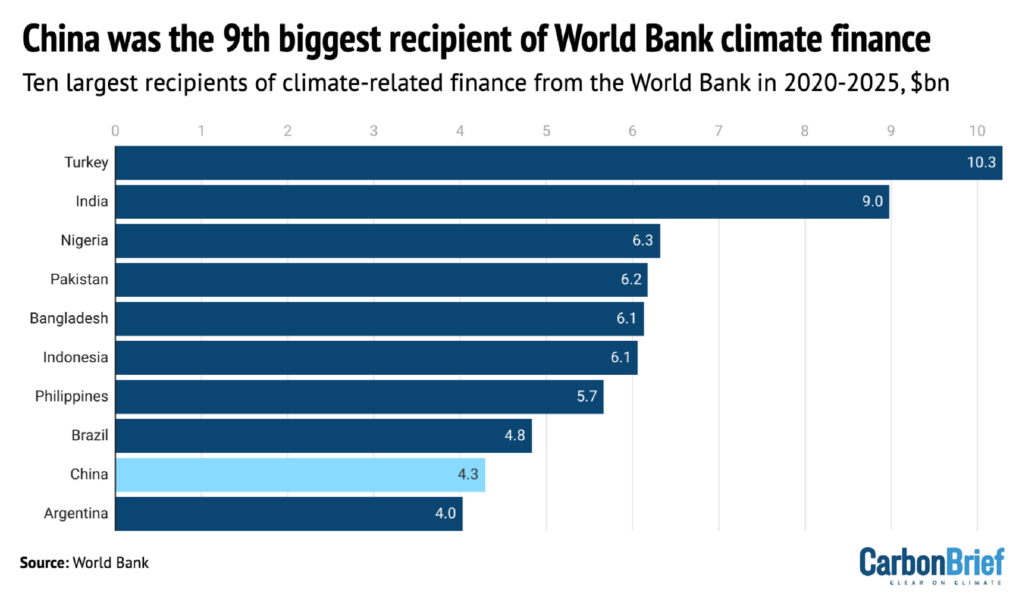
China received $4.3bn in climate finance from the World Bank in 2020-2025, according to Carbon Brief analysis. The World Bank has dropped a pledge on climate-related lending, reported the Financial Times. The newspaper also reported that the bank will also “phase out its lending to China by 2031”. (China is estimated to have provided $3-4.5bn of climate finance annually to other countries, according to estimates by different thinktanks.)
Spotlight
Interview: Dr Sun Yixian on his new database tracking Chinese climate ‘leadership’
A new database has mapped every climate initiative launched or run by China.
In this issue, Carbon Brief interviewed Dr Sun Yixian, professor of sustainability governance at the University of Bath, on what this data shows about China’s approach to climate “leadership”.
Below are highlights from the conversation. The full interview is published on the Carbon Brief website.
Carbon Brief: Your team has compiled a database of China’s “environmental leadership”. What do you mean by leadership?
Sun Yixian: In this project, what we are trying to look at is China’s role in global environmental governance – China’s shifting role, especially from a more passive participant in global governance processes to play a more proactive role in developing or managing its own initiatives on transnational or cross-border environmental governance.
So, [this includes] different environmental issues, but, of course, we found that climate change is a very important issue area. We have come up with a typology of different governance functions, trying to look at what specific activities Chinese actors are doing, or what kind of public goods Chinese actors are delivering, to the audiences of different initiatives.
CB: Could you explain what some of these climate initiatives look like in practice?
SY: In practical terms, there are all different kinds of initiatives. [The majority focus on] sharing information and building platforms, or developing capacity – capacity building activities, which can be training delivered by China to other countries.
Or also by providing funding, for example, China has created this south-south climate fund. It can also include research collaboration.
It can be traditional leadership activities, in the sense of developing certain international regulatory frameworks or rules or standards. It can also be pilot projects. China sometimes can start to work directly with some international partners to trial new ideas and new practices.
CB: The database stops at 2024 – just before the current administration withdrew the US from the Paris Agreement. Have you noticed any changes in China’s global climate engagements following this?
SY: I would say the trend is a continuous one, even [before] the withdrawal of the US…Over the past 10 years, we have seen an upward trend, with more and more new initiatives created by Chinese actors.
But I think the shift will probably help Chinese initiatives get more traction from their international partners – or countries or actors that haven’t been engaged very closely with China – to work more closely with China.
Whether or not this will translate into new initiatives or strengthen existing initiatives, I think that’s an open question.
CB: The theme of the data set is environmental leadership, but…Chinese officials have eschewed being called a climate leader. Would you say that China wants to be seen as a climate leader?
SY: We are entering into the implementation phase for the Paris Agreement. That means it is very difficult to create new agendas at this stage. [Instead the focus is] trying to see if countries can deliver.
If we want to see whether China is becoming a leader, we have to look at how fast, for example, China is accelerating its energy transition and how fast China can reduce its emissions.
Then, in terms of international engagement, what our data is trying to show is that China has become more proactive in that space.
When I was in China a few months ago, [leading experts] said the government…[is] not ready to become a global leader. But, at the same time, I think…in climate governance, but also in clean-energy supply chains – China is playing a leading role.
So, I think the question is whether this…will translate into the understanding, or mindsets, of policymakers or decision-makers.
This interview was conducted by Anika Patel via Zoom on 1 July 2026.
Watch, read, listen
ENVOY INTERVIEW: Climate envoy Liu Zhenmin spoke to state broadcasting station CGTN about climate finance, expectations for China to “lead climate action” and trade tensions.
VIEW FROM THE US: The Atlas Live podcast hosted a debate on “what it will take” for the US to match China’s strength in manufacturing clean-energy technologies.
‘ELECTROSTATE’ EXPLORED: The state media-affiliated WeChat blog Yuyuan Tantian discussed how becoming an “electrostate” would boost China’s “resilience against external risks”.
HYDROGEN TARGETS: The Switched On podcast explored what China’s new targets for “green hydrogen” mean for the development of the industry.
New science
- Offshore wind could provide 3-18% of China’s electricity by 2050 | Communications Earth and Environment
- A new “environmental and nutritional database” of the eight major cuisines of China, including Sichuan, Cantonese and Hunan, reveals “significant variability” in carbon dioxide (CO2) emissions and nutrient content | Scientific Data
Recently published on WeChat
China Briefing is written by Anika Patel, with contributions from Lekai Liu. It is edited by Simon Evans. Please send tips and feedback to china@carbonbrief.org
The post China Briefing 9 July 2026: Guangxi floods | ‘Beautiful China’ plan | New EU-China mechanism appeared first on Carbon Brief.
China Briefing 9 July 2026: Guangxi floods | ‘Beautiful China’ plan | New EU-China mechanism

June Rubis is a steering group committee member for the Cali Fund, from Sarawak in Malaysian Borneo.
At COP16 in Cali, governments made a significant commitment: at least half of the funding from the new Cali Fund should support the self-identified needs of Indigenous Peoples and local communities, including women and youth. It was a watershed moment for multilateral benefit-sharing.
The challenge now is to translate that commitment into access arrangements that recognise the different institutions, priorities and decision-making processes of Indigenous Peoples and local communities.
For generations, biodiversity and traditional Indigenous knowledge have provided significant value to companies who depend on nature’s genetic diversity to discover new drugs that fight diseases, create products that improve health, and grow crops resilient to extreme heat and flooding events. While some compounds are sampled directly from the source country, increasingly the digital blueprints are held in online public databases which are freely accessible to use for innovation and research.
Countries urged to ramp up “insufficient” nature policies at COP17
The Cali Fund was established at COP16 to encourage commercial users of Digital Sequence Information, or DSI, to share benefits arising from its use. Estimates suggest it could generate over $3.5 billion a year – a stark contrast to the modest $10,656 currently committed to the fund from just five SMEs, underlining how much progress must be made at COP17 over the next two weeks.
The COP16 decision that set up the fund offers two routes for money to reach Indigenous Peoples and local communities: through government authorities, and through direct payments to institutions identified by Indigenous Peoples and local communities themselves.
Varied ways of organising
Indigenous Peoples and local communities organise through a wide range of institutions. Some have national or regional organisations experienced in managing international grants. Others work through territorial organisations, customary institutions, community associations, cooperatives or networks. Some have professional finance teams and audited accounts; others have extensive experience governing territories, collective resources or conservation work without having been organised around international funding requirements.
For direct access, some questions are already apparent. Which institutions should be able to receive funds? How should they be identified? What fiduciary standards should apply? How should safeguards and accountability work where institutional capacities differ? What support may be needed where institutions have strong community mandates but less experience with international finance?
Comment: Protecting nature is a public duty, not a Wall Street profit opportunity
If access is designed mainly around institutions that already meet the expectations of large international finance mechanisms, early funding will tend to favour those already familiar to funders. They will gain further experience and become better positioned for future funding, while institutions with less administrative capacity may remain outside the system despite strong community mandates and long histories of stewardship.
These first decisions matter most, because they set the terms for everyone who follows.
The role of intermediaries requires care. Some Indigenous organisations may want a fiscal host to hold and manage funds on their behalf. Communities may choose to work through an NGO they trust. Government-facilitated arrangements may work well in particular national contexts.
What matters is the function an intermediary performs and the authority that comes with it. Providing administrative support is different from deciding which Indigenous organisations qualify, which priorities can receive support, or how success will be assessed. Direct access means communities keep that decision-making authority.
Decision-making power
The COP16 decision refers to institutions that Indigenous Peoples and local communities identify. But authority among Indigenous Peoples does not sit in one kind of body. It may sit with territorial organisations, customary institutions, community associations or combinations of these. Legal recognition and customary authority do not always align neatly.
Global deforestation slowed in 2025 but Brazil’s election could undo “fragile” gains
An important feature of the Cali Fund’s governance is that Indigenous Peoples and local communities participate as full members of the Steering Committee, rather than as observers. Seven Indigenous Peoples and local community representatives, one from each of the seven socio-cultural regions, participate in consensus-based decision-making alongside representatives of governments and UN entities. Six additional representatives from civil society, scientific institutions and the private sector participate as observers.
That representation carries responsibility. Institutional legitimacy, access and representation take different forms across the seven socio-cultural regions. Indigenous Peoples and local communities members therefore have an important role in bringing those differences into the Fund’s governance and in ensuring that arrangements developed for one context do not become the assumed model for everyone else.
Safeguards and clear responsibilities
COP17 can establish the core principles and direction, while allowing operational pathways to develop in ways that respond to different regional contexts. The decisions countries take in Yerevan will shape how that flexibility is realised in practice.
The choices made around access will influence which institutions are able to participate, which routes become established and which forms of authority are recognised within the funding architecture. The aim should be an architecture with enough structure to maintain confidence while allowing for different forms of Indigenous and community governance.
A credible direct-access pathway will need safeguards, financial oversight and clear responsibilities. This would give the 50% commitment a stronger institutional foundation.
The Cali Fund’s importance will ultimately depend not only on how much funding reaches Indigenous Peoples and local communities, but on whether they are able to determine how the money is accessed, governed and used. This requires access pathways that recognise their institutions, priorities and decision-making processes, rather than requiring them to conform to a single predetermined model.
The post COP17 must settle who decides how Cali Fund money is disbursed appeared first on Climate Home News.
COP17 must settle who decides how Cali Fund money is disbursed
The UK government has approved extraction at the Jackdaw gas field in the North Sea, despite acknowledging that this decision could make it harder for Britain to convince other countries to move away from fossil fuel production.
UK energy secretary Miatta Fahnbulleh approved the drilling on Wednesday after months of high-profile debate, fuelled in part by interventions from US President Donald Trump. She argued that the project would boost energy security in the wake of the Middle East fossil fuel crisis, protect hundreds of jobs and add £2.9 billion ($3.88bn) to the UK economy.
She said Jackdaw’s gas would be cleaner than imported gas and would not prevent the UK from meeting its legally-binding carbon targets and its goal of net zero by 2050. As the field is already licensed, she said extraction was consistent with the Labour Party’s 2024 manifesto promise not to issue any new oil and gas licenses.
The same morning, the government announced a new Energy Wealth Fund to reinvest oil and gas revenues in the climate transition. It will start with £2 billion ($2.67bn) from the government and be topped up over time with tax revenues from offshore oil and gas production.

Climate campaigners in the UK and abroad were quick to condemn the decision, while a leading legal expert told Climate Home News it goes against the advice of the International Court of Justice. Meanwhile, the government’s own documents reveal that it recognises the drilling could damage the UK’s reputation and its ability to push forward the global transition away from fossil fuels.
“Climate leadership” blow
The 92-page decision document says Fahnbulleh “acknowledges that international standing on climate is important and accepts that a decision to grant consent may not further the UK’s international climate leadership.”
It adds: “She acknowledges concerns about the potential implications for the UK’s credibility and influence – including the difficulty inherent in encouraging other states to move away from fossil fuel production while the UK continues, in a limited and transitional way, to draw on its own domestic resources.”
While noting that Jackdaw has not been issued with a new license – just permission to extract gas – the document says Fahnbulleh “accepts this does not fully resolve the underlying tension in the UK’s position” but “considers this alongside the substance of the UK’s wider record [on emissions reduction], which remains significant”.
It continues that she accepts these concerns are “legitimate” and weigh against approving gas extraction, but only gives this argument a “moderate negative weight” set against the benefits of gas production.
“Huge” wrong signal
In international climate talks, the UK has long supported the transition away from fossil fuels and is one of very few major oil and gas producers to ban new licenses. Across the North Sea, the Norwegian government continues to make offshore areas available for oil and gas exploration through annual licensing rounds.
Climate experts and campaigners shared the concern, acknowledged in the decision document, that approving Jackdaw could set a precedent for fossil fuel production elsewhere. Sam Fankhauser, professor of climate change economics at Oxford University, said the direct climate impact of Jackdaw is “much smaller than the debate around it would suggest” but the “wrong signal it sends, however, is huge”.
-
Carbon capture industry faces tough future, as UK raids green spending
Despite a spate of projects getting underway, the mood at an industry conference in London this week was low with government subsidies set to shrink
