
Heathrow Airport is raising its climate ambition once again. In 2026, the airport plans to use Sustainable Aviation Fuel (SAF) at levels 2% higher than the UK government’s mandate. This means total SAF use at Heathrow could reach 5.6% of all jet fuel next year.
The UK requires 3.6% SAF blending in 2026. Heathrow’s extra incentive pushes that figure higher, which could translate into around 350,000 tonnes of SAF being used at the airport. About 124,000 tonnes of that would come directly from Heathrow’s own incentive scheme.
To support this effort, Heathrow has set aside more than £80 million to help airlines cover the higher cost of SAF compared to traditional jet fuel. SAF remains more expensive to produce, so this financial support helps narrow the price gap and makes cleaner fuel more attractive for carriers.
This is the fifth year in a row that Heathrow has expanded its SAF support program, showing a consistent push toward lower-carbon flying.
How SAF Cuts Aviation Emissions
Sustainable Aviation Fuel works in today’s aircraft without major changes. Airlines can blend it with regular jet fuel and use existing engines and infrastructure. The key difference lies in how SAF is produced.
It can be made from waste oils, agricultural residues, household waste, or through synthetic processes that combine renewable electricity with captured carbon. Because of these production methods, SAF can reduce lifecycle greenhouse gas emissions by more than 70% compared to fossil jet fuel, according to the UK government.
If Heathrow achieves its 5.6% SAF target in 2026, the airport estimates emissions could fall by around 600,000 tonnes in one year.
To understand the scale:
- A round-trip economy flight from London Heathrow to New York JFK produces about 612 kilograms of CO₂ per passenger, based on ICAO calculations.
- Cutting 600,000 tonnes would equal roughly 950,000 return passenger journeys on that route.
That level of reduction highlights how even small percentage increases in SAF use can create large carbon savings.
Understanding the UK SAF Mandate
The UK introduced the SAF Mandate to ensure steady growth in cleaner aviation fuel. Instead of relying only on voluntary airline commitments, the policy legally requires fuel suppliers to blend increasing amounts of SAF into their total jet fuel supply.
The system includes two parts. The main obligation requires suppliers to meet a rising SAF percentage each year.
- It started at 2% in 2025 and will increase to 10% by 2030 and 22% by 2040. A second requirement, known as the Power-to-Liquid obligation, focuses on advanced synthetic fuels made using renewable electricity. This part begins at 0.2% in 2028 and grows to 3.5% by 2040.
Suppliers earn certificates based on how much carbon savings their SAF delivers. The greater the emissions reduction, the more certificates they receive. They can use these certificates to prove compliance, trade them with others, or pay a buy-out fee if they fail to meet targets. The buy-out price is designed to encourage real SAF supply rather than paying the penalty.
- By 2040, the UK government estimates the mandate could deliver up to 6.3 megatonnes of carbon savings each year.
Matt Gorman, Heathrow’s Director of Sustainability, said,
“Sustainable Aviation Fuel is not a hypothetical concept for the future, it’s already producing real impact in 2026. Heathrow is leading the way globally, with 17% of the world’s SAF supply in 2024 used at the airport. SAF is a key lever on aviation’s journey to net zero by 2050, and a key element of Heathrow’s Net Zero Plan. Our incentive delivers real progress today, as well as a future promise for tomorrow.”
- FURTHER READING: Greening the Aviation: Lufthansa and Airbus Team Up to Cut Business Travel Emissions Using SAF
Heathrow’s SAF expansion fits into a larger strategy to reach net-zero emissions. As one of the world’s busiest international hubs, the airport is working to cut carbon both in flight operations and in ground activities.
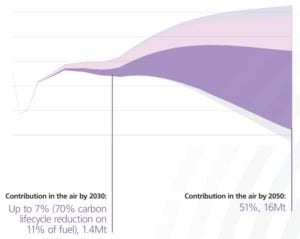
By 2030, Heathrow aims to reduce flight-related emissions by up to 15% compared to 2019 levels. Achieving this depends heavily on scaling up SAF use and improving aircraft efficiency.
Looking further ahead, the airport targets at least an 80% reduction in emissions by 2050. The remaining emissions would need to be removed from the atmosphere to achieve full net zero.
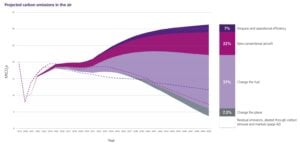
Heathrow’s main roadmap assumes three key developments: continued improvements in aircraft efficiency, introduction of zero-carbon aircraft from the mid-2030s, and large-scale replacement of fossil jet fuel with SAF. In its lead scenario, SAF could replace up to 90% of remaining kerosene by 2050, delivering major lifecycle carbon savings.
There is also a more ambitious scenario in which fully synthetic fuels with near-zero lifecycle emissions replace all fossil-based jet fuel by mid-century.
Use of Hydrogen and Drop-in SAF
Hydrogen-powered aircraft could also play a role in aviation’s future. These planes may use hydrogen in fuel cells or burn it directly in turbines. However, experts expect hydrogen aircraft to serve mainly short-haul routes by 2050.
Shorter flights represent about 30% of global aviation emissions. Long-haul flights, which account for roughly 70%, will likely continue to depend on liquid fuels for decades. For those routes, drop-in SAF remains the most practical and scalable solution.
Heathrow says it must prepare its infrastructure to support hydrogen aircraft while keeping a strong focus on expanding SAF use for conventional planes.
Global SAF Market Reaches a Turning Point
The year 2025 marks a major shift for the global SAF market. Blending mandates in both the European Union and the UK have begun to drive demand growth. SAF demand in the EU could reach about 0.9 million tonnes in 2025, while the UK could require around 0.25 million tonnes. Globally, total demand may approach 2 million tonnes this year.
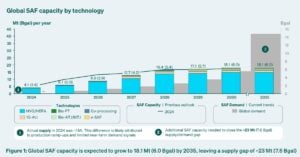
Industry report says, by 2030, global SAF demand could climb to 15.5 million tonnes. Around 4.4 million tonnes of that would come from existing mandates, while the rest would depend on new policies, incentives, and voluntary airline commitments. Nearly 60 airlines have pledged to use 10% SAF by 2030, creating additional market momentum.
However, supply remains fragile. Announced global SAF production capacity for 2030 stands at about 18 million tonnes. While this appears enough on paper, delays and project cancellations in Europe, the UK, and the United States have raised concerns. Lower fossil fuel prices, policy uncertainty, and broader economic pressures have slowed some investments.
Beyond 2030, the challenge grows even larger. By 2035, global SAF demand could reach 40 million tonnes. Meeting that level will require rapid expansion of production capacity over a short period.
A Strong Signal to the Aviation Industry
Heathrow’s decision to exceed the national SAF mandate sends a clear message. Airports can influence the pace of decarbonization, not just governments and airlines.
By offering financial incentives and committing to higher SAF uptake, Heathrow strengthens confidence in the long-term growth of sustainable aviation fuel. Whether supply can scale fast enough remains the key question. For now, the airport’s 5.6% SAF target for 2026 marks a bold and practical step toward cleaner aviation.
The post Heathrow Boosts 2026 Sustainable Aviation Fuel (SAF) Incentive 2% Above UK Government Mandate appeared first on Carbon Credits.
Carbon Footprint
Apple Beats ‘Carbon Neutral’ Lawsuit, But Greenwashing Scrutiny Is Heating Up
A U.S. federal judge has dismissed a proposed class-action lawsuit accusing Apple of misleading consumers with “carbon neutral” marketing for several Apple Watch models. The case targeted the Apple Watch Series 9, Apple Watch SE, and Apple Watch Ultra 2. Plaintiffs said the company exaggerated the environmental benefits of the watches. They claimed Apple relied on carbon offset projects that did not truly cancel the products’ emissions.
Seven buyers filed the lawsuit in February 2025 in federal court in California. They argued they would not have bought the watches, or would have paid less, if they knew the details of Apple’s carbon accounting.
In February 2026, U.S. District Judge Noël Wise dismissed the case. The court ruled the complaint lacked strong evidence showing Apple’s carbon-neutral claims were false or misleading. Wise said:
“At this juncture, the court has a narrow question to consider: have plaintiffs plausibly alleged that Apple’s claims of carbon neutrality are false? Because the court finds that the answer to that question is no, Apple’s motion to dismiss is granted.”
The ruling gives Apple an early legal win. But it also highlights growing scrutiny of corporate climate marketing.
How Apple Calculates a “Zero-Emission” Watch
Apple launched its first carbon-neutral devices in September 2023. The company said the Apple Watch models achieved neutrality through a mix of emissions reductions and carbon offsets.
For example, Apple estimates the lifecycle carbon footprint of a carbon-neutral watch model at about 8.1 kg of CO₂-equivalent emissions per device before offsets. After applying carbon credits, Apple says the net footprint becomes 0 kg CO₂e.
The tech giant says it lowers emissions by:
- using recycled materials,
- increasing renewable electricity in manufacturing,
- improving product efficiency, and
- reducing shipping emissions.
Any remaining emissions are offset through environmental projects.
The lawsuit challenged two offset projects tied to Apple’s claims. One project protects forests in Kenya’s Chyulu Hills, while another supports reforestation efforts in China. Critics argued such projects may not always deliver additional carbon reductions.
The court did not rule on the scientific debate over offsets. Instead, it said the plaintiffs failed to show Apple’s claims were clearly deceptive.
The Tech Giant’s 2030 Net-Zero Roadmap
Apple’s carbon-neutral watches are part of a larger climate plan known as “Apple 2030.” The company aims to make its entire business, supply chain, and product lifecycle carbon neutral by 2030.

The iPhone maker has made progress toward that goal. The company says its global greenhouse gas emissions have fallen by more than 60% compared with 2015 levels.
In 2024, Apple reported a total carbon footprint of about 16.5 million metric tons of CO₂-equivalent emissions across its operations and supply chain. That figure represented a decline from the previous year.

Most of Apple’s emissions come from Scope 3 sources, including manufacturing and product use. To address that, it works closely with suppliers. The company reports that 17.8 gigawatts of renewable electricity are now operating in its global supply chain. Those projects helped avoid about 21.8 million metric tons of greenhouse gas emissions in 2024 alone.
Apple has also increased recycled materials in its products. About 24% of the materials used in Apple devices in 2024 came from recycled or renewable sources. These efforts are central to the company’s climate strategy.
Greenwashing on Trial: Climate Claims Face Legal Tests
Even though Apple won the U.S. case, climate lawsuits are rising worldwide. Greenwashing claims typically challenge marketing statements such as:
- “carbon neutral”
- “net zero”
- “climate friendly”
These terms can involve complex carbon accounting that consumers may not fully understand.
Apple has faced legal pressure outside the United States as well. A court in Frankfurt, Germany ruled in 2025 that Apple could not advertise the Apple Watch as “CO₂-neutral” in Germany. The court said the claim could mislead consumers under local competition law.
European regulators are also tightening rules on environmental claims. New EU consumer protection rules will restrict vague labels like “carbon neutral” in advertising beginning in 2026. These legal developments could reshape how companies communicate climate progress.
Big Tech Emissions: Clean Energy vs. Rising Power Demand
The Apple case reflects a larger trend in the technology sector. Tech companies are under growing pressure to cut emissions as demand for digital services rises.
Data centers, cloud computing, and artificial intelligence require massive amounts of electricity. As a result, technology firms are investing heavily in renewable energy and carbon removal projects.
Apple’s progress contrasts with some peers whose emissions have risen due to expanding AI infrastructure. Apple still emitted about 15.3 million metric tons of CO₂ in 2024, but that figure is far below its 2015 baseline of 38.4 million tons.
At the same time, clean energy adoption is growing globally. The rapid expansion of renewable power also supports other low-carbon industries, including electric vehicles.

Companies such as Tesla rely heavily on the decarbonization of electricity systems. The climate benefit of electric cars increases when power grids shift toward renewable energy.
Global electric vehicle adoption is rising quickly. According to the International Energy Agency, EVs represented about 20% of global car sales in 2024, compared with 18% in 2023 and just 4% in 2020. That growth is expected to continue as governments strengthen climate policies and consumers adopt cleaner transportation.
Technology companies and automakers both depend on credible climate strategies to maintain investor confidence.
The Role of Carbon Credits in Corporate Climate Plans
Carbon credits remain a key tool for many companies pursuing net-zero goals. Apple increased its use of carbon credits in 2024, retiring about 737,100 tons of CO₂-equivalent offsets—its highest level to date.
Carbon offsets support several projects such as:
- forest protection,
- reforestation,
- methane capture, and
- renewable energy development.
However, the quality of carbon credits has become a major issue in climate policy.
Some researchers argue that certain nature-based credits may overestimate their climate impact. Others say these projects are essential for protecting ecosystems and funding conservation. The debate is likely to intensify as more corporations adopt net-zero targets.
A Legal Win, but Climate Claims Under the Microscope
Apple’s victory in the U.S. greenwashing lawsuit marks an important moment in the evolving field of climate litigation. The court ruled that the plaintiffs did not present enough evidence to prove the tech giant’s carbon-neutral claims were misleading.
However, the case also shows how closely corporate climate messaging is now examined. Companies across technology, energy, and transportation sectors face growing pressure to show real emissions reductions and transparent reporting.
As the clean-energy transition accelerates, and industries from consumer electronics to electric vehicles expand, clear standards for climate claims will become increasingly important.
For Apple and other global companies, the challenge is not only reducing emissions but also proving those reductions in ways that stand up to scientific, legal, and public scrutiny.
- READ MORE: Oil Giants Under Fire: ExxonMobil Fights Climate Laws as TotalEnergies Found Guilty of Greenwashing
The post Apple Beats ‘Carbon Neutral’ Lawsuit, But Greenwashing Scrutiny Is Heating Up appeared first on Carbon Credits.
Carbon Footprint
China’s New 2030 Climate Playbook and What It Means for the EV Market
China has released updated climate goals for the period leading to 2030, framed as part of its 15th Five‑Year Plan (2026–2030). These goals focus mainly on improving carbon efficiency, that is, lowering emissions relative to economic output, rather than capping total emissions.
Under the new plan, China aims to reduce carbon dioxide (CO₂) emissions per unit of gross domestic product (GDP) by 17% between 2026 and 2030. The immediate 2026 target is to cut carbon intensity by about 3.8% from the prior year.
The world’s largest emitter has not announced a new absolute cap on total CO₂ emissions for 2030. This means emissions could still rise in total even as the economy becomes more efficient. That cautious tone has drawn attention from analysts.
Norah Zhang, China country lead for Climate Action Tracker, remarked:
“In 2025, renewable electricity generation in China grew faster than overall electricity demand, which helped reduce coal-fired power generation and lowered CO₂ emissions in the power sector. However, the new five-year plan does not update the 2030 target for newly-installed solar and wind capacity, which China already achieved in 2024. By not updating these targets, the new plan misses an opportunity to create additional momentum through more ambitious goal setting for 2030 and beyond.”
What the New Targets Mean in Practice
China has long said it will peak carbon emissions before 2030 and achieve carbon neutrality by 2060 — often called its “dual‑carbon” goals under the Paris Agreement. However, the new 2030 plan places greater emphasis on intensity improvements rather than absolute reductions.

China’s updated climate strategy reflects a balance between economic growth and emissions control. The plan includes a GDP growth target of 4.5–5% for 2026, suggesting the government expects continued industrial expansion. But this raises the possibility that total CO₂ emissions could climb even as carbon intensity improves.
The new plan also prioritizes energy transition actions, such as:
- Replacing ~30 million tonnes of coal per year with renewables
- Relying on China’s booming renewable industry to limit coal use
- Supporting wind, solar, nuclear, and transmission infrastructure
- Expanding the carbon emission trading system
- Setting up a low‑carbon transition fund and energy storage build‑outs
However, the absence of an absolute emissions cap means China’s total carbon output may still grow if economic expansion is strong.
China’s Global Emissions Weight: Why It Matters
China is the world’s largest emitter of greenhouse gases, accounting for roughly 30% of global CO₂ emissions. Most studies suggest that the country’s emissions will peak between 2027 and 2030 with a peak between 11.6 and 13.2 gigatonnes of CO₂ equivalent (GtCO₂e) under current policy trajectories.
China’s transition has been supported by rapid renewable energy growth. China accounts for more than half of global solar panel production and is a global leader in wind and solar deployment.

Growth in clean energy helped fossil fuel use fall by an estimated 2% in 2025, and renewable sources met about 84% of electricity demand growth, according to independent analysis. This trend is expected to make global fossil fuel demand begin to decline by 2030 if current energy shifts hold.

EV Market Spotlight: Cleaner Power, Bigger Demand
China is also the world’s largest electric vehicle (EV) market. The country plays a major role in EV adoption, and its policies can shape global trends, including demand for vehicles from companies like Tesla.
The Asian nation’s 2030 goals indirectly influence EV demand. Strong efficiency and clean energy targets can make EVs more attractive versus traditional combustion cars by lowering emissions from electricity generation. EVs reduce local pollution and align with both national and global climate ambitions.
Tesla has been expanding in China, including with the Gigafactory Shanghai that supplies vehicles domestically and for export. China’s EV market is projected to grow further, supported by urban electrification policies and consumer incentives.

However, policies that rely mainly on carbon intensity reductions — as opposed to absolute emissions limits — may slow the pace of structural changes needed to fully decarbonize transport and power sectors. Still, China’s rising clean electricity share helps strengthen the climate case for EV adoption by lowering the lifecycle emissions of electric vehicles.
Broader Market Trends, Forecasts, and Investment Signals
China’s cautious climate plan comes amid shifting global policy dynamics. While many countries are enhancing climate targets, some have pulled back from earlier commitments. For example, changes to U.S. federal climate policy have created uncertainty in long‑term emissions strategies.
As of late 2025, around 145 countries had announced or were considering net‑zero targets, covering about 77% of global greenhouse gas emissions. China remains a key driver in this global push.

In carbon markets, China has also taken steps to expand its emissions trading system (ETS). Recent policy outlines suggest broader coverage of sectors and possibly higher stringency in future phases. This could help drive cleaner investments and offer market signals to investors and companies.
- READ MORE: China Expands Carbon Reporting to Airlines and Heavy Industry in Major Climate Disclosure Shift
Renewable energy and clean tech markets may benefit from China’s cautious but steady approach. The country’s demand for solar panels, batteries, and wind equipment can sustain supply chains and keep manufacturing costs down globally — benefiting EV makers and green tech firms alike.
Ambition vs. Reality: Tracking China’s Climate Trajectory
Despite progress in clean energy, challenges remain. China has not set a firm limit on total emissions through 2030, and coal consumption continues to play a major role in power generation. The reliance on carbon intensity targets means that total emissions may grow if GDP expands faster than emissions decline per unit of output.
To stay aligned with Paris Agreement goals, many analysts believe stronger absolute cuts are needed. Independent research suggests that China could reduce emissions by up to 30% by 2035 relative to current levels with more ambitious policy action.
However, the current 2030 plan keeps a cautious balance between economic growth and climate policy. The country aims to improve carbon efficiency and expand clean energy, but stops short of committing to cuts in total emissions. These targets are part of its long‑term plan to peak emissions before 2030 and achieve carbon neutrality by 2060.
For markets and companies like Tesla, China’s climate strategy will continue to matter. As the largest EV market and a leader in clean energy production, China’s demand trends and policy frameworks shape global investment and manufacturing patterns.
The cautious tone of China’s new climate goals shows a complex trade‑off between growth and climate action. Whether China will accelerate its ambition before 2030 remains a key question for global decarbonization and the broader energy transition.
The post China’s New 2030 Climate Playbook and What It Means for the EV Market appeared first on Carbon Credits.
Carbon Footprint
India–Canada Usher in a New Era of Partnership as Cameco Signs $2.6B Uranium Deal
Cameco has signed a major long-term uranium supply agreement with India. The Canadian uranium giant will deliver nearly 22 million pounds of uranium ore concentrate (U3O8) to India over nine years. The contract is valued at about $2.6 billion.
Deliveries will begin in 2027 and continue through 2035. The uranium will power India’s growing fleet of nuclear reactors. The agreement strengthens energy ties between Canada and India at a time when nuclear power is gaining fresh momentum worldwide.
A Strategic Boost for India–Canada Relations
The agreement was celebrated in New Delhi in the presence of Narendra Modi, Mark Carney, and Saskatchewan Premier Scott Moe. Carney’s 2026 visit marked a reset in India–Canada relations.
As we have read and heard earlier, diplomatic ties have been strained in recent years. However, both leaders described this visit as the start of a “new era of partnership.”
The uranium deal was one of the key outcomes of the visit. In addition, both countries renewed efforts to finalize a Comprehensive Economic Partnership Agreement (CEPA) by the end of 2026.
India and Canada also set a bold trade target. They aim to increase bilateral trade to $50 billion by 2030, up from nearly $9 billion in 2024–25.
Both sides agreed to deepen cooperation in:
- Critical minerals
- Renewable energy
- Energy security
- Advanced nuclear technologies, including SMRs
This uranium agreement fits directly into that broader economic and strategic framework.
India’s Nuclear Ambitions and Uranium Demand
India currently operates 24 nuclear reactors. However, the country has much larger plans. Under its long-term energy roadmap, India aims to reach 100 gigawatts (GW) of nuclear capacity by 2047.

The Union Budget 2025–26 placed nuclear energy at the center of this strategy. The government launched the Nuclear Energy Mission for Viksit Bharat. This mission focuses on expanding nuclear capacity, cutting fossil fuel use, and boosting energy security.
- A key part of the plan is the development of small modular reactors (SMRs) that are smaller, more flexible, and easier to deploy. They can power remote regions and replace retiring coal plants.
The government has allocated $2.4 billion to build at least five indigenously designed SMRs by 2033. This move signals strong policy backing for advanced nuclear technology.
As electricity demand rises due to industrial growth and data centers, nuclear power offers a stable, round-the-clock, low-carbon energy source. Therefore, securing a long-term uranium supply is critical for India’s expansion goals.
Cameco Strengthens Its Long-Term Strategy
For Cameco, the deal aligns perfectly with its disciplined contracting model. The company avoids chasing short-term spot fces. Instead, it focuses on securing long-term contracts with reliable customers.
By the end of 2025, Cameco had about 230 million pounds of uranium under long-term contracts. This provides strong revenue visibility for years.
The new India agreement was already included in the company’s disclosed long-term contracting volumes and price sensitivity analysis. The estimated $2.6 billion value is based on a uranium price of $86.95 per pound, reflecting late February 2026 spot price averages.
Uranium: The Backbone of Cameco’s Business
In 2025, the company reported strong financial results. Earnings before income tax in the uranium segment rose by $50 million year over year. Adjusted EBITDA increased by $76 million.

Although fourth-quarter earnings dipped slightly due to sales timing, underlying pricing remained strong. But operationally, Cameco delivered solid production results:
- At Cigar Lake, production reached 19.1 million pounds (100% basis), exceeding annual expectations.
- At McArthur River/Key Lake, production totaled 15.1 million pounds, meeting revised guidance.
Average realized uranium prices improved as market-linked and escalated contracts reflected higher pricing.

Canada’s Expanding Uranium Role
Canada is one of the world’s leading uranium producers. Saskatchewan hosts some of the richest uranium deposits globally. Major mines such as Cigar Lake, McClean Lake, and Rabbit Lake have supplied uranium for decades. Recently, Canada approved its first large-scale uranium mine in over 20 years.
The federal and provincial governments cleared the Phoenix In Situ Recovery (ISR) uranium project. This project is part of Denison Mines’ Wheeler River development in Saskatchewan. Approval allows the construction of both the mine and its processing facilities.
This decision signals Canada’s commitment to supporting global nuclear growth. As more countries expand nuclear capacity, demand for a secure uranium supply continues to rise.

A Deal With Long-Term Impact
Around the world, nuclear energy is regaining policy support. Countries are seeking reliable, low-carbon power to meet climate targets and rising electricity demand. India stands out as one of the fastest-growing nuclear markets. Its target of 100 GW by 2047 represents a massive expansion from current levels.
To reach that goal, India will need a steady uranium supply, new reactor builds, and strong international partnerships. The Cameco deal addresses one key piece of that puzzle: fuel security.
Overall, this agreement goes beyond a simple supply contract. It reflects deeper economic and strategic alignment between the two major democracies. While India secures uranium to power its future reactors, Canada strengthens its role in the global nuclear fuel market. Meanwhile, bilateral trade and diplomatic ties gain fresh momentum.
As nuclear energy returns to the global spotlight, long-term fuel partnerships will become even more important. In that context, Cameco’s $2.6 billion agreement with India marks a decisive step toward a more secure and low-carbon energy future for both nations.
- SEE MORE: Canada Approves First Uranium Mine in 20 Years as Tech Giants Eye Nuclear Fuel for AI Power
The post India–Canada Usher in a New Era of Partnership as Cameco Signs $2.6B Uranium Deal appeared first on Carbon Credits.
-
Greenhouse Gases7 months ago
Guest post: Why China is still building new coal – and when it might stop
-
Climate Change7 months ago
Guest post: Why China is still building new coal – and when it might stop
-
Greenhouse Gases2 years ago嘉宾来稿:满足中国增长的用电需求 光伏加储能“比新建煤电更实惠”
-

Climate Change2 years ago
Bill Discounting Climate Change in Florida’s Energy Policy Awaits DeSantis’ Approval
-
Climate Change2 years ago
Spanish-language misinformation on renewable energy spreads online, report shows
-
Climate Change2 years ago嘉宾来稿:满足中国增长的用电需求 光伏加储能“比新建煤电更实惠”
-
Climate Change Videos2 years ago
The toxic gas flares fuelling Nigeria’s climate change – BBC News
-
Carbon Footprint2 years agoUS SEC’s Climate Disclosure Rules Spur Renewed Interest in Carbon Credits


