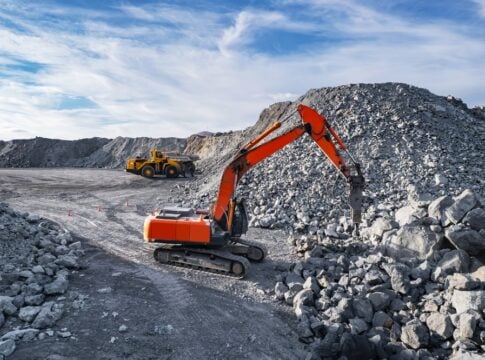
- Enhanced Rock Weathering (ERW) is gaining attention as a scalable carbon removal solution. A recent study suggests the method could remove up to 350 million tonnes of CO₂ per year by 2050 if widely deployed.
What is Enhanced Rock Weathering?
Enhanced Rock Weathering is a carbon removal method that speeds up a natural geological process. Rocks such as basalt and silicates naturally react with carbon dioxide (CO₂) over thousands of years.
ERW involves crushing these rocks into fine powder and spreading them on the soil. The larger surface area makes the rocks react faster with CO₂ in the air and soil. Scientists believe this could permanently capture and store carbon as stable minerals or ocean carbon pools.
This carbon removal has emerged as a promising part of the climate toolkit to help lower atmospheric CO₂ levels.
How ERW Removes Carbon
Natural rock weathering already captures about 1.1 billion tonnes of CO₂ per year from the atmosphere. ERW accelerates this process by increasing the rock’s contact with CO₂.
When rainwater dissolves CO₂, it forms carbonic acid, which reacts with silicate rocks. This reaction locks carbon into bicarbonate ions. Some of the ions wash into rivers and reach the ocean, where they can stay for thousands of years. Because the carbon is stored this way, it is unlikely to return to the atmosphere soon.
In agriculture, ground rocks applied to the soil enhance this process. The rocks react with CO₂ around plant roots and soil microbes. Some companies source rock dust from quarries. They use industrial byproducts instead of new mining.
350 Million Tonnes: The Mid-Century Potential
New research shows that ERW could make a major contribution to climate goals by mid-century. Scaling ERW on suitable agricultural land and other surfaces worldwide could remove an estimated 350 million tonnes of CO₂ per year by 2050. This would come from fast-tracking the natural weathering process across large areas of cropland.
Global modelling studies also suggest even bigger potential. ERW could cut hundreds of millions to billions of tonnes of CO₂ each year by 2050. This depends on widespread use, strong policy support, and proper infrastructure.
Some studies focused on the United States have reported similar potential. Research shows that ERW in U.S. agriculture could cut CO₂ by 160 to 300 million tonnes each year by 2050. If expanded, this number could reach 250 to 490 million tonnes by 2070.

This 350 million-tonne figure sits within a broader picture of potential CDR capacity. Some analyses suggest that ERW could remove billions of tonnes every year. This would occur if the method is used widely across continents with big agricultural sectors.
Why ERW Stands Out in the Carbon Removal Race
One key reason ERW attracts attention is its durability. Carbon captured through rock weathering is stored in stable forms that can last thousands to millions of years. This permanence can make ERW more durable than some nature-based solutions that store carbon only for the lifetime of trees or plants.
ERW also builds on existing farming and mining systems. The technology uses known equipment and methods for crushing and spreading rock. This means ERW is likely easier to use widely than complex methods like direct air capture (DAC). DAC needs big new facilities and a lot of energy.
Enhanced rock weathering has additional benefits beyond carbon capture. When applied to agricultural soils, silicate rock dust can improve soil nutrition and structure. This can enhance crop yields and reduce the need for some fertilizers. Some research has even shown that certain enhanced weathering practices can improve crop performance while removing CO₂.
ERW Carbon Removal Credits Snapshot
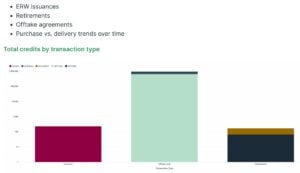
ERW has begun to enter this market with real, verified credits. In early 2025, InPlanet and Isometric issued the first independently verified ERW carbon removal credits. These credits show long-lasting CO₂ removal. They are certified with strict monitoring, reporting, and verification (MRV) protocols.
While ERW still makes up a very small share of total credits traded in 2025, its emergence marks a milestone for carbon removal markets. Early tracking shows that nearly one million ERW credits have been sold, and the total investment in ERW projects is about US$121 million. This reflects increasing interest from companies and offset buyers.

ERW carbon credit prices now range from $200–$500 per tonne. This spread comes from differences in project size, location, and how mature each method is.
Early ERW credits add variety to the carbon market. They focus on carbon removal, which is attracting buyers like Google and Microsoft. They want long-term, verified removal credits along with avoidance credits.
- SEE MORE: Microsoft Backs InPlanet’s Enhanced Rock Weathering Push to Remove 28,500 Tons of CO₂ in Brazil
Scaling Up: Verification, Logistics, and Adoption Hurdles
Despite its promise, ERW faces several challenges before it can deliver on its full potential by 2050.
- Monitoring and verification: Measuring exactly how much CO₂ ERW removes is complex. The process occurs over time and involves soil chemistry, water movement, and geological cycles. Accurate monitoring, reporting, and verification (MRV) systems are needed to ensure that carbon removal amounts are real and not overstated.
- Deployment logistics: Scaling ERW globally would require vast amounts of crushed rock. This means expanded quarrying, crushing, transport, and spreading infrastructure. These steps must be done efficiently to avoid high emissions from transport and machinery.
- Agronomic adoption: Farmers and landowners would need incentives and support to adopt ERW. Also, the use of rock dust must align with soil types, crops, and local farming practices. Long-term studies are ongoing to determine the best application rates and conditions for different regions.
- Environmental questions: While ERW can benefit soil fertility, some uncertainties remain about long-term ecosystem impacts and potential side effects. Careful planning and studies are needed before very large-scale deployments can occur.
A Key Piece in the Net-Zero Puzzle
Climate models show that reducing emissions alone won’t be enough to meet the Paris Agreement’s goals. Many experts argue that carbon dioxide removal (CDR) must play a role in keeping the temperature rise below 1.5°C. ERW is one of several CDR methods being considered.
Other CDR approaches include direct air capture (DAC) and bioenergy with carbon capture and storage (BECCS). DAC uses machines to pull CO₂ directly from the air, but it is still expensive and energy-intensive.
BECCS captures CO₂ from biomass energy but depends on large dedicated biomass supplies. ERW, by contrast, can leverage natural soil processes and agricultural lands for scalable removal.
Policy makers and climate planners see enhanced rock weathering as one piece of a broader carbon removal portfolio. ERW, along with strong emissions cuts, nature-based solutions like reforestation, and new technologies, can help balance hard-to-abate emissions in sectors such as industry and agriculture.
To reach 350 million tonnes of CO₂ removal per year by 2050, ERW must scale rapidly. This will require stronger global commitment from governments, research institutions, and private investors.
Moreover, investment in field trials and pilot programs will help refine practices and decrease uncertainty. As more data becomes available, ERW techniques can be optimized for different soils, climates, and crop systems.
Public policy support will also be key. Carbon markets, incentives, and crediting systems that recognize verified removal could help fund large-scale ERW deployment. If aligned with broader climate goals, ERW could become a major contributor to meeting global net-zero targets.
The post Rocking the Carbon Clock: ERW Could Cut 350 Million Tonnes of CO₂ Annually by 2050 appeared first on Carbon Credits.
Carbon Footprint
Carbon credit project stewardship: what happens after credit issuance
A carbon credit purchase is not a transaction that closes at issuance. The credit may be retired, the certificate filed, and the reporting box ticked. But on the ground, in the forest, in the field, and in the community, the work continues. It endures for years. In many cases, for decades.
![]()
Carbon Footprint
Industries with the biggest nature footprints and what their decarbonisation looks like
A corporate carbon footprint is never just an accounting figure. It maps onto real ecosystems. Before a product leaves the factory gate, something on the ground has already paid the cost. A forest has been converted. A river has been depleted. A patch of savannah that was once home to dozens of species now grows a single crop in every direction.
![]()
Carbon Footprint
Apple, Amazon Lead 60+ Firms to Ease Global Carbon Reporting Rules
More than 60 global companies, including Apple, Amazon, BYD, Salesforce, Mars, and Schneider Electric, are pushing back against proposed changes to global emissions reporting rules. The group is calling for more flexibility under the Greenhouse Gas Protocol (GHG Protocol), the most widely used framework for measuring corporate carbon footprints.
The companies submitted a joint statement asking that new requirements, especially those affecting Scope 2 emissions, remain optional rather than mandatory. Their letter stated:
“To drive critical climate progress, it’s imperative that we get this revision right. We strongly urge the GHGP to improve upon the existing guidance, but not stymie critical electricity decarbonization investments by mandating a change that fundamentally threatens participation in this voluntary market, which acts as the linchpin in decarbonization across nearly all sectors of the economy. The revised guidance must encourage more clean energy procurement and enable more impactful corporate action, not unintentionally discourage it.”
The debate comes at a critical time. Corporate climate disclosures now influence trillions of dollars in capital flows, while stricter reporting rules are being introduced across major economies.
The Rulebook for Carbon: What the GHG Protocol Is and Why It’s Being Updated
The Greenhouse Gas Protocol is the world’s most widely used system for measuring corporate emissions. It is used by over 90% of companies that report greenhouse gas data globally, making it the foundation of most climate disclosures.
It divides emissions into three categories:
- Scope 1: Direct emissions from operations
- Scope 2: Emissions from purchased electricity
- Scope 3: Emissions across the value chain

The current Scope 2 rules were introduced in 2015, but energy markets have changed since then. Renewable energy has expanded, and companies now play a major role in funding clean power.
Corporate buyers have already supported more than 100 gigawatts (GW) of renewable energy capacity globally through voluntary purchases. This shows how influential the current system has been.
The GHG Protocol is now updating its rules to improve accuracy and transparency. The revision process includes input from more than 45 experts across industry, government, and academia, reflecting its global importance.
Scope 2 Shake-Up: The Battle Over Real-Time Carbon Tracking
The proposed update would shift how companies report electricity emissions. Instead of using flexible systems like renewable energy certificates (RECs), companies would need to match their electricity use with clean energy that is:
- Generated at the same time, and
- Located in the same grid region.
This is known as “24/7” or hourly or real-time matching. It aims to reflect the actual impact of electricity use on the grid. Companies, including Apple and Amazon, say this shift could create challenges.

According to industry feedback, stricter rules could raise energy costs and limit access to renewable energy in some regions. It can also slow corporate investment in new clean energy projects.
The concern is that many markets do not yet have enough renewable supply for real-time matching. Infrastructure for tracking hourly emissions is also still developing.
This creates a key tension. The new rules could improve accuracy and reduce greenwashing. But they may also make it harder for companies to scale clean energy quickly.
The outcome will shape how companies measure emissions, invest in renewables, and meet net-zero targets in the years ahead.
Why More Than 60 Companies Oppose the Changes
The companies argue that stricter rules could slow climate progress rather than accelerate it. Their main concern is cost and feasibility. Many regions still lack enough renewable energy to support real-time matching. For global companies, aligning energy use across different grids is complex.
In their joint statement, the group warned that mandatory changes could:
- Increase electricity prices,
- Reduce participation in voluntary clean energy markets, and
- Slow investment in renewable energy projects.
They argue that current market-based systems, such as RECs, have helped scale clean energy quickly over the past decade. Removing flexibility could weaken that momentum.
This reflects a broader tension between accuracy and scalability in climate reporting.
Big Tech Pushback: Apple and Amazon’s Climate Progress
Despite their push for flexibility, both companies have made measurable progress on emissions reduction.
Apple reports that it has reduced its total greenhouse gas emissions by more than 60% compared to 2015 levels, even as revenue grew significantly. The company is targeting carbon neutrality across its entire value chain by 2030. It also reported that supplier renewable energy use helped avoid over 26 million metric tons of CO₂ emissions in 2025 alone.

In addition, about 30% of materials used in Apple products in 2025 were recycled, showing a shift toward circular manufacturing.
Amazon has also set a net-zero target for 2040 under its Climate Pledge. The company is one of the world’s largest corporate buyers of renewable energy and continues to invest heavily in clean power, logistics electrification, and low-carbon infrastructure.

Both companies argue that flexible accounting frameworks have supported these investments at scale.
The Bigger Challenge: Scope 3 and Digital Emissions
The debate over Scope 2 reporting is only part of a larger issue. For most large companies, Scope 3 emissions account for more than 70% of total emissions. These include supply chains, product use, and outsourced services.
In the technology sector, emissions are rising due to:
- Data centers,
- Cloud computing, and
- Artificial intelligence workloads.
Global data centers already consume about 415–460 terawatt-hours (TWh) of electricity per year, equal to roughly 1.5%–2% of global power demand. This figure is expected to increase sharply. The International Energy Agency estimates that data center electricity demand could double by 2030, driven largely by AI.
This creates a major reporting challenge. Even with cleaner electricity, total emissions can rise as digital demand grows.
Climate Reporting Rules Are Tightening Globally
The pushback comes as climate disclosure requirements are expanding and becoming more standardized across major economies. What was once voluntary ESG reporting is steadily shifting toward mandatory, audit-ready climate transparency.
In the European Union, the Corporate Sustainability Reporting Directive (CSRD) is now active. It requires large companies and, later, listed SMEs, to share detailed sustainability data. This data must match the European Sustainability Reporting Standards (ESRS). This includes granular reporting on emissions across Scope 1, 2, and increasingly Scope 3 value chains.
In the United States, the Securities and Exchange Commission (SEC) aims for mandatory climate-related disclosures for public companies. This includes governance, risk exposure, and emissions reporting. However, some parts of the rule face legal and political scrutiny.
The United Kingdom has included climate disclosure through TCFD requirements. Now, it is moving toward ISSB-based global standards to make comparisons easier. Similarly, Canada is progressing with ISSB-aligned mandatory reporting frameworks for large public issuers.
In Asia, momentum is also accelerating. Japan is introducing the Sustainability Standards Board of Japan (SSBJ) rules that match ISSB standards. Meanwhile, China is tightening ESG disclosure rules for listed companies through updates from its securities regulators. Singapore has also mandated climate reporting for listed companies, with phased Scope 3 expansion.
A clear trend is forming across jurisdictions: climate disclosure is aligning with ISSB global standards. There’s a growing focus on assurance, comparability, and transparency in value-chain emissions.
This regulatory tightening raises the bar significantly for corporations. The challenge is clear. Companies must:
- Align with multiple evolving disclosure regimes,
- Ensure emissions data is verifiable and auditable, and
- Expand reporting across complex global supply chains.
Balancing operational growth with compliance is becoming increasingly complex as climate regulation converges and intensifies worldwide.
A Turning Point for Global Carbon Accounting
The outcome of this debate could shape global carbon accounting standards for years.
If stricter rules are adopted, emissions reporting will become more precise. This could improve transparency and reduce greenwashing risks. However, it may also increase compliance costs and limit flexibility.
If the proposed changes remain optional, companies may continue using current accounting methods. This could support faster clean energy investment, but may leave gaps in reporting accuracy.
The new rules could take effect as early as next year, making this a near-term decision for global companies.
The push by Apple, Amazon, and other companies highlights a key tension in climate strategy. On one side is the need for accurate, real-time emissions reporting. On the other is the need for flexible systems that support large-scale clean energy investment.
As digital infrastructure expands and energy demand rises, how emissions are measured will matter as much as how they are reduced. The next phase of climate action will depend not just on targets—but on the systems used to track them.
The post Apple, Amazon Lead 60+ Firms to Ease Global Carbon Reporting Rules appeared first on Carbon Credits.
-
Climate Change9 months ago
Guest post: Why China is still building new coal – and when it might stop
-
Greenhouse Gases9 months ago
Guest post: Why China is still building new coal – and when it might stop
-
Greenhouse Gases2 years ago嘉宾来稿:满足中国增长的用电需求 光伏加储能“比新建煤电更实惠”
-

Climate Change2 years ago嘉宾来稿:满足中国增长的用电需求 光伏加储能“比新建煤电更实惠”
-
Climate Change2 years ago
Bill Discounting Climate Change in Florida’s Energy Policy Awaits DeSantis’ Approval
-
Renewable Energy7 months agoSending Progressive Philanthropist George Soros to Prison?
-
Carbon Footprint2 years agoUS SEC’s Climate Disclosure Rules Spur Renewed Interest in Carbon Credits
-
Greenhouse Gases10 months ago
嘉宾来稿:探究火山喷发如何影响气候预测


