

Volcanic eruptions pose a fundamental challenge for scientists and their climate models.
It is well known that explosive eruptions can cause sudden cooling at the Earth’s surface and that multiple eruptions shape climate variability over decades and centuries.
When sulphur dioxide is injected into the stratosphere during an eruption, it forms aerosols that block sunlight from reaching the Earth’s surface.
Unlike human influences on climate change, which occur slowly and can be accounted for in climate models under a range of socioeconomic scenarios, the sporadic nature of volcanic eruptions poses a challenge for climate projections.
Scientists cannot currently forecast the occurrence of volcanic eruptions – including when and where they will occur and how much sulphur they will emit.
How, then, to account for the climate impact of volcanic eruptions when projecting into the future?
In a recent study, published in Communications Earth & Environment, we show that volcanic eruptions make a substantial contribution to the uncertainty in projections of global temperatures.
Our findings suggest that, when sporadic volcanic eruptions are included in climate projections, breaching of the Paris Agreement’s 1.5C warming limit is slightly delayed – but we will also see more decades with rapid rates of warming and cooling.
Volcanic forcing in climate projections
Climate scientists refer to the influence volcanic eruptions have on the climate – largely through the release of sulphur dioxide gas into the atmosphere – as “volcanic forcing”.
Current climate models apply a constant volcanic forcing value when running future projections. This value is calculated based on the historical average of forcings from 1850 to the present day.
This is the case with the Coupled Model Intercomparison Project (CMIP), the international modelling effort that feeds into the influential assessment reports from the Intergovernmental Panel on Climate Change (IPCC).
However, this approach has significant limitations.
For starters, historically averaged forcing does not capture the episodic nature of eruptions.
Large-magnitude volcanic eruptions happen sporadically – sometimes clustering within decades and other times leaving century-long gaps between events.
Meanwhile, the reference period of 1850 to the present day has seen a relatively low frequency of large-magnitude eruptions that emitted more than 3 teragrams (Tg) of sulphur dioxide (SO2), when compared to multimillennial records.
Finally, volcanic forcing reconstructions used in earlier generations of CMIP climate models did not include small-to-moderate magnitude eruptions that emitted less than 3Tg of SO2.
This is because these eruptions went largely undetected before the satellite era began in 1980. Nonetheless, these smaller, but more frequent, eruptions contribute to 30-50% of long-term volcanic forcing.
Taking a new approach
Traditionally, climate scientists have recognised three main sources of uncertainty in climate projections: internal variability, model uncertainty and scenario uncertainty.
Here, “internal” variability refers to natural fluctuations that are generated within the climate system, such as by El Niño; model uncertainty refers to the differences in the results between multiple climate models; and scenario uncertainty refers to the different ways that the world could develop over the decades to come.
Our results show that volcanic eruptions should be specifically considered as a fourth significant source of uncertainty in climate projections.
To explore how climate projections change when accounting for volcanic forcing uncertainty, our study uses a probabilistic approach that builds on a 2017 methodology developed by Bethke et al.
To do this, we develop “stochastic forcing scenarios” – essentially, 1,000 different plausible timelines of volcanic activity extending to the end of the century.
These scenarios draw from past volcanic activity recorded in ice cores going back 11,500 years, along with satellite measurements and geological evidence. Each scenario represents different combinations of eruption magnitudes, location, timing and frequency.
(In mathematics, “stochastic” systems involve randomness or uncertainty of outcome, making them unpredictable. This is in contrast to “deterministic” systems, which are characterised by having outcomes that are completely predictable based on initial conditions and a set of rules or equations.)
We then simulate climate projections using both stochastic and historically-averaged volcanic forcing between 2015 and 2100, exploring temperature rise under three different emissions scenarios drawn from the Shared Socioeconomic Pathways (SSPs). These are a low-emission scenario (SSP1-1.9), an intermediate scenario that is in line with current climate policies(SSP2-4.5) and a very-high emissions scenario (SSP5-8.5).
For this step, we use a simple climate model, or “emulator”, called FaIR.
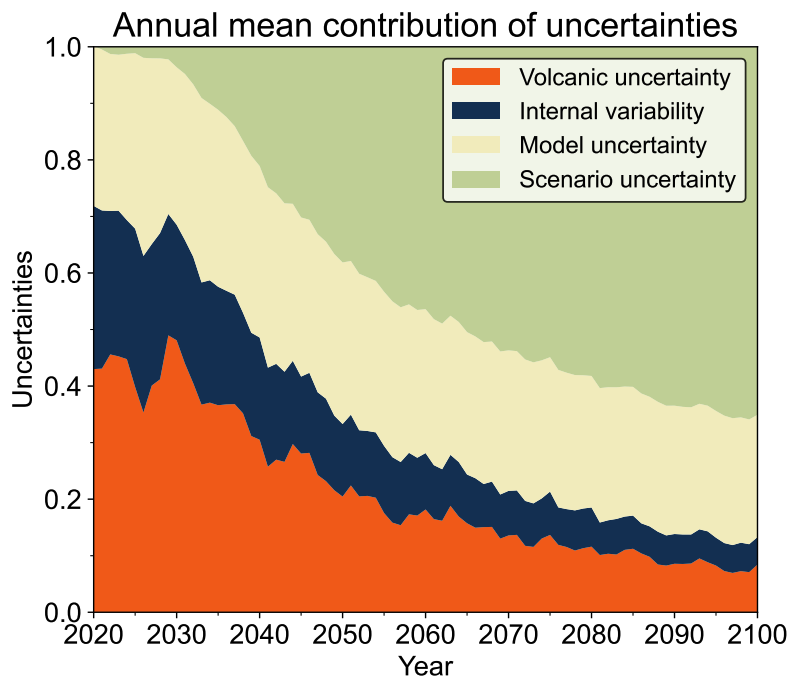
By simulating 1,000 different volcanic futures, we find that the climate uncertainty caused by future 21st century eruptions could exceed the internal variability of the climate system itself over the same period.
We also find that volcanic eruptions could account for more than one-third of total uncertainty in global temperature projections until the 2030s.
You can see these results in the plot below. It shows the contribution to the total uncertainty from the different sources. The colours represent volcanoes (orange), internal variability (dark blue), climate model response (yellow) and scenarios of future human emissions (green).
What this means for the 1.5C threshold
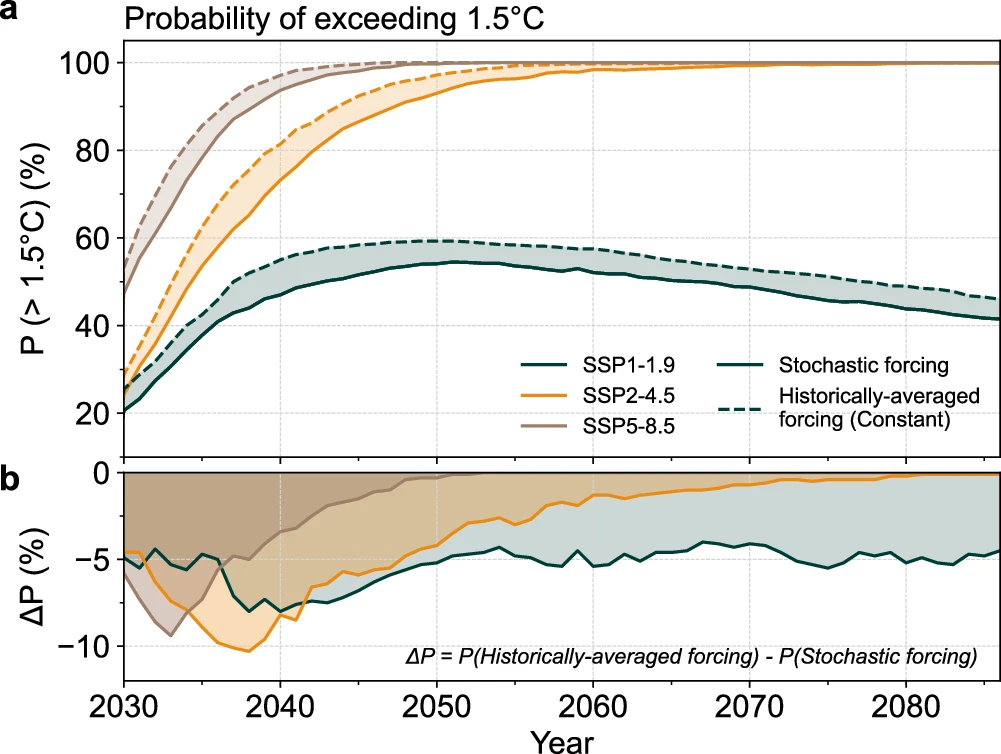
Our simulations demonstrate that incorporating possible timelines of volcanic activity slightly reduces the probability of crossing the Paris Agreement’s aspirational 1.5C temperature limit in the near term.
We find that – depending on the emissions scenario – the probability of exceeding 1.5C decreases by 4-10%, compared to projections using constant volcanic forcing.
While this might sound encouraging, future volcanic activity does not provide any long-term mitigation of human-caused warming.
The eruption of Mount Tambora in 1815 offers a dramatic illustration of this point. While the event cooled global temperatures by an average of 0.8C, it led to a “year without a summer” and caused crop failures and widespread famine across Europe, North America and China.
Eruptions produce temporary cooling lasting just a few years. They do not alter the underlying warming trend driven by human emissions.
Our study finds that, taking into account a range of future volcanic activity, global warming will still exceed 1.5C within decades under all but the very lowest emissions scenarios.
A high level of volcanic activity over the 21st century would help offset just a small fraction of global warming – meaning that emission reduction remains essential for meeting long-term climate goals.
The charts below show the probability of scenarios exceeding 1.5C using stochastic volcanic forcing (solid lines) and constant volcanic forcing (dashed lines) under three emissions scenarios (top) and the difference in probability between the two forcing approaches (bottom).
Decadal-scale temperature variability
Another important insight from our research is that extreme warm and cold decades become more likely once the variability of volcanic forcing is accounted for.
We find that the chance of a negative decadal trend – a decade where global surface temperature cools on average – increases by 10-18% under the intermediate emissions scenario.
We also find a corresponding increase in the probability of extremely warm decades, reflecting how volcanic forcing variability enhances the likelihood of both cooling and warming extremes.
This underscores how volcanic eruptions could introduce significant variability into the global temperature trends over decadal timescales.
Toward better climate projections
Understanding volcanic effects on the climate is essential for comprehensively assessing future risks to agriculture, infrastructure and energy systems.
Running thousands of volcanic scenarios with full-scale Earth system models is not practical as it requires too much computing power. On the other hand, current approaches have significant limitations, as described above.
However, there is a middle ground for future climate modelling efforts.
The next phase of future climate modelling experiments – the Scenario Model Intercomparison Project for CMIP7 – can use a more representative “average” volcanic forcing baseline that incorporates the effects of small eruptions often missed in historical records. This bias has now been addressed in the historical volcanic forcing dataset that will underpin the next generation of climate model simulations.
Additionally, modelling teams should run additional scenarios with high and low future volcanic activity to capture the range of volcanic uncertainty on climate projections.
While human-caused greenhouse gas emissions remain the dominant driver of climate change, properly accounting for volcanic uncertainty provides a more complete picture of possible climate futures and their implications for society.


The post Guest post: Investigating how volcanic eruptions can affect climate projections appeared first on Carbon Brief.
Guest post: Investigating how volcanic eruptions can affect climate projections

Next week, diplomats from around the world will descend on Yerevan, Armenia, to negotiate a series of decisions under the UN Convention on Biological Diversity (CBD).
Between 19 and 30 October, 196 parties will gather to hammer out the precise wording of the dozens of legal texts that make up the decisions under the Conference of the Parties (COP) to the CBD.
This year’s summit is particularly significant, as it marks the halfway point between the agreement of the Kunming-Montreal Global Biodiversity Framework and the deadline for achieving its targets.
The CBD has found that countries are currently not on track to meet 22 out of the framework’s 23 targets.
During the fortnight, delegates will also be negotiating decisions relating to the two supplemental protocols to the CBD: the Cartagena Protocol, which covers biosafety; and the Nagoya Protocol, which covers access and benefit-sharing for the use of genetic resources.
(The Cartagena and Nagoya Protocols, which are each governed by a “meeting of the parties”, or “MOP”, have fewer parties than the CBD as a whole, with 173 and 141, respectively.)
Carbon Brief is tracking the progress of countries towards consensus on dozens of negotiating texts using the interactive table below.
The tracker includes texts from the COP, as well as the MOPs for the Cartagena and Nagoya protocols. It also includes draft decisions from the most recent subsidiary body meetings, as these form the starting point for the negotiations in Yerevan.
The CBD has three subsidiary bodies: the subsidiary body on scientific, technical and technological advice (SBSTTA), the subsidiary body on implementation (SBI) and the subsidiary body on article 8(j) and other provisions (SB8J).
SB8J focuses on issues related to the Indigenous peoples and local communities. It was established at COP16 in Cali, Colombia, in 2024.
The first two columns of the interactive tracker list the topic of each agenda item and the relevant body, with subsequent columns including dates, page counts and links to the original documents.
The table is searchable and can be sorted using the arrows in the header.
Areas of disagreement in UN draft texts are denoted by square brackets. Counting the brackets in a particular iteration of a text therefore gives a sense of how far parties are from reaching consensus.
The bracket column is colour-coded, with dark green indicating a low number of brackets and red indicating a high number of brackets remaining.
Texts can also present parties with choices using “options” or alternatives (“alt”), which are counted together in the sixth column of the table.
The key discussions in Yerevan will centre around two agenda items in particular. The first is the global review, which will assess progress towards the GBF and make recommendations for accelerating action.
The second is finance, which can be separated into two parts: resource mobilisation and the financial mechanism. On resource mobilisation, biodiverse global south countries are likely to push for an increased amount of international finance for conservation.
Disagreement over the creation of the financial mechanism led to the suspension of COP16 in Cali in October 2024, as parties failed to find agreement on the mobilisation of finance before the end of the summit.
Global south countries want the establishment of a separate financial mechanism under the control of the CBD; global north countries largely prefer to maintain the existing mechanism, which sits under the Global Environment Facility.
At the resumed session of COP16 in Rome in early 2025, countries agreed on a roadmap that would lead to the establishment of a permanent mechanism.
related
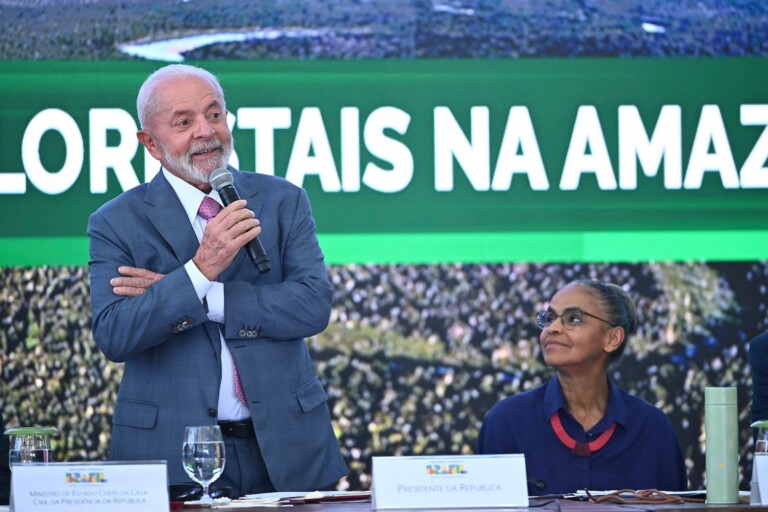
Analysis: Lula presidency saved at least 20,000km2 of Brazilian Amazon since 2022
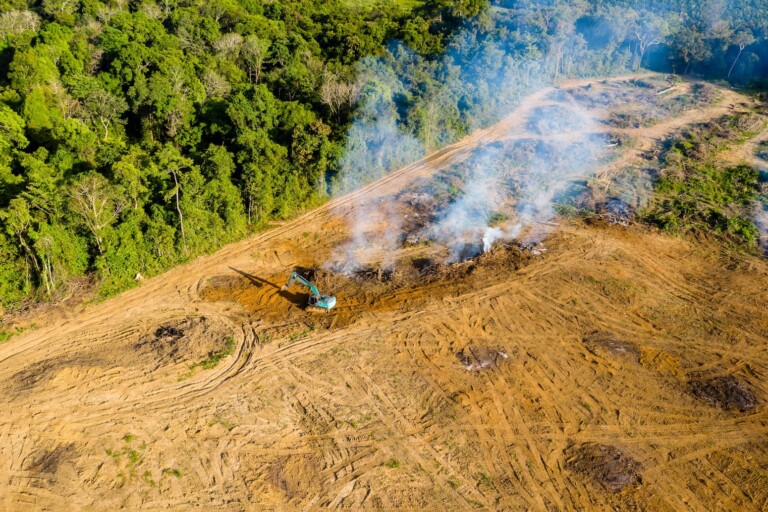
Why land-use emissions have fallen by a third this century – in six charts

Analysis: 84% of nations miss deadline to identify ‘nature-harming’ subsidies by 2025
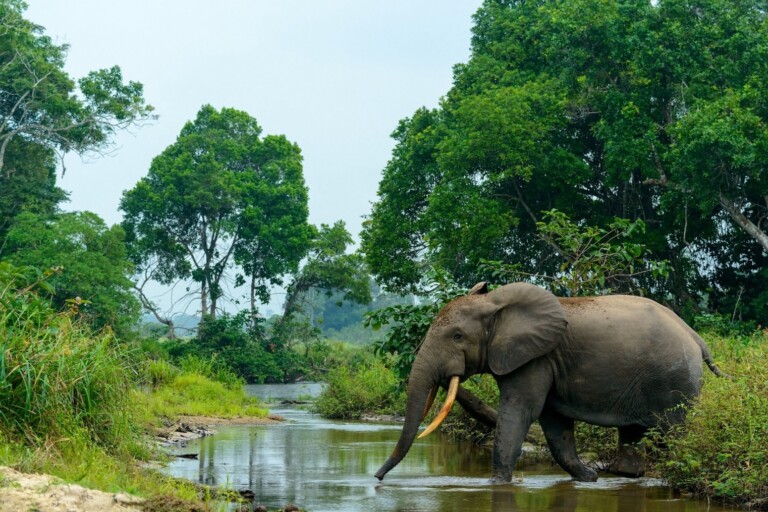
UK withdraws millions in funding from world’s second-largest rainforest in Congo
The post Interactive: Tracking negotiating texts at the COP17 biodiversity summit appeared first on Carbon Brief.
Interactive: Tracking negotiating texts at the COP17 biodiversity summit
A beacon of love
On an outer island of Fiji, two thousand nautical miles from Sydney, is a shining light of hope and resilience for our troubled world.
The island of Kioa is home to a Tuvaluan community who migrated from their atoll of Vaitupu in the late 1940s. It is a land of warm hearts, big smiles, and deep cultural roots; a place where the sound of a conch still summons the island together, where islanders paddle out to fish in carved outrigger canoes, and healthy happy children walk barefoot to school.
Here, culture is life. Kioans live sustainably through their traditional knowledge and practices. The island is alive with song, dance and the rhythms of a life tied to the tides, the winds, and the seasons.
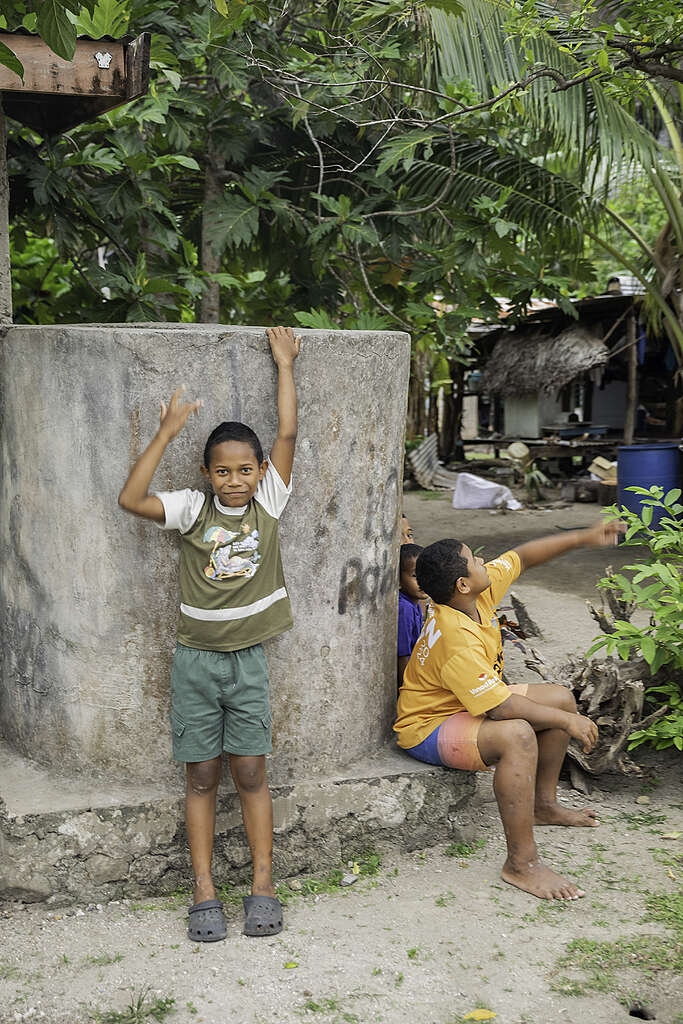
Facing the future
Greenpeace has been lucky to have a relationship with Kioa for a number of years now, and we are continually learning from this remarkable community.
Last week, as part of our Voyaging Oceania project, we returned to the island. Our purpose was twofold —- to carry messages from the island to leaders gathering in Nadi this week for the Pacific Pre-COP, and to support the Kioa community in their efforts to improve water security for the island.
Unlike Tuvalu itself, with its eight atolls, Kioa is a mountainous, forested and richly fertile island. It will remain habitable far into the future. Kioans did not initially migrate from Vaitupu due to climate change, but the move was prophetic. They now have a lifeboat.
However, even Kioa faces challenges on our rapidly warming planet, in particular when it comes to water. Climate change is shifting once reliable rainfall patterns. On top of this, the island is already feeling the effect of this year’s intensifying El Niño event, which for Fiji means reduced rainfall and prolonged dry spells.
Right now, fresh water has to be carefully rationed, and is only available for a few hours a day. During last week’s visit aboard our campaigning ship Oceania, Greenpeace was privileged to work with the Kioa community on a new solar-powered water distribution project for the island.
Designed and led by the island, the project involves using a solar pump to move water from a reliable source to a storage tank and then using gravity to distribute the water around the village.
It was a lesson in how local knowledge and ingenuity can be the backbone of today’s climate solutions. To build a dam around the source, the local community knew the exact spot where they could gather gravel at low tide to mix with the cement. They took only what was needed, knowing that all resources must be carefully conserved. Kioa has no roads and no machinery, and it was an all-of-island effort to carry the materials up to the project site, including many heavy bags of sand and rock.
Such projects truly bring to life the vision of a resilient, locally-led, fossil fuel free Pacific.