

Food systems are responsible for around one-third of the world’s greenhouse gas emissions – and beef has the largest carbon footprint of any food.
Moving diets away from beef and other red meat has become increasingly seen as an important part of mitigating food-related emissions.
But such changes can have unintended consequences, especially for countries that rely heavily on beef production and exports.
In our new study, published in Ecological Economics, we examine the impacts of a gradual reduction in Brazil’s beef consumption on the country’s emissions and economy.
Using an economic model, we find that reducing the average person’s beef intake in line with health recommendations could make up as much as a third of the world’s potential mitigation from dietary changes (according to the UN) – with little impact on Brazil’s overall economy.
Mitigation potential
Research shows that shifts toward plant-based diets can contribute to both mitigating climate change and improving human health.
Meat and animal-derived food production emits more greenhouse gases and consumes more water and land resources than plant-based food production.
Animal-derived food production also results in calorific loss down the food chain. The amount of calories contained in an animal that humans consume is much lower than the sum of the calories of that animal’s food.
For example, of every 100 calories used for sustenance and growth in animals, humans receive between 17 and 30 calories from meat consumption. This loss during the process of raising, processing and consuming animals is due to various factors, including inefficiencies in digestive processes and the physical activity of the animals themselves.
According to the 2019 special report on climate change and land from the Intergovernmental Panel on Climate Change (IPCC), dietary shifts have the potential to mitigate up to 8bn tonnes of CO2-equivalents (GtCO2e) around the world each year by 2050.

In Brazil, approximately 60% of the country’s annual emissions stem from land-use change and agriculture. It is one of the largest beef producers in the world.
In addition, global demand for beef is directly linked to deforestation in the Amazon as forests are cleared to make space for rearing cattle. It is also of global concern, due to the importance of the Amazon as a carbon sink.
Reducing beef consumption
Reducing red meat consumption is crucial not only for mitigating greenhouse gas emissions, but also for improving public health.
Studies have shown that excessive meat consumption can lead to higher rates of cardiovascular diseases, type 2 diabetes and colorectal cancer. According to research from the World Cancer Research Fund and the American Institute for Cancer Research, the ideal limit for red meat – that is, beef, pork, lamb and goat – consumption is up to 300 grams per week per person.
Brazil – along with the US, Australia and Argentina – surpasses this recommended average per-capita meat consumption. Annual beef consumption in Brazil is more than 460 grams per week, according to data from the UN Food and Agriculture Organization and the Organisation for Economic Co-operation and Development.
Thus, in our study, we set out to reach the recommended per-capita average beef consumption by 2050 – a reduction in consumption of 40%.
We test two scenarios to reduce consumption.
First, we look at relative price changes. We consider a situation where taxes on beef are raised over time from the 2015 average rate of around 8% to approximately 40% in 2050. (Existing taxes on beef in Brazil vary, with specific rates set at the state level.) In a related scenario, we consider what would happen if the funds from such a tax were put towards subsidies for lower-carbon foods.
Second, we look at changing consumer preferences. This could require formal interventions, such as information campaigns and the consideration of culture, emotions and morality. However, it could also occur naturally. Our model does not consider the drivers of the change, but recognises that such a change would occur slowly.
Although there is some movement towards reduced meat consumption due to changing consumer preferences, it remains relatively limited and more concentrated in developed countries. Reasons for this shift in preferences may include higher levels of education and income.
However, in Brazil, meat is viewed as a culturally essential food. In addition, regional preferences differ – for example, there is typically a high beef consumption in the northern region of Brazil, where the Amazon is located.
Despite the international attention linking excessive beef consumption to climate change and Amazon deforestation in Brazil, it has had minimal impact on Brazilian dietary preferences.
Modelling impacts
Our study analyses the impacts of a reduction in beef consumption on Brazil’s domestic market.
We focus on impacts on the country’s economy as a whole, effects on individual sectors such as agriculture and industry, regional impacts and deforestation reduction in the Amazonia and Matopiba regions. Matopiba is a region in the Cerrado, a savannah biome where agriculture has advanced in the last three decades.
The map below shows how Brazil is divided between the Amazon (green), the Matopiba region (orange) and the rest of the country (blue).
MAP

We conduct a set of simulations using an economic model for the two regions. In our model, different groups – such as consumers and firms, including investors, agricultural firms, industries and food service – are assumed to make the best decisions based on what they prefer and what they can afford. For firms, the “best decisions” are the ones that minimise their costs, while consumers seek to maximise their “utility”, or satisfaction.
This model represents how the economy works by looking at how people and businesses behave, how they interact in markets, and when the market will reach equilibrium – that is, when supply and demand are balanced.
We use the model to analyse the effects of policies and shocks on different sectors, regions and groups. We present our results as deviations from a baseline trajectory that assumes constant per-capita beef consumption until 2050, with overall consumption growing at the same rate as the Brazilian population.
It is essential to note that the deforestation reduction captured in the model is related to agricultural activity, not to deforestation associated with illegal logging or land grabbing. However, beef and other agriculture drives around 90% of deforestation in Brazil currently, so this is unlikely to significantly change our results.
The latter has various motivations and can be more effectively inhibited through increased environmental monitoring, land demarcation and other mechanisms developed and applied over the last two decades.
Deforestation impacts
We find that a 40% reduction in beef consumption from 2022 to 2050 would help prevent deforestation of approximately 65,000 square kilometres – larger than the area of Sri Lanka.
It also has the potential to mitigate up to 2.8GtCO2e per year, which is one-third of the total mitigation potential from changing diets presented in the IPCC’s special report on land.
The charts below show the amount of avoided deforestation for the Amazon and Matopiba regions relative to the baseline scenario.
Grey and light green indicate lower amounts of avoided deforestation and dark green indicates the highest amounts. The top, middle and bottom maps show reduced beef consumption through changing consumer preferences, a beef tax and a beef tax with subsidies for other foods, respectively.

In addition to deforestation, we considered the impacts that these shifts would have on Brazil’s economy.
Our findings suggest that dietary shifts due to changes in preferences would have virtually no impact on Brazilian GDP in 2050, reducing it by 0.03% – largely due to a slight decrease in investment.
Adjusting diets through an increase in beef taxes would lead to overall cost increases, resulting in decreases in exports and GDP. We find that GDP would decline by 0.64% in this scenario, with exports decreasing by 1.5%.
However, in the scenario where the beef tax revenue is applied to other foods as subsidies, the national GDP declines by only 0.18%, despite similar decreases in exports.
In all scenarios, we find that the economic impacts would differ from one area of the country to the next. In particular, they would affect regions most dependent on the cattle and beef sector, which are also the most directly affected by the proposed taxation policies. In the beef tax scenario without subsidies, two northern states experience declines in GDP of 3% or higher.
Although Brazilians reducing their beef consumption would bring environmental and health benefits to the country, emissions mitigation cannot be solely Brazil’s responsibility. We observe that the reduction in beef consumption through preference changes leads to a negative effect on the domestic price of beef.
This decrease in domestic prices would, in turn, favour Brazilian beef exports, resulting in less mitigation and a smaller reduction in deforestation. Therefore, it is crucial for this change in habit to be followed by other economies worldwide – notably, those that heavily import Brazilian beef, including China, the US and EU.


The post Guest post: How shifting diets away from beef could cut Brazil’s emissions appeared first on Carbon Brief.
Guest post: How shifting diets away from beef could cut Brazil’s emissions

Next week, diplomats from around the world will descend on Yerevan, Armenia, to negotiate a series of decisions under the UN Convention on Biological Diversity (CBD).
Between 19 and 30 October, 196 parties will gather to hammer out the precise wording of the dozens of legal texts that make up the decisions under the Conference of the Parties (COP) to the CBD.
This year’s summit is particularly significant, as it marks the halfway point between the agreement of the Kunming-Montreal Global Biodiversity Framework and the deadline for achieving its targets.
The CBD has found that countries are currently not on track to meet 22 out of the framework’s 23 targets.
During the fortnight, delegates will also be negotiating decisions relating to the two supplemental protocols to the CBD: the Cartagena Protocol, which covers biosafety; and the Nagoya Protocol, which covers access and benefit-sharing for the use of genetic resources.
(The Cartagena and Nagoya Protocols, which are each governed by a “meeting of the parties”, or “MOP”, have fewer parties than the CBD as a whole, with 173 and 141, respectively.)
Carbon Brief is tracking the progress of countries towards consensus on dozens of negotiating texts using the interactive table below.
The tracker includes texts from the COP, as well as the MOPs for the Cartagena and Nagoya protocols. It also includes draft decisions from the most recent subsidiary body meetings, as these form the starting point for the negotiations in Yerevan.
The CBD has three subsidiary bodies: the subsidiary body on scientific, technical and technological advice (SBSTTA), the subsidiary body on implementation (SBI) and the subsidiary body on article 8(j) and other provisions (SB8J).
SB8J focuses on issues related to the Indigenous peoples and local communities. It was established at COP16 in Cali, Colombia, in 2024.
The first two columns of the interactive tracker list the topic of each agenda item and the relevant body, with subsequent columns including dates, page counts and links to the original documents.
The table is searchable and can be sorted using the arrows in the header.
Areas of disagreement in UN draft texts are denoted by square brackets. Counting the brackets in a particular iteration of a text therefore gives a sense of how far parties are from reaching consensus.
The bracket column is colour-coded, with dark green indicating a low number of brackets and red indicating a high number of brackets remaining.
Texts can also present parties with choices using “options” or alternatives (“alt”), which are counted together in the sixth column of the table.
The key discussions in Yerevan will centre around two agenda items in particular. The first is the global review, which will assess progress towards the GBF and make recommendations for accelerating action.
The second is finance, which can be separated into two parts: resource mobilisation and the financial mechanism. On resource mobilisation, biodiverse global south countries are likely to push for an increased amount of international finance for conservation.
Disagreement over the creation of the financial mechanism led to the suspension of COP16 in Cali in October 2024, as parties failed to find agreement on the mobilisation of finance before the end of the summit.
Global south countries want the establishment of a separate financial mechanism under the control of the CBD; global north countries largely prefer to maintain the existing mechanism, which sits under the Global Environment Facility.
At the resumed session of COP16 in Rome in early 2025, countries agreed on a roadmap that would lead to the establishment of a permanent mechanism.
related
Analysis: Lula presidency saved at least 20,000km2 of Brazilian Amazon since 2022
Why land-use emissions have fallen by a third this century – in six charts

Analysis: 84% of nations miss deadline to identify ‘nature-harming’ subsidies by 2025
UK withdraws millions in funding from world’s second-largest rainforest in Congo
The post Interactive: Tracking negotiating texts at the COP17 biodiversity summit appeared first on Carbon Brief.
Interactive: Tracking negotiating texts at the COP17 biodiversity summit
A beacon of love
On an outer island of Fiji, two thousand nautical miles from Sydney, is a shining light of hope and resilience for our troubled world.
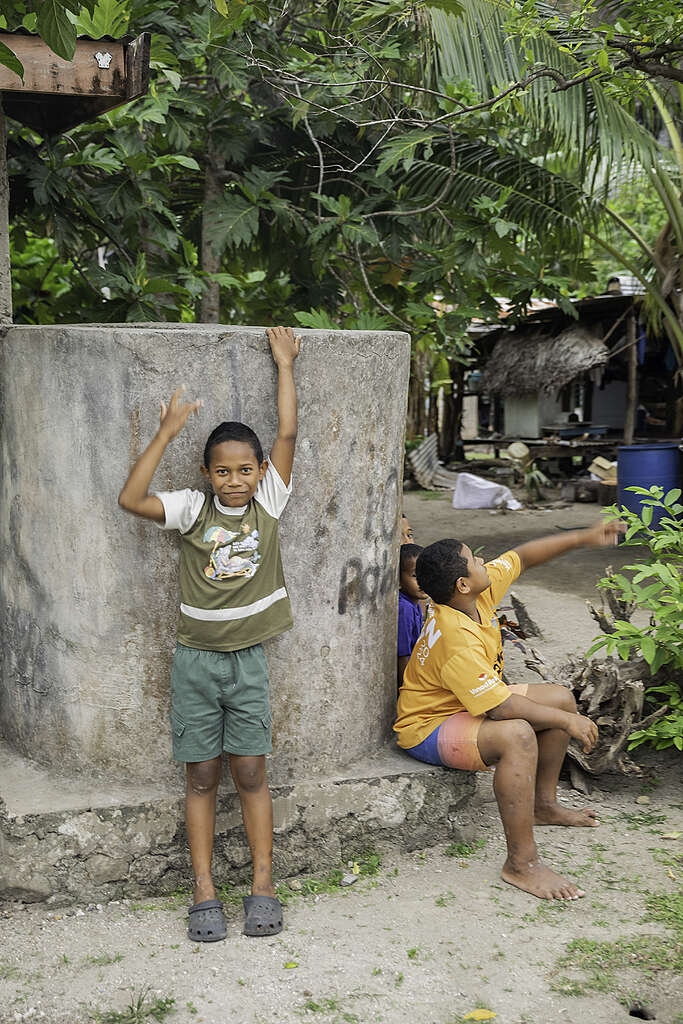
The island of Kioa is home to a Tuvaluan community who migrated from their atoll of Vaitupu in the late 1940s. It is a land of warm hearts, big smiles, and deep cultural roots; a place where the sound of a conch still summons the island together, where islanders paddle out to fish in carved outrigger canoes, and healthy happy children walk barefoot to school.
Here, culture is life. Kioans live sustainably through their traditional knowledge and practices. The island is alive with song, dance and the rhythms of a life tied to the tides, the winds, and the seasons.
Facing the future
Greenpeace has been lucky to have a relationship with Kioa for a number of years now, and we are continually learning from this remarkable community.
Last week, as part of our Voyaging Oceania project, we returned to the island. Our purpose was twofold —- to carry messages from the island to leaders gathering in Nadi this week for the Pacific Pre-COP, and to support the Kioa community in their efforts to improve water security for the island.
Unlike Tuvalu itself, with its eight atolls, Kioa is a mountainous, forested and richly fertile island. It will remain habitable far into the future. Kioans did not initially migrate from Vaitupu due to climate change, but the move was prophetic. They now have a lifeboat.
However, even Kioa faces challenges on our rapidly warming planet, in particular when it comes to water. Climate change is shifting once reliable rainfall patterns. On top of this, the island is already feeling the effect of this year’s intensifying El Niño event, which for Fiji means reduced rainfall and prolonged dry spells.
Right now, fresh water has to be carefully rationed, and is only available for a few hours a day. During last week’s visit aboard our campaigning ship Oceania, Greenpeace was privileged to work with the Kioa community on a new solar-powered water distribution project for the island.
Designed and led by the island, the project involves using a solar pump to move water from a reliable source to a storage tank and then using gravity to distribute the water around the village.
It was a lesson in how local knowledge and ingenuity can be the backbone of today’s climate solutions. To build a dam around the source, the local community knew the exact spot where they could gather gravel at low tide to mix with the cement. They took only what was needed, knowing that all resources must be carefully conserved. Kioa has no roads and no machinery, and it was an all-of-island effort to carry the materials up to the project site, including many heavy bags of sand and rock.
Such projects truly bring to life the vision of a resilient, locally-led, fossil fuel free Pacific.