Connect with us

Published

on

The global battery industry is moving fast, and China’s battery giant CATL is already looking beyond today’s technologies.

At the 2026 Forum on Building China Into an Equipment Manufacturing Power, CATL Chief Scientist Wu Kai highlighted lithium-air batteries as one of the most promising technologies for the future. While the technology is still far from commercial use, its potential could transform electric vehicles (EVs) and energy storage systems over the next decade.

At the same time, CATL is pushing ahead with sodium-ion batteries and expanding its energy storage testing capabilities, showing that the company is working on both near-term and long-term battery solutions.

Why Lithium-Air Batteries Are Creating Excitement

Battery makers constantly search for ways to store more energy in smaller and lighter packages. This is where lithium-air batteries stand out.

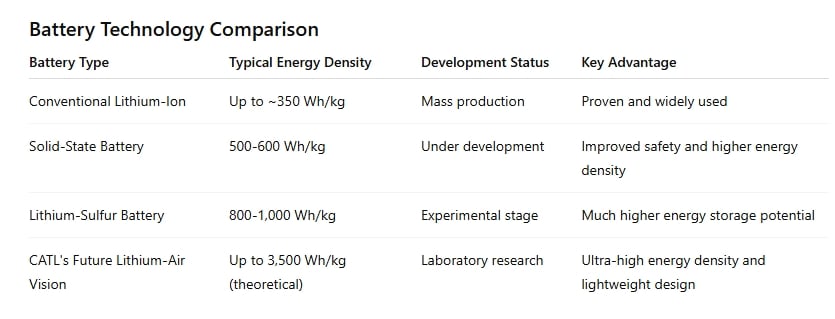
  • According to Wu Kai, lithium-air batteries could theoretically achieve an energy density of up to 3,500 watt-hours per kilogram (Wh/kg). That is several times higher than today’s commercial lithium-ion batteries.

Higher energy density means a battery can store more power without increasing weight. For electric vehicles, this could translate into significantly longer driving ranges. For energy storage systems, it could mean more power in a smaller footprint.

The concept itself is not new. Scientists first discussed lithium-air batteries in the 1970s, and rechargeable versions appeared in the 1990s. Since then, researchers worldwide have worked to unlock the technology’s potential.

Major companies and research groups have continued exploring the field. Around 2010, IBM conducted extensive lithium-air battery research. More recently, U.S. researchers reported important breakthroughs, including improved cycle life and energy density under laboratory conditions.

However, despite decades of research, lithium-air batteries remain largely confined to laboratories.

How Lithium-Air Batteries Work

Unlike conventional lithium-ion batteries, lithium-air batteries use metallic lithium as the anode.

The biggest difference lies on the cathode side. Instead of relying on heavy solid materials, lithium-air batteries use oxygen from the surrounding air. The oxygen enters through a porous carbon structure and participates in the battery’s chemical reactions.

This design reduces the amount of material required inside the battery, helping create an extremely lightweight system.

Because the battery draws oxygen from the atmosphere, it can theoretically achieve much higher energy density than existing battery technologies.
lithium ion battery CATL
Data compiled from chinaevhome.com article

The table shows why lithium-air technology attracts so much attention. Even compared with advanced solid-state batteries, the theoretical energy storage potential is dramatically higher.

Significant Challenges Still Remain

Despite its promise, lithium-air technology faces several major obstacles.

One challenge involves lithium peroxide, a material that forms during discharge. This compound acts as an electrical insulator, making battery operation less efficient.

In addition, scientists still struggle with slow reaction speeds inside the battery. Catalysts designed to improve these reactions have yet to deliver consistent results.

Another issue is electrolyte stability. Current electrolytes tend to degrade over time, limiting battery lifespan. Furthermore, lithium metal anodes can develop dendrites—tiny needle-like structures that may reduce performance and create safety concerns.

Because of these technical barriers, industry experts generally believe large-scale commercialization remains at least a decade away.

Sodium-Ion Batteries Are Much Closer to Reality

While lithium-air batteries represent a long-term goal, CATL is making faster progress with sodium-ion technology.

The company unveiled its sodium-ion battery platform last year and expects large-scale production to begin in 2026.

Sodium-ion batteries use abundant sodium instead of lithium. Although they generally store less energy than lithium-based batteries, they offer several advantages:

  • Lower material costs
  • Greater resource availability
  • Better performance in cold weather
  • Reduced dependence on lithium supply chains

To support commercialization, CATL recently launched Phase VI expansion of its Fuding manufacturing base in Fujian Province.

The company plans to invest approximately RMB 5 billion ($725 million) in a new production line capable of adding 40 gigawatt-hours (GWh) of annual sodium-ion battery capacity.

Meanwhile, CATL and Changan Automobile have announced plans to launch the world’s first mass-produced passenger vehicle powered by sodium-ion batteries. The vehicle is expected to reach customers in mid-2026.

CATL Continues to Dominate Global EV Batteries

CATL’s investment strategy comes as the company strengthens its position in the global battery market.

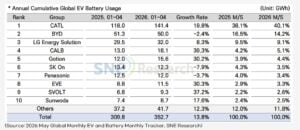
According to data from SNE Research, CATL installed 141.4 GWh of batteries worldwide during the first four months of 2026. That represented nearly 20% growth compared with the same period last year.

  • The company’s global market share climbed to 40.1%, reinforcing its leadership in the EV battery sector.

Chinese battery manufacturers continue to gain ground across the industry. Companies such as CALB, Gotion, EVE Energy, SVOLT, and Sunwoda all reported strong year-over-year growth.

Meanwhile, BYD maintained its position as the world’s second-largest battery supplier. Although its battery installations declined slightly, the company’s overseas EV expansion and battery innovations could support future growth.
Battery storage CATL
Source: SNE Research

CATL Opens World’s Largest Energy Storage Validation Center

Beyond batteries themselves, the company is also investing heavily in energy storage reliability. It recently opened the CATL Xiamen Energy Storage Validation Research Institute (ESVL), which it describes as the world’s largest and most comprehensive energy storage testing and validation platform.

The facility covers roughly 10 hectares and required an investment of around RMB 3 billion ($440 million).

Importantly, CATL says the platform will operate as open infrastructure available to the broader energy storage industry.

ESVL lab CatL
Source: CATL

Why Real-World Testing Matters

As energy storage installations expand worldwide, performance and reliability have become major concerns.

Many storage projects fail to perform exactly as expected after deployment. Delays in grid connection and operational challenges can increase costs and reduce returns for developers and investors.

CATL believes the industry must move beyond testing individual components and focus on validating entire systems under real operating conditions.

The ESVL facility is designed to evaluate:

  • Safety performance
  • Grid-support capabilities
  • Long-term reliability
  • Station-level operational performance

According to Wu Kai, scientific testing and rigorous validation will become increasingly important as energy storage projects grow larger and more complex.

The facility also works with international certification organizations, including TÜV SÜD, TÜV Rheinland, China General Certification Center, and CSA Group.

Looking Ahead

CATL’s latest moves reveal a two-track strategy. On one hand, the company is preparing for the future through advanced technologies such as lithium-air batteries. On the other hand, it is accelerating the commercialization of sodium-ion batteries and expanding energy storage infrastructure today.

Lithium-air batteries may still be years away from reaching consumers. Nevertheless, their enormous theoretical energy density makes them one of the most intriguing battery technologies under development.

Meanwhile, sodium-ion batteries and advanced energy storage systems are already moving toward commercial reality. Together, these efforts could help CATL maintain its position at the center of the rapidly evolving global battery industry.

The post CATL Bets on Lithium-Air Batteries While Expanding Sodium-Ion and Energy Storage Leadership appeared first on Carbon Credits.

Continue Reading

Carbon Footprint

What Does “Net Zero Emissions” Really Mean?

Published

on

net zero emissions

The recent report from climate scientists is crystal clear: the world must act now. That means limiting global warming to 2 or 1.5 degrees Celsius.

But what does this entail?

Cutting a lot of emissions and reaching net zero. And this is urgent.

Embracing the urgency of this matter, more and more entities are pledging their net zero targets. There are now over 80 nations and hundreds of businesses that laid out their net zero roadmaps. These include the world’s supper emitters – China, the United States, the European Union, and India.

But what does achieving net zero emissions really mean?

This guide will explain the key facts and insights about this world-saving concept.

What Does Hitting Net Zero Emissions Mean?

Being at net zero emissions refers to a point where the GHG emissions released by humans into the air are balanced by the emissions removed from the air.

Think of it as a weighing scale. Emitting carbon and other GHG tips the scale and the net zero aim is to get the scale back into balance.

Reaching this balance requires two things.

  1. Reducing the emissions released from human activities closest to zero.
  2. Removing the emissions that are hard to reduce.

Getting to net zero means we can still generate some emissions. But as long as they are offset by initiatives that reduce GHG already in the atmosphere.

There are plenty of carbon removal solutions and technologies being developed to suck in CO2 from the air and store it.

So, emission reductions and removals go together in the world’s race to net zero.

When Must The World Get to Net Zero?

Every new ton of carbon emitted into the atmosphere is heating the planet more. The sooner the world stops adding CO2 and other GHG to the air, the better. But what’s the timeline for this?

As per IPCC’s latest report, to honor the Paris Agreement and limit temperature rise at 1.5°C, global emissions should be at net zero by 2050.

Still, hitting net zero in 2050 is too far distant away. Short-term emissions reduction targets are necessary. The Paris accord requires countries to reduce emissions by 7% each year this decade (from 2020 to 2030).

Climate science suggests a global timeline to be at net zero under two scenarios: limiting warming to 1.5°C and to 2°C.

The figure below shows this timeline. It separates two significant emissions – carbon dioxide and total GHG.

net zero emissions timeline

What the picture depicts is that achieving net zero CO2 emissions must be by 2050 (1.5°C) or by 2070 (2°C) at the latest. Whereas for non-CO2 emissions, it means by 2060 and by the end of the century.

The sooner emissions peak, the more realistic hitting net zero becomes.

This scenario results in less dependence on removing carbon beyond 2050.

But this timeline doesn’t say that all countries need to be at net zero at the same time. There are a lot of factors to consider here including:

  • Responsibility for past GHG emissions
  • Per-capita emissions
  • Capacity to act

This suggests that the deadline for the wealthier, higher emitters could be earlier. The opposite holds true for poorer emitters.

For instance, India has net zero targets by 2070 while Saudi Arabia and China both pledged to be at net zero by 2060.

Whereas the US, EU, UK, and Japan have all committed to hitting it by 2050.

But it’s crucial not just for countries but also for companies to have net zero targets. More so, their near-term emissions reduction goals must align with their net zero pledges.

Why It’s Vital to Align Interim CO2 Reduction Targets with Net Zero Plans?

Entities often set their net zero targets by 2050.

But to ensure that they’re on track toward their net zero pledge, their long-term goals must inform their interim targets.

This is critical to prevent locking in carbon-intensive and non-resilient infrastructure and technologies. It can also help them align the costs by investing in projects that can cut emissions now and still do so years later.

This is more vital for countries to design consistent policies that support reduction efforts in the long run. Also, countries party to Paris Agreement and COP26 agreed to submit their climate plans.

Such plans form part of their NDCs or nationally determined contributions. The NDCs outline interim emissions targets by 2030 and align governments’ climate plans with their near-term goals.

Most countries with net zero targets are starting to incorporate them into their interim NDCs. Here’s the current global map of countries that have net zero ambitions and their status.

net zero emissions
Source: ClimateWatch Net Zero Tracker

More importantly, the corporate world had also paved its path toward net zero emissions.

World’s Heaviest Emitting Companies With Net Zero Targets And Strategies

According to BloombergNEF (BNEF) analysis, 2/3 of the world’s heaviest emitters set their net zero goals. These focus companies (100+) represent over 80% of global industrial GHG emissions.
 
BNEF estimates that the net zero targets of those companies will cut emissions by 3.7 billion metric tons of CO2 equivalents in 2030. And by 2050, reductions will become 9.8 billion Mt. This is equal to over a quarter of global GHG emissions today.
 
The chart below shows the emission reductions for those companies per sector.
 
companies net zero emissions targets

The oil and gas sector accounts for over a third (3.4 GtCO2e) of targeted reductions, more than any other sector.

European oil majors have set net zero emissions targets by 2050 last year like Shell and Total. They already made some progress by investing in low-carbon initiatives.
 
The same goes with some US oil majors ExxonMobil, Occidental Petroleum, and Chevron.
 
In particular, Exxon pledges to reach net zero global operations by 2050. Part of this climate goal is a couple of key promises such as:
  • $15 billion towards reducing GHG emissions over the next six years
  • Better processes to reduce methane gas leakage
  • To reach net zero within the U.S. Permian Basin shale field by 2030

Exxon also bid the highest to get offshore properties to use for carbon sequestration.

Likewise, Chevron also announced a $10 billion dollar investment into low carbon initiatives as part of its net zero targets.

Half of that budget will be for reducing emissions from fossil fuel initiatives. The remaining half will be for hydrogen energy and renewable fuels.

Specifically, Chevron will increase:

  • Renewable fuels production to 100,000 barrels per day
  • Renewable natural gas output to 40 billion British thermal units (BTUs) per day.
  • Hydrogen production to 150,000 tonnes per year
  • Carbon capture and offsets to 25 million tonnes per year.

Meanwhile, Occidental Petroleum has also set its net-zero ambition by 2050. Like other oil majors, Occidental also invests in direct air capture (DAC) technology as one of its net zero strategies.

The firm expects to pull as much as 1 million metric tons/year of CO2 emissions via DAC.

The second heaviest emitting sector is the utilities with 2.3GtCO2e.

Italy-based Enel, one of the world’s biggest utility firms, has an initial net-zero emissions target by 2050 but moved it to 2040 instead. The firm also expressed to exit coal generation by 2027 and gas by 2040.

Enel plans to invest $160 billion to fund its net zero strategies to reach its ambitious goal. Part of that is to install around 154GW of renewable capacity by 2030.

Duke Energy also set ambitious climate goals. That’s to have at least a 50% reduction in CO2 emissions from electricity generation in 2030 on its way to net zero by 2050. They’re also targeting net zero methane emissions for their natural gas distribution by 2030.

The third sector with high emissions is manufacturing (1.4GtCO2e) which includes automakers.

While the utility companies are turning to renewables, car manufacturers are becoming electric.

Tesla led the way in its all-electric lineup and amassed huge carbon credit sales for it. It also produces green products that further add to its credit generation. Yet, it still hasn’t revealed its net zero goals.

Stellantis, on the other hand, has pledged to hit net zero emissions the soonest time by 2038.

While it used to rely on Tesla to meet its regulatory emissions, the European carmaker managed to cut down its emissions.

It was through its electrification ramp-up and technical improvements. This includes its battery electric vehicles (BEVs) and low-emission vehicles (LEVs) production.

To become carbon net zero in 2038, the carmaker focuses on these main levers:

  • Energy-efficient projects and energy management in all plants
  • Site compression and improvement of industrial footprint
  • Use and production of renewable energies
  • Technical innovations (e.g. Hydrogen, Power to gas)
  • CO2 capture and storage

Other manufacturers also made significant strides in their way toward decarbonization. Take for example the case of Del Monte Foods.

Del Monte Foods has invested significantly in renewable energy and reduced food waste. It also doubled capital investment in energy-efficient production operations.

The company’s strategy to reach net zero emissions by 2050 is to invest more in:

  • Renewable energy,
  • Automation,
  • Transportation efficiency,
  • Regenerative agricultural practices, and
  • Eco-friendly packaging innovation

Though they’re not directly specified as a sector in the chart above, the airlines are also one of the big emitters.

In fact, the global aviation industry generates around 2.1% of all CO2 emitted by humans. Within the transport sector, it accounts for 12% of emissions compared to 75% from road transport. 

Here’s how the major US airlines are dealing with their net zero targets.

airlines carbon net zero plan

The Way to Net Zero 

It is certain that the world needs to take action and treat climate change as an emergency.

And the only means to face this emergency heads on is for countries and companies to hit their net zero emissions.  

There’s no single approach to how the world reaches net zero by 2050 or earlier. It requires a combination of various initiatives or strategies as to how different companies are doing it.

Another major element of that is setting near-term climate targets that align with long-term goals.

This will help investors assess the climate ambitions of their portfolio companies. It will also help corporations to have a good benchmark as they go on their journey to net zero.

The post What Does “Net Zero Emissions” Really Mean? appeared first on Carbon Credits.

Continue Reading

Carbon Footprint

IATA’s New Carbon Credit Alliance: Can Aviation Secure Enough Offsets for Net Zero?

Published

on

IATA’s New Carbon Credit Alliance: Can Aviation Secure Enough Offsets for Net Zero?

The global aviation industry has launched a new effort to solve one of its biggest net-zero challenges. It is trying to secure enough high-quality carbon credits.

The International Air Transport Association (IATA) recently launched the Supporting Alliance for CORSIA Eligible Emissions Unit (EEU) Supply. It brings together airlines, governments, carbon market players, investors, and civil society groups.

  • The goal is ambitious. The alliance aims to increase the supply of 225 million to 250 million CORSIA-eligible carbon credits by spring 2027.

The move shows a key reality in aviation. Sustainable aviation fuel (SAF) is still the main tool for cutting emissions, but supply is still limited. Because of this, airlines will depend more on carbon markets in the short term to meet climate rules under CORSIA.

The alliance is not only about carbon credits. It also shows how aviation, climate finance, and carbon markets are becoming more connected.

A $5 Billion Carbon Credit Race Takes Flight

CORSIA stands for the Carbon Offsetting and Reduction Scheme for International Aviation. It was created by the International Civil Aviation Organization (ICAO) in 2016. It is still the only global market-based offsetting scheme for managing aviation emissions.

Under this system, airlines must offset emissions that go above set limits. They do this by buying and canceling approved carbon credits called CORSIA Eligible Emissions Units (EEUs).

CORSIA compliance requirements abatable
Source: Abatable

These credits must meet strict environmental rules. They also need approval from host governments. This helps avoid double counting under the Paris Agreement.

The main problem is supply.

  • IATA estimates airlines will need about 200 million CORSIA EEUs by January 2028. This represents a market worth about $4 billion to $5 billion. Demand could rise to nearly 2 billion EEUs by 2035 as rules expand.

Even with this demand, supply is still low. Many countries have not approved credits for CORSIA use. This creates a regulatory bottleneck. It is now one of the biggest risks for aviation’s climate plans.

According to Marie Owens Thomsen, IATA’s Senior Vice President Sustainability and Chief Economist,

“The Supporting Alliance will provide implementation assistance to clear this [double-counting] and other bottlenecks that prevent credits from coming to the CORSIA market. It should be noted that CORSIA will likely generate $4-5 billion of climate finance in the first phase, and potentially $100 billion by 2035, depending on market prices. This will help fund climate action, support remote communities, and spur economic development. We welcome all carbon market stakeholders and related organizations to join forces in the Supporting Alliance to help CORSIA realize its potential social, economic and climate benefits.”

The new alliance aims to fix this. It will help governments connect national climate goals with global carbon market rules under Article 6.2 of the Paris Agreement.

Aviation’s Net-Zero Path Is Becoming More Challenging

The launch comes at a time when airlines face growing pressure. They must cut emissions while air travel demand continues to rise.

sustainable aviation fuel saf for net zero ICAO
Source: ICAO

The aviation industry has pledged to reach net-zero carbon emissions by 2050. IATA says Sustainable Aviation Fuel could deliver about 65% of the emissions cuts needed. However, SAF production is still very low.

IATA expects global SAF production to reach over 2 million tonnes in a low-case scenario. But this is only 0.7% to 0.8% of total aviation fuel use. This gap is large. But it can also increase up to 32 million in a high-case scenario. 

SAF production
Source: ICAO

SAF can reduce lifecycle emissions by about 80% compared with regular jet fuel. This makes it one of the most important tools for decarbonization. But high costs, limited raw materials, and slow production growth are holding it back.

SAF production cost vs jet fossil fuel

Because of this, carbon credits are still a key bridge solution. They help airlines reduce emissions while SAF production scales up. This is also increasing demand for CORSIA-compliant credits and stronger carbon market systems.

From Voluntary Offsets to Compliance-Driven Carbon Markets

The alliance launch also reflects wider growth in global carbon markets. Over the past decade, carbon pricing has become a major climate policy tool. Governments, companies, and investors now see carbon markets as a way to fund emissions cuts and support net-zero goals.

For aviation, carbon credits help cover emissions that cannot yet be reduced with technology.

This is important because aviation is one of the hardest sectors to decarbonize. Unlike cars or trucks, long-distance flights still rely heavily on liquid fuels.

As demand for CORSIA credits grows, carbon project developers may see new opportunities. These include nature-based solutions, renewable energy, methane reduction projects, and engineered carbon removal. All must meet CORSIA rules and get government approval.

The creation of a dedicated alliance for credit supply shows a shift. Carbon markets are moving from voluntary tools to more structured, compliance-based systems for aviation. This shift could bring more investment into high-quality carbon projects worldwide.

Why the World’s Biggest Airlines Are Backing the Alliance

The alliance already has strong support from the industry. It includes more than 32 founding organizations. These include major airline groups such as:

  • Air France-KLM,
  • Lufthansa Group,
  • Qatar Airways,
  • Singapore Airlines,
  • Japan Airlines,
  • International Airlines Group (IAG),
  • AirAsia,
  • ANA, and
  • SWISS.

Their participation shows how important future credit supply is.

Many airlines already invest in sustainability programs. These include fleet upgrades, efficiency improvements, SAF contracts, and carbon reduction projects. At the same time, airlines are under growing pressure from investors, regulators, and customers to improve climate performance.

Access to high-quality CORSIA credits may become more important as airlines meet both regulatory and ESG goals.

The alliance also creates a space for cooperation between governments, airlines, project developers, and financial institutions. This may speed up credit approval and improve transparency in the market.

A Carbon Market Test for Aviation’s Future

The Supporting Alliance for CORSIA EEU Supply could become one of the most important carbon market developments for aviation in recent years. The industry’s net-zero plan depends on SAF, efficiency gains, new technologies, and carbon markets. But the supply of both SAF and CORSIA credits is still below what is needed.

By targeting up to 250 million credits by 2027, IATA is trying to close a growing supply gap before it becomes a bigger compliance issue.

More broadly, this shows how carbon markets are becoming part of real decarbonization strategies. They are no longer just voluntary tools. They are now part of regulated systems for hard-to-decarbonize sectors.

For the airline sector, the pressure is high. Passenger demand is rising while emissions pressure is also increasing every year.

Whether the alliance succeeds or not, its launch sends an important message. The future of aviation net zero will depend not only on cleaner fuels and better aircraft but also on strong and scalable carbon markets.

The post IATA’s New Carbon Credit Alliance: Can Aviation Secure Enough Offsets for Net Zero? appeared first on Carbon Credits.

Continue Reading

Carbon Footprint

The real cost of 1 tonne of CO2: Translating carbon into hectares

Published

on

Every business carbon footprint report ends with a number, the amount of carbon emissions produced by the business, less the amount of carbon reduced and offset, given in tonnes of CO₂. Many of the people who sign off on that number, including those who paid for it, cannot picture what it represents on the ground. A tonne is a unit of mass. CO₂ is invisible. The link between the amount offset in the report and a real piece of restored forest somewhere in the world is almost never indicated.

Continue Reading

Trending

Copyright © 2022 BreakingClimateChange.com

