

Brazil is rushing to regulate its critical minerals industry and unlock its vast untapped reserves of rare earths, aiming to position itself as a strategic producer with Chinese and US companies competing for fresh supplies.
Despite opposition from some environmental and Indigenous rights groups, lawmakers in Brazil’s lower house of Congress passed the government’s critical minerals policy bill last month, and backers now hope to secure final Senate approval before October’s presidential election.
Already a major mining nation with large reserves of graphite and copper, Brazil has the world’s second-largest reserves of rare earth elements after China, with the difference that Brazilian reserves are largely untapped. This group of 17 minerals is used in permanent magnets for electric motors vital for clean technologies such as electric vehicles (EVs) and wind turbines.
As Chinese and US companies compete to secure supplies, Brazil hopes to serve them both.
“We don’t have any preferences. Whoever wishes to participate with us to help with the mining, processing, and production of the wealth that these rare earths can bring is welcome to invest in Brazil,” President Luiz Inácio Lula da Silva told journalists after meeting President Donald Trump in Washington in May.
Value-added mining
The draft legislation, which is backed by industry groups, creates a $380-million Guarantee Fund for Mineral Activity meant to provide financial support for mining projects, grants priority status for permitting strategic mining projects, and requires companies to dedicate a share of their revenue for domestic research and development on mineral extraction and processing – part of the policy’s effort to maximise the benefits of mining.
To select strategic projects and support their environmental licensing, the bill envisions establishing a Committee for Strategic and Critical Minerals, which includes representatives from different government agencies, state and local governments, industry and civil society.
Mining Minister Alexandre Silveira said the government’s bill “aligns mineral exploration with national interests”, and he has pledged to work closely with the Senate to pass it in the coming months.
“Brazil … doesn’t intend to be a mere exporter of unprocessed raw materials, but to expand its industrial and technological capacity, too,” Silveira said last month.
The Brazilian government says the country presents an “unparalleled” opportunity for refining “green minerals”, given that around half of its electricity comes from hydropower.
At the other end of the supply chain, several Chinese companies have vast plans to assemble EVs in Brazil. EV manufacturing giant BYD opened a massive production facility in the state of Bahia last October – the company’s largest EV factory outside China. BYD’s top executive in Brazil told Reuters it is aiming to produce and source 50% of its vehicle components in the country by the end of the year. BYD’s subsidiaries in Brazil directly own mineral rights in the country’s “lithium valley”.
Brazil’s Congress defies Lula to push through “devastation bill” on COP30’s heels
Some pro-government lawmakers had proposed the creation of a state-owned agency that would hold a monopoly over mining projects, but that was eventually rejected after the federal government decided that no additional state intervention was needed in the sector.
Mônica Sodré, CEO of the Brazilian Center for International Relations (CEBRI), said the country’s mining rules were created when minerals were mainly seen as “commodities for export”. Today, they are “central to economic security, industrial policy and geopolitics,” she said.
The proposed legislation, she added, is “an important first step, not a final solution” to position the country as a major mineral producer, and developing projects will require continued efforts through the newly-created committee.
Soft on safeguards?
But despite the government’s pledges to develop a critical minerals sector that benefits the national interest, some environmental groups have opposed the critical minerals policy bill, saying it does not create enough safeguards for the protection of affected communities.
Adriana Pinheiro, public policy advisor with Observatório do Clima, a network representing 130 environmental nonprofits, told Climate Home News that the bill “lacks explicit provisions on free, prior and informed consultation”.
-
In Brazil’s lithium belt, locals fear push to dismantle legal protections
As demand for transition minerals soars, pro-business lawmakers and environmental activists in COP30 host Brazil are in a tug of war over how to regulate the mining industry -
The scramble to stockpile critical minerals could drive up energy transition costs
Researchers warn that uncoordinated stockpiling could push up prices of minerals needed for clean energy technologies and delay their roll out -
Recycling could meet half of Europe’s critical mineral needs by 2050
A new report by an EU-funded research project says the bloc could harness its “urban mines” to reduce its dependence on China for energy transition minerals


The Articulation of Indigenous Peoples of Brazil (Apib) said in a note to Congress that the bill has the “potential to significantly impact indigenous territories without adequately incorporating mechanisms for protection and participation”.
Sodré said the concerns are valid, but that the draft bill is not the place to address them. Instead, she said, indigenous rights and participation should be considered on a project-by-project basis and that safeguards exist under Brazil’s “extensive” environmental permitting legislation.
“Precaution is essential in mining policy, but it should not lead to inaction. Blocking investments or delaying projects without clear evidence of unacceptable risks can result in significant social and economic costs,” she said.
Pinheiro, of the Observatório do Clima, added that while the bill encourages domestic processing of critical minerals, it does not create mandatory quotas. Countries such as Indonesia and Zimbabwe have banned raw exports, forcing investors to set up processing plants in the country.
“This regulation is only positive if it combines industrial strategy with strong safeguards,” Pinheiro said.
Geological advantage
China extracts about 70% of the world’s rare earths and controls around 90% of the processing – creating a potential chokepoint that has alarmed Western countries at a time of heightened geopolitical tension. The US and China have opted to stockpile key minerals in case trade restrictions are enacted against them.
Brazil, which has strong trade and diplomatic ties with both Beijing and Washington, views the intensifying competition for rare earth supplies as an opportunity for it to develop a new mining sector. Brazil’s National Mining Agency has reported about 2,700 rare earths projects under consideration, according to local news outlet Folha de Sao Paulo.
The country’s rare earths reserves also have a geological advantage, as they are predominantly contained in ionic clay rather than hard rock. These deposits contain sought-after “heavy rare earths” and require less processing to extract.

Backed by $2.7 billion in financial support from US government agencies, American mining firm USA Rare Earths acquired Brazil’s Serra Verde group, which owns the high-grade Pela Ema mine. The ionic clay mine is the only one outside Asia capable of supplying all the four major rare earths at scale, according to the company’s CEO Barbara Humpton.
Other major firms have followed, with Canada’s Aclara conducting studies in the $680-million Carina mine and Australian companies Meteoric and Viridis also seeking to develop ionic clay mines for European and American buyers.
Despite growing Western investments, China remains Brazil’s largest trade partner and the country’s imports from Brazil have already tripled between 2024 and 2025, according to data by the Brazil-China Business Council.
The draft bill does not guarantee that Brazil will be able to compete with Chinese rare earths on the international market, Sodré noted. A “more realistic benchmark” is how effectively the country can position itself as major supplier of critical minerals for the energy transition, she added.
Pinheiro said clearer regulation may help shape investments into the country, but foreign companies will not necessarily wait for Brazil’s critical minerals policy.
“The central question is whether Brazil will use this moment to build domestic value chains, ensure socio-environmental safeguards and protect affected communities,” she said.
The post Brazil jostles for rare earths share as US-China rivalry heats up appeared first on Climate Home News.
Brazil jostles for rare earths share as US-China rivalry heats up

For the first time, new-energy vehicles (NEVs) made up 67% of new car sales in China in September, according to the latest data from the China Passenger Car Association (CPCA).
The figures show that NEVs, which include battery electric cars and plug-in hybrids, captured a record share of sales, even though fewer were sold than last year.
This is because sales of combustion-engine cars are falling steeply, a trend that the CPCA has attributed to rising petrol prices following the start of the Hormuz crisis.
Indeed, sales of fuel-only cars were down 31% year-on-year in the first nine months of 2026, with plug-in hybrid sales down 26% – whereas battery EV sales were only down 4%.
One analyst tells Carbon Brief that China’s rapidly growing EV fleet has offset demand for 143m barrels of oil since the start of the Hormuz crisis.
Another says that the crisis is “reinforcing China’s electrification of road transport”.
Meanwhile, amid slowing domestic sales, Chinese carmakers’ exports of NEVs more than doubled [in 2026 to date / in September] from a year earlier.
NEV record
A record two out of every three cars sold in September in China were NEVs, according to CPCA data, as shown in the figure below.
(NEVs predominantly include battery electric vehicles – BEVs – and plug-in hybrids – PHEVs. BEVs only run on electricity, whereas PHEVs also have a combustion engine.)
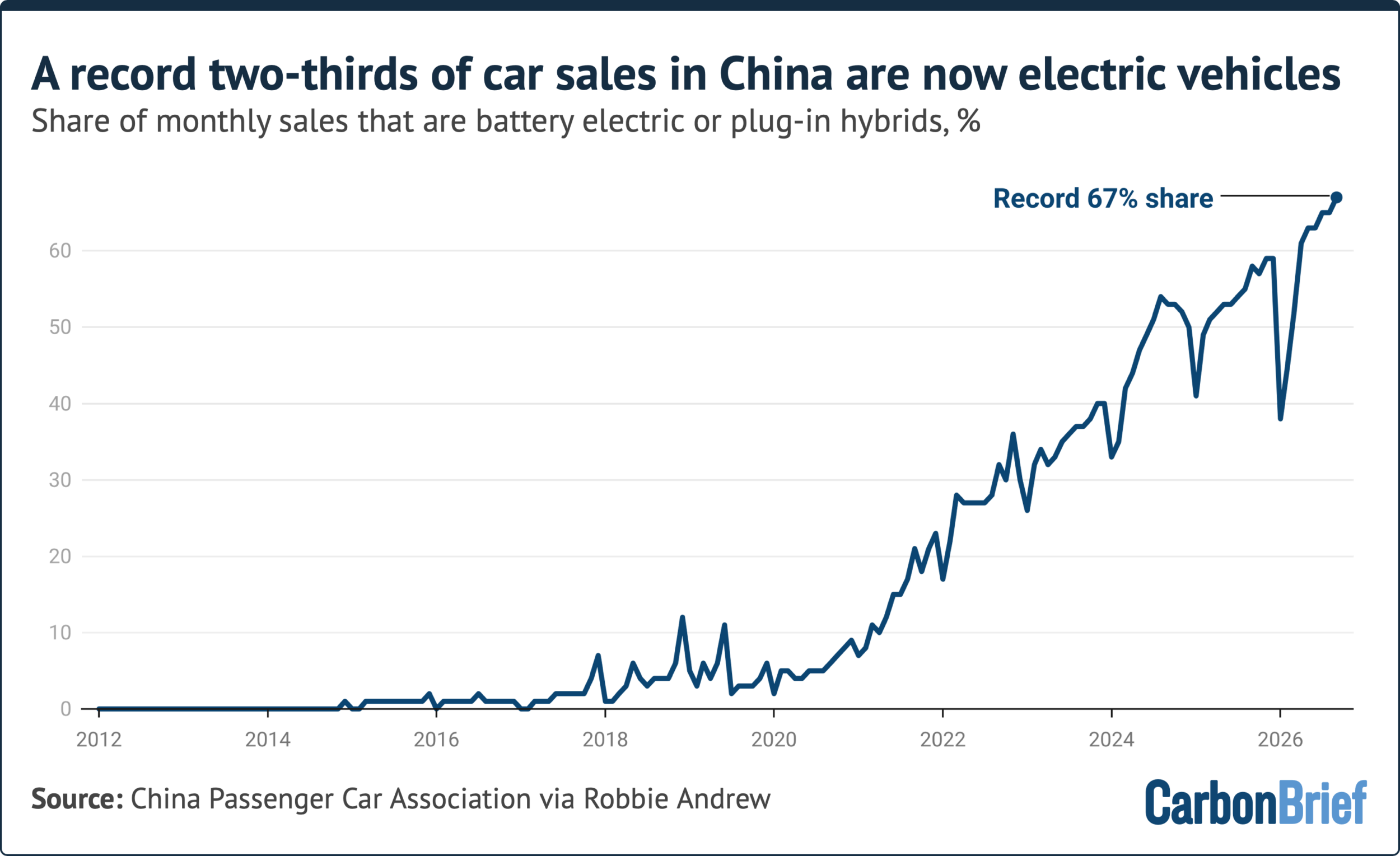
This marks a rapid rise for NEVs from just 6% of new car sales in 2020 up to 58% in 2026 to date – and a record 67% in the month of September.
This year, NEVs’ share of sales has also bounced back from a low of 39% in January, after the full purchase tax exemption that had been in place for more than a decade came to an end in December 2025.
The gain in NEV share in 2026 has come amid a slowdown across the wider domestic passenger-car market, which has hit sales of combustion-engine vehicles particularly hard.
This September, passenger-car retail sales across all categories declined, with overall sales volumes falling 28% year-on-year.
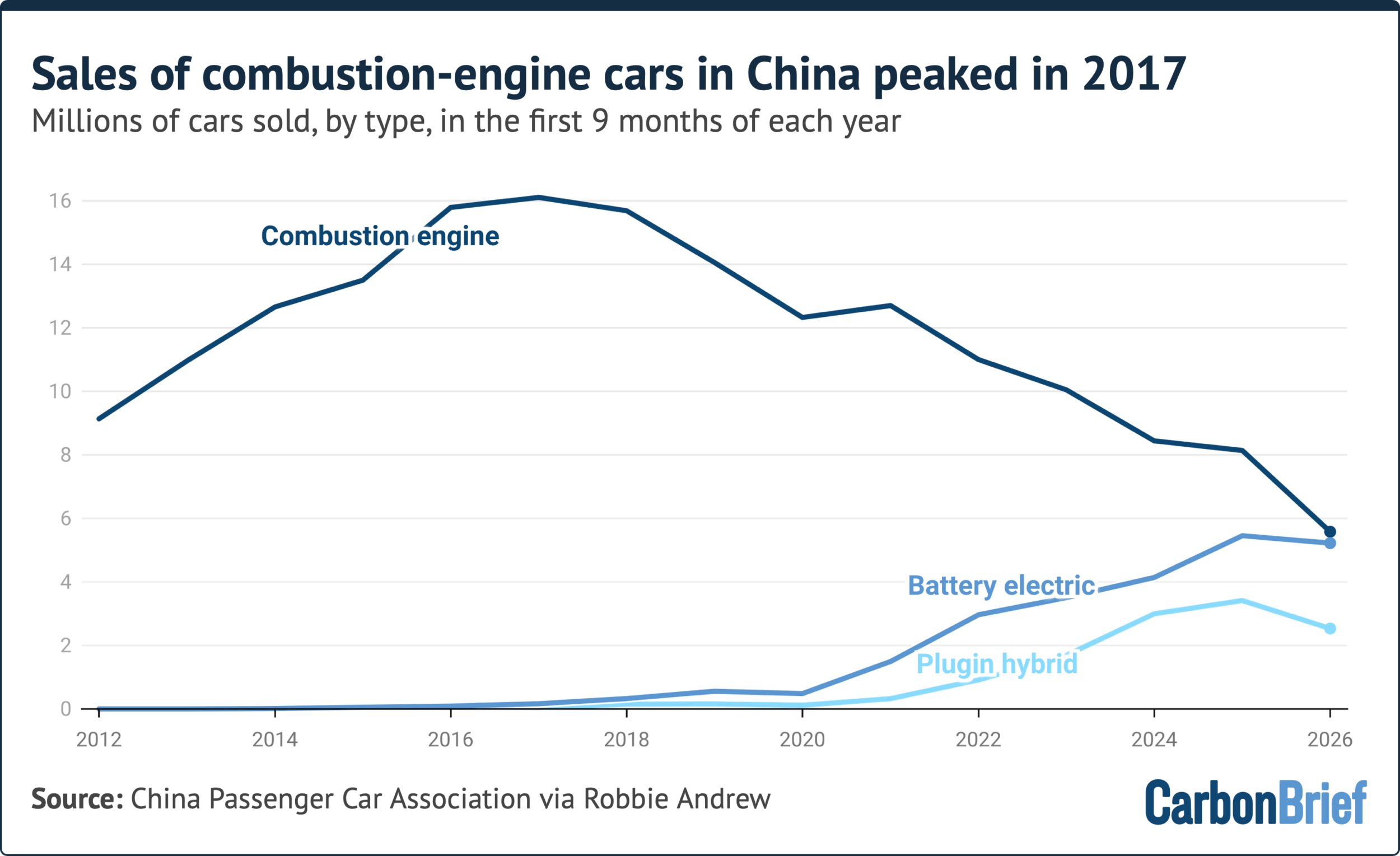
The contraction was led by combustion-engine vehicles, which saw sales fall 43% year-on-year in September and 31% in 2026 to date.
However, sales of PHEVs also fell by 36% year-on-year in September and by 26% in 2026 to date. By comparison, BEVs performed better, although sales still declined 8.5% from a year earlier in September and 4% in 2026 to date.
As a result, NEV sales overall fell by 17% in September and 13% in 2026 to date.
While the market changes in 2026 to date were particularly dramatic, they reflect a broad continuation of trends seen over the past decade.
Indeed, sales of combustion-engine cars in China peaked in 2017 and they have been declining ever since, shown in the figure below.
Impact of Hormuz
Part of the reason for the advance of NEVs in 2026, said Chinese technology news outlet OFweek, was petrol cars “giving up market share” as they were outperformed by electric alternatives.
Cui Dongshu, secretary-general of the CPCA, cited higher petrol prices as an explanation for September’s weak combustion-car sales, in comments to financial news outlet National Business Daily.
Imports of oil into China in January-September have fallen 15% compared to 2025, equivalent to 470m barrels, as ongoing conflict tightened supply and drove up prices.
China’s passenger-car NEV fleet has displaced 143m barrels of oil so far during the strait of Hormuz crisis, Euan Graham, senior energy analyst at thinktank Ember, tells Carbon Brief.
EVs “accounted for 12% of the decrease in China’s oil use post-Hormuz”, according to an estimate provided to thinktank the Brookings Institute by an unnamed analyst.