

The recent report from climate scientists is crystal clear: the world must act now. That means limiting global warming to 2 or 1.5 degrees Celsius.
But what does this entail?
Cutting a lot of emissions and reaching net zero. And this is urgent.
Embracing the urgency of this matter, more and more entities are pledging their net zero targets. There are now over 80 nations and hundreds of businesses that laid out their net zero roadmaps. These include the world’s supper emitters – China, the United States, the European Union, and India.
But what does achieving net zero emissions really mean?
This guide will explain the key facts and insights about this world-saving concept.
What Does Hitting Net Zero Emissions Mean?
Being at net zero emissions refers to a point where the GHG emissions released by humans into the air are balanced by the emissions removed from the air.
Think of it as a weighing scale. Emitting carbon and other GHG tips the scale and the net zero aim is to get the scale back into balance.
Reaching this balance requires two things.
- Reducing the emissions released from human activities closest to zero.
- Removing the emissions that are hard to reduce.
Getting to net zero means we can still generate some emissions. But as long as they are offset by initiatives that reduce GHG already in the atmosphere.
There are plenty of carbon removal solutions and technologies being developed to suck in CO2 from the air and store it.
So, emission reductions and removals go together in the world’s race to net zero.
When Must The World Get to Net Zero?
Every new ton of carbon emitted into the atmosphere is heating the planet more. The sooner the world stops adding CO2 and other GHG to the air, the better. But what’s the timeline for this?
As per IPCC’s latest report, to honor the Paris Agreement and limit temperature rise at 1.5°C, global emissions should be at net zero by 2050.
Still, hitting net zero in 2050 is too far distant away. Short-term emissions reduction targets are necessary. The Paris accord requires countries to reduce emissions by 7% each year this decade (from 2020 to 2030).
Climate science suggests a global timeline to be at net zero under two scenarios: limiting warming to 1.5°C and to 2°C.
The figure below shows this timeline. It separates two significant emissions – carbon dioxide and total GHG.
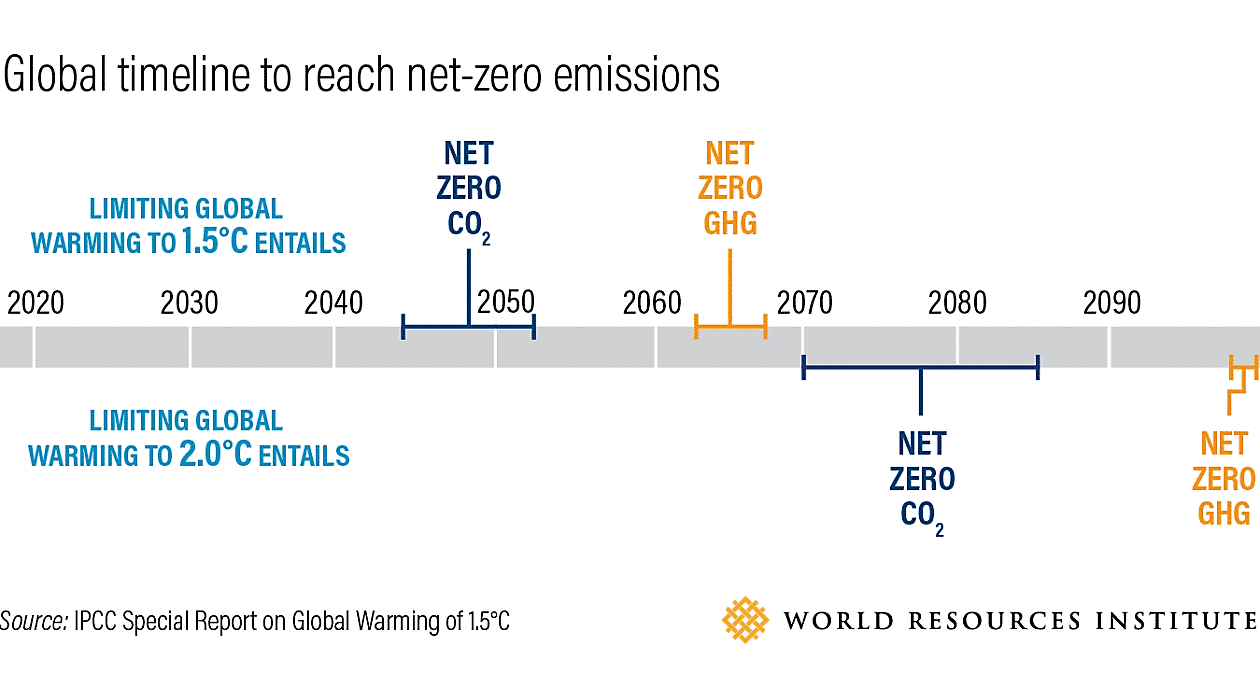
What the picture depicts is that achieving net zero CO2 emissions must be by 2050 (1.5°C) or by 2070 (2°C) at the latest. Whereas for non-CO2 emissions, it means by 2060 and by the end of the century.
The sooner emissions peak, the more realistic hitting net zero becomes.
This scenario results in less dependence on removing carbon beyond 2050.
But this timeline doesn’t say that all countries need to be at net zero at the same time. There are a lot of factors to consider here including:
- Responsibility for past GHG emissions
- Per-capita emissions
- Capacity to act
This suggests that the deadline for the wealthier, higher emitters could be earlier. The opposite holds true for poorer emitters.
For instance, India has net zero targets by 2070 while Saudi Arabia and China both pledged to be at net zero by 2060.
Whereas the US, EU, UK, and Japan have all committed to hitting it by 2050.
But it’s crucial not just for countries but also for companies to have net zero targets. More so, their near-term emissions reduction goals must align with their net zero pledges.
Why It’s Vital to Align Interim CO2 Reduction Targets with Net Zero Plans?
Entities often set their net zero targets by 2050.
But to ensure that they’re on track toward their net zero pledge, their long-term goals must inform their interim targets.
This is critical to prevent locking in carbon-intensive and non-resilient infrastructure and technologies. It can also help them align the costs by investing in projects that can cut emissions now and still do so years later.
This is more vital for countries to design consistent policies that support reduction efforts in the long run. Also, countries party to Paris Agreement and COP26 agreed to submit their climate plans.
Such plans form part of their NDCs or nationally determined contributions. The NDCs outline interim emissions targets by 2030 and align governments’ climate plans with their near-term goals.
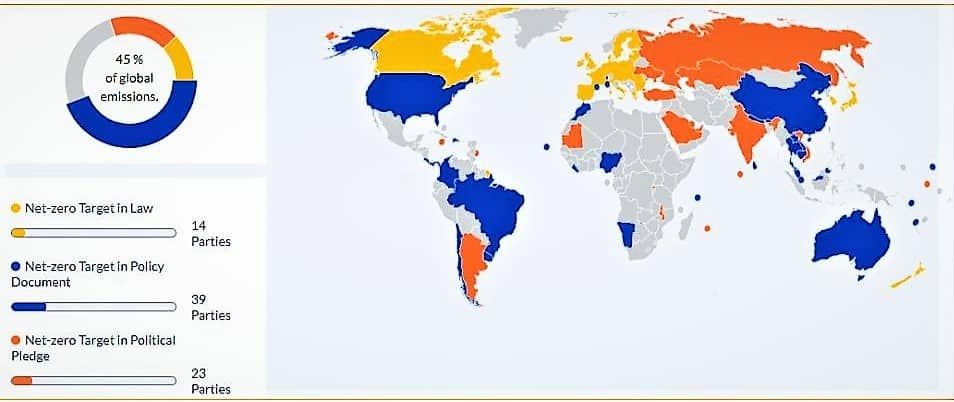
Most countries with net zero targets are starting to incorporate them into their interim NDCs. Here’s the current global map of countries that have net zero ambitions and their status.
More importantly, the corporate world had also paved its path toward net zero emissions.
World’s Heaviest Emitting Companies With Net Zero Targets And Strategies
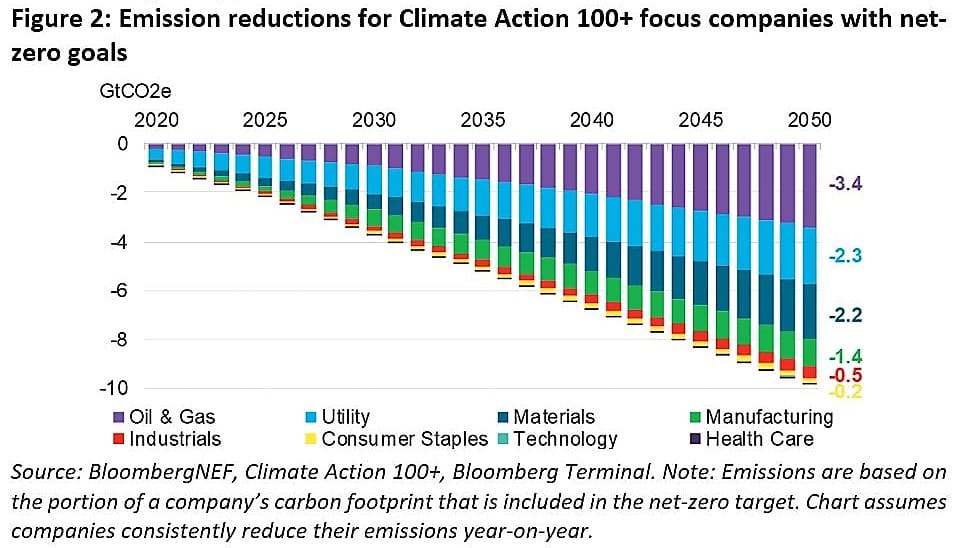
The oil and gas sector accounts for over a third (3.4 GtCO2e) of targeted reductions, more than any other sector.
-
$15 billion towards reducing GHG emissions over the next six years
-
Better processes to reduce methane gas leakage
-
To reach net zero within the U.S. Permian Basin shale field by 2030
Exxon also bid the highest to get offshore properties to use for carbon sequestration.
Likewise, Chevron also announced a $10 billion dollar investment into low carbon initiatives as part of its net zero targets.
Half of that budget will be for reducing emissions from fossil fuel initiatives. The remaining half will be for hydrogen energy and renewable fuels.
Specifically, Chevron will increase:
- Renewable fuels production to 100,000 barrels per day
- Renewable natural gas output to 40 billion British thermal units (BTUs) per day.
- Hydrogen production to 150,000 tonnes per year
- Carbon capture and offsets to 25 million tonnes per year.
Meanwhile, Occidental Petroleum has also set its net-zero ambition by 2050. Like other oil majors, Occidental also invests in direct air capture (DAC) technology as one of its net zero strategies.
The firm expects to pull as much as 1 million metric tons/year of CO2 emissions via DAC.
The second heaviest emitting sector is the utilities with 2.3GtCO2e.
Italy-based Enel, one of the world’s biggest utility firms, has an initial net-zero emissions target by 2050 but moved it to 2040 instead. The firm also expressed to exit coal generation by 2027 and gas by 2040.
Enel plans to invest $160 billion to fund its net zero strategies to reach its ambitious goal. Part of that is to install around 154GW of renewable capacity by 2030.
Duke Energy also set ambitious climate goals. That’s to have at least a 50% reduction in CO2 emissions from electricity generation in 2030 on its way to net zero by 2050. They’re also targeting net zero methane emissions for their natural gas distribution by 2030.
The third sector with high emissions is manufacturing (1.4GtCO2e) which includes automakers.
While the utility companies are turning to renewables, car manufacturers are becoming electric.
Tesla led the way in its all-electric lineup and amassed huge carbon credit sales for it. It also produces green products that further add to its credit generation. Yet, it still hasn’t revealed its net zero goals.
Stellantis, on the other hand, has pledged to hit net zero emissions the soonest time by 2038.
While it used to rely on Tesla to meet its regulatory emissions, the European carmaker managed to cut down its emissions.
It was through its electrification ramp-up and technical improvements. This includes its battery electric vehicles (BEVs) and low-emission vehicles (LEVs) production.
To become carbon net zero in 2038, the carmaker focuses on these main levers:
- Energy-efficient projects and energy management in all plants
- Site compression and improvement of industrial footprint
- Use and production of renewable energies
- Technical innovations (e.g. Hydrogen, Power to gas)
- CO2 capture and storage
Other manufacturers also made significant strides in their way toward decarbonization. Take for example the case of Del Monte Foods.
Del Monte Foods has invested significantly in renewable energy and reduced food waste. It also doubled capital investment in energy-efficient production operations.
The company’s strategy to reach net zero emissions by 2050 is to invest more in:
- Renewable energy,
- Automation,
- Transportation efficiency,
- Regenerative agricultural practices, and
- Eco-friendly packaging innovation
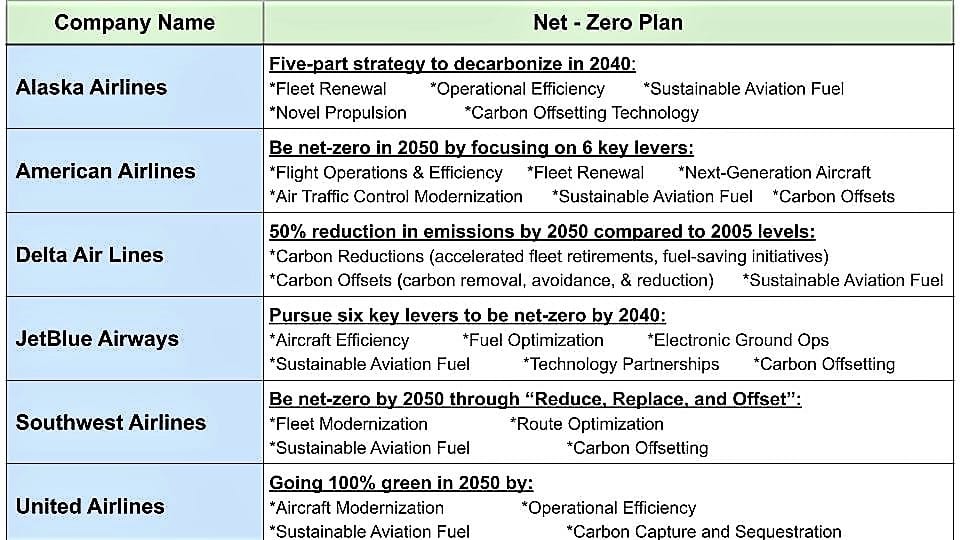
Though they’re not directly specified as a sector in the chart above, the airlines are also one of the big emitters.
In fact, the global aviation industry generates around 2.1% of all CO2 emitted by humans. Within the transport sector, it accounts for 12% of emissions compared to 75% from road transport.
Here’s how the major US airlines are dealing with their net zero targets.
The Way to Net Zero
It is certain that the world needs to take action and treat climate change as an emergency.
And the only means to face this emergency heads on is for countries and companies to hit their net zero emissions.
There’s no single approach to how the world reaches net zero by 2050 or earlier. It requires a combination of various initiatives or strategies as to how different companies are doing it.
Another major element of that is setting near-term climate targets that align with long-term goals.
This will help investors assess the climate ambitions of their portfolio companies. It will also help corporations to have a good benchmark as they go on their journey to net zero.
The post What Does “Net Zero Emissions” Really Mean? appeared first on Carbon Credits.

EU carbon credit claims changed on 27 September 2026, the day the Directive (EU) 2024/825 began to apply across the European Union. The change is narrow. It changes how a company can talk about the credits it buys. A product can no longer be called neutral on the strength of compensation alone; however, every specific, evidenced statement about what a company measured, reduced, and funded stays fully available.

The post Promoting Improved Cooking Practices in Nigeria appeared first on Terrapass.



-
Climate Change1 year ago
Guest post: Why China is still building new coal – and when it might stop
-

 Greenhouse Gases2 years ago
嘉宾来稿:满足中国增长的用电需求 光伏加储能“比新建煤电更实惠”
-
Greenhouse Gases1 year ago
Guest post: Why China is still building new coal – and when it might stop
-

 Climate Change2 years ago
嘉宾来稿:满足中国增长的用电需求 光伏加储能“比新建煤电更实惠”
-