

Methane, a potent greenhouse gas, is responsible for about 30% of the global temperature increase observed since the industrial revolution.
China accounts for more than 10% of annual global human methane emissions, in large part due to unintended releases – known as “fugitive” emissions – from its energy sector.
In a recently published study, we take a closer look at China’s coal-mine methane (CMM) emissions, which account for roughly 40% of the nation’s total methane emissions.
Leveraging newly collected, mine-specific data, we develop granular estimates of CMM emissions in China since 2000.
These estimates reveal that China’s coal production is shifting towards provinces with lower-emission mines.
In addition, there has been a significant increase in the capturing of methane from coal mines for energy use.
Together, these developments have helped to limit the rise of CMM emissions, despite an overall increase in coal production since 2016.
Mine data
To estimate CMM emissions at a granular level, we needed to understand how emissions vary from one mine to the next across China.
To do this, we made use of existing safety regulations in China. As methane is a highly flammable gas, the Chinese government enforces mandatory methane gas level identification in coal mines and implements safety regulations accordingly.
Coal mines are categorised based on their “methane emission factors”, the volume of methane emitted per tonne of coal produced.
At one end are low-gas mines, with an emissions factor of less than 10 cubic metres (m3) of methane emitted per tonne of coal. At the other are high-gas mines, at more than 10m3 of methane emitted per tonne. Beyond this are “outburst” mines, which are those that have experienced coal seam or gas outburst incidents.
To get a clearer sense of how much low-gas, high-gas and outburst mines emit in practice, we built a model of the relationship between gas levels and emission factors, using a 2011 database of all Chinese coal mines.
This database includes information on methane gas levels, mine-specific emission factors, coalbed depth, mine ownership and production capacity. We further validated this relationship with newly collected coal mine data from 2023, published by Chinese local governments.
The results show that the distribution of emission factors, as shown in the figure below, varies significantly with gas level.
The top row in the figure below shows the emissions factors for a range of mines in 2011 classed as low-gas (top left, green), high-gas (top centre, pink) or outburst (top right, red). The dashed vertical lines show the central estimate for each type, ranging from 4.1m3 per tonne for low-gas mines through to 19.9m3/tonne for high-gas and 28.4m3/tonne for outburst mines.
The bottom row shows the same metrics based on the more recent 2023 data.
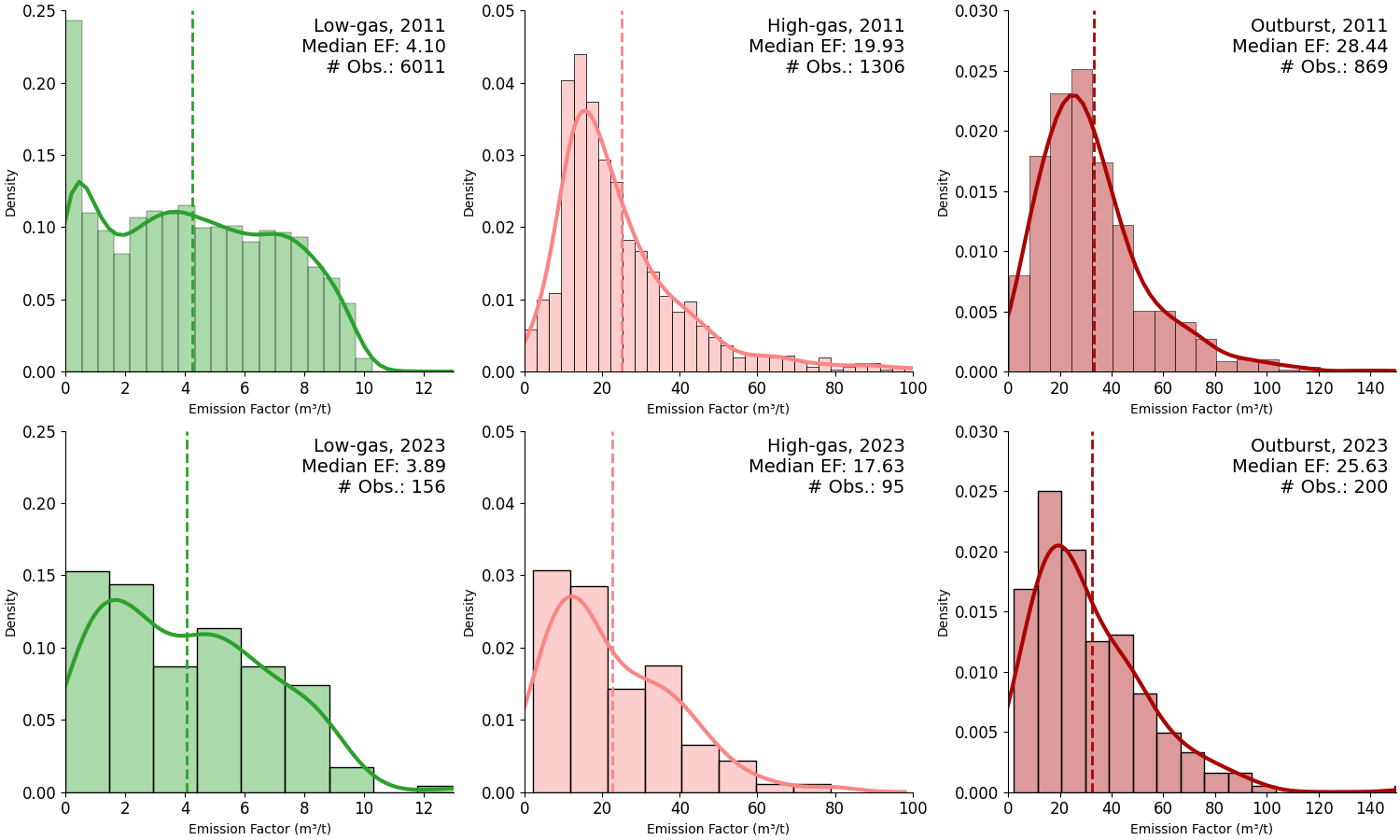
The strong correlation shown in the data above suggests that gas level is a crucial indicator of how much methane a coal mine emits.
In contrast, our analysis reveals no significant correlation between how much a coal mine emits and either coal mine depth or ownership.
Comparing the distributions for the same gas levels between 2011 and 2023 also shows that the link between gas levels and methane emissions remains fairly constant over time.
Therefore, the gas level of a mine can reliably serve as a proxy for its methane emissions per tonne of production, when direct measurements are unavailable.
Provincial shift
To estimate CMM emissions for each province in China, we assumed that the percentage of coal produced by mines of each gas level remains roughly constant as in 2011.
For instance, if 20% of Guizhou’s coal production in 2011 came from low-gas mines, we maintained this percentage for subsequent years.
We then calculated CMM emissions by multiplying provincial-level production-weighted emission factors by total coal production.
The line chart below illustrates our estimated CMM emissions since 2000.
The raw estimates, depicted by the lower grey dashed line, show a rapid increase in CMM emissions from approximately 5m tonnes in 2000 to nearly 21m tonnes in 2013.
This was followed by a decrease to 15m tonnes in 2016 and a subsequent rebound to 24m tonnes in 2023.
The decline between 2013 and 2016 aligns with a period of reduced coal production in China.
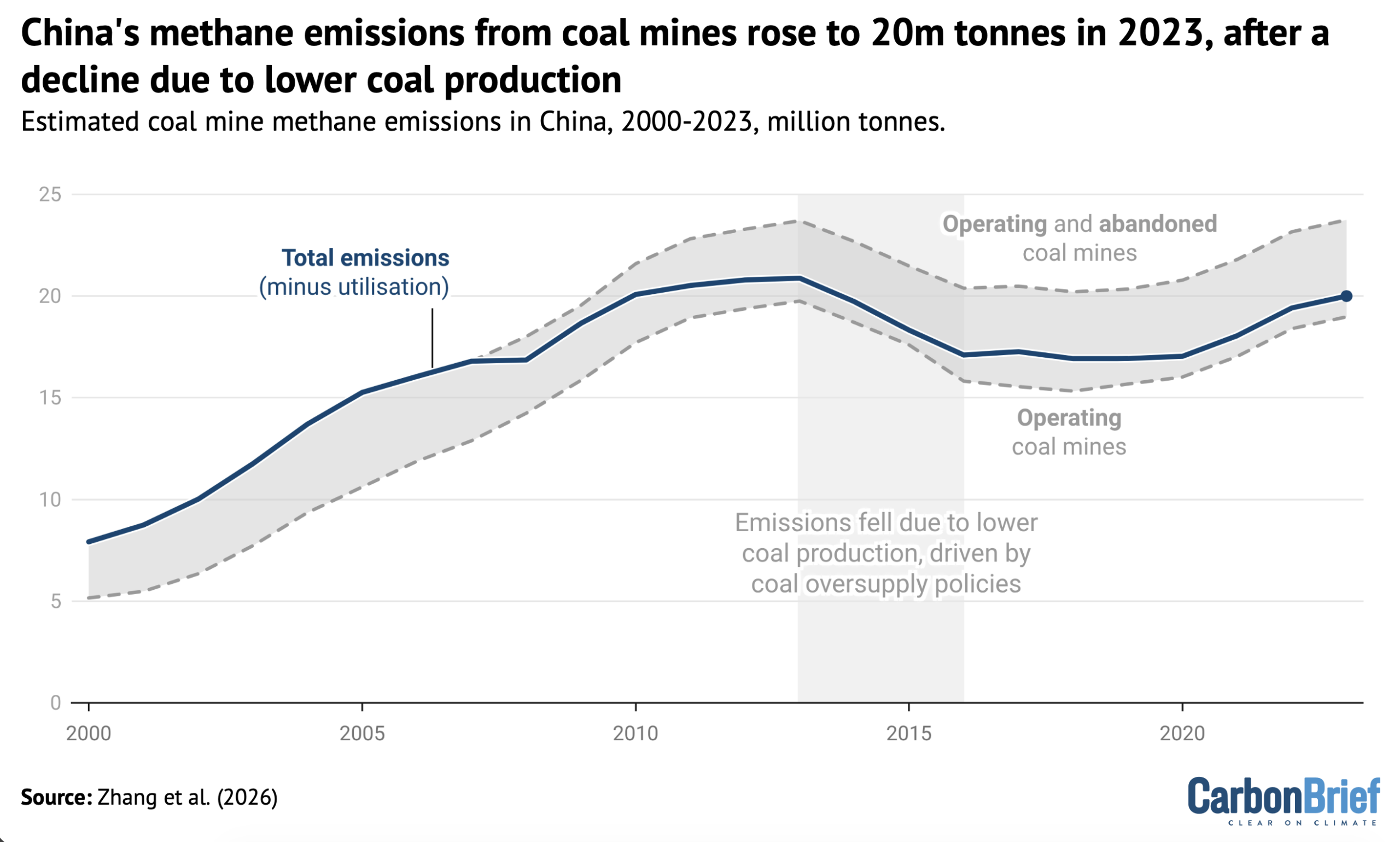
On the chart, the upper grey line represents CMM emissions when abandoned coal mines are included.
These mines, which continue to release methane long after operations cease, were responsible for 4.8m tonnes of methane emissions in 2020, contributing approximately 25% to the total CMM emissions.
Meanwhile, the blue line shows CMM emissions when the capture and use of methane in energy supply is taken into consideration.
National methane utilisation increased from 1.2m tonnes in 2008 to 3.7m tonnes in 2020, resulting in a reduction of total emissions by 5% and 17%, respectively.
It is noteworthy that CMM emissions did not immediately rebound after 2016, despite a reported increase in coal production by China’s National Bureau of Statistics.
This delay can likely be attributed to shifts in production locations to lower-emissions provinces, the closure of high-emissions mines and the adoption of technologies for capturing and using methane that effectively mitigate emissions.
The figure below compares CMM emissions across provinces in 2012 and 2021, two years with nearly identical total coal production levels.
Overall, changes in methane emissions closely mirrored shifts in where the coal was being mined. There is a clear geographic trend: production and emissions surged in northern and north-western regions such as Xinjiang, Shaanxi and especially Shanxi.
In fact, Shanxi alone emitted nearly 8m tonnes of coal-mine methane in 2021, making up roughly half of China’s total CMM emissions.
Meanwhile, both production and emissions dropped in south-western provinces, including Guizhou, Sichuan and Yunnan.
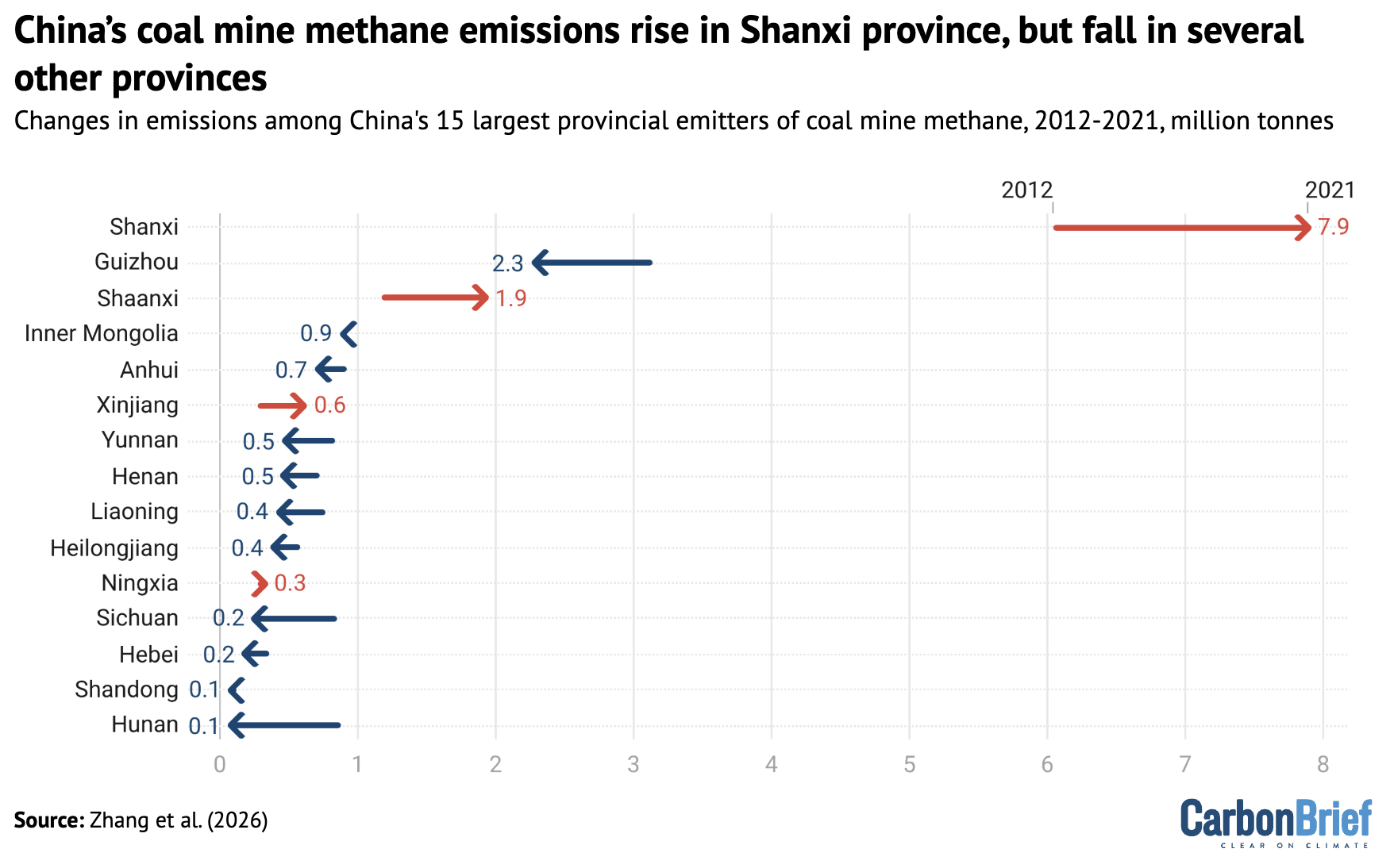
The figure shows that China’s coal production has switched from regions in the south-west where emissions per unit of coal production are relatively high, to lower-emission areas in the north and north-west. At the same time, total production levels have stayed similar, at just over 4bn tonnes in both 2012 and 2021.
Tackling methane
China has signalled its intention to address methane emissions, with key tasks for the next five years outlined in a national methane action plan published in 2023.
The broad trends of CMM emissions observed in this study will likely continue in China.
Small-scale coal mines – those producing less than 300,000 tonnes of coal per year – are at risk of closing or being consolidated, while increased production from large-scale, lower-emission mines in Xinjiang and Inner Mongolia will likely lead to an overall reduction in national production-weighted emission factors.
(This reduction in the rate of emissions per unit of coal production does not guarantee a reduction in methane emissions overall, as several analyses show this also depends on the total coal output. Even following closures, methane may still leak from abandoned mines.)
However, this regional shift in coal production – and, thus, methane emissions – could also help to address public health concerns from pollution associated with the gas.
The Chinese government has also introduced significant changes in policy on the capturing and use of methane gas. The Ministry of Ecology and Environment recently revised coal-mine methane standardsto mandate the capture and use of methane with concentrations above 8%, down from a previous 30%.
In addition, the government has a programme providing financial incentives for capturing methane and reducing CMM emissions.
Together, these measures could help China achieve its short- and medium-run methane capture and use goals set by the methane action plan.

The post Guest post: How changes to coal mining have affected China’s methane emissions appeared first on Carbon Brief.
Guest post: How changes to coal mining have affected China’s methane emissions

Climate Change
GREENPEACE GAS PROTEST DAY TWO: Activists spend first night on Woodside’s Scarborough gas platform, “in this for the long haul”
- NEW footage and photos available here and on Instagram – more being uploaded today.
- Interviews available with campaigners on board the Rainbow Warrior on request.
Greenpeace Australia Pacific activists have slept overnight on Woodside’s Floating Production Unit and dropped a massive 12×14-metre banner reading “Stop Woodside’s Dirty Gas. Save Scott Reef”.
Two activists have set up temporary hanging tents on the South East pillar, while the other two returned to the Rainbow Warrior late yesterday afternoon, after fulfilling their initial role. The activists will occupy the platform for as long as possible.
The environmental advocacy group is peacefully protesting Woodside’s plans to drill for oil and gas at Scott Reef as part of its Browse proposal.
Sakyo Noda, one of the Greenpeace Australia Pacific activists, said: “As a Japanese person living in Australia, I feel incredibly passionate about stopping Australia’s gas exports to Asia.
“Despite what the gas industry tells us, Australia’s gas is not helping to decarbonise Asia. It is simply not true. We shouldn’t be allowing fossil fuel companies like Woodside to extract new fossil fuels, let alone at extraordinary places like Scott Reef”.
Aboard the Rainbow Warrior, Geoff Bice, WA Campaign Lead at Greenpeace Australia Pacific, added, “Everyone is in good spirits. We’re in it for the long haul.”
Links:
Photos and video of Scott Reef here
Audio and footage of yesterday’s press conference here
Content and live updates will be uploaded to a live blog and Instagram
In-person interviews in Perth with David Ritter, CEO of Greenpeace Australia Pacific, can be organised. Dial-in, SimSat and Zoom interviews with Geoff Bice, WA Campaign Lead at Greenpeace Australia Pacific, currently aboard the Rainbow Warrior, can be organised.
Saturday, 17 October 2026
7.18 AM AWST
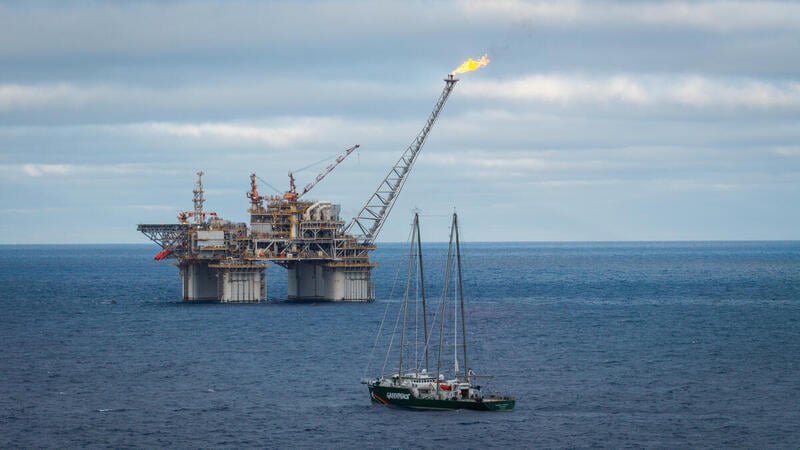
Hi folks! We’re joining you live from the Rainbow Warrior where we will be providing you with updates as our four activists continue scaling and occupying Woodside’s gas platform. The activists are peacefully protesting against Woodside’s latest gas expansion plans, the Browse project, which would see up to 57 toxic wells drilled at Scott Reef.
“Right now our activists are scaling Woodside’s massive Floating Production Unit. They are scaling the South-East pillar and the underside of the Helideck. They’ll be setting up camp soon and have plenty of provisions with them – so stick around!”
5:45 AM AWST
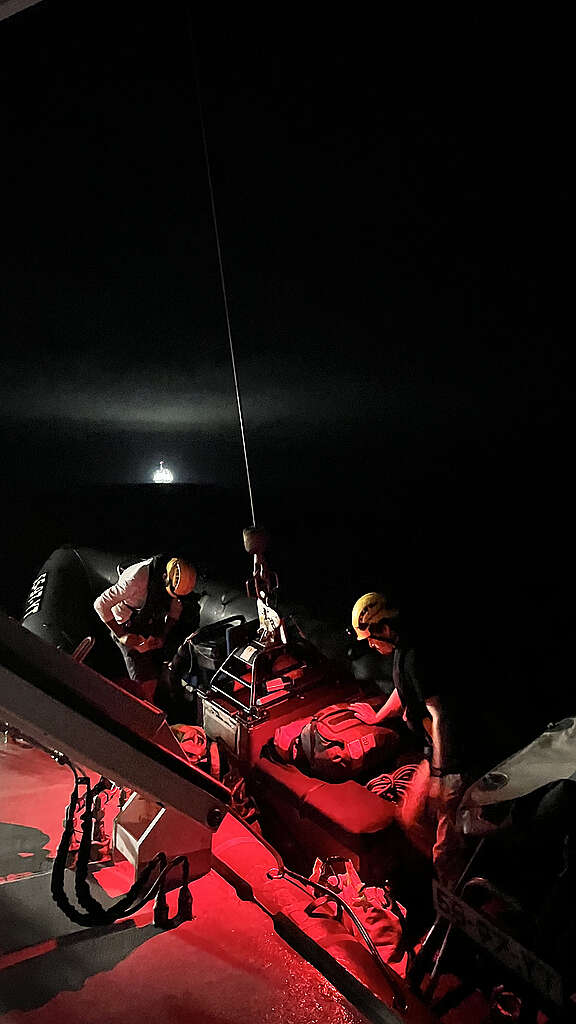
Our RHIBS are in the water! We’ve deployed our four activists and our ship crew on our small fast boats, headed to the gas platform. We’re carrying crew and equipment, plenty of food, all of our safety climbing gear, some big banners, cameras and a whole lot of heart… someone even has something to read after they get settled in.
5:26 AM AWST
Before sunrise activists prepared to launch RHIBS from the Rainbow Warrior.
Looking for a front seat view?
You can follow along with the Live Rainbow Warrior bow cam here!
Looking for more?
Follow us on Instagram for a peek behind the scenes and hear from our Rainbow Warrior crew.
Live blog: Greenpeace activists occupy Woodside gas project to save Scott Reef
Climate Change
Greenpeace activists climb and occupy Woodside’s Scarborough gas project calling on the Australian government to “Stop Woodside’s Dirty Gas” and “Save Scott Reef”
PERTH, Saturday 17 October 2026 — Four Greenpeace Australia Pacific activists are scaling and occupying a Floating Production Unit at Woodside’s Scarborough gas project off the coast of Western Australia, displaying banners reading: “Stop Woodside’s Dirty Gas. Save Scott Reef.”
- Photos and video available here and here. More will be uploaded throughout the day.
- Content and live updates will be uploaded to a live blog and to Instagram
Early this morning at 05:45 AWST, Greenpeace Australia Pacific activists launched from the Rainbow Warrior, Greenpeace’s flagship vessel, scaling and attaching themselves to a Floating Production Unit (FPU), a key piece of gas processing infrastructure at the Scarborough gas field over 200km off the coast of Exmouth.
Woodside has since confirmed it has initiated a temporary shut down of the FPU.
Greenpeace Australia Pacific is occupying the gas platform in peaceful protest of Woodside’s plans to drill for oil and gas at Scott Reef as part of its Browse proposal.
David Ritter, CEO at Greenpeace Australia Pacific, said: “Greenpeace Australia Pacific is taking action today to expose the unacceptable risk to Scott Reef posed by Woodside’s plans.
“Australians love our oceans. Woodside’s reckless Browse gas proposal would turn the magnificent Scott Reef into an industrial gas zone. Woodside wants to drill up to 57 toxic wells around Scott Reef, Australia’s largest oceanic reef, home to nesting green sea turtles, and endangered species like pygmy blue whales and the dusky sea snake; it is a place like nowhere else on Earth.
“Woodside has an alarming track record of oil spills, incidents and environmental neglect, and can’t be trusted with our oceans. From whaling in Albany in the seventies, to Woodside’s threat to Scott Reef today, there’s more than fifty years of history, of Greenpeace taking action off WA’s coasts to protect our oceans.
“There’s no future in new gas projects. Our future is in secure homegrown renewable energy, green industry and exports, where communities and places like Scott Reef are protected — there’s no future in dirty gas shipped offshore.
“The prospect of drilling for oil or gas on the Great Barrier Reef would be considered absolute madness today, but that is exactly the decision before the government: save Scott Reef or risk its destruction at the hands of a gas corporation.”
From aboard the Floating Production Unit, Dr Chris Holden, Greenpeace Australia Pacific activist said: “As a doctor, when I see new fossil fuel projects like Woodside’s Browse project being put forward, I can’t help but think about the impact this is going to have on the health of our communities and planet, and feel a sense of duty to act.
“Not only will this project do irrevocable harm to nature at Scott Reef, it will have a terrible impact on our climate, putting all of our lives at risk.
“On the Rainbow Warrior I’m carrying a copy of the 2025 Lancet countdown report, which warns that health impacts of climate change are worsening, with millions dying needlessly each year due to fossil fuel dependence, growing emissions, and failure to adequately adapt.
“With warnings like this from the leading global health professionals, our government simply can’t allow fossil fuel projects like Woodside’s Browse project to go ahead. It is their duty to do what is in the best interest of our communities.”
Almost half a million people have signed a petition calling on the government to Save Scott Reef and Woodside’s Browse gas project.
-ENDS-
Notes:
- Dial-in, SimSat and Zoom interviews with Geoff Bice, WA Campaign Lead at Greenpeace Australia Pacific, currently aboard the Rainbow Warrior, can be organised separately
Media contact:
Greenpeace Australia Pacific media team on +61 406 231 892 or +61 407 581 404

GREENPEACE GAS PROTEST DAY TWO: Activists spend first night on Woodside’s Scarborough gas platform, “in this for the long haul”

Making Billions by Harming Others

