

Global yields of wheat are around 10% lower now than they would have been without the influence of climate change, according to a new study.
The research, published in the Proceedings of the National Academy of Sciences, looks at data on climate change and growing conditions for wheat and other major crops around the world over the past 50 years.
It comes as heat and drought have this year been putting wheat supplies at risk in key grain-producing regions, including parts of Europe, China and Russia.
The study finds that increasingly hot and dry conditions negatively impacted yields of three of the five key crops examined.
Overall, global grain yields soared during the study period due to technological advancements, improved seeds and access to synthetic fertilisers.
But these yield setbacks have “important ramifications for prices and food security”, the study authors write.
Grain impacts
Most parts of the world have experienced “significant” yield increases in staple crops since the mid-20th century.
The new study notes that, in the past 50 years, yields increased by 69-123% for the five staple crops included in the research – wheat, maize, barley, soya beans and rice.
But crop production is increasingly threatened by climate change and extreme weather. A 2021 study projected “major shifts” in global crop productivity due to climate change within the next two decades.
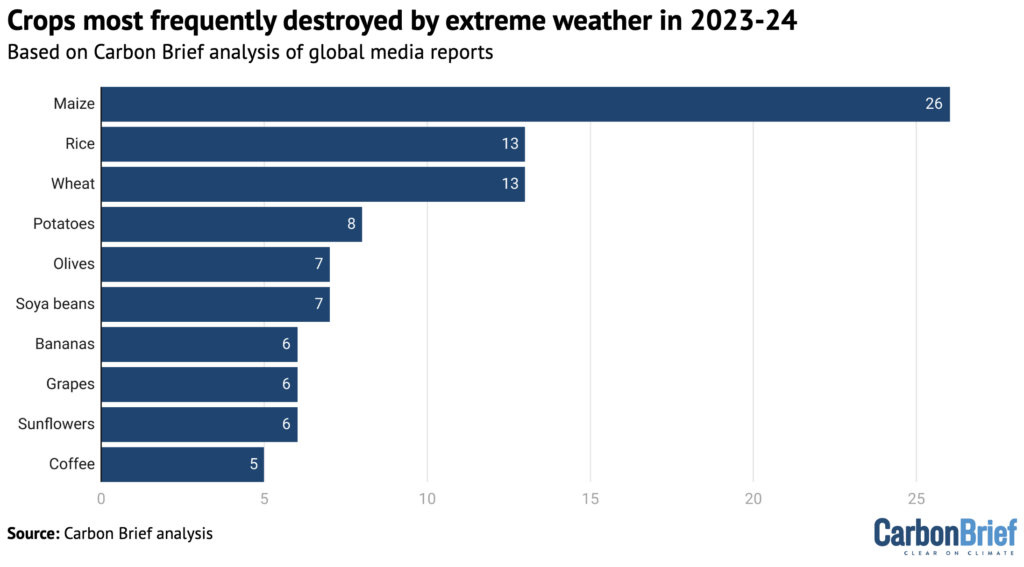
Earlier this year, Carbon Brief mapped out news stories of crops being destroyed around the world by heat, drought, floods and other weather extremes in 2023-24. Maize and wheat were the crops that appeared most frequently in these reports.
Hot and dry weather is currently threatening wheat crops in parts of China, the world’s largest wheat producer, Reuters reported this month.
In the UK, wheat crops are struggling amid the “driest start to spring in England for almost 70 years”, the Times recently reported. Farm groups say some crops are already failing, the Guardian said.
As a result, global wheat supplies are “tight”, according to Bloomberg, with price rises possible depending on weather conditions in parts of Europe, China and Russia.
Food security and prices
The study uses climate datasets, modelling and national crop statistics from the UN Food and Agriculture Organization to assess crop production and climate trends in key grain-producing countries over 1974-2023, including Argentina, Brazil, Canada, China, the EU, Russia and the US.
The researchers assess climate observations and then use crop models to calculate what yields would have been with and without these climate changes.
For example, “if it has warmed 1C over 50 years and the model says that 1C leads to 5% yield loss, we’d calculate that the warming trend caused a loss of 5%”, Prof David Lobell, the lead study author and a professor at Stanford University, tells Carbon Brief.
The study looks at two reanalysis climate datasets that include information on temperature and rainfall over the past 50 years: TerraClimate (TC) and ERA5-Land. (Reanalysis data combines observations with a modern forecasting model.)
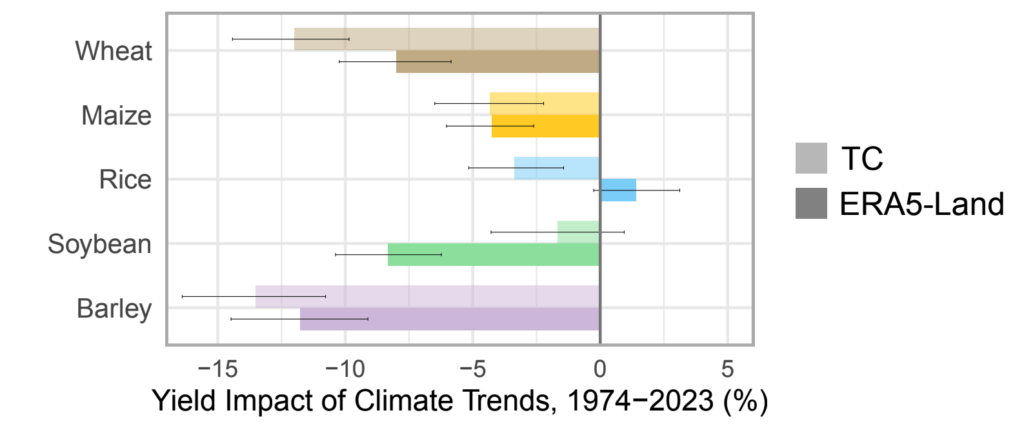
The researchers find that yields of three of the five crops are lower than they would have been without warmer temperatures and other climate impacts in the past 50 years.
Yields were lower than they otherwise would have been by 12-14% for barley, 8-12% for wheat and 4% for maize.
The impacts on soya beans were less clear as there were “significant differences” between data sources. But both datasets show a negative impact on yields, ranging from 2% to 8%.
The effects on rice yields were inconclusive, with one dataset showing a positive effect of around 1% while the other showed a negative effect of about 3%.
The chart below shows the estimated yield impacts for each crop based on the calculations from the two climate datasets.
Given soaring overall crop yields during this time, impacts of 4-13% “may seem trivial”, the researchers write. But, they say, it can have “important ramifications for prices and food security” given growing food demand, noting:
“The overall picture of the past half-century is that climate trends have led to a deterioration of growing conditions for many of the main grain-producing regions of the world.”
Water stress and heat
The study also assesses the impacts that warming and vapour pressure deficit – a key driver of plant water stress – have on crop yields.
Vapour pressure deficit is the difference between the amount of water vapour in the air and the point at which water vapour in the air becomes saturated. As air becomes warmer, it can hold more water vapour.
A high deficit can reduce plant growth and increase water stress. The models show that these effects may be the main driver of losses in grain yield, with heat having a more “indirect effect”, as higher temperatures drive water stress.
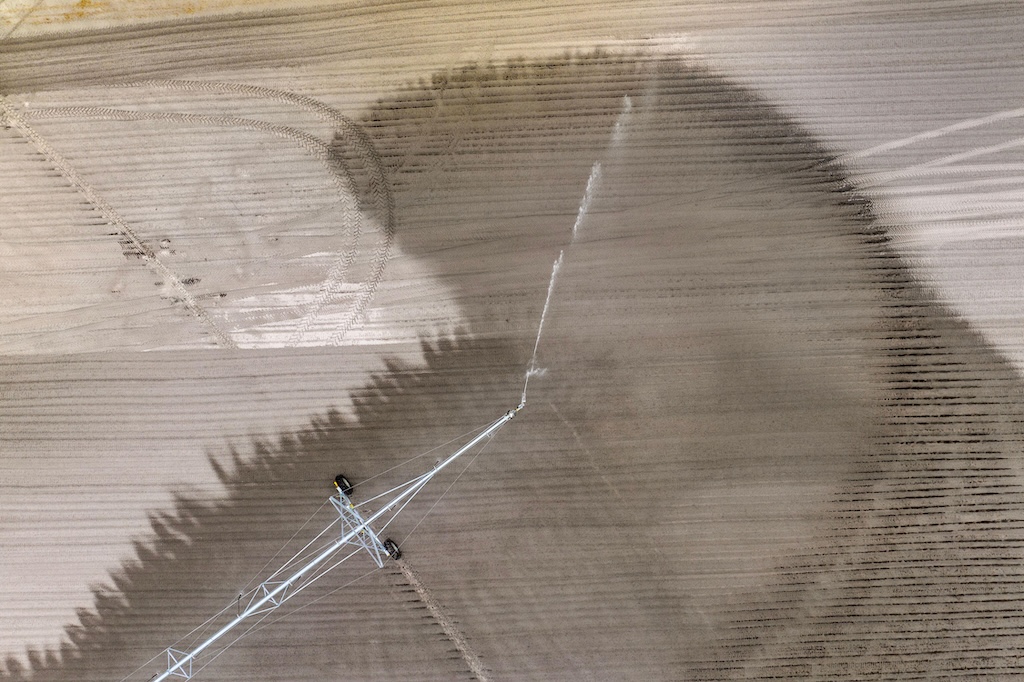
The study finds that vapour pressure deficit increased in most temperate regions in the past 50 years.
The researchers compare their data to climate modelling simulations covering the past 50 years. They find largely similar results, but notice a “significant underestimation” of vapour pressure deficit increases in temperate regions in most climate models.
Many maize-growing areas in the EU, China, Argentina and much of Africa have vapour deficit trends that “exceed even the highest trend in models”, they write.
The researchers also find that most regions experienced “rapid warming” during the study period, with the average crop-growing season now warmer than more than 80% of growing seasons 50 years ago.
The findings indicate that, in some areas, “even the coolest growing season in the present day is warmer than the warmest season that would have occurred 50 years ago”.
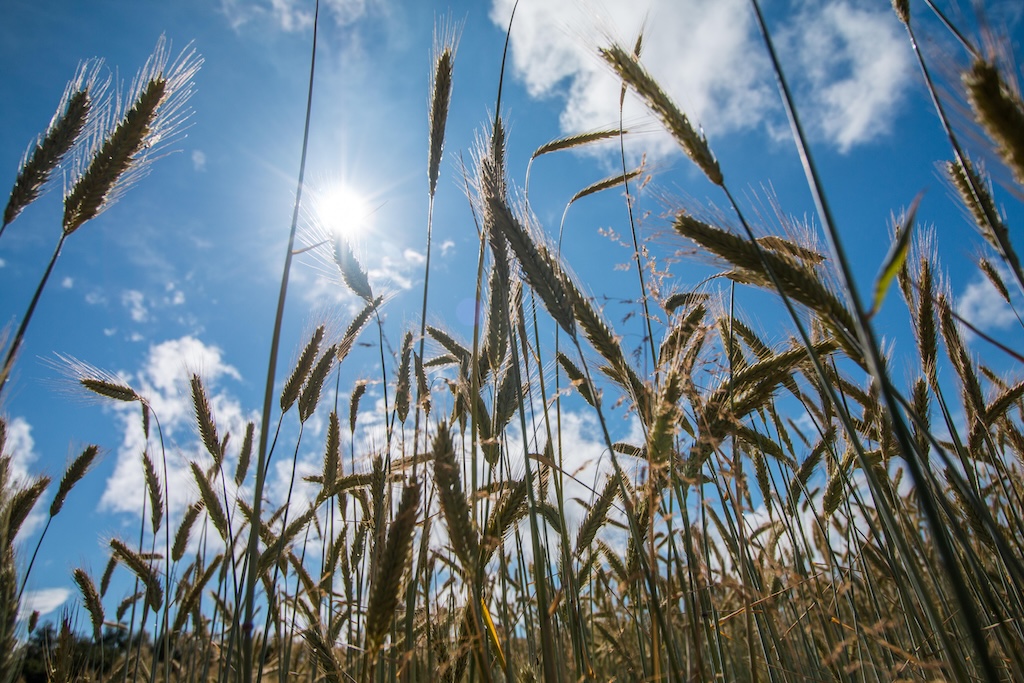
An exception to this is in the US and Canada, they find, with most maize and soya bean crop areas in the US experiencing lower levels of warming than other parts of the world and a “slight cooling” in wheat-growing areas of the northern Great Plains and central Canada.
(The central US has experienced a cooling trend in summer daytime temperatures since the middle of the 20th century, according to the National Oceanic and Atmospheric Administration. There are many theories behind this “warming hole”, which has continued despite climate change.)
CO2 greening
Dr Corey Lesk, a postdoctoral researcher at Dartmouth College who studies the impacts of climate on crops, says these findings are in line with other recent estimates. He tells Carbon Brief:
“There are some uncertainties and sensitivity to model specification here – but it’s somewhat likely climate change has already reduced crop yields in the global mean.”
The study’s “main limitation” is that it is “behind” on including certain advances in understanding how soil moisture impacts crops, Lesk adds:
“Moisture changes and CO2 [carbon dioxide] effects are the largest present uncertainties in past and future crop impacts of climate change. This paper is somewhat limited in advancing understanding on those aspects, but it’s illuminating to pause and take stock.”
The research looks at whether the benefits of CO2 increases during the past 50 years exceed the negative effects of higher levels of the greenhouse gas.
Rising CO2 levels can boost plant growth in some areas in a process called “CO2 fertilisation”. However, a 2019 study found that this “global greening” could be stalled by growing water stress.
Yield losses for wheat, maize and barley “likely exceeded” any benefits of CO2 increases in the past 50 years, the study finds.
The opposite is true for soya beans and rice, they find, with a net-positive impact of more than 4% on yields.
Climate science has “done a remarkable job of anticipating global impacts on the main grains and we should continue to rely on this science to guide policy decisions”, Lobell, the lead study author, says in a press release.
He adds that there may be “blind spots” on specialised crops, such as coffee, cocoa, oranges and olives, which “don’t have as much modelling” as key commodity crops, noting:
“All these have been seeing supply challenges and price increases. These matter less for food security, but may be more eye-catching for consumers who might not otherwise care about climate change.”

The post Global wheat yields would be ‘10%’ higher without climate change appeared first on Carbon Brief.
Global wheat yields would be ‘10%’ higher without climate change

Latin American governments cracked down on forest clearing in 2025, leading global deforestation to fall by the most this decade, but political shifts and the likely impact of a strong El Niño threaten to undo those “fragile” gains, a new report has found.
Seven million hectares of forests – roughly the size of Ireland – were lost last year, a 15% drop from 2024. This marks the first meaningful slowdown in deforestation since 145 countries committed to ending deforestation by 2030 at COP26 in Glasgow in 2021, according to an annual assessment of the pledge.
But the researchers cautioned that the world remains 70% off track from fulfilling that promise and, despite progress in Latin America, deforestation in tropical Africa, home to the Congo Basin, kept rising. For the first time, it nearly matched losses in Latin America – a trend the report’s publishers called “particularly ominous”.
Erin Matson, a lead consultant at Climate Focus and one of the report’s authors, said the slowdown in the rate of deforestation “is welcome news”, but last year’s figures “look good in part because previous years look so bad”.
She added that, at the moment, last year’s progress should be seen as an “exception and not a new trajectory because the underlying problem has not gone away”.
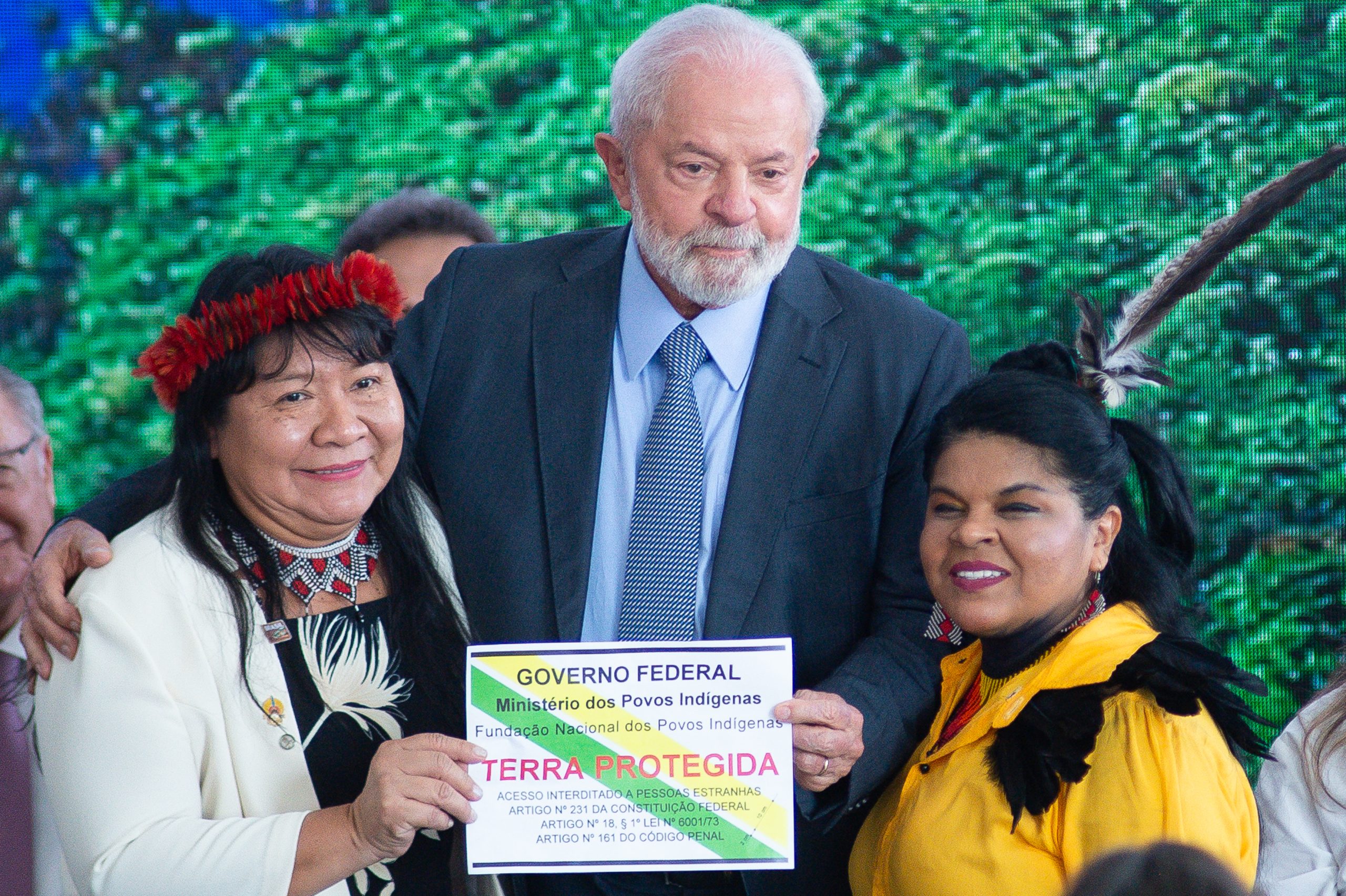
Lula’s policies drive progress
The decline in deforestation was primarily driven by reduced expansion of agriculture and cattle ranching in the Brazilian Amazon rainforest, thanks to a new deforestation action plan introduced by the Lula government and stronger enforcement measures, the report found.
“Brazil provides a concrete example of how national policies can be successful,” said Ana Flávia Corleto, legal analyst at Climate Policy Initiative in Brazil. “The combination of near real-time monitoring and targeted enforcement has contributed to a historical reduction in deforestation alerts in the Amazon, with a 36% decline between August 2025 and July 2026”.
-
Brazil confident new rainforest fund will reach $10bn donor milestone
Brazil’s environment minister said the Tropical Forest Forever Facility has raised billions in record time – which he hopes will convince more investors -
As El Niño intensifies, we should be investing more in the world’s farmers
Finance to help agriculture adapt to a hotter world and more extreme weather is vital for food security – but new data shows it’s on a downward trend


President Lula bolstered efforts to protect the vital Amazon ecosystem when he returned to office in 2023 after enforcement had deteriorated and deforestation skyrocketed under his far-right predecessor Jair Bolsonaro.
Neighbouring Colombia also contributed to the slowdown in forest loss in Latin America last year, posting a fourth consecutive year of falling deforestation, driven in part by reduced cattle-linked clearing.
Brazilian election puts gains at risk
But the researchers warn that this progress rests heavily on the choices of a small number of governments and it is “highly vulnerable” to political shifts in recent and upcoming elections across the Amazon basin.
On October 25, Brazilian voters will choose between Lula and Flávio Bolsonaro, the former president’s son, in a run-off election. Bolsonaro narrowly led the first round with 47% of the vote to Lula’s 45% and polls show the pair neck and neck.
In an interview with TV Globo in August, Bolsonaro said he did not believe in climate change, only in “cyclical” extreme weather events. As a senator, he voted in 2025 for a bill loosening environmental licensing rules.
Although he has pledged to end illegal deforestation by 2029, Brazilian environmental groups fear he could follow his father’s example of weakening forest protections. “Instead of restoring forests, we would face the dismantling of environmental safeguards, land grabbing, illegal mining, and deforestation,” Observatório do Clima, a network of climate NGOs, said on Tuesday. “At the worst possible moment in the global climate crisis, electing another Bolsonaro would be a gift to environmental crime and those who profit from the destruction of the planet”.
Climate Policy Initiative’s Corleto said changing political priorities in the Brazilian federal government can have significant consequences, especially for federal institutions and budgets. But she added that much of the country’s environmental policy is implemented at local or state level and some continuity can be expected there.
Deforestation growth in Congo Basin
Threats to forest conservation are already growing elsewhere in the Amazon region. In Colombia, recently elected far-right President Abelardo de la Espriella has repealed mining restrictions and promised to support oil and gas exploration, which the report’s authors said pose threats to forests.
Latin America has historically been the world’s deforestation hotspot but the second-largest tropical forest, Africa’s Congo basin, has been catching up, the assessment found. Deforestation in tropical Africa rose to 2.4 million hectares in 2025, almost level with the 2.5 million hectares lost across tropical Latin America and the Caribbean.
Forest loss there is driven primarily by smallholder agricultural expansion, logging, infrastructure development, and regulatory systems that lack either the capacity or the political mandate to counter those pressures, the authors found.
“We need to see states with very clear policies, strong legislation and very rigorous enforcement capacity,” said Samuel Nguiffo, a lawyer and founder of Cameroon’s Centre for Environment and Development. “Unfortunately, this is what we seem to be missing. There is a deficit in government capacity”.
El Niño threat
The report also warns that last year’s progress in keeping trees standing could also be eroded by a possible spike in forest fires fuelled by the so-called super El Niño weather pattern which could peak this December.
In Indonesia, which is severely affected by drought in El Niño years, wildfires are currently burning vast swathes of forest. Fire emissions in Indonesia are on track to match 2015, the country’s worst fire season this century, experts told Carbon Brief.
Matson said the world saw a “huge spike” in tree cover loss during the last “super” El Niño event in 2015 and expects to see a similar increase this year. “We can’t fully project the future, but it’s unlikely that in 2026, we’ll see the same kind of reductions that we saw last year”.
The post Global deforestation slowed in 2025 but Brazil’s election could undo “fragile” gains appeared first on Climate Home News.
Global deforestation slowed in 2025 but Brazil’s election could undo “fragile” gains
The UK government warned the Carbon Capture and Storage Association’s (CCSA) annual conference on Tuesday that the fledgling industry should prepare to receive less financial support from taxpayers in the future.
As the left-wing Labour government, under its new leader Andy Burnham, seeks to boost military spending in line with NATO allies, it is reportedly looking to cut funding for emissions-reduction projects, with subsidies for carbon capture and heat pumps among the projects in the firing line.
Martin McCluskey, a junior minister in the UK’s Department for Energy and Net Zero (DESNZ), told the CCSA conference in Westminster that, while the government supports the industry, “it is no secret that we are operating in a challenging fiscal environment and this government remains committed to meeting its fiscal rules”.
“So I owe it to you today to level with you,” he said. “The next phase of the CCUS (carbon capture, use and storage) programme will be in the context of broader, difficult decisions on funding. We must ensure that public investment is targeted where it can deliver the greatest value while continuing to build confidence in the long-term future of the sector.”

He warned that this may mean “making decisions about priorities, sequencing and pace and recognising that progress will not always happen everywhere at once”. “But this will also mean opportunity as we move beyond first-of-a-kind projects,” he added.
Earlier in the day, the energy ministry’s industrial carbon capture and storage (CCS) lead Stefanie Murphy was asked by an audience member if it had become clear that the government could not afford to support future carbon transport and storage projects at the same level as in the past.
“I think yes,” she replied. “We can all see the fiscal realities that we’re facing,” she said, adding that the government’s top priority is tackling the cost of living and, while it also wants to grow the economy, there are lots of competing priorities for its money.
She urged the industry to reduce costs and demonstrate its benefits in terms of job creation and regeneration of economically deprived areas.
-
Japan uses “diplomatic muscle” to push carbon capture as fossil fuel panacea
Two regional summits led by Japan, with a major focus on carbon capture and storage in Asia-Pacific, have drawn criticism from climate campaigners
