There are days when the sulphur-like, toxic smell coming from the nearby oil facilities is so potent that Azuh Chinenye struggles to go outside her house early in the morning. “When you inhale, you as a person, your body system, and every other thing will change… you can’t stand the odour,” she said.
Chinenye lives in Oyigbo, a town less than 20 miles (32 km) from Port Harcourt, in the Niger Delta, the heart of Nigeria’s main oil-producing region.
Signs of the industry are everywhere in Oyigbo. Active flare stacks stand just metres from homes and businesses, whose walls are caked in soot. Close to a primary school, Climate Home News saw oil spilling from a corroded underground pipe.
The local oil field here was for many years owned and operated by Shell, until it was sold to a Nigerian firm for $533 million in early 2021. Since the sale, gas flaring has increased dramatically at Oyigbo, despite the new operator’s promise to “protect our planet” and the health of communities.
A local doctor and residents told Climate Home News that the opposite is happening in reality, as people struggle with the effects of noxious pollutants released by flaring at production facilities close to their homes.
Flaring worsens climate crisis
Fifteen times more gas was burned at the Oyigbo field in 2024 compared to 2020, according to an analysis of satellite data prepared for Climate Home News by SkyTruth, an environmental watchdog. This pattern is repeated at other fields previously owned by Shell across the Niger Delta, the data shows.
Flaring occurs when gas produced during oil drilling is burned off, instead of being utilised. The process releases vast amounts of carbon dioxide and methane, a potent planet-heating greenhouse gas, alongside toxic chemicals.
Failure to tackle gas flaring pushes global climate goals further out of reach, as cutting methane emissions from the oil and gas industry is widely seen by climate and energy experts as a quick win to slow global warming in the short term.
Shell claims to have significantly reduced its emissions and says it achieved zero routine flaring last year, but our analysis reveals that this was driven primarily by selling off high-emission assets – from the US to Nigeria – which are then free to continue polluting, albeit under different management.
After Shell divestments, flaring on the rise
A spokesperson for Shell told Climate Home News by email that, when the energy giant selects buyers for divestments, it assesses “a number of factors such as their financial strength, operating culture and environmental performance” and shares emissions reduction plans for the assets, where relevant.
But Shell does not monitor the performance of those assets once it has handed over control to the buyer, the spokesperson said, adding that regulation of operations by the new owner is carried out by governments.
After years of staying flat at the global level, flaring has risen again since 2023, including in Nigeria, where smaller home-grown firms have been ramping up production seeking to maximise oil revenues while lacking the expertise to prevent flaring, according to a World Bank report.
To understand more about how this wasteful and dangerous process continues to harm people’s lives, Climate Home News went to the Niger Delta, a part of the world unique for how many residents are forced to live in close proximity to flare stacks.
New owner promised sustainable production


“Gas flaring has increased in the years since Shell left,” said Chief Maduabuchi Felix Achiele, a community leader in Oyigbo. “In a week, we can observe two, three, four instances of flaring but when Shell was here, it was just once in a while.”
The field has been owned by Trans-Niger Oil and Gas (TNOG) since January 2021, along with the rest of the assets within the OML 17 oil block. The company that runs operations in the block – Lagos-based Heirs Energies – has boasted about turning an “underperforming asset” into an economic success after taking it over from Shell.
Heirs Energies said it has doubled production at OML 17 without that coming at the expense of environmental and climate integrity. “We can create a symmetry, a symbiotic relationship between oil and gas, the environment and people […] sustainability is infused in what we are doing,” its CEO Osayande Igiehon said in an interview late last year.
-
Africa records fastest-ever solar growth, as installations jump in 2025
Africa’s solar power installations have increased sharply, driven by utility-scale projects and privately financed rooftop and commercial systems -
Southern Africa floods intensified by warming highlight climate injustice, scientists say
Climate change is fuelling extreme rainfall in the region, while insufficient adaptation and aid cuts have left people highly exposed to floods


Heirs Energies announced an agreement with the Nigerian National Petroleum Corporation (NNPC) to capture and monetise gas from OML 17 in December, though the company did not give a timeframe for when this project would be completed. Heirs failed to respond to questions sent by Climate Home News for this story.
On its website, the company says it is “committed to eliminating routine flaring and greenhouse gas emissions by 2025”. But the emissions figures and experience of the local community tell a radically different story.
Jump in flaring volumes
In OML 17, the vast oil block that covers much of the urban area of Port Harcourt and its surrounding towns like Oyigbo, gas flaring volumes grew sevenfold between 2020 – the last year of Shell’s involvement – and 2024, according to data presented to Climate Home News by SkyTruth.
To conduct this analysis, we tracked sales of onshore Nigerian assets, determined the location of each site using open source data, and then worked with SkyTruth to monitor flaring from these locations using data from the Earth Observation Group at the Colorado School of Mines.
Within OML 17, at Agbada, about a 30-minute drive north of Port Harcourt city centre, flaring doubled immediately after the sale in 2021. The following year, it almost doubled again and has remained close to that mark since. In Nkali, another asset within OML 17, flaring was nearly four times higher in the year after the sale.
While SkyTruth’s analysis was only able to use figures up to 2024, flaring remained high at these oil blocks throughout 2025, according to publicly available data from the NNPC.
This pattern can be seen in other oil blocks. Shell lost its right to operate OML 11 in August 2021, a block that spans the Ogoniland region. This helped the company to record a drop in emissions from both greenhouse gases and volatile organic compounds, while flaring went up under the block’s new operator, a subsidiary of the government-owned NNPC.
“Catastrophic” for communities
Communities in Ogoniland are seeking reparations for the decades-long environmental devastation caused by oil drilling. When it took control of the assets in 2021, the NNPC said the firm’s operations would be driven by “a social contract that would put the people and environment of the Niger Delta above pecuniary considerations”. Nonetheless, gas flaring tripled between 2021 and 2024 across all OML 11 fields, according to the analysis prepared by SkyTruth.
It was a similar story at Nembe Creek, part of the OML 29 block sold by Shell to Nigerian firm Aiteo for $1.7bn in March 2015. That year, flaring rose by around a quarter and then doubled in 2016.
For blighted Niger Delta communities, oil spill clean-ups are another broken promise
Production at the facility fell dramatically following a huge oil spill in 2021 that dumped 20,000 barrels of oil per day into local creeks for a month. Gas flaring at Nembe Creek spiked again in 2024, to an annual volume 54% higher than in 2014, when Shell still ran the field. In June 2024, another spill forced Aiteo to halt production.
Andrew Baxter, senior director for business and energy transition at the Environmental Defense Fund (EDF), told Climate Home News: “Flaring and spills harm human health. Flaring is not just a climate menace, it’s catastrophic to the communities that live around these facilities.”
It also wastes energy, he said. “This is a depressing waste of resources when there are still significant challenges around energy access,” he added.
Q&A: “False” climate solutions help keep fossil fuel firms in business
Given the need to address climate change, it’s important that when majors sell fossil fuel assets, buyers have comparable green targets and operating standards, according to organisations like EDF.
Baxter argued that the way Shell managed its troubled oil operations in the Niger Delta over decades had limited its options when selling them on.
“When operators have a poor environmental record and substandard record of community engagement, it should come as little surprise when they cannot attract many interested buyers for those assets. This rule applies globally,” he said.
Big Oil’s “paper decarbonisation”
Between 2016 and 2023, more than 60% of Shell’s emissions reductions came from divestments. That matters because, despite these emissions no longer being Shell’s responsibility, they are still heating up the Earth’s climate.
Krista Halttunen, a visiting researcher at Imperial College London who focuses on the future of the oil industry, told Climate Home News that companies like Shell are practising “paper decarbonisation”, reducing emissions in their annual reports rather than the real world.
“This story shows the limits of company-driven emissions reduction,” she said. “Very few companies are reducing real-world emissions. Fossil fuel companies can’t meaningfully decarbonise without changing their business model, because their whole reason for being is digging up material that will add more carbon to the atmosphere.”
Shell did not reply to Climate Home News’ questions about how it had achieved its emission reductions.
It also appears that Shell’s achievement of reaching zero routine flaring in 2025 was achieved in large part through the sale of its Nigerian assets. In March of that year Shell sold its onshore Nigerian assets to a consortium of companies called Renaissance Africa. Earlier, in 2023, Shell had stated that its remaining Nigerian assets accounted for around half of total routine and non-routine flaring in its integrated gas and upstream facilities.
Removing Nigerian assets from its portfolio, whether in the Renaissance deal or earlier transactions, may have helped transform Shell’s flaring emissions, but for people living in the Niger Delta life has stayed the same.


“Flaring is not new in this community,” explained Theodore Ike Ogu, a 60-year-old smallholder farmer who lives in Oyigbo. “We are suffering and flaring is increasing.”
Here, temperatures regularly hover around 35 degrees Celsius during the day, with humidity often exceeding 50%. When the flares are going full blast, the heat for those living and working nearby can be unbearable, locals said. At night, when the town is quiet, the noise from the flares keeps people awake.
Chief Maduabuchi recalled that residents used to collect water during the rainy season to drink and wash. “You can’t even use it to wash because, as it comes down, it is dirty because of the smoke,” he complained.
Health risks from toxic chemicals
Gas flaring releases harmful chemicals, and numerous studies, including some conducted in the Niger Delta, have linked living close to flares with being more likely to contract forms of cancer and respiratory illnesses.
Complaints from local communities about health issues and unexplained deaths have been rising in oil-producing communities such as Oyigbo as gas flaring intensifies, according to Dr Bieye Renner Briggs, a Port Harcourt-based public health physician and environmental advocate.
While he cautions that a direct link has not yet been scientifically proven in the Niger Delta, Dr Briggs says the connection is “probable”, given similar findings in other oil regions worldwide. He recommended performing routine autopsies in the local communities to establish clear evidence of whether deaths are caused by gas flaring or oil pollution.

Dr Briggs warned that people living near flare sites face a wide range of serious health hazards, from hypertension and cardiomyopathy, which can increase the risk of heart failure, to asthma, chronic bronchitis and kidney disease.
Soot particles released by flaring represent a particularly acute health risk, he warned. These are small enough to bypass the body’s natural defences and enter the bloodstream, increasing the risk of cancers and other conditions, he told Climate Home News. “Everything a smoker will suffer and more is what somebody that is exposed to soot will suffer,” he said, noting that, unlike smokers, residents can do little to limit their constant exposure.
The oil companies contacted by Climate Home News for this article, including Shell, did not respond to requests for comment on the health effects of flaring.
“I have different health issues: incessant lung pains, at times a cough, all those things, catarrh,” said Theodore Ike Ogu, adding there are “so many things that we notice health-wise which we believe are due to flaring”.
Azuh Chinenye’s husband, Kelechi Prince Azuh, died in May last year after suffering from breathing difficulties and frequent asthma attacks. “He was 49 years old,” she said, fighting back tears. “You see his poster outside there and three of the children are in university. He didn’t even see them complete their first year.”


“Nowhere else to go”
Oil production, meanwhile, has increased at former Shell fields. Extracting oil from mature fields like those in Nigeria produces a significant amount of associated gas and, in the absence of funding and infrastructure to make use of this, it is often flared.
Last May, Heirs Energies CEO Igiehon told the Financial Times that Nigerian firms could build better relationships with locals, after years of tension with oil majors over frequent spills and the destruction of local livelihoods. “We’re able to move around unfettered because we have a robust relationship with the communities,” he argued.
The increase in flaring in blocks like OML 17 has tested that idea.
Colombia aims to launch fossil fuel transition platform at first global conference
“Shell was great,” said Chief Maduabuchi, who explained that the company provided healthcare and food to the local community. The new operator, he says, “only gives us a small amount of rice, unlike Shell which used to give us each 50kg”.
Asked why she has chosen to stay in Oyigbo after her husband’s death, Azuh Chinenye explains that it’s much cheaper to live here than in the centre of Port Harcourt. She uses her inhaler when she struggles to breathe and tries not to go outside when the soot gets bad.
“I can easily pack up, but this is my compound, this is my community, and there is nowhere else I will go,” she said.
Cover photo: A woman empties a plastic bowl filled with tapioca, which is derived from cassava paste, on sewn sacks laid on the ground close to a gas flaring furnace in Ughelli, Delta State, Nigeria September 17, 2020. (Photo: REUTERS/Afolabi Sotunde)
The post Gas flaring soars in Niger Delta post-Shell, afflicting communities appeared first on Climate Home News.
Gas flaring soars in Niger Delta post-Shell, afflicting communities

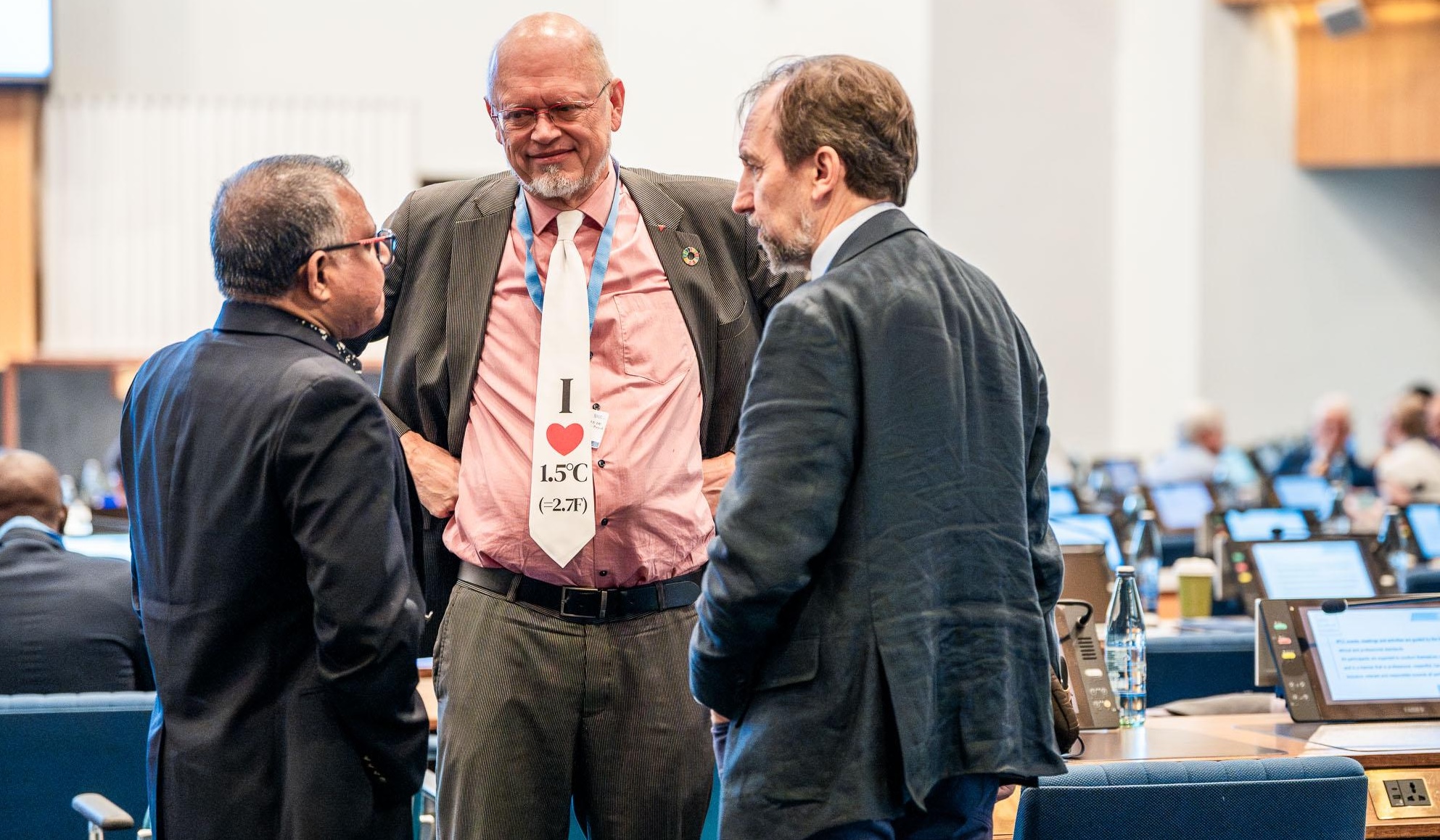
Scientists have vowed to keep working on the next flagship set of reports for the Intergovernmental Panel on Climate Change (IPCC), after a political row over the timeline for their release saw its latest session suspended on Friday evening without agreement.
During the weekend, government officials and scientists alike expressed disappointment over the inability to reach a compromise before some delegates from developing countries and small island states had to leave the week-long meeting in Ethiopia to catch flights home.
The disagreement – which has persisted since early 2024 – turns on whether the three key parts of the AR7 assessment should all be published before the conclusion of the UN’s next Global Stocktake of global climate action, which is due to be completed in late 2028.
The IPCC issued a statement after the close of the session, saying that “key agenda items” – the timelines for the three AR7 reports, as well as the IPCC budget – remain open and under discussion. It said the IPCC’s plenary session and its deliberations on the pending agenda “will resume at the earliest opportunity”, giving no further details of when.
IPCC Chair Jim Skea told delegates in closing remarks that recent months had been some of the most turbulent for the climate science panel and that, if there were stronger words than “profound disappointment” he would use them, according to a summary published by the Earth Negotiators Bulletin (ENB). IPCC discussions happen behind closed doors.
IPCC scientists remained committed
In an open letter, issued on Monday, a group of nearly 120 scientists – from a total of 664 AR7 authors – said they “stand committed to continue working to deliver the AR7 reports in a manner that is rigorous, timely and inclusive, in line with our mandate to be policy-relevant”.
“An assessment that arrives after the decisions it is meant to inform cannot serve its purpose,” they emphasised. “The second Global Stocktake in 2028 is such a decision point, and the world should not have to face it without the IPCCʼs latest assessment.”
Europe, small islands and the least developed countries, plus many Latin American and developed nations, want the IPCC to meet this deadline, arguing that the findings from the UN climate science body are irreplaceable in the UN climate policy-making process.
However, around a dozen developing countries plus Russia have argued that the reports should come later in order to allow for greater research input from the Global South – something that, in their view, would make the findings fairer. They also claim that a shorter timeline would put excessive pressure on experts.
-
Who shapes climate science? The equity question facing the IPCC
Early completion of the next global climate science assessment reports risks excluding research from the Global South, which is key to ensuring the findings are fair -
Governments that support climate science must stand firm against naysayers
The IPCC is meeting to decide the timing of its next major report, as some countries try to delay it and weaken the case for faster emissions cuts


The most vocal of this group at last week’s meeting were India and Saudi Arabia, according to the ENB summary and a developed country diplomat. Critics see this push for a longer timeline as an excuse to deprive government decision-makers of the latest science and ease pressure on emerging economies to raise their ambition, particularly on cutting emissions.
Commenting on last week’s meeting, France’s ambassador for climate negotiations Benoît Faraco said a broad coalition of developed and developing countries from all five continents, “united in their support for science and the timeline proposed by scientists”, had withstood pressure “from a few countries” seeking to slow down the process of adopting the IPCC reports.
He added that France would not back down and would “continue to fight tirelessly for science, protect the integrity of information, and convince our partners that without the best available scientific data, we will be less effective in tackling climate change and protecting our populations”.