Vishal Prasad is director of Pacific Islands Students Fighting Climate Change.
When the International Court of Justice (ICJ) delivered its advisory opinion on climate change last year, it marked a turning point not just for the Pacific, but for international climate law.
The court was unambiguous: states have legal obligations to protect the environment from greenhouse gas emissions, and they face accountability when they fail. For those of us who carried this campaign from a classroom in Vanuatu to Europe and New York, it was a moment of profound validation.
World’s top court opens door to compensation from countries responsible for climate crisis
But we have always said that the advisory opinion was a tool, not an endpoint. The ICJ affirmed what many in the Pacific have been saying for some time. Now we have a legal blueprint, we must carry this momentum from the courtrooms to the negotiating rooms.
Potential to shape climate politics
The advisory opinion has already begun to reshape the climate landscape. At COP30 in Belém, we saw countries that had supported the campaign citing the opinion in their interventions, while those blocking progress were clearly concerned of its implications. Its potential to shape climate politics and policy is significant.
This year we have arrived at the mid-year climate negotiations in Bonn not only with the advisory opinion, but with a UN General Assembly resolution endorsing it. Despite a fierce campaign from the usual suspects, just eight countries, including the USA, Saudi Arabia, Russia and Iran voted against. That is a victory for multilateralism at a moment when multilateralism is under strain.
UN General Assembly backs “climate obligations” set by world’s top court
But we know that advisory opinions alone are not enough. Legal clarity will not automatically translate into reduced emissions, increased finance flows or stronger national climate plans. That translation requires political will in the negotiating rooms, both here in Bonn and all the way through Fiji and finally in Antalya this November.
What the Pacific needs from this negotiating year
The Pacific put significant political capital into the joint Australia-Pacific bid for COP31. It is fair to say that the compromise of Australia holding the role of president of negotiations while the COP is held and presided over by Türkiye is not what we imagined.
But we in the Pacific are used to looking for silver linings. Both Australia and Türkiye have acknowledged the important role the Pacific will have at COP31, through the appointment of Pacific champions and the hosting of a Pacific Pre-COP in Fiji with a leaders event in Tuvalu. These are genuine opportunities to bring the world to our shores and ensure that Pacific issues are front and centre going into the final negotiations.
But we are not naive. Envoy positions and meeting locations are just the architecture of goodwill. We need to see that goodwill converted into concrete negotiating outcomes and finance.
COP31 leaders unveil global targets, with spotlight on electrification
The Pacific helped put Australia’s climate minister Chris Bowen in this important position, so we expect to see Australia advocate not only for us, but to turn a mirror towards itself as one of the world’s biggest fossil fuel exporters.
At Bonn, and then in Antalya, we need ambition on mitigation that reflects the ICJ’s clarity on state obligations and the science. That means action on fossil fuels.
We need climate finance that is new, additional and accessible to the countries that need it most. In the Pacific we have already demonstrated what that looks like.
The Pacific Resilience Facility is the first climate finance facility designed, governed and managed by Pacific people, built specifically to reach the grassroots and community initiatives that larger funds routinely bypass. We need the international community to meet that ambition with contributions that reflect climate justice, starting with pledges to meet the $500-million capitalisation goal.
And we need the oceans – which are the lifeblood of the Pacific and a critical part of the global climate system – treated as a central element of the negotiations rather than a thematic aside.
Energy crisis driven by imported fossil fuels
The days of speaking about climate and fossil fuels purely as a moral issue are long gone. Pacific ministers recently adopted the Tassiriki Call for a Fossil Fuel Free Pacific, in the context of a deepening energy crisis that has triggered states of emergency in several Pacific nations. Our dependence on imported fossil fuels is both a climate and an economic vulnerability.
Conflict in the Middle East is pushing our region into an energy crisis. We are dependent on imported fossil fuels for 80% of our energy needs. My home country of Fiji could see an increased fuel bill of nearly three times our annual healthcare budget.
Comment: COP31 must persuade countries to make fossil fuel transition plans
We need the technical and financial support to transition to 100% renewable energy. Not only because it is what the world owes us for decades of carbon pollution that continue to render parts of our home uninhabitable, damaging ecosystems and culture. But because we must be part of that transition. Fossil fuels have proven to be the greatest source of damage to our climate, and with their volatility, to our sovereignty as well.
What next?
The demands have not changed. Greater action on mitigation, adaptation, finance, loss and damage: these remain the substance of what the Pacific requires from the international community. What has changed is the legal foundation beneath them.
The ICJ has affirmed that these are not requests. They are obligations. The task this year is to make the negotiations reflect that.
The post The Pacific made history in the courts – now we must do it in the negotiations appeared first on Climate Home News.
The Pacific made history in the courts – now we must do it in the negotiations

For the first time, new-energy vehicles (NEVs) made up 67% of new car sales in China in September, according to the latest data from the China Passenger Car Association (CPCA).
The figures show that NEVs, which include battery electric cars and plug-in hybrids, captured a record share of sales, even though fewer were sold than last year.
This is because sales of combustion-engine cars are falling steeply, a trend that the CPCA has attributed to rising petrol prices following the start of the Hormuz crisis.
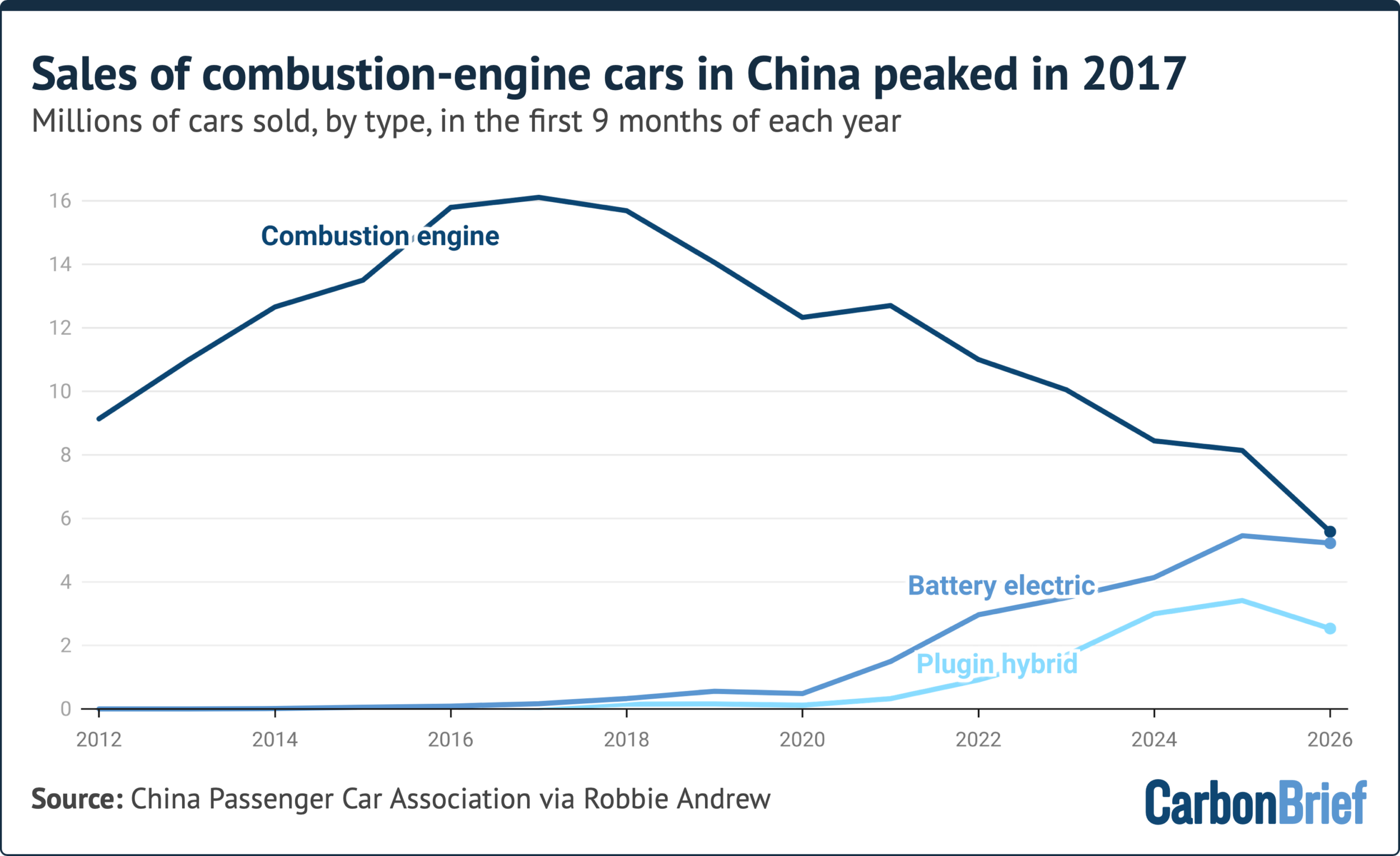
Indeed, sales of fuel-only cars were down 31% year-on-year in the first nine months of 2026, with plug-in hybrid sales down 26% – whereas battery EV sales were only down 4%.
One analyst tells Carbon Brief that China’s rapidly growing EV fleet has offset demand for 143m barrels of oil since the start of the Hormuz crisis.
Another says that the crisis is “reinforcing China’s electrification of road transport”.
Meanwhile, amid slowing domestic sales, Chinese carmakers’ exports of NEVs more than doubled [in 2026 to date / in September] from a year earlier.
NEV record
A record two out of every three cars sold in September in China were NEVs, according to CPCA data, as shown in the figure below.
(NEVs predominantly include battery electric vehicles – BEVs – and plug-in hybrids – PHEVs. BEVs only run on electricity, whereas PHEVs also have a combustion engine.)
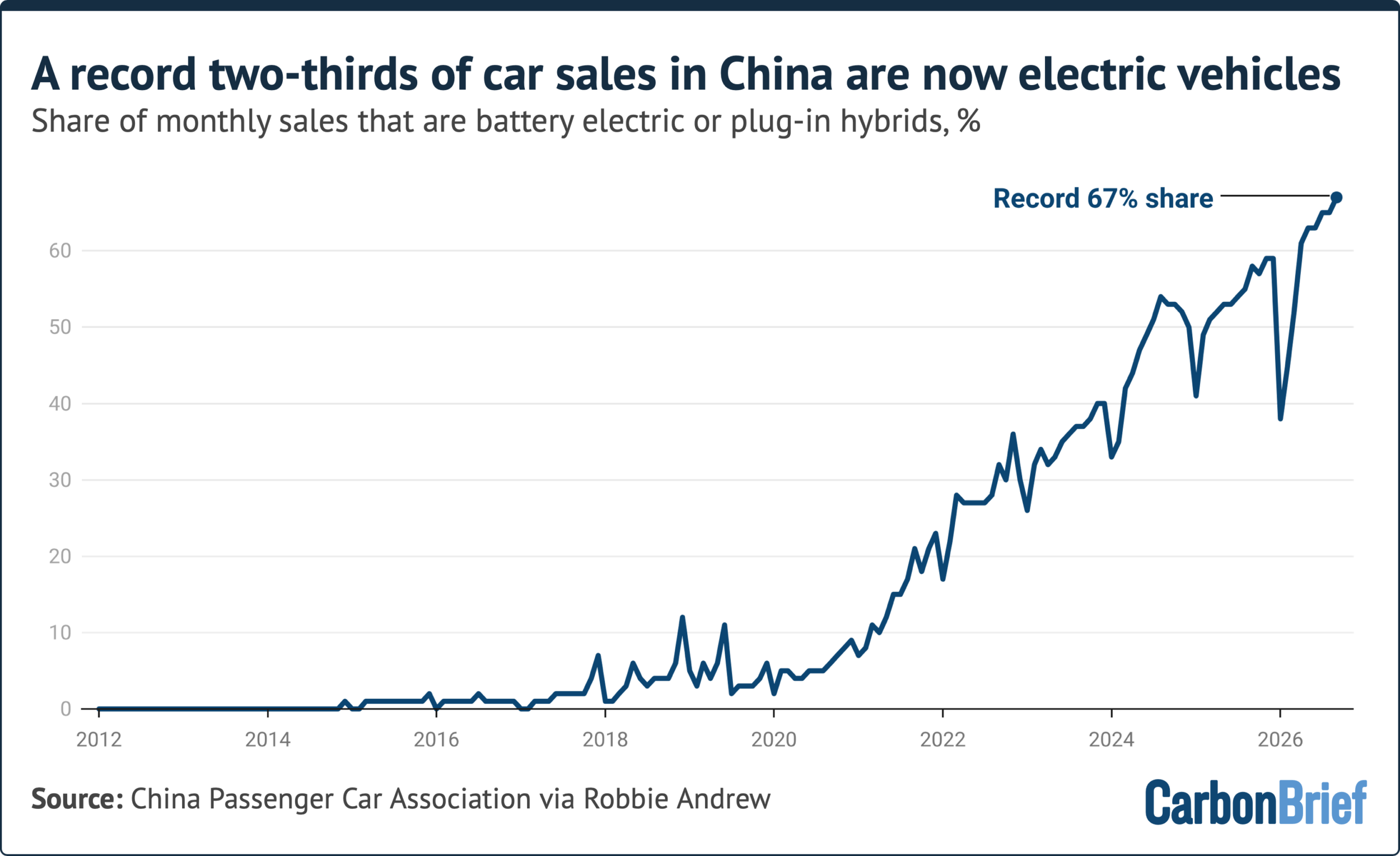
This marks a rapid rise for NEVs from just 6% of new car sales in 2020 up to 58% in 2026 to date – and a record 67% in the month of September.
This year, NEVs’ share of sales has also bounced back from a low of 39% in January, after the full purchase tax exemption that had been in place for more than a decade came to an end in December 2025.
The gain in NEV share in 2026 has come amid a slowdown across the wider domestic passenger-car market, which has hit sales of combustion-engine vehicles particularly hard.
This September, passenger-car retail sales across all categories declined, with overall sales volumes falling 28% year-on-year.
The contraction was led by combustion-engine vehicles, which saw sales fall 43% year-on-year in September and 31% in 2026 to date.
However, sales of PHEVs also fell by 36% year-on-year in September and by 26% in 2026 to date. By comparison, BEVs performed better, although sales still declined 8.5% from a year earlier in September and 4% in 2026 to date.
As a result, NEV sales overall fell by 17% in September and 13% in 2026 to date.
While the market changes in 2026 to date were particularly dramatic, they reflect a broad continuation of trends seen over the past decade.
Indeed, sales of combustion-engine cars in China peaked in 2017 and they have been declining ever since, shown in the figure below.
Impact of Hormuz
Part of the reason for the advance of NEVs in 2026, said Chinese technology news outlet OFweek, was petrol cars “giving up market share” as they were outperformed by electric alternatives.
Cui Dongshu, secretary-general of the CPCA, cited higher petrol prices as an explanation for September’s weak combustion-car sales, in comments to financial news outlet National Business Daily.
Imports of oil into China in January-September have fallen 15% compared to 2025, equivalent to 470m barrels, as ongoing conflict tightened supply and drove up prices.
China’s passenger-car NEV fleet has displaced 143m barrels of oil so far during the strait of Hormuz crisis, Euan Graham, senior energy analyst at thinktank Ember, tells Carbon Brief.
EVs “accounted for 12% of the decrease in China’s oil use post-Hormuz”, according to an estimate provided to thinktank the Brookings Institute by an unnamed analyst.
Erica Downs, a senior research scholar at Columbia University’s Center on Global Energy Policy, tells Carbon Brief that the strait of Hormuz crisis and higher oil prices are “reinforcing China’s electrification of road transport”.
She says the “world’s largest oil supply disruption” vindicates China’s early bet on EVs, which was partly driven by concerns about oil-supply security.
NEV demand down
Nevertheless, NEV sales have fallen year-on-year, albeit at a slower rate than overall car sales. The growth in NEV market share has also been decelerating.
Zhang Yichao, a partner at consulting firm AlixPartners, tells Carbon Brief that NEVs benefit from government trade-in policies and a “strong pipeline” of new models, particularly those involving innovation.
He says these factors help explain why NEVs sales have fallen at a slower rate to their combustion-car counterparts.
Cui told the state-run China National Radio that the fall for NEVs and for cars overall in September 2026, is also due to a high baseline of sales from the same month in 2025, as well as changes to trade-in policies and disruptions from the holiday period.
Other factors, says consulting firm Wood Mackenzie, are the weakened demand due to “demand pull-forward” in 2025 caused by the end of subsidies, as well as “tighter financing conditions”.
Zhang tells Carbon Brief he does not “see much more room ahead” for further growth in NEVs’ market share.
He adds that, in his view, their share in China is unlikely to exceed 80%, as some premium-market segments and specific use cases will continue to require combustion-engine vehicles.
Exports surge
Meanwhile, while domestic NEV retail sales fell 17% in September 2026, exports more than doubled, increasing 164% year-on-year, according to the CPCA.
This extends the decline in domestic sales and very strong growth in exports seen across 2026 to date, as shown in the figure below.
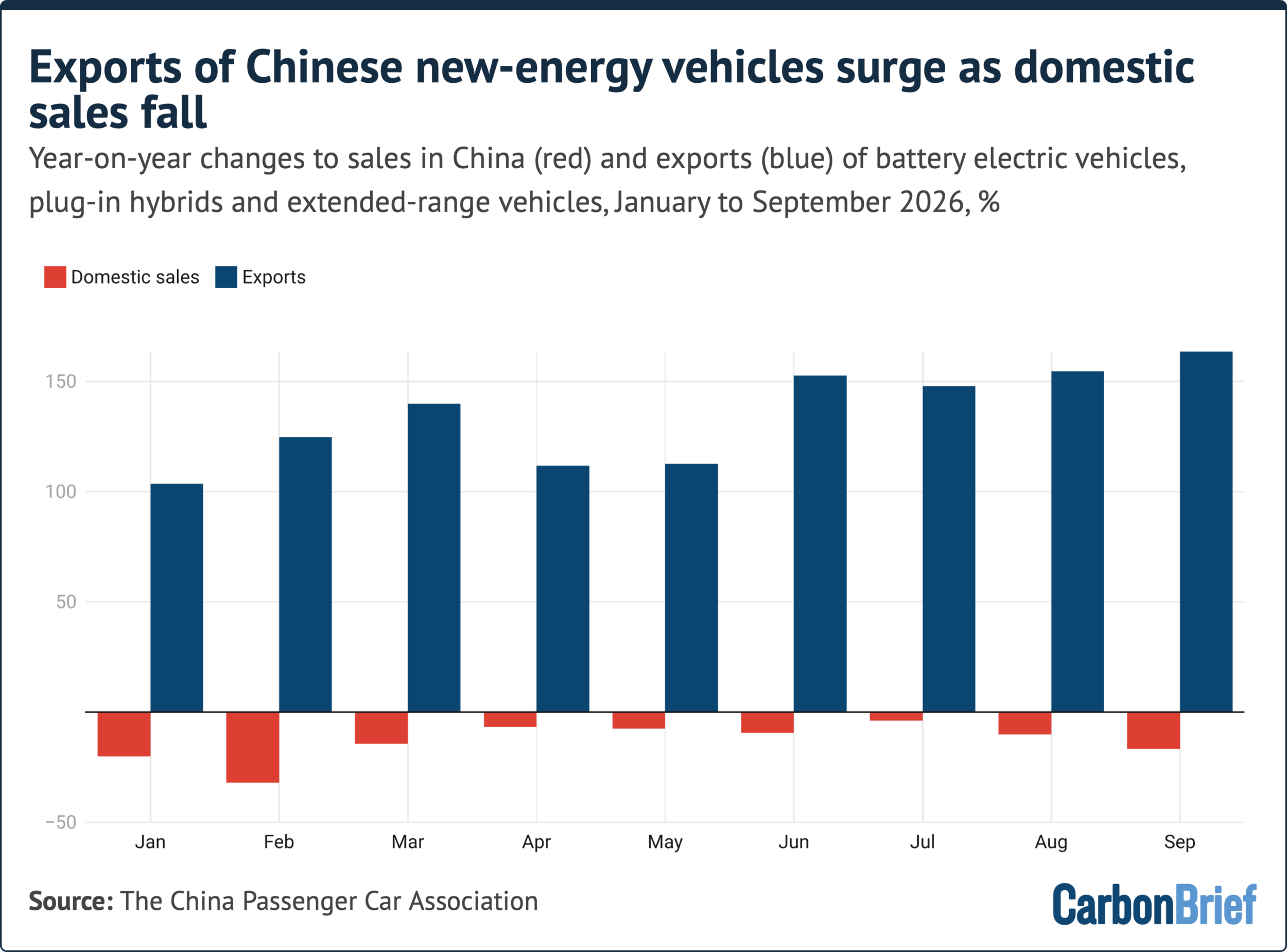
In September, 1,084,000 NEVs were sold domestically in China, while 558,000 NEVs were exported.
Exports are becoming increasingly important to Chinese carmakers, in the face of weaker domestic demand and cut-throat industrial competition.
The CPCA says exports have become “a core priority” for some carmakers.
However, the surge in exports from China has created concern in the EU, which has placed tariffs on imports of EVs from China and recently agreed plans to cut imports of hybrids.
Countries including Mexico and Turkey have also placed tariffs on Chinese EV imports.
At the same time, the Chinese government is putting policies in place that might be expected to disincentivise exports, such as cutting VAT export rebates.
Analysts differ on what impact this policy shift will have, with some saying it will be limited, while others believe it could cause the price of exported cars to rise.