France has approved a major new energy law that cuts back renewable energy targets and strengthens support for nuclear power. The law was passed by decree on 13 February 2026 after nearly three years of political debate.
The law is part of France’s Multiannual Energy Programming (PPE), a 10-year framework that guides energy policy through 2035. It sets long-term goals for how power is produced, with revised targets for wind, solar, and nuclear energy.
French Finance Minister Roland Lescure said the changes reflect slower electricity demand growth than expected and the government’s desire for a stable energy mix. He also said nuclear power remains the “backbone” of France’s electricity system, while adding:
“We need to stop our internal family squabbling. We need both nuclear and renewables.”
The new law marks a significant shift in French energy policy. It alters renewable goals that were set to help cut emissions and diversify power sources.
Wind and Solar Ambitions Dialed Down
However, the new regulation lowers France’s wind and solar capacity goals for 2035. Previously, draft plans set higher targets for renewable capacity, but under the new law, the goals dropped.
- Wind and solar combined (draft): 133–163 GW by 2035.
- Wind and solar (new law): 105–135 GW installed capacity by 2035.
The law also adjusts specific sub-targets:
-
Offshore wind: reduced to 15 GW by 2035 (from 18 GW).
The reduction aims to show slower growth in electricity demand. It also addresses challenges in permitting and grid integration in France and the wider EU.
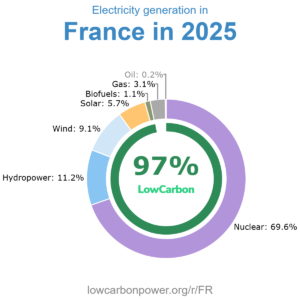
France’s wind and solar power deployment has been slower than in some neighbouring countries. Recent energy plans show that renewables made up about 14.6% of France’s electricity mix. Wind and solar still lag behind nuclear and hydro power.
Critics say that while renewable energy is growing, the new targets might slow down carbon cuts. They worry it could also make investors less confident in wind and solar projects.
Nuclear Reasserted as the Backbone
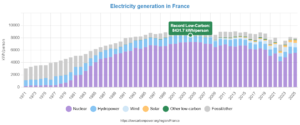
France’s low-carbon electricity history centers on nuclear power. In the 1980s, nuclear output grew quickly as new reactors came online. Growth slowed in the 1990s and early 2000s and after 2009, production declined.
Output later recovered, with gains of more than 25 TWh in 2021 and over 40 TWh in 2023 and 2024. Nuclear remains central to France’s low-carbon power system, again.
The new energy law lets state-run utility Électricité de France (EDF) keep 14 nuclear reactors open. This requirement was part of earlier commitments and had been controversial.
Instead, the framework reinforces nuclear’s role in the energy mix. It also sets a goal for net production of 650–693 terawatt-hours (TWh) of decarbonized electricity by 2035, compared with about 540 TWh today.
EDF currently operates a fleet of 57 nuclear reactors, which supply roughly 65% of France’s electricity — one of the highest nuclear shares in the world. The law also foresees the construction of at least six new nuclear reactors, with the first expected to be inaugurated around 2038.
EDF welcomed the revision and said the law would help the company focus on its output goals and long-term planning.
Support for nuclear power reflects a broader policy shift. France has long relied on nuclear energy for low-carbon generation, and policymakers view it as vital for energy security and independence.
Rebalancing the Power Mix for 2035
The new law reshapes France’s energy mix. It places greater emphasis on nuclear while easing pressure on the rollout of renewables.
The revised framework aims to balance supply security, carbon goals, and economic considerations. Slower electricity demand growth is one reason officials cited for the policy shift.
France is also planning to increase the share of electricity in overall energy consumption to 60% by 2030, up from around 30% today. This goal reflects efforts to electrify transport, buildings, and industry as part of broader decarbonization strategies.
However, renewable energy growth has not kept pace with previous plans. France has reduced its wind and solar capacity targets. Some projects are also facing delays due to regulations and grid issues.
Hydroelectric power is a key renewable source in France, but wind and solar are becoming more important. The country aims to cut fossil fuel use and meet EU renewable goals.
A Divisive Shift in the Energy Transition
The energy law triggered a heated debate among legislators. Some lawmakers criticised the reduction in renewables targets as a step backward for the energy transition.
Marine Le Pen, leader of the far-right National Rally party, urged lawmakers to submit a no-confidence motion in response to the law. She argued that lowered targets could harm French industry and agriculture.
Environmental groups also voiced concern. Greenpeace France stated:
“If this PPE is more than two years late on paper, it’s at least a decade behind in its vision of an energy transition.”
Industry groups, including wind and solar developers, had mixed reactions. Some welcomed the clarity provided by the law after years of uncertainty, while others cautioned that investment could slow without stronger renewable goals.
The debate reflects broader tensions in France between emissions reduction goals and economic and security considerations. The law tries to balance these priorities in the face of fiscal pressures and geopolitical uncertainties.
EDF at the Center of France’s Power Strategy
EDF plays a central role in France’s electricity system. The utility’s large nuclear fleet is critical for providing low-carbon base power. The company is also expanding its renewable business. It runs hydroelectric plants and is involved in wind and solar projects domestically and abroad.
However, abundant wind and solar power across Europe has pressured wholesale power prices, reducing revenue for nuclear plants that operate best at higher price levels. The new law seeks to ease some of this pressure by rebalancing targets and supporting nuclear output.
EDF is also working on modernising its fleet. In recent years, it secured financing to extend the life of its older reactors and to pursue small modular reactor (SMR) technologies for future deployment.
The utility’s path forward will involve managing a complex energy mix that includes nuclear, renewables, hydroelectric, and other clean sources. Meeting climate goals while ensuring reliable, affordable power remains a key challenge.
The Road to 2035: Implementation and Impact
France’s new energy law sets the course for the next decade. It guides energy planning through 2035 under the PPE framework.
The law aligns nuclear and renewable policy with expected demand and economic conditions. It seeks to stabilise the power market and support key utilities like EDF.
Energy markets, investors, and grid operators will be watching how capacity targets unfold and how demand patterns evolve. France’s approach may influence broader EU energy policy debates, especially around balancing nuclear with renewable goals in the transition to net zero.
The post France Shocks Energy Sector and Rewrites Energy Future: New Law Boosts Nuclear, Cuts Renewables appeared first on Carbon Credits.
Carbon Footprint
Carbon credit project stewardship: what happens after credit issuance
A carbon credit purchase is not a transaction that closes at issuance. The credit may be retired, the certificate filed, and the reporting box ticked. But on the ground, in the forest, in the field, and in the community, the work continues. It endures for years. In many cases, for decades.
![]()
Carbon Footprint
Industries with the biggest nature footprints and what their decarbonisation looks like
A corporate carbon footprint is never just an accounting figure. It maps onto real ecosystems. Before a product leaves the factory gate, something on the ground has already paid the cost. A forest has been converted. A river has been depleted. A patch of savannah that was once home to dozens of species now grows a single crop in every direction.
![]()
Carbon Footprint
Apple, Amazon Lead 60+ Firms to Ease Global Carbon Reporting Rules
More than 60 global companies, including Apple, Amazon, BYD, Salesforce, Mars, and Schneider Electric, are pushing back against proposed changes to global emissions reporting rules. The group is calling for more flexibility under the Greenhouse Gas Protocol (GHG Protocol), the most widely used framework for measuring corporate carbon footprints.
The companies submitted a joint statement asking that new requirements, especially those affecting Scope 2 emissions, remain optional rather than mandatory. Their letter stated:
“To drive critical climate progress, it’s imperative that we get this revision right. We strongly urge the GHGP to improve upon the existing guidance, but not stymie critical electricity decarbonization investments by mandating a change that fundamentally threatens participation in this voluntary market, which acts as the linchpin in decarbonization across nearly all sectors of the economy. The revised guidance must encourage more clean energy procurement and enable more impactful corporate action, not unintentionally discourage it.”
The debate comes at a critical time. Corporate climate disclosures now influence trillions of dollars in capital flows, while stricter reporting rules are being introduced across major economies.
The Rulebook for Carbon: What the GHG Protocol Is and Why It’s Being Updated
The Greenhouse Gas Protocol is the world’s most widely used system for measuring corporate emissions. It is used by over 90% of companies that report greenhouse gas data globally, making it the foundation of most climate disclosures.
It divides emissions into three categories:
- Scope 1: Direct emissions from operations
- Scope 2: Emissions from purchased electricity
- Scope 3: Emissions across the value chain

The current Scope 2 rules were introduced in 2015, but energy markets have changed since then. Renewable energy has expanded, and companies now play a major role in funding clean power.
Corporate buyers have already supported more than 100 gigawatts (GW) of renewable energy capacity globally through voluntary purchases. This shows how influential the current system has been.
The GHG Protocol is now updating its rules to improve accuracy and transparency. The revision process includes input from more than 45 experts across industry, government, and academia, reflecting its global importance.
Scope 2 Shake-Up: The Battle Over Real-Time Carbon Tracking
The proposed update would shift how companies report electricity emissions. Instead of using flexible systems like renewable energy certificates (RECs), companies would need to match their electricity use with clean energy that is:
- Generated at the same time, and
- Located in the same grid region.
This is known as “24/7” or hourly or real-time matching. It aims to reflect the actual impact of electricity use on the grid. Companies, including Apple and Amazon, say this shift could create challenges.

According to industry feedback, stricter rules could raise energy costs and limit access to renewable energy in some regions. It can also slow corporate investment in new clean energy projects.
The concern is that many markets do not yet have enough renewable supply for real-time matching. Infrastructure for tracking hourly emissions is also still developing.
This creates a key tension. The new rules could improve accuracy and reduce greenwashing. But they may also make it harder for companies to scale clean energy quickly.
The outcome will shape how companies measure emissions, invest in renewables, and meet net-zero targets in the years ahead.
Why More Than 60 Companies Oppose the Changes
The companies argue that stricter rules could slow climate progress rather than accelerate it. Their main concern is cost and feasibility. Many regions still lack enough renewable energy to support real-time matching. For global companies, aligning energy use across different grids is complex.
In their joint statement, the group warned that mandatory changes could:
- Increase electricity prices,
- Reduce participation in voluntary clean energy markets, and
- Slow investment in renewable energy projects.
They argue that current market-based systems, such as RECs, have helped scale clean energy quickly over the past decade. Removing flexibility could weaken that momentum.
This reflects a broader tension between accuracy and scalability in climate reporting.
Big Tech Pushback: Apple and Amazon’s Climate Progress
Despite their push for flexibility, both companies have made measurable progress on emissions reduction.
Apple reports that it has reduced its total greenhouse gas emissions by more than 60% compared to 2015 levels, even as revenue grew significantly. The company is targeting carbon neutrality across its entire value chain by 2030. It also reported that supplier renewable energy use helped avoid over 26 million metric tons of CO₂ emissions in 2025 alone.

In addition, about 30% of materials used in Apple products in 2025 were recycled, showing a shift toward circular manufacturing.
Amazon has also set a net-zero target for 2040 under its Climate Pledge. The company is one of the world’s largest corporate buyers of renewable energy and continues to invest heavily in clean power, logistics electrification, and low-carbon infrastructure.

Both companies argue that flexible accounting frameworks have supported these investments at scale.
The Bigger Challenge: Scope 3 and Digital Emissions
The debate over Scope 2 reporting is only part of a larger issue. For most large companies, Scope 3 emissions account for more than 70% of total emissions. These include supply chains, product use, and outsourced services.
In the technology sector, emissions are rising due to:
- Data centers,
- Cloud computing, and
- Artificial intelligence workloads.
Global data centers already consume about 415–460 terawatt-hours (TWh) of electricity per year, equal to roughly 1.5%–2% of global power demand. This figure is expected to increase sharply. The International Energy Agency estimates that data center electricity demand could double by 2030, driven largely by AI.
This creates a major reporting challenge. Even with cleaner electricity, total emissions can rise as digital demand grows.
Climate Reporting Rules Are Tightening Globally
The pushback comes as climate disclosure requirements are expanding and becoming more standardized across major economies. What was once voluntary ESG reporting is steadily shifting toward mandatory, audit-ready climate transparency.
In the European Union, the Corporate Sustainability Reporting Directive (CSRD) is now active. It requires large companies and, later, listed SMEs, to share detailed sustainability data. This data must match the European Sustainability Reporting Standards (ESRS). This includes granular reporting on emissions across Scope 1, 2, and increasingly Scope 3 value chains.
In the United States, the Securities and Exchange Commission (SEC) aims for mandatory climate-related disclosures for public companies. This includes governance, risk exposure, and emissions reporting. However, some parts of the rule face legal and political scrutiny.
The United Kingdom has included climate disclosure through TCFD requirements. Now, it is moving toward ISSB-based global standards to make comparisons easier. Similarly, Canada is progressing with ISSB-aligned mandatory reporting frameworks for large public issuers.
In Asia, momentum is also accelerating. Japan is introducing the Sustainability Standards Board of Japan (SSBJ) rules that match ISSB standards. Meanwhile, China is tightening ESG disclosure rules for listed companies through updates from its securities regulators. Singapore has also mandated climate reporting for listed companies, with phased Scope 3 expansion.
A clear trend is forming across jurisdictions: climate disclosure is aligning with ISSB global standards. There’s a growing focus on assurance, comparability, and transparency in value-chain emissions.
This regulatory tightening raises the bar significantly for corporations. The challenge is clear. Companies must:
- Align with multiple evolving disclosure regimes,
- Ensure emissions data is verifiable and auditable, and
- Expand reporting across complex global supply chains.
Balancing operational growth with compliance is becoming increasingly complex as climate regulation converges and intensifies worldwide.
A Turning Point for Global Carbon Accounting
The outcome of this debate could shape global carbon accounting standards for years.
If stricter rules are adopted, emissions reporting will become more precise. This could improve transparency and reduce greenwashing risks. However, it may also increase compliance costs and limit flexibility.
If the proposed changes remain optional, companies may continue using current accounting methods. This could support faster clean energy investment, but may leave gaps in reporting accuracy.
The new rules could take effect as early as next year, making this a near-term decision for global companies.
The push by Apple, Amazon, and other companies highlights a key tension in climate strategy. On one side is the need for accurate, real-time emissions reporting. On the other is the need for flexible systems that support large-scale clean energy investment.
As digital infrastructure expands and energy demand rises, how emissions are measured will matter as much as how they are reduced. The next phase of climate action will depend not just on targets—but on the systems used to track them.
The post Apple, Amazon Lead 60+ Firms to Ease Global Carbon Reporting Rules appeared first on Carbon Credits.
-
Climate Change9 months ago
Guest post: Why China is still building new coal – and when it might stop
-
Greenhouse Gases9 months ago
Guest post: Why China is still building new coal – and when it might stop
-
Greenhouse Gases2 years ago嘉宾来稿:满足中国增长的用电需求 光伏加储能“比新建煤电更实惠”
-

Climate Change2 years ago嘉宾来稿:满足中国增长的用电需求 光伏加储能“比新建煤电更实惠”
-
Climate Change2 years ago
Bill Discounting Climate Change in Florida’s Energy Policy Awaits DeSantis’ Approval
-
Renewable Energy7 months agoSending Progressive Philanthropist George Soros to Prison?
-
Carbon Footprint2 years agoUS SEC’s Climate Disclosure Rules Spur Renewed Interest in Carbon Credits
-
Greenhouse Gases10 months ago
嘉宾来稿:探究火山喷发如何影响气候预测


