

French citizens will go to the polls for two rounds of voting on 30 June and 7 July to elect deputies to the national assembly.
Following the results of the European parliamentary elections earlier in June, French president Emmanuel Macron called a snap election. (He himself is not up for reelection until 2027.)
Macron’s centrists had suffered a “crushing defeat”, securing just 15% of the vote, less than half the tally for Marine Le Pen’s far-right National Rally (Rassemblement National or RN).
Subsequently, the president took what he described as the “serious” and “heavy” decision to dissolve the country’s national assembly as an “act of confidence” in the French people.
Candidates had until 16 June to register for the 577 seats in the lower house of the national assembly, with campaigning then officially starting on Monday 17 June – just 13 days before the first round of voting is set to take place.
Under France’s electoral system, candidates who obtain at least 12.5% of total registered votes during the first round will advance to the second round of voting. Candidates who then get the most votes during the second round will be elected as deputies (members of parliament).
Macron will then have to appoint a prime minister, taking into account the results of the elections.
In the interactive grid below, Carbon Brief tracks the commitments made by each of the main party alliances in their election manifestos, across a range of issues related to climate and energy. The parties covered are:
- The New Popular Front (Le Nouveau Front Populaire or NFP): a coalition of four of France’s leftwing parties, the Socialist party (PS), Greens, Communists and France Unbowed (LFI).
- Together (Ensemble): a coalition of France’s ruling Renaissance party and other centrist parties, led by current French prime minister, Gabriel Attal.
- National Rally (Rassemblement National or RN): Marine Le Pen’s far-right party. Leading the campaign is Jordan Bardella, who is likely to take the job of PM if the RN win.
Each entry in the grid represents a direct quote from one of these documents.
Approach to net-zero
Climate change and net-zero are not expected to be a key focus in the French election, as perceived opposition to green policies has grown over the past year in Europe.
The election follows significant losses for the French Green party in the European Parliament elections, which contributed to fears that the swing towards rightwing parties could lead to a weakening of climate ambition in the country.
France’s main Green party, EELV, saw its share of votes fall from 13% to 5% in the European parliamentary elections, while RN increased its share of votes from 23.34% to 31.4%.
RN has previously called the EU Green Deal a tool of “punitive ecology” and has pledged to dismantle it, Clean Energy Wire notes. If it gains a majority in the upcoming election, it could “unravel progress in the energy and climate policies of the EU’s second largest economy and weaken ambitions at a critical point in time”, the outlet adds.
The party uses similar language in its election manifesto, which does not mention climate or net-zero directly. It argues that environmental standards penalise economic growth.
The RN manifesto pledges to “develop a common-sense ecology, based on scientific realities, that protects the standard of living of French people and guarantees our national independence”.
The NFP pledges to “implement a climate plan aiming for carbon neutrality by 2050”. Ensemble targets reducing greenhouse gas emissions by 55% compared to 1990 levels by 2030 – in line with the EU target set out in the Green New Deal.
France – the second most populous country in the EU, with around 67 million inhabitants – was the world’s 25th largest greenhouse gas emitter in 2018. (See Carbon Brief’s France profile for more.)
Both NFP and Ensemble recognise the threat of climate change in their manifestos, with the latter citing ecology as one of the “challenges of a generation” facing the country.
The main issues in the French election are expected to be retirement, energy bills and immigration.
(NFP’s manifesto does note that migration has a climate angle and includes an aim to “create a status for climate displaced people”. For more on migration and climate change, see Carbon Brief’s in-depth Q&A.)
Energy bills and security
The energy crisis in recent years, driven by surges in gas prices following the Russian invasion of Ukraine – but amplified in France by significant nuclear outages – has made energy security a key election concern.
Until recently, the French government had owned a 84% stake in national electricity firm and nuclear plant operator EDF. However, in July the country’s then-prime minister, Élisabeth Borne, announced plans to renationalise EDF within her first state-of-the-nation speech as concern about energy prices and security soared.
“We must have full control over our electricity production and performance. We must ensure our sovereignty in the face of the consequences of the war and the colossal challenges to come…That’s why I confirm to you the state’s intention to own 100% of EDF’s capital,” said Borne, a member of Macron’s party Renaissance.
The decision was seen as an attempt to garner cross-party support, given the left had called for the nationalisation of EDF previously and Macron’s centrist Ensemble supported expanding nuclear power.
Ensemble has reiterated its support for nuclear in its manifesto, pledging to build eight new reactors “to ensure France’s energy independence and move towards a carbon-free economy”.
It notes that the construction will be accelerated due to a law passed in May 2023, which followed a similar piece of legislation aimed at speeding up the rollout of renewable energy.
NFP focuses more explicitly on renewables, with minimal mention of nuclear power in its manifesto. It pledges to make France a European leader in marine energy, in particular offshore wind and the development of tidal energy.
Beyond this, it focuses on energy bills, including pledging to scrap Macron’s 10% tax on energy bills – an increase in excise duty on electricity called Contribution to Electricity Public Services (CSPE) – and cancel the planned increase in gas prices of 11% on 1 July.
While French consumers were protected from some of the biggest price spikes between 2021 and 2023 by the government’s “energy tariff shield”, the subsequent removal of this, as well as high inflation, is pushing up energy bills.
All three party groupings include some focus on bills, with Ensemble promising a reduction in electricity bills of 15% due to reform of the European electricity market.
Meanwhile RN pledges to exit European rules that “set energy prices and weaken our competitiveness”. This echos the party’s pledge during the 2019 presidential election that it would exit the European electricity market “to restore decent prices”. It adds:
“The attractive costs and reliability offered by our electricity system are a thing of the past, and the government is making the French pay for its misguidance on nuclear issues and on the disastrous rules of the European energy market.”
RN plans to lower VAT on all energy products, again echoing a pledge from 2019 to drop VAT levels for fuel, energy, electricity, gas and heating oil, from 20% to 5.5%, labelling them as basic necessities.
Other climate policies
Beyond energy, there is limited focus on climate related issues within the manifestos.
NFP pledges to develop industry to end France and Europe’s dependence on international markets for strategic sectors such as electric cars and solar panels. Ensemble also argues it will expand industry, pledging to create 200,000 industrial jobs and 400 additional factories by 2027.
All three party groupings pledge increased support for the agricultural sector, with NFP stating it will ban imports that do not respect France’s environmental standards, Ensemble saying it will boost prices for farmers and RN promising farmers prices that “respect their work”, amongst other pledges.
This follows protests by French farmers at the beginning of the year, partly over plans to reduce agricultural fuel subsidies. Similar protests took place across Europe, which were often framed as a “net-zero revolt” in some parts of the media.


The post France election 2024: What the manifestos say on energy and climate appeared first on Carbon Brief.
France election 2024: What the manifestos say on energy and climate

Continue Reading
Three countries have been named by the Paris Agreement’s compliance committee for failing to submit a nationally determined contribution (NDC) and repeatedly snubbing offers of help with their climate plans.
After months of internal debate over whether to identify serial non-responders, the Paris Agreement’s Implementation and Compliance Committee (PAICC) named the three countries which have failed to engage with it over their NDCs on Friday.
It named Democratic Republic of Congo, Senegal and North Korea in a footnote of its annual report, adding that it decided to name them “with a view to facilitating engagement”, adding that representatives of the three nations had been invited to its meeting in early 2027 “with the purpose of identifying any challenges and constraints”.
“The Committee noted the importance of Parties engaging with the Committee in a timely manner, while noting that some delays may be due to the national capabilities and circumstances of the Parties”, the report said.
-
Under US pressure, World Bank says it will back gas “where appropriate”
The US wants the World Bank to expand its gas support while climate campaigners are pushing for it to end – its head spoke this week of limited backing for the fossil fuel -
IPCC scientists vow to press on with climate reports despite political deadlock
After governments again failed to agree a timeline, nearly 120 IPCC authors pledged to complete their assessment on time and with full scientific rigour -
Paris Agreement committee snubbed over missing NDC climate plans
Many governments have still not submitted a nationally determined contribution to the UN, breaching a key requirement of the Paris Agreement

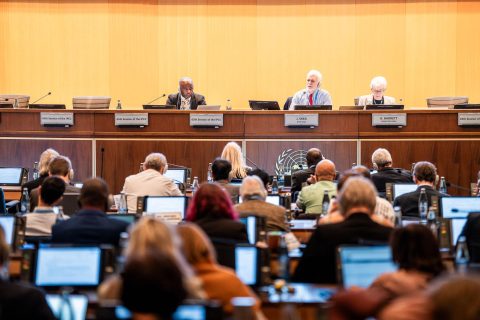

In July, PAICC said 12 countries had ignored its repeated attempts to discuss why they had not published an NDC as required every five years under the 2015 Paris accord.
Members of the committee had been divided over whether to name them, but at a September meeting decided to do so in their annual report to the annual climate COP summit.
By the time the report was published on Friday, only Congo, Senegal and North Korea “had not communicated an NDC or submitted a [Biennial Transparency Report] and had not yet responded to any of the Committee’s notifications, despite several reminders issued by the Committee in this regard”.
Rainforest and renewable energy ambitions
The silence from Congo and Senegal is notable because the former is home to much of the Congo Basin rainforest while the latter has sought billions of dollars in climate finance to support its renewable energy ambitions.
After Brazil, Congo has more rainforest than any country in the world. This forest, and the country’s peatlands, absorb huge amounts of greenhouse gas but are fast being lost to expanding farmland, charcoal production, logging and mining.
Senegal signed a Just Energy Transition Partnership with Canada and wealthy European nations in 2023, to help it meet its renewable energy targets under the-then government of Macky Sall. It was chair of the Least Developed Countries group between January 2022 and December 2023.

Tejas Rao, who is researching the PAICC as part of a doctoral thesis at Cambridge University, said the governments of the three countries should engage with the committee.
“Engagement costs these governments very little and the committee has shown it will listen,” he said.
“Silence leaves the committee with no basis to help, and it leaves the [governments] exposed to the narrative that they are simply disengaged,” he told Climate Home News.
Paris Agreement requirement
The 2015 Paris Agreement requires all parties to publish an NDC every five years outlining their emissions reduction targets, with each plan meant to be more ambitious than the country’s last NDC.
The latest set – the third round of plans, with new targets for 2035 – was due in February 2025. While most countries missed this deadline, all but around 30 – mostly small emitters but including Egypt, Vietnam and Argentina – have now submitted them.
Over the year, the PAICC – which is made up of government climate officials from developed and developing countries – has been communicating with governments that have not submitted NDCs and trying to overcome barriers to them doing so.
Some nations have cited exceptional circumstances as the reason for not submitting an NDC, a process that requires a significant amount of work in tracking emissions and consulting on how to curb them across the economy. For example, a letter from a Sudanese official to the PAICC, seen by Climate Home News, said that the country’s civil war had led to the suspension of its NDC preparation.
-
IPCC scientists vow to press on with climate reports despite political deadlock
After governments again failed to agree a timeline, nearly 120 IPCC authors pledged to complete their assessment on time and with full scientific rigour -
Under US pressure, World Bank says it will back gas “where appropriate”
The US wants the World Bank to expand its gas support while climate campaigners are pushing for it to end – its head spoke this week of limited backing for the fossil fuel -
Who shapes climate science? The equity question facing the IPCC
Early completion of the next global climate science assessment reports risks excluding research from the Global South, which is key to ensuring the findings are fair
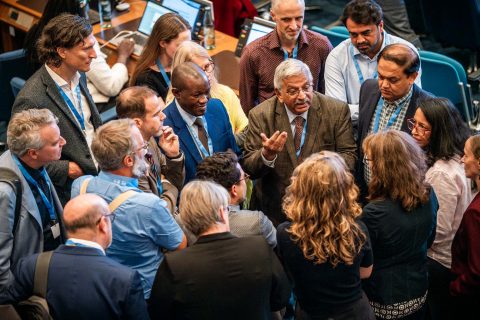
The US and Iran are not signed up to the Paris Agreement and so do not have active NDCs, nor does Taiwan, which is not a UN member state.
Rao said that because the PAICC is “facilitative and non-punitive”, naming the countries “is meant to open a door, not close one – the invited consultation is the point”.
“In recent months, governments that explained their constraints, whether capacity, finance or domestic process, have been met with follow-up and support rather than sanction, and the number of silent governments has fallen sharply,” Rao said.
The post Paris Agreement committee names three countries snubbing it over NDCs appeared first on Climate Home News.
Paris Agreement committee names three countries snubbing it over NDCs