

Research on climate change in urban areas is skewed towards large, well-established cities in the global north, according to analysis of more than 50,000 studies.
The research, published in Nature Cities, uses keyword searching and machine-learning methods to produce a database of studies on climate change and cities published over 1990-2022.
The authors find that small, fast-growing cities – especially in Africa and Asia – are underrepresented in their database.
“While cities like London, New York and Berlin are extensively studied, fast-growing cities such as Goma (Democratic Republic of the Congo), Surat (India) and Huế (Vietnam) are barely visible in the literature,” one study author tells Carbon Brief.
Inhabitants of these cities have collectively contributed very little to global greenhouse gas emissions, but face the greatest impacts from the warming planet, the authors say.
The paper finds that literature on climate change and cities is growing “exponentially”, with 84% of studies on this topic published over 2012-22.
The new analysis is published as scientists from around the world start work on the Intergovernmental Panel on Climate Change (IPCC) special report on climate change and cities, which is due for publication in March 2027.
The study finds that, in its most recent set of headline reports, the IPCC captured “only” 5% of the total available literature on climate change and cities.
One study author tells Carbon Brief that the study is a “call to action” for the IPCC and broader research community “to synthesise more, to look beyond familiar places and to take seriously the diversity of urban realities that will define the future of climate mitigation and adaptation”.
Climate change and cities
More than half of the world’s population live in cities. These densely populated areas are responsible for the majority of global emissions and are also hotspots for climate extremes, including heatwaves and flooding.
Research about climate change and cities is a fast-growing field that encompasses, among other topics, the impacts of climate change on city infrastructure, adaptation measures that city-dwellers are taking and technological measures to limit emissions from cities.
The IPCC’s upcoming assessment report will feature its biggest overview of research on cities to date, as the organisation has commissioned a special report on climate change and cities as part of its upcoming assessment cycle. The report’s outline has already been agreed and the final document is scheduled for publication in March 2027.
However, the new study argues that, without a dedicated effort to “pre-aggregate the underlying literature by the entire research community”, the IPCC “may struggle to deliver a balanced and comprehensive review”.
The new analysis is the “first global stocktake of literature” on climate change and cities, according to a press release from the University of Sussex. The research was produced in-part to help advise the authors of the IPCC report about the current landscape of literature on climate change and cities, the study authors tell Carbon Brief.
Author Dr Tim Repke is a researcher at the Potsdam Institute for Climate Impact Research. He tells Carbon Brief that he hopes that the new study “can serve as a starting point of searchable, clean data” to help the authors of the upcoming IPCC special report to “do their work more efficiently”.
A growing field
The amount of literature on climate change in cities is “much larger than previously estimated”, the paper says.
Moreover, the analysis points to “rapid, exponential growth” in literature on climate change and cities over the past three decades.
The graph below shows the number of studies about climate change and cities published each year over 1990-2022 (dark blue) and the subset of studies that focus on specific city case studies (light blue).
The plot also shows how many studies were published during the writing periods of each IPCC assessment report. For example, 37,539 studies on climate change and cities were published in time to feature in the IPCC’s sixth assessment cycle (AR6).
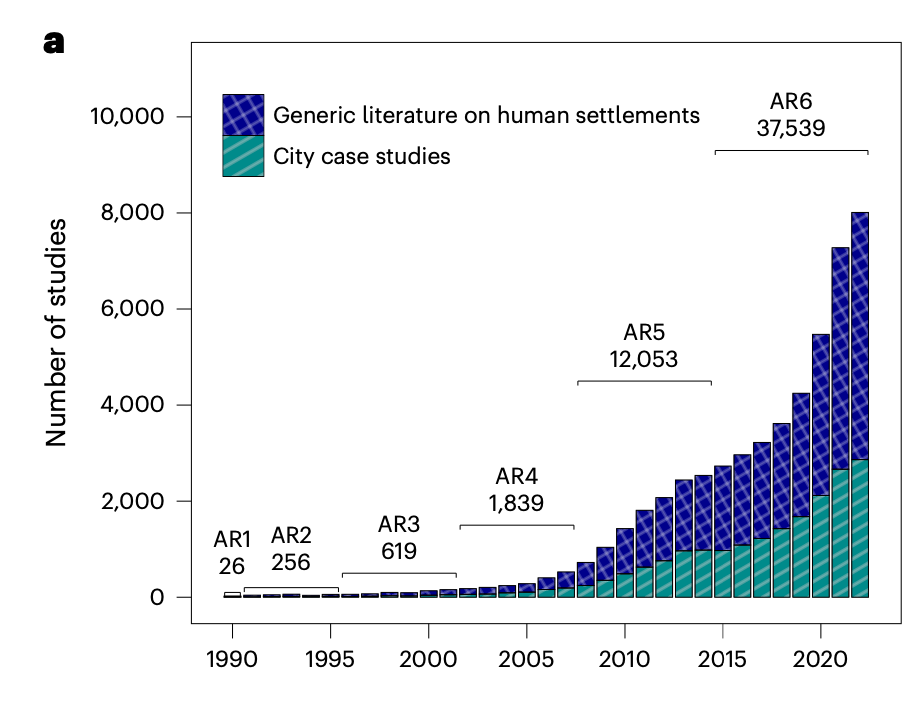
The authors find that 84% of studies in their database were published over 2012-22.
Literature on climate change and cities is currently growing 4.5 times faster than literature on climate change alone, they add.
Dr Simon Montfort is a postdoctoral researcher at Switzerland’s École Polytechnique Fédérale de Lausanne and lead author of the study. He tells Carbon Brief that the rapid growth in literature on climate change and cities is “not really surprising” because population growth in cities means that these areas are “becoming more and more important”.
The data can be explored further in their interactive online tool.
Uneven focus
There is a well-established skew in climate change literature towards wealthy nations in the global north. The new study finds that this skew is highly evident in literature on climate change and cities.
The map below shows the locations of the 20,000 “case study” papers. Darker colours indicate more highly researched areas. The map shows cities that were researched in one study (pink), between one and five studies (orange) and in more than five studies (red). The graph in the bottom left shows this information broken down by continent.
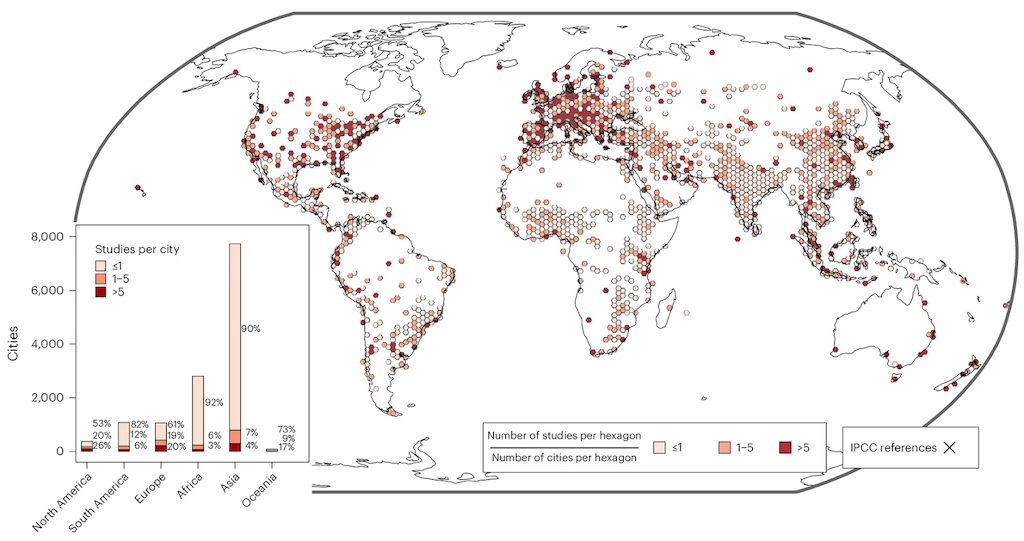
The authors identify more than 4,000 studies in Europe and 3,000 in North America. According to the authors, half of cities in these continents are covered by more than one study.
However, the map reveals a lack of research focused on cities in central and South America, Africa, the Middle East and south and south-east Asia.
The authors identify more than 8,900 studies focused on cities in Asia. One-third of these focus on Chinese cities, they find. The authors identify more than 1,500 studies on Beijing alone, most of which focus on mitigation, rather than impacts or adaptation.
Meanwhile, they find that 92% of cities in Africa are researched in no more than one study. Nigeria is the most highly studied country on the continent, with almost 400 studies – half of which focus on Lagos.
The authors identify a bias in their research database towards large cities with high emissions. Meanwhile, they find that small, fast-growing, non-coastal cities are underrepresented in the literature.
Prof Felix Creuztig is the head of the working group on cities at the Potsdam Institute for Climate Impact Research. He is an author on the study and on the upcoming IPCC special report.
He tells Carbon Brief:
“While cities like London, New York and Berlin are extensively studied, fast-growing cities such as Goma, Surat and Huế are barely visible in the literature. These smaller and rapidly urbanising cities in Africa and Asia are precisely where climate risks and emissions are increasing fastest, yet they are strikingly underrepresented.”
50,000 studies
To identify all existing literature on climate change and cities, the authors conducted their search using the open-access research database OpenAlex.
They first used a long list of keywords to search the abstracts of every paper on OpenAlex for research focused on cities and climate change. Keywords for literature on cities included “urban” and “built-up”, while key words for climate change ranged from “changing climate” to “carbon taxes”.
They then checked these papers using a “machine learning classifier”, which filtered out any research that was unsuitable.
The authors used a machine-learning approach to scan the abstracts of studies in their database, to determine which topics are most frequently covered.
More than half of the papers in the database were focused on mitigation, the authors found. The impacts of climate change on cities was covered in around 15,000 papers, and the rest covered adaptation and “cross-cutting” topics.
Lead author Montfort tells Carbon Brief that the database of 50,000 articles is “quite a precise sample, meaning that it includes few irrelevant articles”.
However, he adds that there may be “many relevant articles missing from our sample”. For example, the authors find that their database does not completely capture literature from the “physical sciences”, such as smart energy grids or radiative cooling methods.
Language is another notable bias, as the database only includes research published in English.
Dr Doan Quang Van is a researcher at Japan’s University of Tsukuba and a lead author on the upcoming special report. He praises the study, but notes that the English-only database likely leads to an “underappreciation of non-English regions”.
He also notes that Indigenous knowledge, which is “not necessarily contained in ‘official documents’ like papers or reports” is not included in the database.
IPCC recommendations
The authors compare the tens of thousands of studies cited by the IPCC in its most recent assessment cycle – AR6 – to their own database of literature on cities and climate change. They estimate that the IPCC cited almost 2,500 studies from the database in AR6, representing around 5% of the total.
They find that the IPCC’s choices about which studies to include further deepens the skew towards “large and mega cities” in the global north that is already evident in the literature.
Lead author Montfort tells Carbon Brief that the case studies are a “rich-evidence base” of “nuanced, case-specific knowledge”.
He says that it is important to expand the evidence base to less well-studied cities, but acknowledges it is “highly infeasible to conduct a study for every single city”. As such, he suggests that researchers should “look for ways to generalise findings from the more than 20,000 city-specific case studies already available”. He adds:
“If cities can learn from each other’s experiences, the existing evidence could go much further in informing city practitioners.”
To do this, the authors suggest that scientists should develop a data-driven method of grouping cities based on size, location and language, to enable “cross-city transfer learning from successful climate solutions”.
Dr Tamara Janes is a member of the climate information for international development team at the UK Met Office and an author on the upcoming IPCC special report. She was not involved in the new research.
She tells Carbon Brief that the study is “useful and timely”, adding that it “will undoubtedly help the ongoing special report by providing a solid foundational understanding for the current state of urban research worldwide”.
Janes adds that “this type of study is not only useful for researchers to design their research questions, but also for donor agencies as gaps in research can then be prioritised through flexible funding initiatives”.
Study author Crueztig says:
“For the IPCC and the broader research community, this is a call to action: to synthesise more, to look beyond familiar places and to take seriously the diversity of urban realities that will define the future of climate mitigation and adaptation.”
IPCC working group two co-chair, Dr Winston Chow, tells Carbon Brief that the “voluminous literature on climate change today presents challenges in its assessment”. He adds:
“Our experts are aware of these challenges towards developing reliable findings in informing our assessments and the IPCC is formally discussing this issue in a forthcoming expert workshop on methods of assessment.”
The authors add that they hope their interactive map, which is available online, will update automatically in the future to provide a “searchable, interactive, living database” of literature on climate change and cities.


The post Fast-growing, global-south cities are ‘strikingly underrepresented’ in climate research appeared first on Carbon Brief.
Fast-growing, global-south cities are ‘strikingly underrepresented’ in climate research

Climate Change
“Sink or swim”: WA Gov hugely underestimating decline in regional gas demand while sleeping on green exports, new report finds
PERTH, Tuesday 13 October 2026 — A new report from Greenpeace Australia Pacific and Springmount Advisory reveals green commodity exports are an untapped economic opportunity for Western Australia in a declining Asian gas market, while offering a genuine solution for decarbonising Asia.
From Gas to Green: Building Western Australia’s Future State is a comprehensive analysis of the declining gas market in Asia, and the untapped economic opportunity for WA to become a global leader in green commodity exports while driving the regional shift away from fossil fuels.
The report offers key recommendations for the WA Government to support regional decarbonisation through an orderly phase out of gas exports in favour of green iron and other green exports. It comes as global climate leaders from across business, politics and advocacy prepare to meet for the Global Citizen Now: Perth event focused on decarbonising WA.
Key findings:
- Gas demand is falling across WA’s core markets in Asia: Gas demand fell in 2025 and is projected to continue to decline, driven by a combination of global geopolitical factors and domestic concerns.
- Policy shifts in key markets since the war on Iran now prioritise renewables and nuclear over gas: Japan, South Korea and China have legislated energy plans that prioritise renewables and nuclear over gas.
- New WA gas would arrive in a saturated, uncertain Asian market filled with cheaper gas: The US is now the world’s largest liquefied gas producer and plans to double its capacity as it also targets Asian markets.
- Green commodities offer a real solution to sustain WA’s economy: WA can lead Australia’s green commodity exports, which by 2060 could be worth almost a trillion dollars.
- Exporting more WA gas is likely to delay or impede Asia decarbonisation: Despite claims by the gas industry, there is no evidence that WA gas is displacing coal in Asia, and in fact diverts resources from genuine decarbonisation options.
Geoff Bice, WA Campaign Lead at Greenpeace Australia Pacific said: “As our export partners in Asia shift away from expensive and polluting gas, the WA Government has a golden opportunity to pivot our economy to green exports, like green iron, which is the most effective way to help our region to decarbonise.
“The writing is on the wall: gas is in decline, renewables are our future. In this context, it makes zero sense for the government to encourage high risk projects like Woodside’s reckless Browse gas proposal at Scott Reef.
“This report clearly shows that the WA Government faces a choice: sink or swim. They can either allow the gas industry to keep ripping off West Australians and continue propping up its decline, or choose the path that will deliver enormous benefits to the state and the world by becoming a leader in the rapidly expanding green economy.”
Tom Quinn, Managing Director of Springmount Advisory: “Western Australia prospers when it looks to the future and builds for future demand. Twenty years from now, what the world needs is green commodities made using WAs abundant renewable resources. Just like it did with iron ore in the 1950s and gas in the 1970s, WA should look to the future and build what the world will need, not sunsetting industries like gas that are already past their peak.”
-ENDS-
Media contact
Kate O’Callaghan on 0406 231 892 or kate.ocallaghan@greenpeace.org
Lucy Keller on 0491 135 308 or lucy.keller@greenpeace.org
A report from Greenpeace Australia Pacific and Springmount Advisory reveals the untapped green economic opportunity for Western Australia in a declining Asian gas market, which also offers a genuine solution for decarbonisation in Asia.
Is Western Australia clinging to a fading gas industry while a thriving green future passes it by? As major Asian trading partners rapidly pivot away from volatile gas imports toward cheap solar and battery storage, this report exposes a high-stakes choice: risk becoming stranded in an oversupplied fossil fuel market, or harness WA’s unmatched sun and wind to lead the global clean energy transition.
Summary
From Gas to Green: Building Western Australia’s Future State reveals that Western Australia (WA) faces a critical juncture as falling Asian gas demand, geopolitical gas supply volatility and accelerating renewable energy deployment undermine the long-term economic viability of gas exports. By harnessing its world-class wind and solar resources, the report demonstrates that WA can execute an orderly phase-out of gas and pioneer a green commodity export economy that could generate $987 billion in economic value by 2060, create 24,000 ongoing jobs, and drive a 9.6% reduction in global greenhouse gas emissions.
Key Findings
- Gas demand is falling in Asia – WA can no longer rely on gas exports: Gas demand in core Asian markets fell in 2025 and is projected to continue to decline in 2026. Legislated energy plans in Japan, South Korea, and China now prioritise renewables and nuclear over gas.
- Asia is increasing renewables, importing gas just gets in the way: Evidence from markets like Thailand suggests that gas imports are increasingly crowding out cheaper renewable energy investments and battery storage rather than displacing coal, locking in more emissions over time.
- Green commodities offer a real solution to decarbonise Asia – this is a major win for WA: With world-class renewables, WA can lead Australia’s green commodity exports, which by 2060 could be worth almost a trillion dollars ($987 billion) and support a genuine 9.6% reduction in global emissions.
Recommendations to WA government
Recommendation 1: Plan an orderly gas phase-out aligned with a trading partner pivot plan
Implement a managed, orderly phase-out of gas exports aligned with trading partners’ decarbonisation pathways, rather than waiting for demand to collapse, by:
- Developing and implementing a staged phase-out of gas facilities aligned with feedstock supply expiry or typical end of facility lifespans.
- Committing to no new gas development for gas expansion, including Browse and Kimberley fields.
- Developing new, reciprocal trade relationships with existing gas trade partners, structured to progressively replace gas exports with green commodities – integrated with recommendation 2.
Recommendation 2: Develop an integrated green commodity export strategy, positioning WA as a global green iron manufacturing hub
Establish an integrated green commodity export strategy that immediately prioritises green iron development, positioning WA as a global green iron manufacturing hub, by:
- Committing to green commodity export targets to give industry and investors a clear demand signal.
- Prioritising green iron as the lead sector within the broader green commodity strategy, given WA’s iron ore endowment and first-mover potential.
Recommendation 3: Reject false solutions such as carbon dumping (CCS) and blue hydrogen
Reject carbon dumping (also described as carbon capture and storage, or CCS) and blue hydrogen as viable decarbonisation technologies, and prioritise green hydrogen and proven renewables for clean energy and fuel production by:
- Excluding blue hydrogen projects (and CCS-dependent projects) from all government support programs.
- Requiring existing hydrogen-based production (including ammonia, methanol, synthetic fuels) to have clear, near-term transition timelines to switch to green hydrogen production.

What you can do
Together, we can push for a prosperous green future.
You can help by:
- Sending an email to Environment Minister Murray Watt and Prime Minister Anthony Albanese, calling on them to reject Browse.
- Sharing this story to help more Australians understand what’s at stake.
- Encouraging your friends and family to take action.
REPORT: “From Gas to Green” Building Western Australia’s Future State
Cleaner cooking projects in the UN carbon market will have to set aside a share of their credits to insure against the risk that the trees they save are lost to fire, drought or logging, after the market’s regulator rejected calls to exempt the sector.
The requirement is part of a new rulebook that the Paris Agreement carbon market regulator – the Article 6.4 Supervisory Body – approved last Friday for programmes that aim to cut emissions by distributing new and cleaner cookstoves in regions that still burn w