- What timeline options were delegates debating?
- How did the timeline discussions unfold?
- What were the main points of disagreement?
- Why is the IPCC in a ‘serious funding crisis’?
- How have scientists reacted?
- What other issues remain unresolved?
- How are the IPCC AR7 reports progressing?
- How might the IPCC use AI and enhance gender inclusivity?

A “critical assessment” report commissioned by the Trump administration to justify a rollback of US climate regulations contains at least 100 false or misleading statements, according to a Carbon Brief factcheck involving dozens of leading climate scientists.
The report – “A critical review of impacts of greenhouse gas emissions on the US climate” – was published by the US Department of Energy (DoE) on 23 July, just days before the government laid out plans to revoke a scientific finding used as the legal basis for emissions regulation.
The executive summary of the controversial report inaccurately claims that “CO2-induced warming might be less damaging economically than commonly believed”.
It also states misleadingly that “excessively aggressive [emissions] mitigation policies could prove more detrimental than beneficial”.
Compiled in just two months by five “independent” researchers hand-selected by the climate-sceptic US secretary of energy Chris Wright, the document has sparked fierce criticism from climate scientists, who have pointed to factual errors, misrepresentation of research, messy citations and the cherry-picking of data.
Experts have also noted the authors’ track record of promoting views at odds with the mainstream understanding of climate science.
Wright’s department claims the report – which is currently open to public comment as part of a 30-day review – underwent an “internal peer-review period amongst [the] DoE’s scientific research community”.
The report is designed to provide a scientific underpinning to one flank of the Trump administration’s plans to rescind a finding that serves as the legal prerequisite for federal emissions regulation. (The second flank is about legal authority to regulate emissions.)
The “endangerment finding” – enacted by the Obama administration in 2009 – states that six greenhouse gases are contributing to the net-negative impacts of climate change and, thus, put the public in danger.
In a press release on 29 July, the US Environmental Protection Agency said “updated studies and information” set out in the new report would “challenge the assumptions” of the 2009 finding.
Carbon Brief asked a wide range of climate scientists, including those cited in the “critical review” itself, to factcheck the report’s various claims and statements.
The post Factcheck: Trump’s climate report includes more than 100 false or misleading claims appeared first on Carbon Brief.
https://www.carbonbrief.org/factcheck-trumps-climate-report-includes-more-than-100-false-or-misleading-claims/
Continue Reading
Countries have failed – for the sixth time running – to agree on the timeline for publishing the Intergovernmental Panel on Climate Change’s (IPCC) next set of influential reports.
The IPCC’s 65th session (IPCC-65) was seen by many to be the final opportunity for countries to agree on a schedule where its seventh assessment report (AR7) would be published in time for the UN’s second “global stocktake” of climate action.
Before last week’s meeting in Addis Ababa, Ethiopia, IPCC chair Prof Sir Jim Skea had warned that releasing the reports in time for the stocktake in 2028 would depend on a timelines being agreed by the end of 2026.
But the week-long meeting descended into fraught disagreements between governments, resulting in Skea “suspending” the talks on Friday evening with no decision made.
Countries were also unable to agree on the IPCC’s budget for the rest of the AR7 cycle, leaving the body with a “serious funding crisis”.
The IPCC has pledged to reconvene the meeting at the “earliest opportunity”; however, it has not yet given an indication of when this will be.
In his concluding remarks, Skea described the Addis Ababa summit as a “profound disappointment” and “among the most difficult IPCC meetings”, according to reporting from the Earth Negotiations Bulletin (ENB).
Some countries have reacted with dismay to the breakdown of negotiations, warning that a failure to have the IPCC’s latest assessments on climate adaptation and mitigation ready for the UN stocktaking exercise would undermine global climate action.
A climate envoy from a Pacific island state said it was a “travesty that a handful of countries continue to delay the IPCC’s reports – the science we need back home to help us save lives and livelihoods”.
Below, Carbon Brief explores the key developments, debates and disagreements at the IPCC meeting.
- What timeline options were delegates debating?
- How did the timeline discussions unfold?
- What were the main points of disagreement?
- Why is the IPCC in a ‘serious funding crisis’?
- How have scientists reacted?
- What other issues remain unresolved?
- How are the IPCC AR7 reports progressing?
- How might the IPCC use AI and enhance gender inclusivity?
What timeline options were delegates debating?
Top of the agenda during the Addis Ababa meeting was a decision on the timeline of the publication of AR7’s three working group reports – also known as the “work plan”. The three reports cover climate science (WG1), impacts and adaptation (WG2) and mitigation (WG3).
Countries failed to reach a resolution on the scheduling of the influential reports at five consecutive IPCC meetings since 2024 – despite drafting being well underway.
(For more, see Carbon Brief’s write-up of discussions in Istanbul, Sofia, Hangzhou, Lima and Bangkok.)
Reporting from the ENB from inside these meetings has highlighted that countries are split, broadly, into two groups – those that want all three reports to be published in time for the UN’s second “global stocktake” in 2028, and those that one, or more, to be published afterwards.
A key pillar of the Paris Agreement, the global stocktake is a formal assessment of the world’s collective progress on tackling climate change. The exercise is designed to guide future global climate action, including decisions on national emissions targets and climate finance.
The second global stocktake is due to culminate in late 2028 at the COP33 climate summit.
The Addis Ababa meeting was the final IPCC plenary where countries would be able to agree on a stocktake-aligned timeline. In April, Skea told Carbon Brief that publishing reports by the end of 2028 would only be possible if a decision was taken before the end of 2026.
India, Kenya, Russia and Saudi Arabia have emerged as among the loudest voices calling for a timeline where the IPCC’s latest assessment of climate impacts and mitigation are published after the stocktake. They have argued that developing countries need more time to prepare, review and approve working group reports.
A coalition of developed nations and small-island developing states, meanwhile, have argued in favour of all three reports being published in time for the stocktake, so that the latest climate science can inform future climate action.
(For more on the standoff around the reports and why it matters for climate action, read Carbon Brief’s explainer.)
Ahead of the Addis Ababa meeting, the IPCC’s secretariat, on behalf of Skea, published a document setting out three options for a timeline for the working group reports. These are summarised below.
| Option 1 | Option 2 | Option 3 | ||||
| Proposal set out by working group co-chairs at IPCC-61 in Sofia. | Revisited proposal presented by working-group co-chairs at IPCC-63 in Lima. | Submissions by India and Saudi Arabia to a survey sent out by IPCC in 2026. | ||||
| Report approval | Plenary | Proposed month of approval | Plenary | Proposed month of approval | Plenary | Proposed month of approval |
| Working Group 1 | IPCC-69 | May 2028 | IPCC-69 | May 2028 | IPCC-69 | May 2028 |
| Working Group 2 | IPCC-70 | June 2028 | IPCC-70 | July 2028 | IPCC-71 | April 2029 |
| Working Group 3 | IPCC-71 | July 2028 | IPCC-71 | Sept 2028 | IPCC-72 | July 2029 |
Source: Table 1 and Appendix A in “Work plan of the IPCC seventh assessment report”, IPCC.
Over several days of fraught talks in Addis Ababa, the number of timeline options in contention ballooned to seven – before being reduced down to four.
How did the timeline discussions unfold?
On Monday, Skea established a “contact group”, chaired by Brazil and Ireland, to focus on the timeline issue.
By Friday morning, the group reported back to the plenary that they were still a “long way from consensus”, according to the ENB.
By that afternoon, four options still remained – the three set out by the IPCC ahead of the meeting and a fourth, proposed by Haiti, which would see WG1 approval in April 2028, WG2 in July 2028 and WG3 in October 2028.
The IPCC’s secretariat subsequently presented a “draft decision” for the timeline issue to plenary, informed by the contact group’s work. The text did not establish a formal decision on the timeline, but presented a number of options for how the IPCC could move forward on the issue, as well as proposals for addressing inclusivity concerns.
Two out of three options suggested that IPCC co-chairs to continue work on reports in 2027 “without prejudging the panel’s agreement on the timing of the respective approval sessions” and for timeline discussions to be continued at a future session.
Another suggestion was that the IPCC fund a second delegate for developing countries and “economies in transition” for future approval sessions.
After one delegation said they were uncertain how to engage with the draft text, Skea clarified the text had three elements – a preamble, the timeline and a section on inclusivity and avenues for providing input.
He said that “it was clear the panel would not be able to take a decision on the timeline at IPCC-65” and explained the idea was to include the four timeline options that emerged from the contact group in an annex “in order to capture progress made during IPCC-65”.
After countries were not able to agree on the draft decision, Skea suspended the meeting at 8:29pm on Friday.
He noted that it would no longer be inclusive for the meeting to continue, given that a number of delegations from developing countries had left.
Earlier in the plenary, Antigua and Barbuda’s delegation had emphasised that 6pm was its deadline and noted that representatives of other small-island developing states had departed. Nepal’s negotiating team had also stated it was leaving.
What were the main points of disagreement?
The ENB’s report details how the five-day meet was beset by disagreements between country delegations on the timeline issue.
As proceedings kicked off on Monday, a significant number of countries set out their position on whether publication of the reports should occur before, or after, the global stocktake.
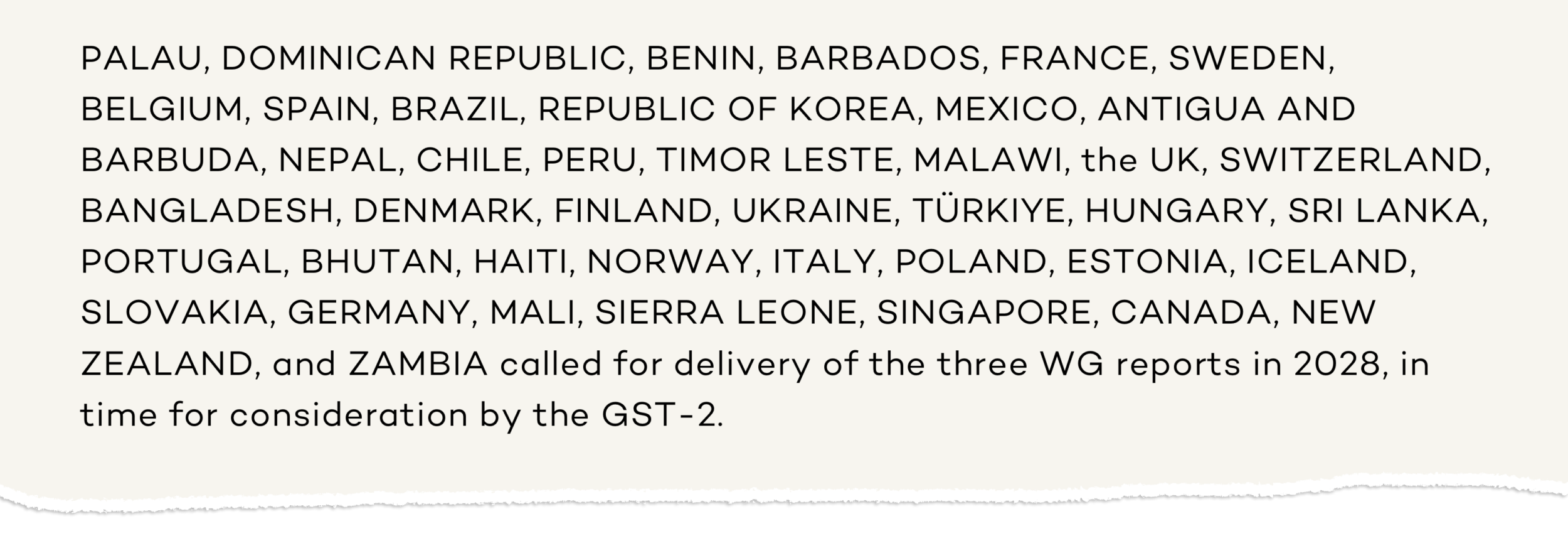
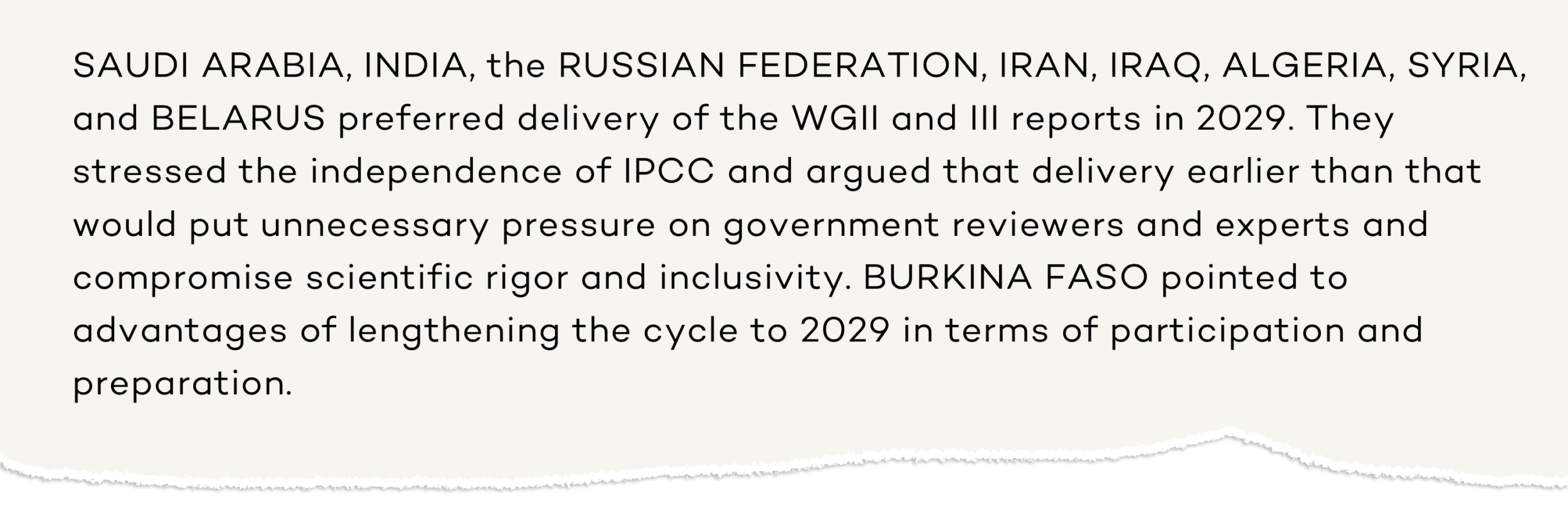
Both camps cited inclusivity concerns. Those in favour of a stocktake-aligned timeline said that “inclusivity is a priority and should be addressed, but said delaying delivery of the report would further disadvantage the countries most vulnerable to climate change”, according to the ENB.
In discussions on Monday, the Pacific island nation of Vanuatu underscored that “every year of delay is a year in which communities on the frontlines bear losses that cannot be measured or claimed”, the ENB says. The delegation pointed to the International Court of Justice’s 2025 advisory opinion that countries have binding obligations to protect the climate.
The Netherlands delegation said it was “inconceivable” that two years before the conclusion of second global stocktake, the “body created to produce scientific advice accepts it will not deliver working group reports on mitigation and adaption, while the [IPCC co-chairs] say it is possible”, according to the ENB.
But other countries emphasised that the global stocktake could draw from other sources of science if the reports were not ready in time, the ENB notes.
China’s delegation opposed the IPCC holding more than three plenaries each year and said IPCC reports did not need to be linked to the global stocktake. Kenya said that publishing reports after the stocktake “did not mean science would not inform policy”.
Also among those to argue for a longer timeline were Iran and Iraq, with the latter underscoring the importance of participating in IPCC processes on an “equal footing” with other governments, the ENB says.
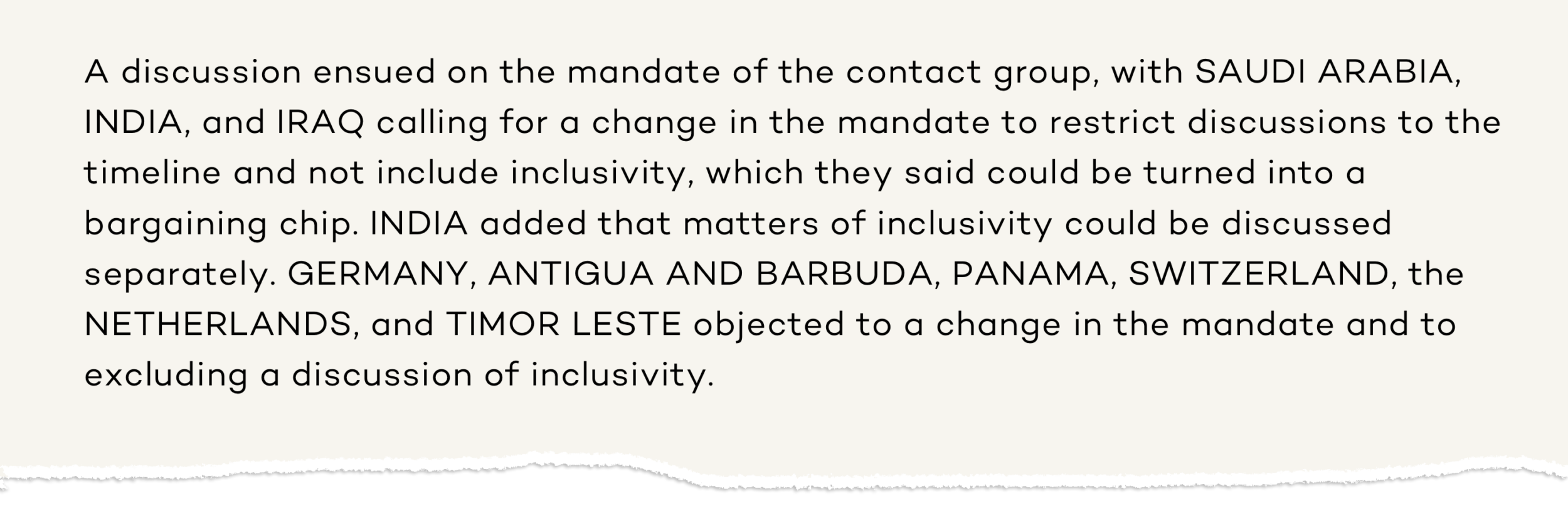
There were also disagreements over the specific mandate of the contact group set up by Skea on Monday to advance the timeline question. This debate endured well into the end of the week and days after the contact group had started its work.
Countries pushed back on each others’ characterisation of the different timeline options. Proponents for a longer timeline described plans where reports were published in 2028 as “rushed”, whereas those who wanted all reports published in time for the stocktake referred to the longer timeline as “delayed” or “significantly extended”, according to the ENB.
Countries also failed to reach consensus on the draft timeline decision presented to plenary on the last day of the meeting.
While some countries – including Antigua and Barbuda, Costa Rica, France, Germany, Hungary, Italy, Kiribati, Marshall Islands, Mexico, the UK and Uruguay – detailed their preference for particular passages of the IPCC secretariat’s text, others rejected it outright.
For example, Algeria, India, Iraq and Saudi Arabia stated the draft text could not serve as a basis for work or decisions, according to ENB. India, meanwhile, argued that it could not engage in the decision as the contact group reached “no clear conclusion”.
In an analysis of developments at IPCC-65, the ENB states that discussions in Ethiopia had revealed “room to compromise” between countries.