



- What timeline options were delegates debating?
- How did the timeline discussions unfold?
- What were the main points of disagreement?
- Why is the IPCC in a ‘serious funding crisis’?
- How have scientists reacted?
- What other issues remain unresolved?
- How are the IPCC AR7 reports progressing?
- How might the IPCC use AI and enhance gender inclusivity?

Longer ago than I care to admit, I was leaving school via a city bus in Chicago.
Heavy, dense snow fell in blankets as the wind-whipped bus careened on icy sheets of road. A little less than a mile to my stop, the bus driver pulled over, opened the door, and in a loud yet tired voice said, “That’s it, y’all. I can’t go on. You have to get out.” While I had visited Chicago as a child many times, this was the first year I was taking the bus regularly to and from school–I was thirteen years old. I sat for a moment in disbelief as my eyes connected with the strong man at the wheel. He looked away with a shrug.
I disembarked and began my walk home going east towards the turbulent Lake Michigan and spotted massive waves threatening to overflow from the concrete barrier built around the road. The wind whistled and moaned in my ears and my eyes were blinded by the wave of white. As I walked, each step felt like plunging into and out of concrete and I found myself becoming sweaty, tired and colder as the wind chilled my sweat. I hoped I wasn’t walking on the road.
Up ahead, I saw someone–a small person–emerge from a pile of snow. I drew closer and realized that she was a little kid, no more than six or seven. Her hair completely matted in snow, wearing only a tattered sweater and ballet slipper-type shoes. My eyes immediately brimmed, and I rushed forward. I started to wipe away the snow from her hair and face and asked if she lived nearby. She nodded–tears streaked her face and her eyes reflected the fear I felt pulsing through my own body. I opened my coat and cocooned her in it as tightly as I could, and began to limp forward against the wind as I tried to keep her feet above the ground.
We reached a condo building about four blocks later that had a small grocery and convenience store and went inside. I took her shoes and socks off and began to warm her feet with my hands. I asked the person working if there were socks that could be given to her–it was an emergency, afterall, but was shut down with a look and bark: “Price of socks is two dollars”. I bought the socks and slid them on her feet as I was trying to find out the girl’s name, phone number, and where she lived. She wouldn’t talk. She was crying and petrified.
Eventually, I was able to call her mother who was one block away and came to take her home. As I walked the rest of the way home, now freezing from the warmth of the building in the wilding wind, I began to process what had happened. I remember feeling shame that I had the basics of a good coat, hat, mittens, a scarf and boots. Guilt ran through me like a cold snake: what kind of world is this where children don’t have what they need? Where people turn each other away? Is this the way life is supposed to be?
I view this experience as being foundational as I walked my path into adulthood towards believing that climate and environmental justice is the only way to address creating a loving and equitable world.

The winter storm that occurred that year in Chicago was one of the biggest Chicago had ever experienced and led to the ouster of the mayor and the election of the first female Mayor of Chicago. It inspired critical infrastructure changes in public services financed by tax dollars; and served as a marker for holding elected leaders responsible for actually serving the public. I recognize today how that two hour event sharpened my worldview on just about everything, and serves as my lived analogy to what is happening in our world today.
Threaded in the destruction, hunger, displacement and death caused by our reliance on fossil fuel is the iniquity of people around the world. We who live with next to nothing, who live on the tentative nature of a paycheck are juxtaposed to those very few who enjoy much, much more than enough. In the ironic twist of fate that often accompanies existential crises, those who have the least are often those who have been colonized, forced into building the infrastructure that those who have the most take for granted on a global level.
Growing my conscientiousness has also deepened my grieving for those who are being forced from their homes to face the hostility of a wildly “cold” world. They, too, do not have the metaphoric coats, boots, mittens and hats to face the climate crisis. Will we as a collective humanity offer succor? If not now, when? If not us, who?
I did not expect that everything I needed to know about the world I would find out at thirteen. As we witness and experience injustices only brought into finer focus through climate change, we have a moment in time to create and make real a just world. I can see this world in my dreams: where we collectively channel our power, leaning into believing in our connectedness with the world and all of its eco- and people- systems. I see this as a brilliant and vibrant tree continually gaining strength as it ages into time.
Today, I am leaning into us: I choose to create connections. It is the only way I know to make my dreams realities. As I prepare to attend COP28, I embrace the possibilities in raising my voice in community and collective consciousness with my brothers and sisters from around the world.

Denise joined the Climate Generation team in May 2020 and leads fundraising and marketing efforts. As Senior Director of Development and Marketing, Denise supports Climate Generation’s team in growing resources to amplify our mission and vision. Denise has a Bachelor of Arts degree from the University of St. Catherine, and has worked in fundraising and development for 17 years. She has served as the founding chair of the Saint Paul Almanac, as director for the Lex/Ham Community Council, and on the Central Corridor Community Advisory Committee. Denise’s passion is fueling transformative work through collaborative processes, and has worked in early childhood development, employment and health and human services. While new to working directly on environmental issues, Denise has seen the first hand effect of environmental disparity in communities where she has lived and believes that radical, lasting change in who we are as a people will come from uniting around practical and expedient action to restore and nourish the environment.
Denise is a Climate Generation Window Into COP delegate for COP28. To learn more, we encourage you to meet the full delegation and subscribe to the Window Into COP digest.
The post Everything I Need to Know, I Learned in a Snowstorm appeared first on Climate Generation.
Continue Reading
Three countries have been named by the Paris Agreement’s compliance committee for failing to submit a nationally determined contribution (NDC) and repeatedly snubbing offers of help with their climate plans.
After months of internal debate over whether to identify serial non-responders, the Paris Agreement’s Implementation and Compliance Committee (PAICC) named the three countries which have failed to engage with it over their NDCs on Friday.
It named Democratic Republic of Congo, Senegal and North Korea in a footnote of its annual report, adding that it decided to name them “with a view to facilitating engagement”, adding that representatives of the three nations had been invited to its meeting in early 2027 “with the purpose of identifying any challenges and constraints”.
“The Committee noted the importance of Parties engaging with the Committee in a timely manner, while noting that some delays may be due to the national capabilities and circumstances of the Parties”, the report said.
-
Under US pressure, World Bank says it will back gas “where appropriate”
The US wants the World Bank to expand its gas support while climate campaigners are pushing for it to end – its head spoke this week of limited backing for the fossil fuel -
IPCC scientists vow to press on with climate reports despite political deadlock
After governments again failed to agree a timeline, nearly 120 IPCC authors pledged to complete their assessment on time and with full scientific rigour -
Paris Agreement committee snubbed over missing NDC climate plans
Many governments have still not submitted a nationally determined contribution to the UN, breaching a key requirement of the Paris Agreement
In July, PAICC said 12 countries had ignored its repeated attempts to discuss why they had not published an NDC as required every five years under the 2015 Paris accord.
Members of the committee had been divided over whether to name them, but at a September meeting decided to do so in their annual report to the annual climate COP summit.
By the time the report was published on Friday, only Congo, Senegal and North Korea “had not communicated an NDC or submitted a [Biennial Transparency Report] and had not yet responded to any of the Committee’s notifications, despite several reminders issued by the Committee in this regard”.
Rainforest and renewable energy ambitions
The silence from Congo and Senegal is notable because the former is home to much of the Congo Basin rainforest while the latter has sought billions of dollars in climate finance to support its renewable energy ambitions.
After Brazil, Congo has more rainforest than any country in the world. This forest, and the country’s peatlands, absorb huge amounts of greenhouse gas but are fast being lost to expanding farmland, charcoal production, logging and mining.
Senegal signed a Just Energy Transition Partnership with Canada and wealthy European nations in 2023, to help it meet its renewable energy targets under the-then government of Macky Sall. It was chair of the Least Developed Countries group between January 2022 and December 2023.

Tejas Rao, who is researching the PAICC as part of a doctoral thesis at Cambridge University, said the governments of the three countries should engage with the committee.
“Engagement costs these governments very little and the committee has shown it will listen,” he said.
“Silence leaves the committee with no basis to help, and it leaves the [governments] exposed to the narrative that they are simply disengaged,” he told Climate Home News.
Paris Agreement requirement
The 2015 Paris Agreement requires all parties to publish an NDC every five years outlining their emissions reduction targets, with each plan meant to be more ambitious than the country’s last NDC.
The latest set – the third round of plans, with new targets for 2035 – was due in February 2025. While most countries missed this deadline, all but around 30 – mostly small emitters but including Egypt, Vietnam and Argentina – have now submitted them.
Over the year, the PAICC – which is made up of government climate officials from developed and developing countries – has been communicating with governments that have not submitted NDCs and trying to overcome barriers to them doing so.
Some nations have cited exceptional circumstances as the reason for not submitting an NDC, a process that requires a significant amount of work in tracking emissions and consulting on how to curb them across the economy. For example, a letter from a Sudanese official to the PAICC, seen by Climate Home News, said that the country’s civil war had led to the suspension of its NDC preparation.
-
IPCC scientists vow to press on with climate reports despite political deadlock
After governments again failed to agree a timeline, nearly 120 IPCC authors pledged to complete their assessment on time and with full scientific rigour -
Under US pressure, World Bank says it will back gas “where appropriate”
The US wants the World Bank to expand its gas support while climate campaigners are pushing for it to end – its head spoke this week of limited backing for the fossil fuel -
Who shapes climate science? The equity question facing the IPCC
Early completion of the next global climate science assessment reports risks excluding research from the Global South, which is key to ensuring the findings are fair
The US and Iran are not signed up to the Paris Agreement and so do not have active NDCs, nor does Taiwan, which is not a UN member state.
Rao said that because the PAICC is “facilitative and non-punitive”, naming the countries “is meant to open a door, not close one – the invited consultation is the point”.
“In recent months, governments that explained their constraints, whether capacity, finance or domestic process, have been met with follow-up and support rather than sanction, and the number of silent governments has fallen sharply,” Rao said.
The post Paris Agreement committee names three countries snubbing it over NDCs appeared first on Climate Home News.
Paris Agreement committee names three countries snubbing it over NDCs
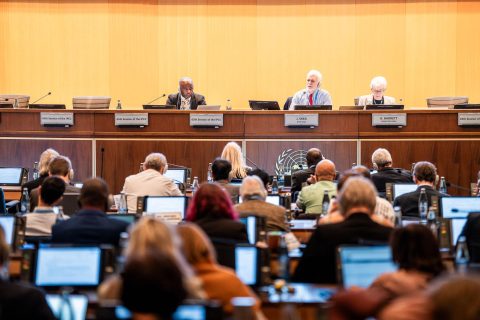
Countries have failed – for the sixth time running – to agree on the timeline for publishing the Intergovernmental Panel on Climate Change’s (IPCC) next set of influential reports.
The IPCC’s 65th session (IPCC-65) was seen by many to be the final opportunity for countries to agree on a schedule where its seventh assessment report (AR7) would be published in time for the UN’s second “global stocktake” of climate action.
Before last week’s meeting in Addis Ababa, Ethiopia, IPCC chair Prof Sir Jim Skea had warned that releasing the reports in time for the stocktake in 2028 would depend on a timelines being agreed by the end of 2026.
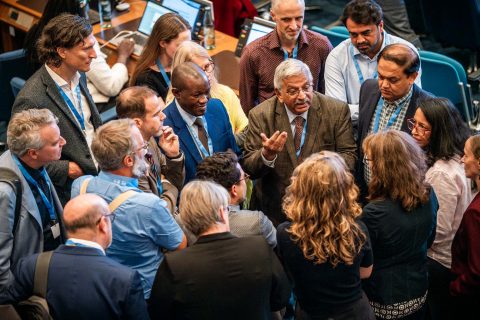
But the week-long meeting descended into fraught disagreements between governments, resulting in Skea “suspending” the talks on Friday evening with no decision made.
Countries were also unable to agree on the IPCC’s budget for the rest of the AR7 cycle, leaving the body with a “serious funding crisis”.
The IPCC has pledged to reconvene the meeting at the “earliest opportunity”; however, it has not yet given an indication of when this will be.
In his concluding remarks, Skea described the Addis Ababa summit as a “profound disappointment” and “among the most difficult IPCC meetings”, according to reporting from the Earth Negotiations Bulletin (ENB).
Some countries have reacted with dismay to the breakdown of negotiations, warning that a failure to have the IPCC’s latest assessments on climate adaptation and mitigation ready for the UN stocktaking exercise would undermine global climate action.
A climate envoy from a Pacific island state said it was a “travesty that a handful of countries continue to delay the IPCC’s reports – the science we need back home to help us save lives and livelihoods”.
Below, Carbon Brief explores the key developments, debates and disagreements at the IPCC meeting.