

The European Union’s decision to dilute its corporate sustainability rules could hurt the bloc’s efforts to fight climate change and risks rewarding companies with a poor track record, environmental NGOs and clean energy advocates say.
In a deal clinched in the early hours of Tuesday, EU leaders, the European Commission and the Parliament agreed a series of amendments to the Corporate Sustainability Due Diligence Directive (CSDDD), which will require larger companies to identify and address any environmental or human rights violations in their supply chains.
The amendments, which still need formal approval by the Parliament and EU member states, mean the due diligence requirements will apply to far fewer companies than initially targeted and maximum penalties will be reduced from 5% to 3% of a company’s annual global turnover.
In another change, the EU also scrapped a requirement for companies to publish climate transition plans setting out how they would make their business model compatible with the Paris Agreement.
-
Mining is destroying our homes: We need global binding rules for mineral extraction
Amid a rush for minerals needed for the energy transition, voluntary safeguards and corporate goodwill are insufficient to protect nature and human rights -
Brazil’s Lula requests national roadmap for fossil fuel transition
After countries failed to formally back a global energy transition roadmap at COP30, Brazil’s president takes the initiative by mandating a national plan


The EU Commission said the changes, which follow months of corporate lobbying, US pressure and interventions by France and Germany, will remove all requirements for many smaller companies and introduce greater flexibility for larger companies, which will help to ease administrative burdens on businesses and drive investment.
But climate campaigners and clean tech industry representatives said the watered down rules were a setback for European efforts to clean up supply chains and reduce emissions.
“By deleting the climate transition plan implementation, the EU is weakening the key legislative frameworks for businesses to prepare for climate risks and global challenges that can severely affect their operations and value chains,” said Julia Otten, who works on corporate due diligence at Frank Bold, a sustainability NGO and law firm.
“This is counter-productive for businesses, weakens accountability, and jeopardises the EU’s own plans and objectives on climate and the industrial transition,” she added.
“Extremely disappointing”
Industry leaders in clean energy technologies say that the changes undermine their sector’s climate efforts and risk putting companies that prioritise sustainability at a disadvantage.
Rachel Owens, CEO of the Solar Stewardship Initiative, a multistakeholder scheme that has set out standards for what transparent and sustainable solar value chains should look like, told Climate Home News the move was “extremely disappointing”.
Requiring companies to set out their climate transition plans would have demonstrated that the production of solar panels and other renewable energy technologies and the energy they generate have much lower emissions than their fossil fuel alternatives, she said.
For Maurice Loosschilder, global head of sustainability at Signify – a multinational company that manufactures LED lighting systems that help reduce energy consumption – the removal of the climate transition plans from the law will make it more difficult to align businesses and their supply chains with the EU’s climate goals and could reduce incentives for innovation.
Because of its large size, Signify still falls under the law’s requirement. But Loosschilder said he was concerned that the company could lose its competitive edge when faced with small companies for which the same sustainability rules do not apply.
Intense lobbying
The agreement reached on Tuesday followed intense lobbying by industry and governments.
In a letter addressed to EU leaders, the US and Qatar warned that investment and energy supplies to the EU would be harmed if the CSDDD came into effect in its original form.
Documents obtained by the Amsterdam-based Centre for Research on Multinational Corporations (Somo) show how 10 major companies lobbied to dilute the regulation. This included oil and gas majors ExxonMobil, Chevron and TotalEnergies as well as metals and minerals producer Nyrstar, a subsidiary of commodity trading giant Trafigura Group.
Total Energies defended its advocacy in Brussels and in European capitals as being “in full compliance with applicable laws and regulations”. The other companies did not respond to Somo’s requests for comment.
-
South Africa’s platinum mine dumps get a second look as clean energy lifts demand
Mining firms say extracting minerals from tailings is a sustainable way to boost global supplies, but local communities want to see benefits this time around -
Efforts to green lithium extraction face scrutiny over water use
Direct lithium extraction has been hailed as a way to reduce mining impacts in South America but experts warn the technology may not be ready for large-scale deployment -
Self-taught mechanics give second life to Jordan’s glut of spent EV batteries
As EV sales boom in Jordan, a lack of formal infrastructure for dealing with end-of-life batteries is leading to some innovative solutions


NGO Global Witness accused EU leaders of giving in to lobbying by the fossil fuel industry.
“Major oil and gas giants will now be able to dodge their responsibility to act on [the] climate, largely thanks to intense US political and corporate pressure,” Beate Beller, a senior campaigner at Global Witness, told Climate Home News.
The EU’s about-face also weakens efforts to clean up the supply chains of technologies needed for the energy transition such as electric vehicles, batteries and solar panels.
“Clean tech cannot be ‘clean’ if the raw materials behind it are mined under weakened standards. This is what made the spirit of the CSDDD so promising: it paired climate transition plans to cut fossil-fuel dependence with robust human-rights and environmental due diligence across clean-tech supply chains,” she added.
Lower bar on supply chain oversight
The rules will now only apply to companies established in the EU with at least 5,000 employees and a net global turnover of 1.5 billion euros. It had originally applied to companies with at least 1,000 employees and turnover of 450 million euros. Member states have until July 2028 to transpose the requirements into national law.
When assessing their supply chains, companies will need to follow a risk-based approach and focus on areas that carry the biggest potential for harm. For example, an EV maker might focus on the production of the battery, which requires a range of different minerals whose extraction and processing carry high risks.
However, companies are no longer required to carry out comprehensive mapping of their direct and indirect suppliers. Instead, they will need to conduct “a general scoping exercise” based on “reasonably available information”.
Johannes Blankenbach, a senior researcher at the Business and Human Rights Centre, told Climate Home News that it is important that companies identify risks beyond their direct suppliers.
That’s because the most severe risks typically lie further up the supply chain, for example, where raw materials are sourced or extracted from the ground, he said.
In addition, harmonised rules across the EU to allow victims of harms to take companies to court have been removed, which will make it more difficult for communities to find legal remedies, Blankenbach added.
While the EU Commission said the less onerous requirements should help drive investment, Sonia Dunlop, CEO of the Global Solar Council, a trade body for the solar industry, said investors in solar farms wanted guarantees about the origin of solar panels and battery storage equipment.
“They want to know where it was made, and they want to know that it was properly made according to the highest environmental, social and governance standards,” she said, citing industry initiatives to boost supply chain transparency and standards such as the Solar Stewardship Initiative.
She said the initiative had been spurred by both the EU’s plan to tighten due diligence laws as well as industry concerns over the use of forced labour in the production of polysilicon used in solar panels in China’s Xinjiang region.
The post EU weakening of corporate sustainability rules ‘jeopardises’ climate action, critics say appeared first on Climate Home News.
EU weakening of corporate sustainability rules ‘jeopardises’ climate action, critics say

For the first time, new-energy vehicles (NEVs) made up 67% of new car sales in China in September, according to the latest data from the China Passenger Car Association (CPCA).
The figures show that NEVs, which include battery electric cars and plug-in hybrids, captured a record share of sales, even though fewer were sold than last year.
This is because sales of combustion-engine cars are falling steeply, a trend that the CPCA has attributed to rising petrol prices following the start of the Hormuz crisis.
Indeed, sales of fuel-only cars were down 31% year-on-year in the first nine months of 2026, with plug-in hybrid sales down 26% – whereas battery EV sales were only down 4%.
One analyst tells Carbon Brief that China’s rapidly growing EV fleet has offset demand for 143m barrels of oil since the start of the Hormuz crisis.
Another says that the crisis is “reinforcing China’s electrification of road transport”.
Meanwhile, amid slowing domestic sales, Chinese carmakers’ exports of NEVs more than doubled [in 2026 to date / in September] from a year earlier.
NEV record
A record two out of every three cars sold in September in China were NEVs, according to CPCA data, as shown in the figure below.
(NEVs predominantly include battery electric vehicles – BEVs – and plug-in hybrids – PHEVs. BEVs only run on electricity, whereas PHEVs also have a combustion engine.)
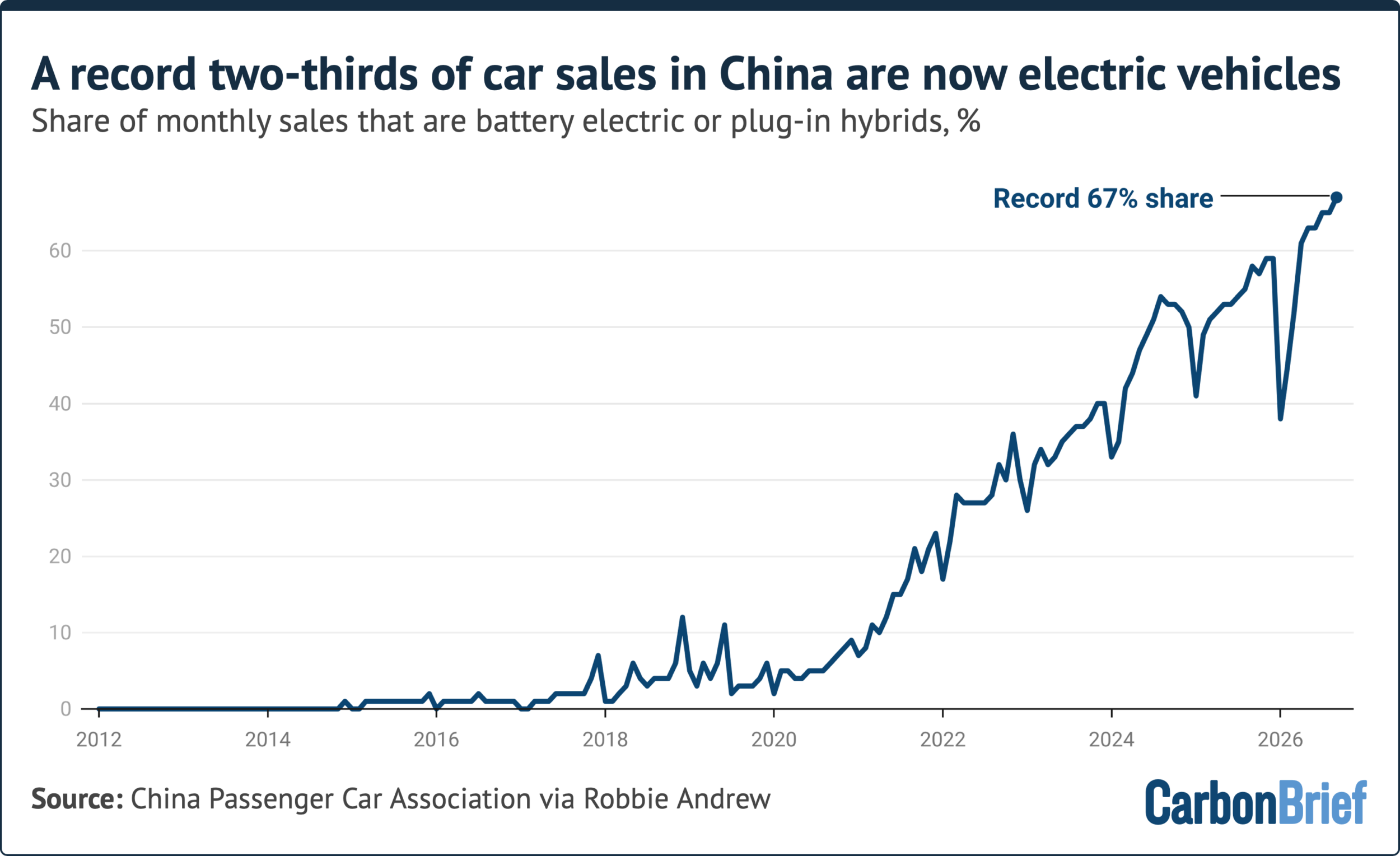
This marks a rapid rise for NEVs from just 6% of new car sales in 2020 up to 58% in 2026 to date – and a record 67% in the month of September.
This year, NEVs’ share of sales has also bounced back from a low of 39% in January, after the full purchase tax exemption that had been in place for more than a decade came to an end in December 2025.
The gain in NEV share in 2026 has come amid a slowdown across the wider domestic passenger-car market, which has hit sales of combustion-engine vehicles particularly hard.
This September, passenger-car retail sales across all categories declined, with overall sales volumes falling 28% year-on-year.
The contraction was led by combustion-engine vehicles, which saw sales fall 43% year-on-year in September and 31% in 2026 to date.
However, sales of PHEVs also fell by 36% year-on-year in September and by 26% in 2026 to date. By comparison, BEVs performed better, although sales still declined 8.5% from a year earlier in September and 4% in 2026 to date.
As a result, NEV sales overall fell by 17% in September and 13% in 2026 to date.
While the market changes in 2026 to date were particularly dramatic, they reflect a broad continuation of trends seen over the past decade.
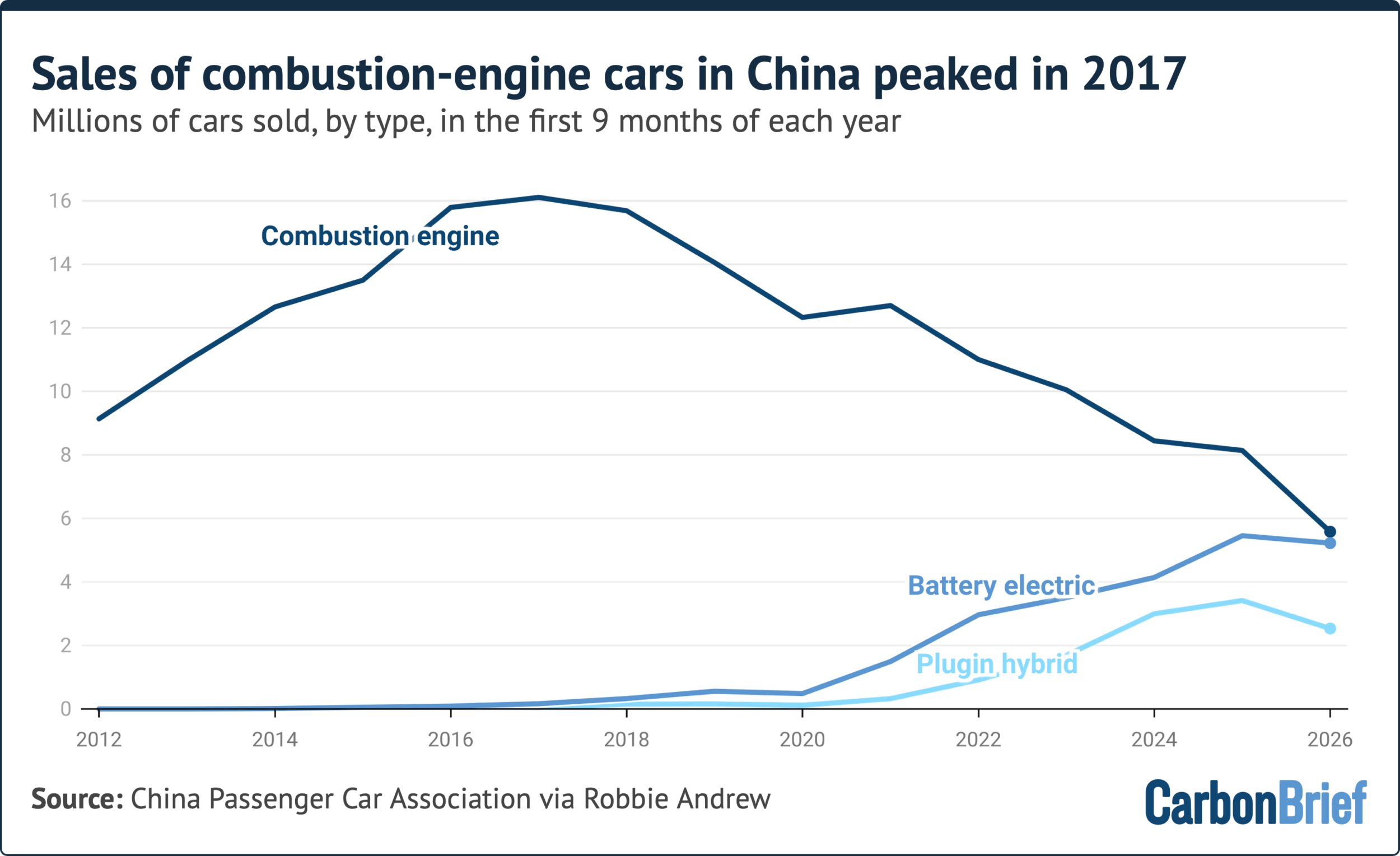
Indeed, sales of combustion-engine cars in China peaked in 2017 and they have been declining ever since, shown in the figure below.
Impact of Hormuz
Part of the reason for the advance of NEVs in 2026, said Chinese technology news outlet OFweek, was petrol cars “giving up market share” as they were outperformed by electric alternatives.
Cui Dongshu, secretary-general of the CPCA, cited higher petrol prices as an explanation for September’s weak combustion-car sales, in comments to financial news outlet National Business Daily.
Imports of oil into China in January-September have fallen 15% compared to 2025, equivalent to 470m barrels, as ongoing conflict tightened supply and drove up prices.
China’s passenger-car NEV fleet has displaced 143m barrels of oil so far during the strait of Hormuz crisis, Euan Graham, senior energy analyst at thinktank Ember, tells Carbon Brief.
EVs “accounted for 12% of the decrease in China’s oil use post-Hormuz”, according to an estimate provided to thinktank the Brookings Institute by an unnamed analyst.