

 Obviously, this is largely a function of where you live. But here’s a factor to consider: Many people charge their EV with the solar PV arrays on their rooves, and thus all their fuel is free.
I have a friend who has not put a molecule of gas in his car, or a single electron from the grid, in over 20 years of driving.
Drivers Want to Know: Is Electricity Cheaper per Mile Than Gas?

 For most of our lives, many of us boomers have believed that the biggest threat to the United States was our president, starting with Tricky Dick Nixon, the inventor of the “trickle-down economics,” liar Ronald Reagan, and GW (the moron) Bush.
But yes, none of us was prepared for the cold, calculating criminal who is Donald Trump.
There Were Prior Threats to the Nation Stemming from the White House
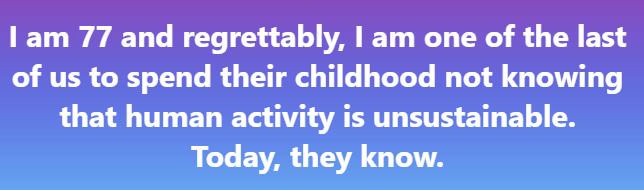 The fact that human activity is unsustainable has been revealed to us gradually over the last century. Rachel Carson’s “Silent Spring” was published 63 years ago.
That said, the ideas of climate change, ocean acidification, and loss of biodiversity have been essentially unchallenged by scientists for just the last couple of decades.
The only thing standing in the way of rapid environmental progress is greed, and in the end, that may prove to be an unbeatable foe. Decarbonizing our grid and transportation sector will eventually destroy the fossil fuel industry, a group so powerful that it has a stranglehold, both on our lawmakers and on our corporate-owned media, that works so hard to misinform our citizenry.
 It’s still possible that our most senior military leaders will insert themselves in time to prevent some truly catastrophic event here in the United States/abroad.
I keep thinking I’ll read about an exchange like this:
Trump: We’re invading Greenland.
Some four-star general: The f*** we are.
This may sound like a pipe dream, but these are people of real honor and integrity who take their oaths to our constitution quite seriously.
Will the U.S. Top Military Intervene Before Trump Inflicts Irreparable Damage



-

 Greenhouse Gases2 years ago
嘉宾来稿:满足中国增长的用电需求 光伏加储能“比新建煤电更实惠”
-
Climate Change1 year ago
Guest post: Why China is still building new coal – and when it might stop
-
Greenhouse Gases1 year ago
Guest post: Why China is still building new coal – and when it might stop
-

 Climate Change2 years ago
嘉宾来稿:满足中国增长的用电需求 光伏加储能“比新建煤电更实惠”
-
Climate Change2 years ago
Bill Discounting Climate Change in Florida’s Energy Policy Awaits DeSantis’ Approval
-

 Renewable Energy11 months ago
Sending Progressive Philanthropist George Soros to Prison?
-
Greenhouse Gases1 year ago
嘉宾来稿:探究火山喷发如何影响气候预测
-

 Climate Change2 years ago
Analysis: China’s CO2 falls 1% in Q2 2024 in first quarterly drop since Covid-19