
Connect with us

Published

on

dell

Dell Technologies is riding two big waves: rising demand for AI servers and a strong push for sustainability. Recently, the company announced record second-quarter earnings and raised its revenue forecast for fiscal 2026. AI systems are now key to its growth and climate goals.

Dell’s AI Servers Drive a Big Revenue Jump

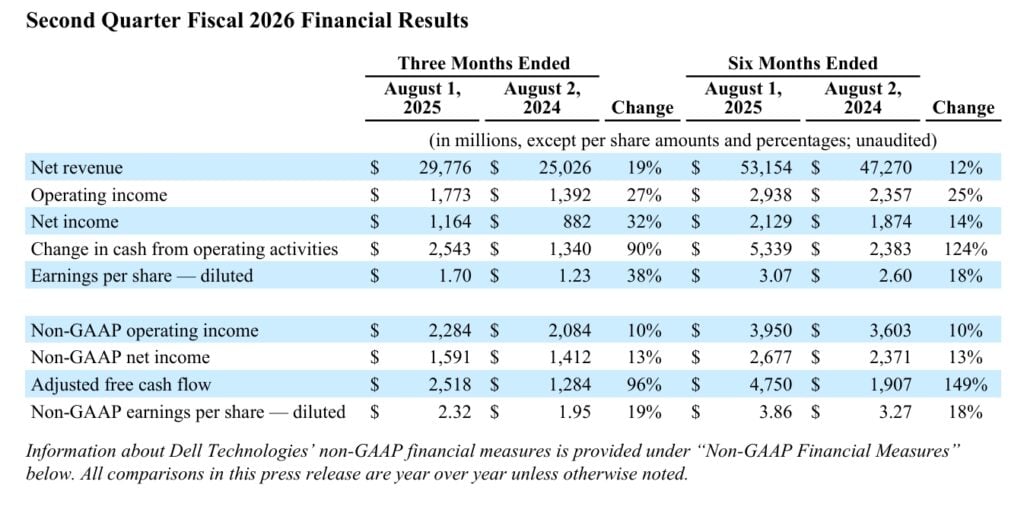
In the second quarter of fiscal 2026, Dell saw rapid growth in its AI sector. Revenue reached a record $29.8 billion, up 19% from last year. Operating income rose to $1.8 billion, a 27% increase. Earnings per share jumped 38% to $1.70, with adjusted EPS hitting a record $2.32.

The standout? AI servers. Built on NVIDIA chips, these systems drove a 44% revenue increase in Dell’s Infrastructure Solutions Group. Sales of servers and networking soared 69% to $12.9 billion. The company shipped $8.2 billion in AI systems, secured $5.6 billion in new orders, and ended the quarter with an $11.7 billion backlog.

This momentum led Dell to raise its AI server sales outlook to $20 billion for fiscal 2026, a 33% increase. The total expected annual revenue is now between $105 billion and $ 109 billion, a 12% increase from last year.

PCs Lag as Enterprise Demand Surges

While AI boosted Dell’s growth, the PC segment lagged. Sales grew only 1%, mainly due to corporate upgrades as support for Windows 10 ends in October. This weak outlook impacted Dell’s near-term forecast, with Q3 EPS projected at $2.45, which fell short of Wall Street’s expectations. Shares dropped nearly 5% after hours.

Even so, a clear trend is emerging. PCs may grow slowly, but enterprise spending on AI and cloud infrastructure is reshaping Dell’s growth story.
dell
Source: Dell

The Sustainability Thread in Dell’s Growth

Dell is aligning its growth with climate goals. The company uses circular economy principles in its supply chain and customer relationships. It aims to reduce waste, enhance resource efficiency, and cut emissions throughout its product lifecycle.

Dell has pledged to achieve net-zero emissions by 2050 across its value chain. Its 2030 goals focus on energy efficiency, renewable power, and responsible sourcing. This shows Dell’s belief that technology can help drive a low-carbon economy.

Tackling Energy and Emissions

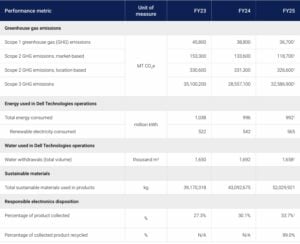
Its sustainability report says that Dell targets Scope 1 emissions, including fuel use from corporate jets and vehicles. The company plans to switch to sustainable aviation fuel (SAF) and work with providers to expand access.

For its fleet, Dell is optimizing vehicle types and numbers while adding more electric options. Electrifying its fleet may raise electricity demand (and Scope 2 emissions), but Dell is balancing this by speeding up its renewable energy transition.

Like many tech firms, Dell’s Scope 2 emissions—from purchased electricity—make up most of its footprint. To address this, Dell invests in renewable power through virtual power purchase agreements (vPPAs), joint PPAs, and renewable energy credits. It is also exploring new on-site solar projects to lessen grid reliance.

It is making significant efficiency improvements in its labs and data centers, where much electricity is consumed. These sites power the servers driving AI growth, making energy efficiency vital for operations and climate goals.
dell emissions
Source: Dell

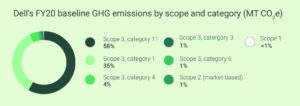
Dell is also tackling Scope 3 emissions throughout its value chain, focusing on two areas: purchased goods and customer product use. Separate targets address both areas.

As it moves toward its 2030 goals, other Scope 3 categories will account for a larger share of emissions. While Categories 1 and 11 are priorities, Dell monitors all Scope 3 sources for meaningful reductions.
Dell scope 3 emissions
Source: Dell

The Role of Carbon Credits in Dell’s Net Zero Goals

Dell knows some emissions will remain, even with aggressive decarbonization. The company plans to offset no more than 10% of its baseline emissions with carbon removals, following best practices from the Integrity Council for the Voluntary Carbon Market (ICVCM).

Currently, Dell is not engaging in large-scale carbon removals, focusing instead on its near-term 2030 decarbonization efforts. As technologies improve, Dell plans to acquire high-quality credits and removals to meet its net-zero target.

Building a Just Transition

Dell insists that the move to net zero must be fair. The company commits to sourcing renewable power only from projects that do not harm underserved communities. It integrates social responsibility into its supplier code, ensuring human rights and fair labor practices.

As a founding member of the Responsible Business Alliance, Dell requires suppliers to commit to decarbonization and respect for vulnerable workers. This involvement ensures its climate ambitions reach throughout its value chain.

Climate Resilience Through Digital Access

Dell views technology access as crucial for climate resilience. Its Solar Community Hub program offers solar-powered internet and computer access to underserved communities worldwide. By promoting digital inclusion, Dell aims to impact one billion lives by 2030, broadening the benefits of the clean energy transition.

Investors Ask: What’s Next?

With its stock outperforming the market this year, investors wonder about Dell’s next steps. According to experts, the answer likely lies in two areas:

  • Earnings trajectory – Analysts will watch if Dell can sustain its AI-driven growth amid weaker PC demand and margin pressures.

  • Sustainability execution – Stakeholders want Dell to show that its booming AI server business can grow without sacrificing climate commitments.

Dell’s guidance of $105–109 billion in annual revenue and $20 billion in AI server sales reflects confidence in growth and demand. Its detailed climate strategy indicates that Dell recognizes investors and customers want progress on emissions, not just profits.

The post Dell’s AI Server Boom Powers Record Earnings and a Net Zero Push appeared first on Carbon Credits.

Continue Reading

Carbon Footprint

Verra’s VM0051 Gains CORSIA Eligibility, Boosting Rice Carbon Credit Demand

Published

on

The global carbon market received a strong signal after the International Civil Aviation Organization (ICAO) Technical Advisory Board approved carbon credits under Verra’s VM0051 methodology for use in the Carbon Offsetting and Reduction Scheme for International Aviation.

This decision brings rice methane reduction projects into a major aviation compliance market. It also opens a new demand channel for agricultural carbon credits, especially for airlines seeking eligible offsets.

The move shows growing recognition that agricultural methane cuts can play a bigger role in global climate goals. It also strengthens the position of rice projects, which have long faced challenges in carbon finance.

VM0051, launched in early 2025, supports improved water and crop management in rice farming. It helps reduce greenhouse gas emissions while improving water use, farm efficiency, and farmer benefits.

With CORSIA eligibility now confirmed, rice carbon credits may emerge as a stronger and more mainstream carbon market asset.

Rice Farming Moves Closer to Mainstream Carbon Markets

Rice production has long carried a large climate footprint. Flooded rice fields release methane, one of the most potent greenhouse gases.

Most of these emissions come from Asia, where rice remains central to food systems and rural economies. At the same time, rising food demand could push emissions even higher in the coming decades.

rice

VM0051 Brings Scalable Rice Methane Solutions

This created a clear need for scalable solutions, yet carbon finance in rice remained limited for years. But VM0051 aims to change this.

The methodology allows project developers to reduce emissions through improved water and crop management. Farmers can adopt practices such as alternate wetting and drying, better nitrogen management, shorter cultivation cycles, and lower-emission rice varieties. Some projects may also use innovative approaches, such as methanotrophic bacteria or avoiding residue burning.

These measures cut methane emissions while improving resource efficiency.

CORSIA Expands Demand for Rice Credits

CORSIA eligibility gives these credits a potential compliance buyer base, which changes the commercial outlook significantly. Airlines can use eligible credits to help meet offsetting obligations, provided projects also secure required host country authorization.

This link between aviation and agricultural methane reduction could help move rice carbon projects from a niche activity into a larger market segment.

Inside the New Framework of VM0051 

The approval also draws attention to how much the methodology has evolved.

Verra designed VM0051 to replace an older Clean Development Mechanism methodology that was retired in 2023. The newer framework includes stronger safeguards, broader project options, and more rigorous emissions accounting.

  • Additionality requirements have been strengthened to show projects go beyond normal farming practices.
  • Dynamic baselines help reflect changing weather conditions. The methodology also requires monitoring of methane, nitrous oxide, and carbon dioxide emissions linked to project activities. This broader accounting matters because carbon markets are placing greater weight on integrity.
  • Flexible quantification approaches, including biogeochemical models, give developers more options for emissions measurement. Digital MRV tools, including remote sensing and machine learning, can also help improve monitoring and verification.

These features make the methodology more aligned with what today’s market increasingly expects.

  • Importantly, VM0051 does more than support methane reduction. It recognizes a broader set of practices, including improved fertilizer management, biochar use, reduced biomass burning, and efficient fossil fuel use in operations.
  • Furthermore, projects must also protect against soil organic carbon losses, an important safeguard in agricultural systems. This wider scope can help developers design stronger projects while improving potential emission reductions.

Credit quality remains central to buyer confidence. In a market shaped by growing scrutiny, methodologies with stronger science and stronger controls tend to attract more attention.

Airlines Could Unlock New Demand for Rice Carbon Credits

The biggest market impact may come from demand. CORSIA eligibility often changes the value proposition of a carbon credit. Access to compliance demand can support liquidity, improve price support, and increase buyer interest.

This is where rice credits may benefit, and countries in South and Southeast Asia could become central to this growth story.

The Verra Registry currently includes eight projects using VM0051, with an estimated annual issuance of more than 1.73 million carbon credits. It remains a relatively small supply base compared with larger project categories in the carbon market.

If airlines begin sourcing these credits, developers may have stronger incentives to expand project pipelines, particularly across major rice-growing economies.

Rice Credits Offer More Than Compliance Value

  • The appeal goes beyond compliance demand alone. Many buyers increasingly seek credits linked to broader sustainability outcomes. Rice methane projects can offer multiple benefits alongside emissions reductions, including improved water management, lower pollution, and stronger farmer livelihoods.
  • Some projects may also support women’s access to training and financial services, adding social value that could strengthen buyer interest.
  • These features may help position rice credits not only as compliance instruments but also as attractive assets in the wider voluntary carbon market.

Market participants will also watch whether CORSIA eligibility supports stronger pricing for these credits.

Historically, compliance-linked credits often receive more market attention than credits limited to voluntary demand. If this pattern holds, VM0051 credits could see stronger commercial interest going forward.

carbon credits

Methane Reduction Gains a Larger Role in Carbon Markets

The approval also fits a larger trend in climate markets. Methane has moved closer to the center of climate strategy. Policymakers, investors, and corporate buyers increasingly view methane reduction as one of the fastest ways to slow warming in the near term.

Thus, this shift has raised interest in projects focused on methane abatement.

Much of this attention has centered on oil and gas, waste, and livestock. Rice cultivation now gains importance because agriculture has often lagged behind other sectors in the carbon market scale.

Forestry, renewable energy, and engineered carbon removal have captured much of the attention. Agricultural methodologies have often faced challenges tied to measurement, fragmentation, and project implementation. And VM0051 significantly addresses some of these barriers through stronger science and digital tools.

The ICAO decision, furthermore, may help reinforce confidence that agriculture can supply credible credits on a larger scale. It may also encourage greater innovation in agricultural carbon methodologies beyond rice.

Developers, registries, and policymakers will likely watch closely to see whether this model expands into broader methane-focused opportunities.

A Turning Point for Rice-Based Carbon Finance

For years, rice carbon credits had strong potential but weak market momentum. Projects faced technical hurdles, limited buyer familiarity, and funding constraints. This approval shifts that outlook.

By adding VM0051 credits to the Carbon Offsetting and Reduction Scheme for International Aviation under the ICAO, a clearer link is created between compliance demand and agricultural methane cuts.

This could accelerate project growth, investment, and adoption of improved rice practices, while pushing agricultural credits closer to mainstream carbon markets.

Future expansion depends on supply, demand, and approvals, but the signal is clear: rice methane credits are entering a larger market phase.

The post Verra’s VM0051 Gains CORSIA Eligibility, Boosting Rice Carbon Credit Demand appeared first on Carbon Credits.

Continue Reading

Carbon Footprint

Renewables Overtake Coal for the First Time as World’s Largest Electricity Source in 2025

Published

on

Renewables Overtake Coal as World's Largest Electricity Source in 2025

Global renewable energy reached a major turning point in 2025. For the first time in history, it generated more electricity than coal, marking a shift in how the world produces power.

Let’s take a closer look at the details and how this milestone impacts the clean energy transition landscape as well as carbon markets.

Clean Energy Hits Historic Milestone in Global Electricity Mix

According to energy think tank Ember, renewables’ share of global electricity overtook coal’s share in 2025. Renewables now supply more than a third of global power, while coal’s share has fallen below one‑third.

clean power growth 2025 ember report

Ember notes that solar and wind together met about 99% of new global electricity demand growth in 2025. This helped push renewables ahead of coal despite rising energy use worldwide.

This milestone reflects years of investment in clean energy and signals a structural change in the global power system. It also shows that renewable technologies are now scaling fast enough to compete with traditional fossil fuels.

clean-growth-exceeds-demand-rise-ember

Solar Power Drives Record Growth in Clean Electricity

Solar energy led the global expansion in renewables. The Ember report stated,

“Record solar growth meant clean power sources grew fast enough to meet all new electricity demand in 2025, thereby preventing an increase in fossil generation. This was the first year since 2020 without an increase in electricity generation from fossil fuels and only the fifth year without a rise this century.”

The data shows that solar generation grew by about 636 terawatt‑hours (TWh) in 2025, the largest annual increase of any single electricity source ever. This surge made solar the main driver of new electricity supply.

Solar output increased by around 30% in 2025, reflecting rapid deployment and falling costs. It also played a key role in meeting rising demand. 

solar power growth close to nuclear ember 2025

Ember’s analysis indicates that solar alone met about 75% of the net increase in global electricity demand in 2025. Wind energy also contributed strongly, helping renewables meet almost all of the year’s additional demand.

The continued drop in solar costs has supported this growth. Over the past decade, solar module prices have fallen by more than 80%, making it one of the cheapest sources of new electricity in many markets.

Asia Powers the Shift: China and India Drive the Transition

The shift toward renewables has been driven largely by Asia’s biggest economies, per Ember data. China remains the largest contributor to global solar growth. It accounted for about 55% of the increase in solar generation in 2025, reflecting its large-scale investments in clean energy infrastructure.

The United States contributed around 14% of global solar growth, while India also expanded its renewable capacity significantly.

A key development in 2025 was the decline in fossil fuel generation in both China and India at the same time. This has not happened in many years.

fossil fuel drop in China and India in 2025 ember

Globally, coal generation dropped by 63 TWh in 2025, driven by reduced output in these major economies. This decline played a critical role in allowing renewables to overtake coal.

The transition in these countries has a global impact. Together, China and India account for a large share of global electricity demand and emissions. 

In 2025, the two countries together represented roughly one‑fifth of global electricity demand and more than one‑fifth of global power‑sector CO₂ emissions, according to Ember’s annual electricity review and supporting analyses.

Emissions Peak? Clean Power Starts to Bend the Curve

Despite rising electricity demand, emissions from the power sector are beginning to stabilize. Global electricity demand increased by about 2.8% in 2025. However, power-sector emissions fell slightly, even with the higher demand. 

According to Ember’s 2025 annual electricity review, power‑sector emissions fell slightly in 2025 despite a rise in global electricity demand. The analysis indicates that, without the growth of solar and wind, emissions from the power sector would have been about 236 MtCO₂ higher than they actually were.

This shows how renewable energy is helping offset emissions from growing energy use. The data further shows that the average kilowatt-hour of electricity produced globally resulted in 458 gCO₂e in 2025, about 2.7% less than 471 gCO₂e in 2024.

The International Energy Agency also projects a steady decline in carbon intensity. Global electricity emissions intensity is expected to fall from 445 grams of CO₂ per kilowatt-hour (gCO₂/kWh) in 2024 to about 400 gCO₂/kWh by 2027.

global carbon emissions from electricity generation
Source: IEA

This represents an average annual reduction of 3.6%, highlighting gradual progress toward cleaner electricity systems.

The Grid Test: Can Power Systems Keep Up With Renewables?

The rapid growth of renewables brings new challenges for power systems. Solar and wind are variable sources, meaning their output depends on weather conditions.

By 2030, variable renewables are expected to supply nearly 30% of global electricity, roughly double current levels. This will require more flexible and resilient power grids.

Key solutions include:

  • Expanding grid infrastructure,
  • Increasing energy storage capacity, and
  • Improving demand-side management.

Battery storage is playing a central role in this transition. Global battery deployment is growing quickly as costs fall.

Battery costs dropped by about 45% in 2025, to a record low of about $70 per kilowatt-hour. Meanwhile, installed storage capacity additions increased by 46% during the same period, reaching about 247 gigawatt-hours in 2025. These systems help store excess solar energy during the day and release it when demand rises.

Current battery capacity can already shift about 14% of solar generation from midday to other times of the day. This improves grid stability and reduces reliance on fossil fuel backup.

Corporate Action Supports Clean Energy Growth

Large companies are also helping drive renewable energy adoption. Microsoft has committed to using 100% renewable electricity for its operations and aims to become carbon negative by 2030. Google is investing heavily in solar and wind projects worldwide, including partnerships in Asia to support clean energy supply for data centers.

corporate clean energy purchases BNEF 2025

Corporate demand for renewable energy is growing as companies set net-zero targets and seek to reduce their carbon footprints. This trend supports further investment in renewable capacity and helps scale clean technologies.

Market Implications for Carbon Credits and Investment

The rise of renewables has important implications for carbon markets and clean energy investment. As renewable generation increases, the need for fossil fuel-based power declines. This can reduce emissions and affect demand for certain types of carbon credits.

At the same time, the transition creates new opportunities. Projects that support grid stability, energy storage, and renewable integration may generate additional carbon credits.

Investors are also shifting focus toward clean energy infrastructure. Renewable energy projects are becoming more competitive as costs fall and policy support strengthens.

The milestone of renewables overtaking coal provides strong evidence that the energy transition is accelerating.

A Turning Point for Global Energy

The fact that renewables have surpassed coal in global electricity generation marks a major turning point. It shows that clean energy is no longer a niche solution. Instead, it is becoming the foundation of the global power system.

Solar and wind are now growing fast enough to meet rising demand while reducing dependence on fossil fuelsChallenges remain, especially in grid integration and storage. However, continued investment and innovation are helping address these issues.

For policymakers, investors, and businesses, the message is clear: The global energy transition is moving from ambition to reality.

As renewable energy continues to expand, it will play a central role in reducing emissions, supporting economic growth, and building a more sustainable energy system.

The post Renewables Overtake Coal for the First Time as World’s Largest Electricity Source in 2025 appeared first on Carbon Credits.

Continue Reading

Carbon Footprint

Oklo Stock Jumps 15% as NVIDIA Partnership Sparks Nuclear-AI Momentum

Published

on

Oklo Inc. gained strong market attention after announcing a strategic partnership with NVIDIA and Los Alamos National Laboratory. The collaboration aims to accelerate the development of nuclear infrastructure, expand AI-enabled research, and push forward next-generation nuclear fuel innovation.

Investors reacted quickly. The company’s stock rose about 15%, closing at $72.41 and continuing to climb to $78.43 in pre-market trading. Over the past week, shares surged roughly 33%, reflecting rising optimism around the intersection of nuclear energy and artificial intelligence.

oklo stock
Source: Yahoo Finance

A Strategic Alliance Powering the Future

The agreement significantly brings together three complementary strengths.

  • Oklo contributes its advanced sodium fast reactor technology
  • NVIDIA adds its powerful AI computing systems
  • Los Alamos provides deep expertise in nuclear materials science and fuel research.

This combination aims to create a new class of reliable, mission-critical energy systems designed for modern infrastructure.

Inside the Plan: AI, Fuels, and Nuclear Innovation

  • Using AI to Improve Nuclear Fuel: A major focus of the partnership is applying AI to nuclear science. The companies will build AI models based on physics and chemistry to test and improve nuclear fuels, especially plutonium-based fuels. These models will help make the process faster and more accurate.
  • Better Materials and Safer Fuel: The collaboration will also work to improve materials and the way nuclear fuel is made. By combining AI with lab research, the partners aim to make fuel safer and more efficient. They will also study how to produce power and keep the grid stable for large energy use.
  • Connecting Nuclear Power with AI Systems: Another key goal is to connect nuclear reactors directly with high-performance computing systems. This includes early-stage testing that could change how energy and computing work together in the future.

Why AI Needs Nuclear—and Vice Versa

The idea of “nuclear-powered AI factories” sits at the center of this partnership. These facilities would run advanced AI workloads using dedicated nuclear power instead of relying on traditional electricity grids. This concept addresses a growing problem. Data centers require massive, constant energy, and demand continues to rise rapidly.

Nuclear energy offers a strong solution because it provides stable, round-the-clock power with low emissions. At the same time, AI can improve nuclear operations. It can analyze real-time data, detect anomalies, predict maintenance needs, and optimize reactor performance. These capabilities can enhance efficiency and reduce operational risks.

However, challenges remain. AI models must meet strict safety standards in nuclear environments. Data quality, cybersecurity, and model reliability are critical concerns. For now, AI will support human decision-making rather than replace it in safety-critical systems.

Oklo’s Technology and Market Position

At the center of Oklo’s strategy is its Pluto reactor, designed to use recycled nuclear material such as surplus plutonium. This approach not only produces energy but also helps reduce nuclear waste. The reactor was selected under the U.S. Department of Energy’s Reactor Pilot Program, highlighting its importance.

Oklo is also working to deploy its Aurora power plant at Idaho National Laboratory, targeting operations before the end of 2027. In the near term, the company faces key milestones, including meeting Department of Energy deadlines tied to reactor development and facility readiness.

Financially, Oklo remains in a strong position. The company holds about $2.5 billion in cash and carries no debt, giving it flexibility to invest in growth. It plans to spend around $400 million annually over the next two years to support expansion and technology development.

Rising Demand and the Bigger Energy Shift

Demand for clean, reliable power is rising quickly, especially from large technology companies. Oklo has already signed an agreement to supply 150 megawatts of electricity to a data center project backed by Meta Platforms by around 2030.

energy demand

This deal shows how major tech firms are actively seeking carbon-free energy solutions to support their operations.

The partnership reflects a broader shift in the global energy landscape. Artificial intelligence is driving a surge in electricity consumption, forcing industries to rethink power generation. Nuclear energy is gaining attention as a dependable, low-carbon solution, while AI is helping modernize nuclear systems.

Despite strong momentum, challenges still exist. Regulatory approvals, technical complexity, and safety requirements could slow deployment. While market enthusiasm remains high, real-world scaling will likely take time.

In the end, the collaboration between Oklo, NVIDIA, and Los Alamos highlights a powerful trend. Clean energy and advanced computing are becoming deeply connected. If successfully executed, this partnership could play a key role in shaping the future of both industries.

The post Oklo Stock Jumps 15% as NVIDIA Partnership Sparks Nuclear-AI Momentum appeared first on Carbon Credits.

Continue Reading

Trending

Copyright © 2022 BreakingClimateChange.com

