

Welcome to Carbon Brief’s DeBriefed.
An essential guide to the week’s key developments relating to climate change.
This week
China’s ‘two sessions’
‘CONCRETE MEASURES’: China’s premier Li Qiang said the country will work “diligently” and take a “series of concrete measures” to achieve the country’s “dual-carbon” goals of peaking CO2 emissions before 2030 and achieving carbon neutrality by 2060, state newspaper China Daily reported. Li made the comments as he delivered the “report on the work of the government”, a major policy document that outlines key priorities for 2025, at the nation’s all-important annual “two sessions” meeting, it said.
RENEWABLES PACKAGE: China also announced plans to develop a package of major projects to tackle climate change at the meeting, Reuters reported. A new report from the country’s National Development and Reform Commission outlined plans to develop new offshore wind farms and accelerate the construction of “new energy bases”, it added. However, coal will remain a “key fuel”, with plans to increase production and supply, the article noted.
NEW NEGOTIATOR: Li Gao was promoted to vice minister at China’s Ministry of Ecology and Environment, replacing Zhao Yingmin, who served as the head of China’s delegation to COP29, according to Bloomberg. Li is a “climate negotiator” with “two decades of experience in global climate change talks” and an “advocate of the country’s carbon-credit programme”, the article noted.
Trump continues cuts
CUTTING FORESTS: Trump signed an executive order to expand logging across 280m acres of US national forests and other public lands, the Guardian reported. Conservation groups warned that this could have a “disastrous impact on climate change, endangered species and local economies dependent on ecotourism”, added Inside Climate News.
‘NATIONAL DISASTER’: BBC News reported that around 880 workers at the US National Oceanic and Atmospheric Administration (NOAA) were fired last week. Reuters said that Jane Lubchenco, the former NOAA administrator under Barack Obama, called the layoffs a “national disaster and a colossal waste of money”, adding: “Destroying NOAA’s ability to provide life-saving information, keep our ocean healthy and strengthen the economy makes no sense – no sense at all.”
‘PIVOTAL CENTERS’: The Trump administration told NOAA that “two pivotal centres for weather forecasting will soon have their leases cancelled”, sources told Axios this week. Elsewhere, Reuters reported that the US is pulling out of the Just Energy Transition Partnership, where wealthy countries help support developing countries to move away from coal, according to several participating countries.
Around the world
- INDIAN AVALANCHE: An avalanche in the Himalayan state of Uttarakhand that killed eight people was triggered by a 600% surge in precipitation within 24 hours, fuelling “climate concerns”, reported the Times of India.
- EU EMISSIONS: The European Commission announced that carmakers will have three more years to meet emissions rules, but the 2035 ban on the sale of petrol and diesel cars remains in place, according to the Financial Times. Reuters added the EU is also still committed to its interim target for zero-emission car sales for 2030.
- JAPANESE WILDFIRE: Japan’s biggest wildfire in 30 years has burned around 2,100 hectares and killed one person so far, the South China Morning Post reported.
- CLIMATE MULTILATERALISM: Brazil will use the COP30 climate summit in November to “press for multilateralism and respect for science”, said president-designate Andre Aranha Correa do Lago, according to Reuters.
- NORTH SEA: The UK has confirmed it will not issue new North Sea oil and gas licences and announced a 2030 end date for the “windfall tax”, first introduced when fossil-fuel company profits skyrocketed in 2022, in new plans released ahead of a consultation, the Press Association reported.
36
The number of fossil-fuel companies responsible for half of global CO2 emissions, the Guardian reported.
Latest climate research
- An AI-driven assessment of COP side events from 2003-23 published in Nature Climate Change examined how fossil-fuel lobbyists have been gaining access to UN climate summits to “uncover power dynamics at the highest levels of climate governance”.
- In a high-emissions future, melting Antarctic ice could lead to Earth’s strongest ocean current slowing down by 20% by 2050, according to a new study in Environmental Research Letters.
- Women and girls continue to bear a disproportionate impacts from heatwaves in South Sudan, according to a new World Weather Attribution analysis.
(For more, see Carbon Brief’s in-depth daily summaries of the top climate news stories on Monday, Tuesday, Wednesday, Thursday and Friday.)
Captured
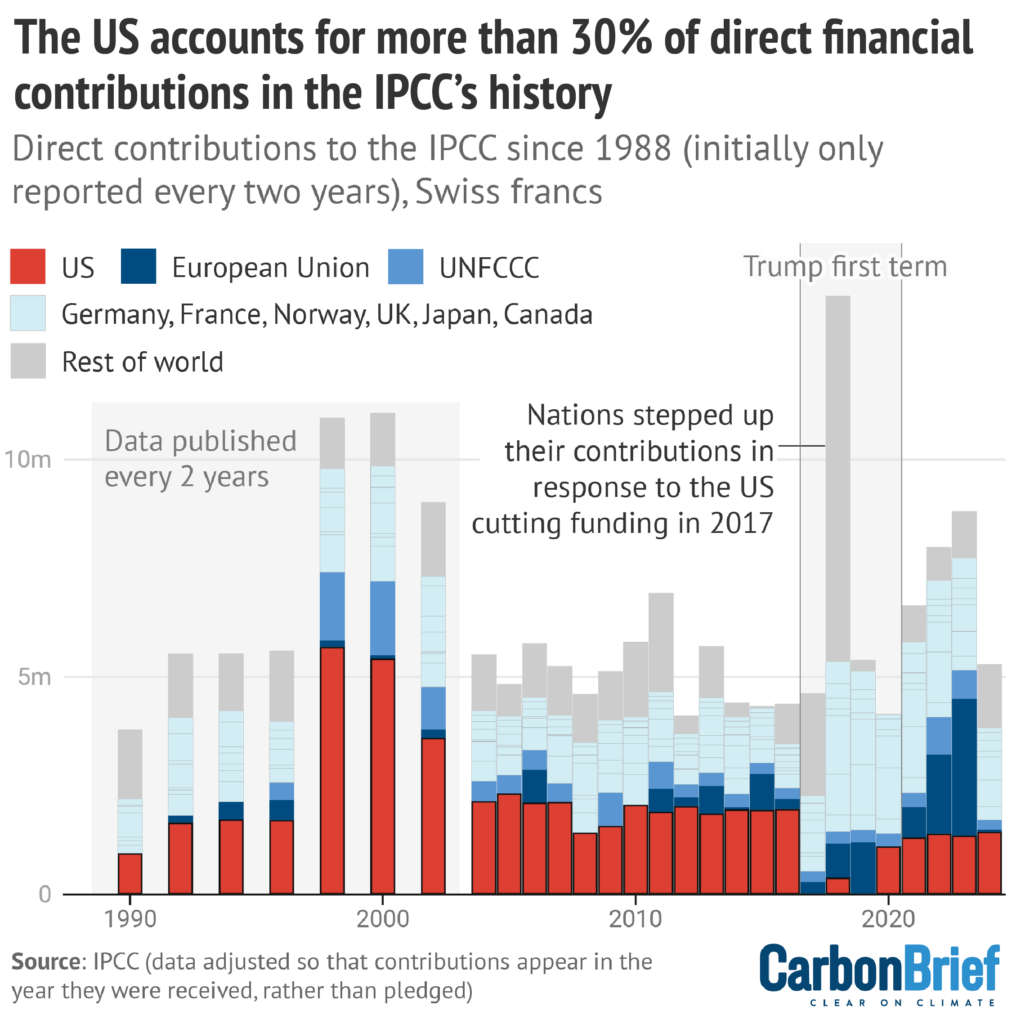
At the Intergovernmental Panel on Climate Change’s (IPCC) meeting in Hangzhou, China, governments failed for a third time to agree to a timeline for the next round of UN climate science reports, according to Climate Home News. The absence of US federal scientists “cast a shadow” over the IPCC meeting, reported the Financial Times. The chart above, from Carbon Brief’s in-depth coverage of the meeting, highlights that the US has provided around 30% of the voluntary contributions to the IPCC’s financial budgets since it was established in 1988.
Spotlight
The ‘Super Grid’ campaign of the 1950s
As the UK looks to expand its grid, Carbon Brief takes a look at what can be learned from the Super Grid expansion 70 years ago.
Electricity demand in the UK is expected to at least double by 2050, requiring an expansion of the grid to keep pace. National Grid has launched the “Great Grid Upgrade“, with at least 17 major infrastructure projects being built as part of this.
However, there has been repeated pushback, with critics condemning plans to “carpet” the countryside with pylons, “devastating” locals and “shattering” rural dreams.
Speaking earlier this year, energy and climate change secretary Ed Miliband said there would need to be a communication campaign to convey the benefits of the expansion, pointing to one during the last big expansion in the 1950s and 60s – known as the “Super Grid”.
Super Grid
The UK’s first electricity transmission grid began operation in 1933 – this excludes Northern Ireland, which is part of Ireland’s power grid. National Grid was created in 1935 and the regional grids were connected into the world’s first integrated national grid in 1938.
By 1950, the grid was at capacity, with demand rising ninefold in just 15 years.
Out of this the idea for a “Super Grid” was born. Made up of 1,150 miles of power lines held by 136-feet-high steel pylons, the grid cost £52m, roughly £1.4bn in today’s prices, over 10 years.
It was designed not just to increase capacity, but also to strengthen the north-to-south interconnections of the existing grid, especially as generation capacity shifted to large coal-fired power stations to the north of London.
After it was announced, opposition around the UK was voiced by local authorities, preservationist groups, voluntary societies and residents, citing concerns about the visual impact of the new pylons on the countryside, as well as concerns around industrialisation and the economy.
Speaking to Carbon Brief, Prof Katrina Navickas at the University of Hertfordshire said that the Super Grid expansions were undertaken during a time when there was a post-war “desire for modernisation, efficiency and growth”, adding:
“These aims were often in tension with popular demands for amenity and countryside preservation, as the national parks were set up from 1949 and a popular idea of preservation of the rural landscape arose out of the right to roam movement.”
Attempts were made to minimise the impact of the pylons on the landscape. For example, the electricity boards argued that the large scale of the infrastructure would fit the landscape better than a “cluster” of smaller grid, noted Navickas.
Debate continued into the 1960s, with ministers questioning the impact of the Super Grid “upon the beauty of the countryside”, calling on army specialists to look at the potential of camouflage and arguing against the pylons being “painted in antinationalisation Tory colours”.
Communication challenges
To try to counter the opposition to the Super Grid and wider grid expansion, the Central Electricity Generating Board (CEGB) launched an information campaign, using articles and adverts to try to convey the benefits of an expanded electricity network.

For example, one advert (above left) highlighted surging electricity demand and the need to ensure supply for future generations.
Others sought to highlight that the CEGB appreciated the need to protect the countryside and expand.
As an advert in Country Life (above right) highlighted, there is a “double duty” that falls on the shoulders of those tasked with managing the grid expansion. This is to “maintain an efficient, economical electricity supply, but also to preserve the amenities of the country”.
Some of the challenges around the attachment to the “amenity value of local landscapes” still exist today, Navickas added:
“But the ecological and environmental considerations are also much more to the fore than they had been in the 1950s and 1960s. Local community consultation has to be at the heart of any planning schemes too, whereas the earlier schemes were implemented in a much more top-down way that assumed that local opposition was based on lack of understanding of national benefits.”
Watch, read, listen
CLIMATE LENS: A new podcast titled Lights, Climate, Action discussed film and TV through a climate lens, with hosts talking about the film Don’t Look Up in their first episode.
ACTIVISM AND TRUMP: Yale360 interviewed activist and author Bill McKibben about “rethinking the role of protest, the global push on clean energy and why he sees reason for hope” in the “age of Trump 2.0”.
WOMEN’S DAY: To mark International Women’s Day, Costa Rican diplomat and former UN climate chief Christiana Figueres is joined by top climate scientist Dr Katharine Hayhoe on her Outrage and Optimism podcast to discuss why ignoring women endangers the climate.
Coming up
- 11 March: Greenland’s general election
- 16-25 March: Climate and Clean Air Conference, Brasilia, Brazil
- 17 March: G20 Second International Financial Architecture Working Group Meeting, Pretoria, South Africa
- 18-19 March: OECD x IEA Global Forum on the Environment and Climate Change, Paris, France
- 18-19 March: Berlin Energy Transition Dialogue, Berlin, Germany
Pick of the jobs
- Union of Concerned Scientists, senior climate scientist | Salary: $134,805. Location: Washington DC/remote
- Intergovernmental Panel on Climate Change, head of communication in the IPCC working group I technical support unit | Salary: Unknown. Location: Paris, France
- Community Energy England, chief operating officer | Salary: £46,000-£52,470. Location: Remote/Sheffield
- Irish Department of the Environment, Climate and Communications, head of circular economy and resource efficiency | Salary: Unknown. Location: Ireland
DeBriefed is edited by Daisy Dunne. Please send any tips or feedback to debriefed@carbonbrief.org.
This is an online version of Carbon Brief’s weekly DeBriefed email newsletter. Subscribe for free here.

The post DeBriefed 7 March 2025: China’s pivotal ‘two sessions’; IPCC indecision; Lessons from UK’s 1950s ‘Super Grid’ appeared first on Carbon Brief.

Climate Change
“Sink or swim”: WA Gov hugely underestimating decline in regional gas demand while sleeping on green exports, new report finds
PERTH, Tuesday 13 October 2026 — A new report from Greenpeace Australia Pacific and Springmount Advisory reveals green commodity exports are an untapped economic opportunity for Western Australia in a declining Asian gas market, while offering a genuine solution for decarbonising Asia.
From Gas to Green: Building Western Australia’s Future State is a comprehensive analysis of the declining gas market in Asia, and the untapped economic opportunity for WA to become a global leader in green commodity exports while driving the regional shift away from fossil fuels.
The report offers key recommendations for the WA Government to support regional decarbonisation through an orderly phase out of gas exports in favour of green iron and other green exports. It comes as global climate leaders from across business, politics and advocacy prepare to meet for the Global Citizen Now: Perth event focused on decarbonising WA.
Key findings:
- Gas demand is falling across WA’s core markets in Asia: Gas demand fell in 2025 and is projected to continue to decline, driven by a combination of global geopolitical factors and domestic concerns.
- Policy shifts in key markets since the war on Iran now prioritise renewables and nuclear over gas: Japan, South Korea and China have legislated energy plans that prioritise renewables and nuclear over gas.
- New WA gas would arrive in a saturated, uncertain Asian market filled with cheaper gas: The US is now the world’s largest liquefied gas producer and plans to double its capacity as it also targets Asian markets.
- Green commodities offer a real solution to sustain WA’s economy: WA can lead Australia’s green commodity exports, which by 2060 could be worth almost a trillion dollars.
- Exporting more WA gas is likely to delay or impede Asia decarbonisation: Despite claims by the gas industry, there is no evidence that WA gas is displacing coal in Asia, and in fact diverts resources from genuine decarbonisation options.
Geoff Bice, WA Campaign Lead at Greenpeace Australia Pacific said: “As our export partners in Asia shift away from expensive and polluting gas, the WA Government has a golden opportunity to pivot our economy to green exports, like green iron, which is the most effective way to help our region to decarbonise.
“The writing is on the wall: gas is in decline, renewables are our future. In this context, it makes zero sense for the government to encourage high risk projects like Woodside’s reckless Browse gas proposal at Scott Reef.
“This report clearly shows that the WA Government faces a choice: sink or swim. They can either allow the gas industry to keep ripping off West Australians and continue propping up its decline, or choose the path that will deliver enormous benefits to the state and the world by becoming a leader in the rapidly expanding green economy.”
Tom Quinn, Managing Director of Springmount Advisory: “Western Australia prospers when it looks to the future and builds for future demand. Twenty years from now, what the world needs is green commodities made using WAs abundant renewable resources. Just like it did with iron ore in the 1950s and gas in the 1970s, WA should look to the future and build what the world will need, not sunsetting industries like gas that are already past their peak.”
-ENDS-
Media contact
Kate O’Callaghan on 0406 231 892 or kate.ocallaghan@greenpeace.org
Lucy Keller on 0491 135 308 or lucy.keller@greenpeace.org
A report from Greenpeace Australia Pacific and Springmount Advisory reveals the untapped green economic opportunity for Western Australia in a declining Asian gas market, which also offers a genuine solution for decarbonisation in Asia.
Is Western Australia clinging to a fading gas industry while a thriving green future passes it by? As major Asian trading partners rapidly pivot away from volatile gas imports toward cheap solar and battery storage, this report exposes a high-stakes choice: risk becoming stranded in an oversupplied fossil fuel market, or harness WA’s unmatched sun and wind to lead the global clean energy transition.
Summary
From Gas to Green: Building Western Australia’s Future State reveals that Western Australia (WA) faces a critical juncture as falling Asian gas demand, geopolitical gas supply volatility and accelerating renewable energy deployment undermine the long-term economic viability of gas exports. By harnessing its world-class wind and solar resources, the report demonstrates that WA can execute an orderly phase-out of gas and pioneer a green commodity export economy that could generate $987 billion in economic value by 2060, create 24,000 ongoing jobs, and drive a 9.6% reduction in global greenhouse gas emissions.
Key Findings
- Gas demand is falling in Asia – WA can no longer rely on gas exports: Gas demand in core Asian markets fell in 2025 and is projected to continue to decline in 2026. Legislated energy plans in Japan, South Korea, and China now prioritise renewables and nuclear over gas.
- Asia is increasing renewables, importing gas just gets in the way: Evidence from markets like Thailand suggests that gas imports are increasingly crowding out cheaper renewable energy investments and battery storage rather than displacing coal, locking in more emissions over time.
- Green commodities offer a real solution to decarbonise Asia – this is a major win for WA: With world-class renewables, WA can lead Australia’s green commodity exports, which by 2060 could be worth almost a trillion dollars ($987 billion) and support a genuine 9.6% reduction in global emissions.
Recommendations to WA government
Recommendation 1: Plan an orderly gas phase-out aligned with a trading partner pivot plan
Implement a managed, orderly phase-out of gas exports aligned with trading partners’ decarbonisation pathways, rather than waiting for demand to collapse, by:
- Developing and implementing a staged phase-out of gas facilities aligned with feedstock supply expiry or typical end of facility lifespans.
- Committing to no new gas development for gas expansion, including Browse and Kimberley fields.
- Developing new, reciprocal trade relationships with existing gas trade partners, structured to progressively replace gas exports with green commodities – integrated with recommendation 2.
Recommendation 2: Develop an integrated green commodity export strategy, positioning WA as a global green iron manufacturing hub
Establish an integrated green commodity export strategy that immediately prioritises green iron development, positioning WA as a global green iron manufacturing hub, by:
- Committing to green commodity export targets to give industry and investors a clear demand signal.
- Prioritising green iron as the lead sector within the broader green commodity strategy, given WA’s iron ore endowment and first-mover potential.
Recommendation 3: Reject false solutions such as carbon dumping (CCS) and blue hydrogen
Reject carbon dumping (also described as carbon capture and storage, or CCS) and blue hydrogen as viable decarbonisation technologies, and prioritise green hydrogen and proven renewables for clean energy and fuel production by:
- Excluding blue hydrogen projects (and CCS-dependent projects) from all government support programs.
- Requiring existing hydrogen-based production (including ammonia, methanol, synthetic fuels) to have clear, near-term transition timelines to switch to green hydrogen production.