

Welcome to Carbon Brief’s DeBriefed.
An essential guide to the week’s key developments relating to climate change.
This week
Raging wildfires
SOUTH KOREAN BLAZE: Wildfires in south-eastern South Korea – the “worst wildfires in its history” – have killed at least 27 people and displaced more than 37,000 from their homes, the Korea Times reported. The Chosun Daily said that the 1,300-year-old Gounsa Temple “was reduced to ashes” and the fire continues to endanger many of the “most prized cultural assets”. A “spate” of recent wildfires in South Korea and Japan have been “linked to climate change”, the Japan Times said.
FUEL TO THE FIRES: Parts of North and South Carolina have been under evacuation orders due to several large, uncontained wildfires, with “millions of downed trees” from September’s Hurricane Helene fuelling the blazes, the Raleigh News & Observer reported. The Guardian added: “Many people in the area are still getting over the hurricane.”
UK climate and energy roundup
DEADLINE DROPPED: The UK’s High Court “agreed to push back the deadline” for the government to modify its “delivery plan” needed to meet its legally binding climate targets, BusinessGreen reported. The plan was published in 2023, but had been “subject to a legal challenge from green groups, which alleged it was not sufficiently detailed”, the outlet added.
‘GREEN SILENCE’: UK chancellor Rachel Reeves made “no mention of green issues” in her spring statement, the Guardian reported, adding that this “silence [came] as a relief” to “green experts”, given cuts announced elsewhere. Meanwhile, the Chinese owner of British Steel “rejected a £500m lifeline offer from the UK government, raising fears about thousands of jobs at the steelmaker”, the Financial Times reported.
Around the world
- IT’S ELECTRIC: Chinese automaker BYD “topped $100bn” in sales of electric vehicles and plug-in hybrids, surpassing electric-only manufacturer Tesla, the Financial Times said. Tesla sales have fallen 49% year-on-year in Europe in 2025, ABC News noted, even as EV sales overall grew 28%.
- CARBON MARKET: China released plans to include its steel, cement and aluminium industries in the country’s carbon-trading market, Reuters reported.
- COAL COMMITMENT: Germany’s incoming coalition “stand[s] by” plans to phase out coal power by 2038, according to a leaked draft reported by Euractiv, which noted the outgoing government had “favoured” 2030.
- POWER SURGE: Record temperatures in 2024 meant “global energy demand surged” last year, according to a report from the International Energy Agency covered by the Wall Street Journal. A record 585 gigawatts of new renewables were added last year, Axios reported, citing International Renewable Energy Agency data.
- SHIP-SHAPE: In Climate Home News, Kenya’s special envoy for climate change, Ambassador Ali Mohamed, “unequivocally” endorsed a proposed carbon levy on emissions from ships.
267
The number of days in 2024 – nearly three-quarters of the year – in which the US was experiencing a “major disaster”, according to analysis of US Federal Emergency Management Agency data by the International Institute for Environment and Development and CNN.
Latest climate research
- Research in the Journal of Environmental Psychology found that political polarisation around climate change becomes more pronounced as countries become wealthier.
- In China, compound hot-dry and hot-wet events became more frequent, long-lasting and intense from 1985 to 2019, with serious implications for crop losses, a new study in Earth’s Future found.
- A study in Environmental Research Letters detailed a machine learning-driven model capable of accurately forecasting marine heatwaves 10 days in advance.
(For more, see Carbon Brief’s in-depth daily summaries of the top climate news stories on Monday, Tuesday, Wednesday, Thursday and Friday.)
Captured
The US National Snow and Ice Data Center announced that Arctic sea ice reached its annual maximum extent on 21 March. At 14.33m km2, the winter peak is the smallest in the 47-year satellite record. Dr Julienne Stroeve, a senior scientist at the NSIDC, told Carbon Brief that the record low “continue[s] the overall long-term decline in the ice cover”.
Spotlight
Warming may turn butterfly hotspots from ‘safe havens to graves’
This week, Carbon Brief covers a new study that mapped and analysed the biodiversity of butterfly species around the world.
Up to a third of butterfly biodiversity “hotspots” will become too warm for the species they host by 2070, according to new research.
The study, which analysed distributional data on more than 12,000 butterfly species, was published this week in Nature Ecology & Evolution.
It found that two-thirds of butterfly species are mountain-dwellers, with mountains holding 3.5 times more butterfly biodiversity hotspots than lowland ecosystems.
The lead author of the paper told Carbon Brief he hopes that the approach laid out in the study will “broadly boost the representation of insects in global ecology and conservation”.

Mapping hotspots
Butterflies are “uniquely well-documented among insects”, Dr Stefan Pinkert, a researcher at Germany’s University of Marburg, told Carbon Brief.
But, even so, “much of this information remain[s] fragmented and inaccessible”, said Pinkert, who led the new study.
Pinkert and his colleagues used a country-level database of butterfly occurrences, along with regional range maps and previously published species-distribution models, to model the distribution of 12,119 butterfly species. They then calculated and mapped the “richness” and “range rarity” of butterfly species around the world.
Species richness was calculated as the number of unique species in the database for a given area. “Range rarity” is inversely proportional to the range size of the species in an area.
For both richness and range rarity, the researchers defined a “hotspot” as the 5% of areas around the world with the highest value of each quantity. They found that only 10% of species richness hotspots and 10% of range rarity hotspots overlap. The study said that this underlines the “limited value” of species-richness hotspots for identifying conservation priorities.
Pinkert told Carbon Brief that he was concerned to find that only 40-45% of butterfly biodiversity hotspots overlap with the biodiversity hotspots of land animals. Land-animal biodiversity has historically “served as main surrogates for defining” priorities for global conservation, he added.
Warming warning
The researchers also found that around two-thirds of all butterfly species they studied live in mountain regions, with species richness peaking at around 2,500 metres elevation and range rarity peaking at 3,500 metres. They noted that, while mountains are known for their species richness, the concentration of butterfly biodiversity is “substantially” higher than it is for other types of organisms, such as plants, birds and reptiles.
They then used climate models to project warming over the next 45 years – as well as how those temperature changes will affect butterfly habitat in the future.
They found that “temperature niche loss” – warming beyond the safe temperature range for species in a given area – would erode up to one-third of species-richness hotspots globally, under a very-high emissions scenario, with some areas losing nearly two-thirds of their hotspot area. Under a moderate emissions scenario, sub-Saharan Africa and south-east Asia would each lose a quarter of their temperature niches.
The loss of safe temperature niches was greater for hotspot areas than non-hotspot areas. The authors concluded that under accelerating warming, mountains might be converted “from safe havens to graves”.
Pinkert told Carbon Brief:
“Our results underscore the urgent need to prioritise insect conservation amid global change…Business-as-usual in prioritisation and implementation [of conservation actions] will threaten ecosystem integrity – the foundation of our well-being and that of future generations.”
Watch, read, listen
TIMELY TREK: Latin America Reports chronicled a journey to visit Colombia’s melting Andean glaciers on the country’s “climate change trail”.
ENERGY OUTLOOK: Kaare Sandholt of top Chinese thinktank the Energy Research Institute talked about the country’s energy transformation outlook – recently covered by Carbon Brief – on the Environment China podcast.
TRUMP-PROOF TOOLS: The Guardian recreated a climate-risk tool that had been purged from the US Federal Emergency Management Agency’s website under Trump’s anti-climate directives.
Coming up
- 2-3 April: 41st UN-Water meeting, Rome
- 7-11 April: Meeting of the Marine Environment Protection Committee of the International Maritime Organization, London
Pick of the jobs
- Earthjustice, legislative director, climate and energy | Salary: $164,000-$182,200. Location: Washington DC
- International Maritime Organization, media and communications associate | Salary: £45,347. Location: London
- UN Environment Programme, finance and budget assistant | Salary: Unknown. Location: Nairobi
DeBriefed is edited by Daisy Dunne. Please send any tips or feedback to debriefed@carbonbrief.org.
This is an online version of Carbon Brief’s weekly DeBriefed email newsletter. Subscribe for free here.

The post DeBriefed 28 March 2025: South Korea’s record-breaking wildfires; Arctic sea ice hits record-low peak; Butterfly biodiversity imperilled appeared first on Carbon Brief.

The UK is roughly halving the climate aid it allocates to developing countries, when accounting changes and inflation are factored in, according to new analysis by Carbon Brief.
On 19 March, the government announced that the UK would provide “around £6bn” of international “climate finance” over the next three years.
This replaces a previous goal to provide £11.6bn across the 2021-2026 period to help nations in the global south cut their emissions and deal with climate threats.
The new target was reported as a spending reduction of up to 14% compared to recent years, reflecting the UK’s wider plan to cut development aid and spend more on defence.
In fact, Carbon Brief analysis reveals that the cut is far larger in real terms, with the new target worth around 30% less per year once inflation is taken into account.
When also excluding the government’s use of widely criticised “creative accounting” to boost apparent spending, the new pledge is roughly 50% lower than the old one.
The drop in climate finance means that – alongside other major donors – the UK is diverging from an international target, agreed in 2024 at COP29 in Baku, to ramp up climate aid to $300bn a year by 2035.
‘Innovative reforms’
Under the Paris Agreement, the UK and other developed countries committed to provide financial support for climate action in developing countries. This “climate finance” comes from the UK’s wider budget for “official development assistance”.
Successive governments have pledged set amounts of climate finance over five-year periods, supporting everything from solar energy in Nigeria to mangroves in Indonesia.
In 2019, the Conservative government promised to “double” the previous target of £5.8bn for the financial years 2016-17 to 2020-21 and reach a total of £11.6bn between 2021-22 and 2025-26.
The current Labour government inherited this goal in 2024, at a time of geopolitical instability, conflict and threats to global climate action.
Alongside other developed countries, the UK then pledged at the COP29 climate summit in2024 to roughly triple the total amount of global climate finance to $300bn a year by 2035.
With its £11.6bn target expiring in April 2026, the government has been under pressure to set a new goal that would increase climate finance in line with this global ambition.
Instead, since COP29, the UK has announced it will cut overall aid spending to 0.3% of gross national income, compared to the historic 0.7%, to raise money for military spending.
This continues a trend of aid cuts started by the former Conservative government and mirrors similar cuts taking place in other countries. Most notably, the US has virtually eliminated its contribution to international climate finance.
In March, foreign secretary Yvette Cooper finally announced details of how the UK’s headline cuts in overseas aid would impact specific spending priorities between 2026-27 and 2028-29, including climate finance. She said:
“Over the next three years, the UK will spend around £6bn of official development assistance as international climate finance. We will balance support between mitigation and adaptation and maintain a focus on nature.”
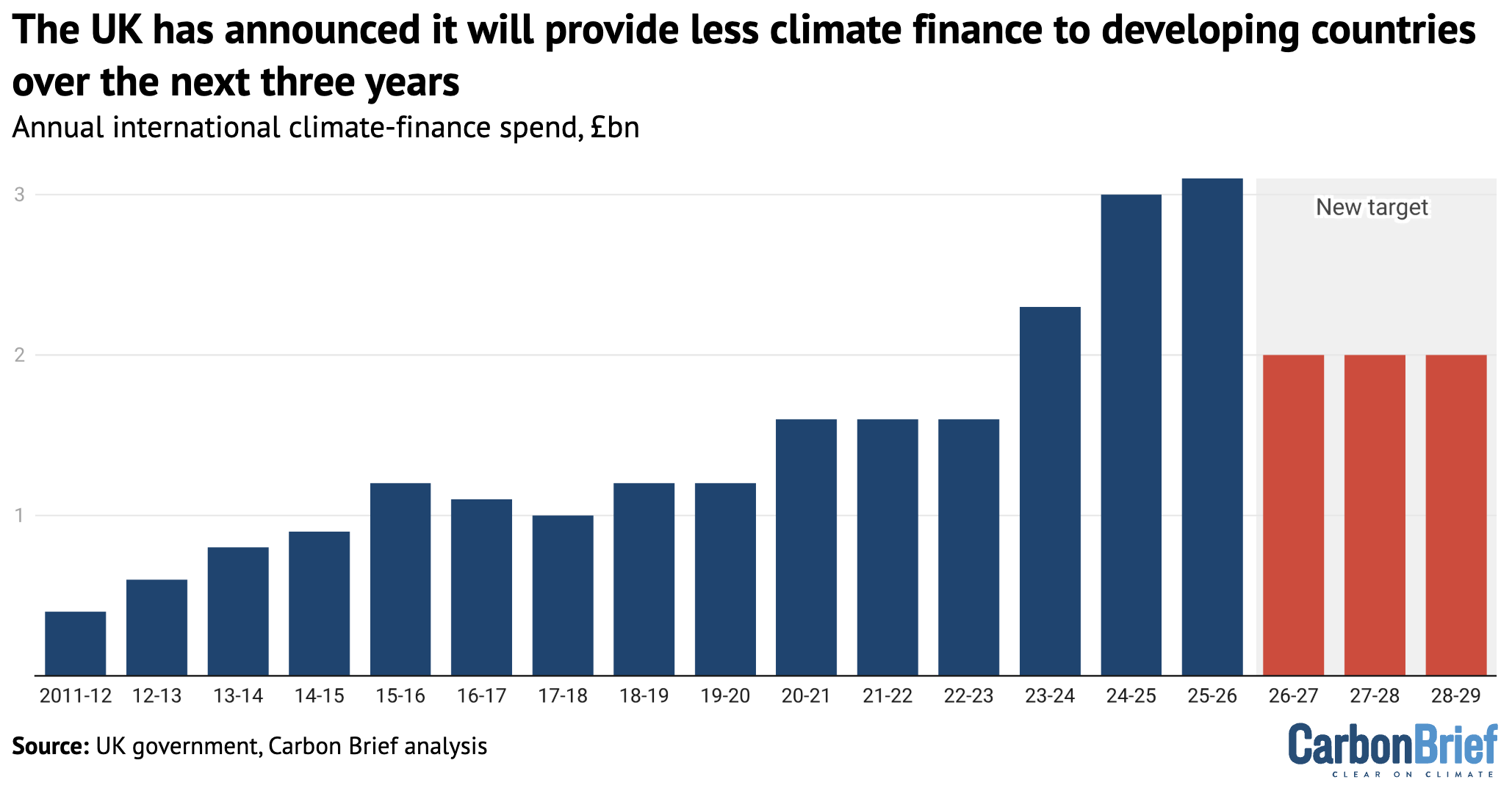
This amounts to a clear cut in annual climate-finance spending, even without considering the impact of inflation or accounting changes, as the chart below shows.
Despite Cooper’s pledge to “maintain a focus on nature”, the government also scrapped the “ring-fencing” of funds for nature and forest conservation, as well as the practice of setting five-year goals to provide more certainty to climate-aid recipients.
(The relatively vague “around” £6bn is also notable, given the previous targets were set at precisely £11.6bn and £5.8bn. This could allow the government to ultimately spend less than £6bn.)
The government is also clear that it is shifting its focus to using public development aid to “unlock private investment for development”, framing its overall approach as “innovative development reforms”. Cooper stated that, as well as the £6bn in climate finance:
“We will aim to generate an additional £6.7bn of UK-backed climate and nature positive investments and to mobilise billions more in private finance.”
Cooper described “climate and nature” as two of the government’s four “priority” themes for its dwindling aid spending.
Nevertheless, the international development committee of MPs expressed “deep concern” about the new climate pledge and NGOs called it a “backward step”.
Accounting changes
Media coverage of Cooper’s announcement stated that the new climate-finance target was 13-14% lower than the previous one.
This is based on the difference between average annual contributions out to 2029 under the new pledge – around £2bn – and the £2.3bn average from the previous period.
However, Carbon Brief analysis suggests that this straightforward approach makes the target seem more ambitious than it actually is.
When the £11.6bn target was set in 2019, only specific, climate-related projects funded directly by the UK government counted towards it. Then, in 2023, the Conservative government decided to loosen the criteria for the funds it counted towards the target.
This included relabelling existing support for multilateral development banks (MDBs), humanitarian aid and more private-sector investments as “climate finance”.
This approach – which mirrors that of other climate-finance donors – means the government is now on track to hit the £11.6bn target. (For more details, see Carbon Brief’s previous coverage.)
NGOs criticised this “creative accounting” at the time. Similarly, the UK’s official aid watchdog described the changes as “moving the goalposts”, as they meant the government could meet its target without providing as much new money. Nevertheless, the current Labour government has retained the changes.
The government released a list of specific aid allocations alongside Cooper’s recent announcement, which includes how much it plans to give to MDBs, as well as the UK-owned development body, British International Investment (BII).
Most of this money would not have been counted as climate finance under the old accounting system. Under the new system, a large portion of it will be.
Carbon Brief estimates that £1.7bn of new climate finance over the next three years – roughly 28% of the total – would not have counted as climate finance before the government’s accounting changes.
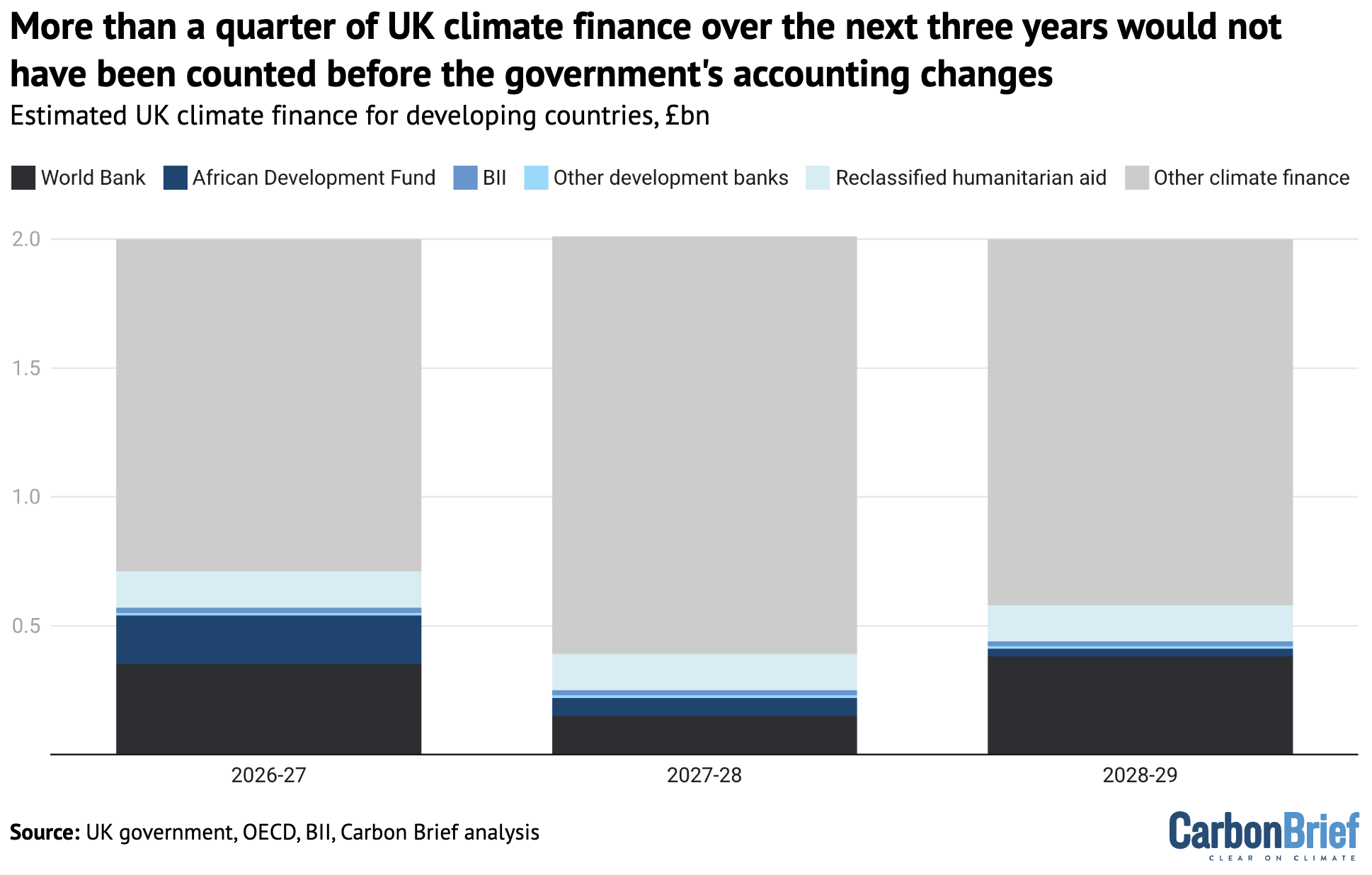
As the chart above shows, much of the money reclassified as climate aid will derive from automatically counting a fixed share of UK funding for MDBs as “climate-relevant”.
MDBs, including the World Bank and the African Development Bank, are major contributors to global climate finance. Member states, such as the UK, pay money into these banks, which then use their financial resources to support development projects.
Notably, while virtually all of the UK’s traditional climate finance has been provided as grants to developing countries, MDBs provide most of their support as loans. The prevalence of loans in global climate finance is a long-standing point of contention for developing countries.
Including inflation
The second key factor that influences the comparison between the UK’s old and new climate-finance targets is inflation. Experts have highlighted the importance of correcting for inflation when considering long-term finance targets.
This issue is particularly important now, as in recent years there has been significant inflation in the UK and around the world. This means the finance that the UK committed to give back in 2019 would not go as far today as it did then.
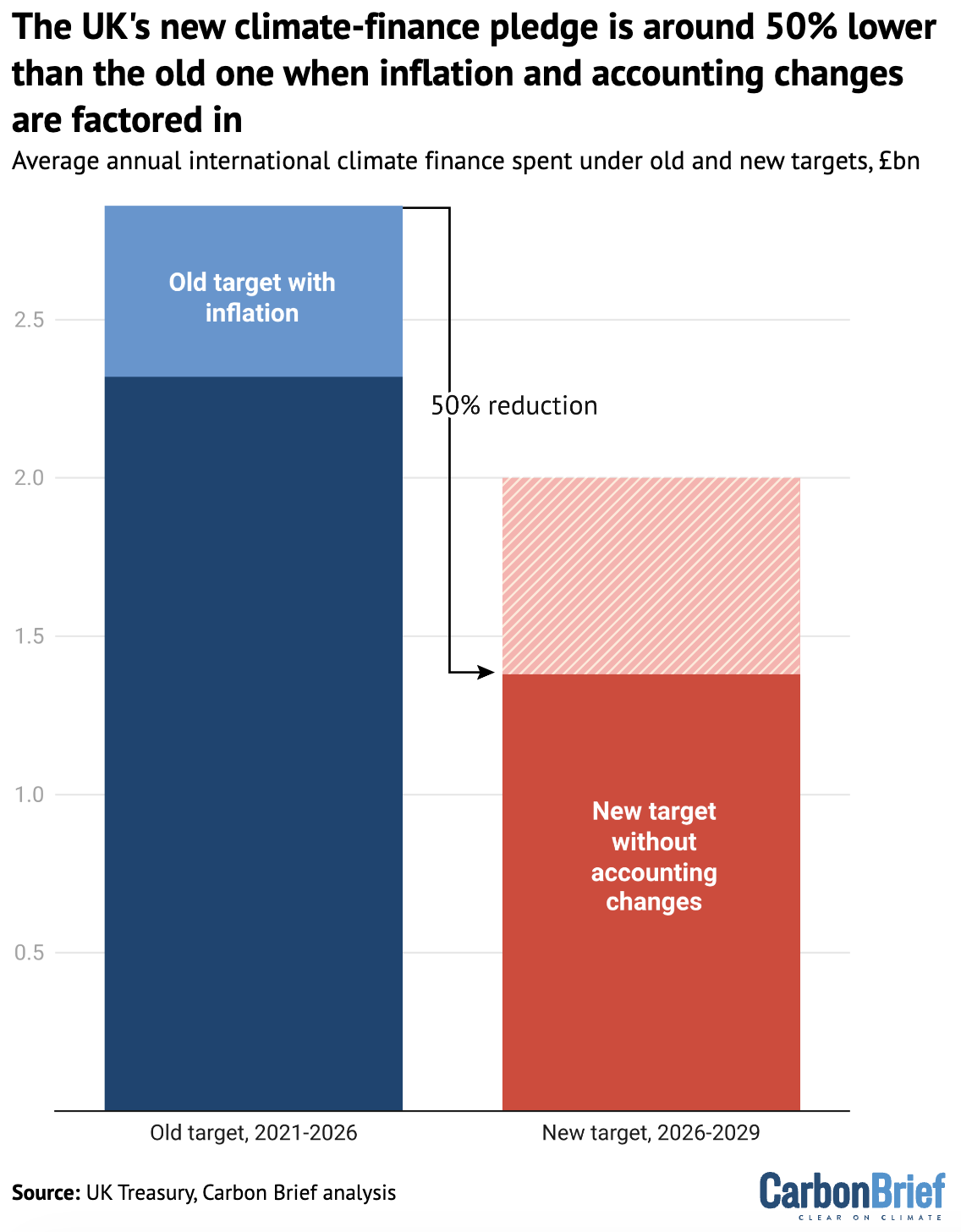
Adjusting for this inflation, Carbon Brief estimates that the £11.6bn target would equate to £14.3bn today, using 2021-22 – the start of the £11.6bn target – as the base year.
This means the government would have to pledge £14.3bn over five years – or £2.86bn a year – just to match the spending power of its previous goal. This new goal of £2bn a year is effectively a 30% real-terms cut in annual climate finance from the UK.
As the chart below shows, the previous climate target from five years ago is roughly twice as large per year as the new 2026 target, after correcting for inflation and once accounting changes have been removed.
Of course, ultimately, the government relied on accounting changes to meet the previous £11.6bn target as well.
Nevertheless, this comparison shows the significant backsliding in ambition, from 2021 when the plan was an £11.6bn goal, relying on a narrow range of sources – to a 2026 target that is lower in real terms, while drawing from a wider range of sources.
Global cuts
In 2024, developed countries such as the UK collectively agreed to raise their global climate-finance contributions to $300bn a year by 2035, as part of their Paris Agreement obligations.
This international target replaced the previous goal of $100bn per year by 2020, which was belatedly met in 2022.
While the new target will include large contributions from the private sector and MDBs, there is an expectation that a significant portion of it will still come directly from developed countries.
In this context, it is clear that the trajectory of UK climate finance is going in the wrong direction – falling, rather than increasing
The UK is certainly not alone in this regard. Speaking in parliament, Cooper told MPs that “allies such as Germany, France and Sweden have made similar choices” to cut aid in order to fund military spending.
Very few developed countries – and none of the biggest donors – have officially announced new or updated climate-finance targets for the coming years.
However, analysis by aid organisation CARE International last year concluded that other major climate-finance donors, including Germany and France, will also see their climate finance fall over the coming year, following cuts to their aid budgets.
The most significant drop has come from the US, which has effectively cut its international climate finance from several billion dollars a year to zero, under the Trump administration.
In addition to cutting its overall contribution, the UK is signalling that it will focus less on grant-based climate finance from government spending and more on “unlocking” billions of pounds in private-sector finance for climate action, as well as on “reform of the international development system”.
Such approaches may end up playing a major role in nations hitting the $300bn target by 2035.
However, this is highly contentious, with many developing countries arguing at UN negotiations that developed countries are reneging on their responsibilities to directly “provide” climate finance.
Methodology
The UK has announced that it will spend “around £6bn” on international climate finance between 2026-27 and 2028-29. Alongside this announcement, it released a list of “official development assistance (ODA) programme allocations 2026-27-2028-29”. These include details of “planned multilateral ODA programming” – covering MDBs – and spending on “arm’s-length bodies, private sector investments, subscriptions”, including BII.
Carbon Brief calculated the climate-related shares of core MDB finance – which the UK now counts as climate finance – using the climate shares for each MDB identified by the Organisation for Economic Co-operation and Development (OECD) in 2023. These estimates may be conservative, as MDBs have committed to increasing the shares of their projects that are climate-related.
Carbon Brief calculated the extra BII contributions that the UK will count as climate finance by assuming, based on the most recent BII annual accounts, that 41% of its commitments each year will be climate-related. Previously, only 30% of BII contributions were counted as climate finance, so Carbon Brief assumed the difference between these shares would be additional.
The government has also said it now automatically counts 30% of all humanitarian assistance provided to the 10% most climate-vulnerable countries as climate finance. Based on figures provided to Carbon Brief via freedom of information request, this amounts to roughly 10% of all humanitarian assistance in recent years. The government has said it will “spend approximately £1.4bn each year in the places with the highest humanitarian need over the next three years”. Carbon Brief assumed that 10% of this – £140m each year – would count as climate finance.
To calculate the impact of inflation on the £11.6bn target, Carbon Brief used the UK Treasury’s GDP deflator, with 2021-22 as the baseline year.
The figures in this analysis are estimates based on the data released by the government so far. Climate-finance data is subject to various accounting changes and the final figures – when they are released – are likely to be different.


The post Analysis: UK is ‘halving’ its climate finance for developing countries appeared first on Carbon Brief.
Analysis: UK is ‘halving’ its climate finance for developing countries
The agency typically doesn’t allow smog-creating ethanol blends in the summer but is relaxing that restriction to appease consumers and farmers.
The Trump administration handed farmers and the ethanol industry a win on Wednesday by issuing a waiver that will allow the use of higher corn-based ethanol blends in gas tanks this summer.
As Prices Soar, EPA Greenlights Higher Ethanol Blends in Gasoline
A group of farmers plans to sue the developers of the East African Crude Oil Pipeline (EACOP) in a British court, claiming the project breaches the Ugandan constitution and climate and environment law.
In a previously unreported letter before action, sent to the developers’ UK-based arm in January, the farmers say they and their livelihoods risk being harmed by climate change which the pipeline will worsen by generating millions of tonnes of greenhouse gas emissions.
Their law firm, London-based Leigh Day, plans to file a formal claim in the next few months, in which it will ask for construction of the pipeline – which will cost around $5.6 billion to build, spans Uganda and Tanzania and is four-fifths complete – to be halted.
The lawsuit has been crowdfunded by donations from over 40,000 people, coordinated by the Avaaz campaign group, which promote the case as “one final chance to stop one of the worst oil pipelines on the planet”.
-
Where East African oil pipeline meets sea, displaced farmers bemoan “bad deal” on compensation
The oil export project has pushed up the price of land, so compensation is too low to maintain affected villagers’ standard of living

The pipeline is a joint venture led by French company TotalEnergies, with smaller stakes owned by Uganda, Tanzanian and Chinese national oil firms. But it is operated by EACOP Ltd, a company registered to an office in Canary Wharf, the tallest building in London’s financial district.
Leigh Day solicitor Joe Snape, who represents the group of farmers, said EACOP highlights how corporations in the Global North are profiting from fossil fuel extraction projects in the Global South which also suffer most from their worsening of climate change.
Ugandan law tested in UK court
The group of four farmers accuses EACOP Ltd of breaching their right to a clean and healthy environment under the Ugandan constitution, as well as its legal obligations under Uganda’s National Environment Act and National Climate Change Act.
Leigh Day solicitor Joe Snape, who represents the farmers, told Climate Home News that Ugandan law has novel clauses allowing people to make environmental claims without having to demonstrate a precise link to their own loss. They just have to show that the action complained of threatens, or is likely to threaten, efforts to reduce emissions or adapt to climate change, he said.
However, these clauses have not yet been tested in court, so it will be up to British judges, if they accept the case, to interpret how they apply in practice.
Leigh Day is keen to use the UK’s legal system because it perceives it as more impartial and efficient than that of Uganda, Snape said. A climate lawsuit filed in Uganda more than a decade ago by a group of young people has yet to conclude.
EACOP has been subject to repeated lawsuits in several countries, none of which have succeeded. A case at the East African Court of Justice, brought by campaign groups against Uganda and Tanzania, was rejected on procedural grounds last November.
A separate ongoing lawsuit in TotalEnergies’ home country of France – a refiled version of an earlier failed claim – cannot stop EACOP going ahead, but it does seek damages from TotalEnergies for affected communities.
Thousands already displaced
The pipeline, which will link Uganda’s Lake Albert oil fields to Africa’s east coast in Tanzania, is around 80% completed according to its developers, with first oil exports possible as early as October.
Thousands of people have already been displaced by the pipeline, with compensation paid and many training schemes – whose quality has been criticised – already completed.
Despite this progress, the farmers’ legal team say that a court could still stop the pipeline from being completed. Any contractual or compensation issues arising from the stoppage and the billions of dollars of sunk costs would have to be dealt with separately, said Snape.
Gerald Barekye, a farmer, researcher and campaigner, from the pipeline-affected Hoima district, will be one of the claimants. He said that Ugandan communities were already living with flooding, drought and food insecurity caused by climate change.
“Allowing these oil companies to complete the construction of the EACOP pipeline and extract millions of barrels of oil, which will produce millions of tonnes of emissions, will only make this situation in this region worse and deepen our suffering,” he said.
Agriculture, which makes up a fifth of Uganda’s GDP and employs two-thirds of its population, is likely to be affected by falling yields, rising plant pests and diseases, reduced suitable for crop growing and changes to growing seasons caused by climate change.
As well as the climate impacts, they will argue that the pipeline will have a significant impact on local nature and wildlife from possible oil spills, habitat fragmentation, noise pollution and new infrastructure, and poses a threat to major water resources.

Michel Forst, UN Special Rapporteur on environmental defenders under the Aarhus Convention, has raised further concerns about “serious allegations of persistent and widespread attacks and threats” against environmental defenders in Uganda over the project.
In 2022, Ugandan police arrested nine activists protesting against EACOP. One protester, Nabuyanda John Solomon, told Climate Home News at the time that police had broken one man’s arm and hit another in the eye with a baton.
EACOP Limited did not respond to a request for comment.
The post Ugandan farmers use British court to try to stop oil pipeline appeared first on Climate Home News.
Ugandan farmers use British court to try to stop oil pipeline



-
Greenhouse Gases8 months ago
Guest post: Why China is still building new coal – and when it might stop
-
Climate Change8 months ago
Guest post: Why China is still building new coal – and when it might stop
-

 Greenhouse Gases2 years ago
嘉宾来稿:满足中国增长的用电需求 光伏加储能“比新建煤电更实惠”
-
Climate Change2 years ago
Bill Discounting Climate Change in Florida’s Energy Policy Awaits DeSantis’ Approval
-

 Climate Change2 years ago
嘉宾来稿:满足中国增长的用电需求 光伏加储能“比新建煤电更实惠”
-
Climate Change Videos2 years ago
The toxic gas flares fuelling Nigeria’s climate change – BBC News
-

 Carbon Footprint2 years ago
US SEC’s Climate Disclosure Rules Spur Renewed Interest in Carbon Credits
-

 Renewable Energy5 months ago
Sending Progressive Philanthropist George Soros to Prison?