Connect with us

Published

on

You may have seen headlines recently about a new global treaty that went into effect just as news broke that the United States would be withdrawing from a number of other international agreements. It’s a confusing time in the world of environmental policy, and Ocean Conservancy is here to help make it clearer while, of course, continuing to protect our ocean.

What is the High Seas Treaty?

The “High Seas Treaty,” formally known as the Agreement on the Conservation and Sustainable Use of Marine Biological Diversity of Areas Beyond National Jurisdiction (BBNJ) Agreement, went into effect on January 17, 2026. We celebrated this win last fall, when the agreement reached the 60 ratifications required for its entry into force. (Since then, an additional 23 countries have joined!) It is the first comprehensive international legal framework dedicated to addressing the conservation and sustainable use of the high seas (the area of the ocean that lies 200 miles beyond the shorelines of individual countries).

To “ensure the conservation and sustainable use of marine biological diversity” of these areas, the BBNJ addresses four core pillars of ocean governance:

  1. Marine genetic resources: The high seas contain genetic resources (genes of plants, animals and microbes) of great value for pharmaceuticals, cosmetics and food production. The treaty will ensure benefits accrued from the development of these resources are shared equitably amongst nations.
  2. Area-based management tools such as the establishment of marine protected areas (MPAs) in international waters. Protecting important areas of the ocean is essential for healthy and resilient ecosystems and marine biodiversity.
  3. Environmental impact assessments (EIA) will allow us to better understand the potential impacts of proposed activities that may harm the ocean so that they can be managed appropriately.
  4. Capacity-building and the transfer of marine technology with particular emphasis on supporting developing states. This section of the treaty is designed to ensure all nations benefit from the conservation and sustainable use of marine biodiversity through, for example, the sharing of scientific information.

Get Ocean Updates in Your Inbox

Sign up with your email and never miss an update.

This field is hidden when viewing the form

Name(Required)


By providing your email address, you consent to receive emails from Ocean Conservancy.
Terms & Conditions and Privacy Policy

This field is hidden when viewing the form
Email Opt-in: Selected(Required)

Why is the High Seas Treaty Important?

The BBNJ agreement is legally binding for the countries that have ratified it and is the culmination of nearly two decades of negotiations. Its enactment is a historic milestone for global ocean governance and a significant advancement in the collective protection of marine ecosystems.

The high seas represent about two-thirds of the global ocean, and yet less than 10% of this area is currently protected. This has meant that the high seas have been vulnerable to unregulated or illegal fishing activities and unregulated waste disposal. Recognizing a major governance gap for nearly half of the planet, the agreement puts in place a legal framework to conserve biodiversity.
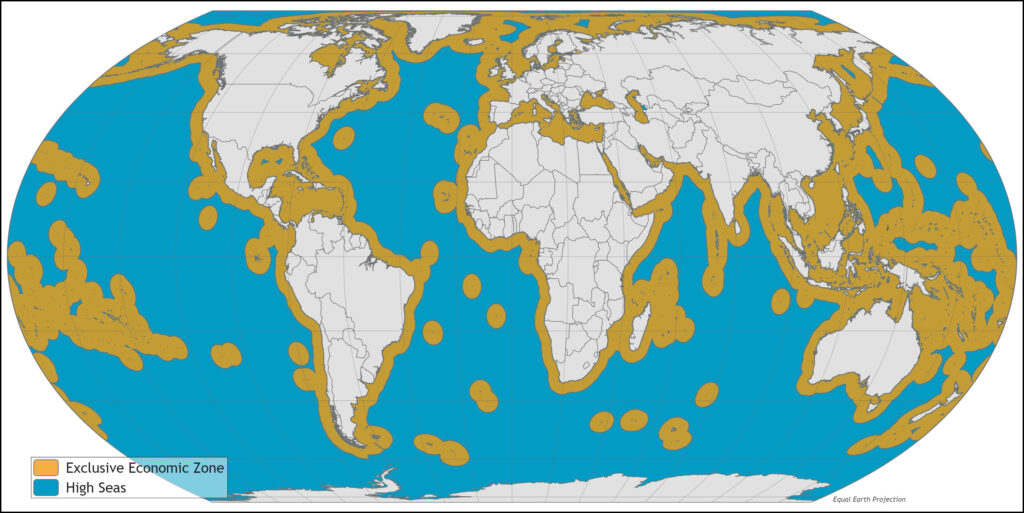
A map of the globe depicting the areas designated as high seas versus exclusively an economic zone. The high seas represent about two-thirds of the global ocean.

As it promotes strengthened international cooperation and accountability, the agreement will establish safeguards aimed at preventing and reversing ocean degradation and promoting ecosystem restoration. Furthermore, it will mobilize the international community to develop new legal, scientific, financial and compliance mechanisms, while reinforcing coordination among existing treaties, institutions and organizations to address long-standing governance gaps.

How is Ocean Conservancy Supporting the BBNJ Agreement?

Addressing the global biodiversity crisis is a key focal area for Ocean Conservancy, and the BBNJ agreement adds important new tools to the marine conservation toolbox and a global commitment to better protect the ocean.

Ocean Conservancy’s efforts to protect the “ocean twilight zone”—an area of the ocean 200-1000m (600-3000 ft) below the surface—is a good example of why the BBNJ agreement is so important. The ocean twilight zone (also known as the mesopelagic zone) harbors incredible marine biodiversity, regulates the climate and supports the health of ocean ecosystems. By some estimates, more than 90% of the fish biomass in the ocean resides in the ocean twilight zone, attracting the interest of those eager to develop new sources of protein for use in aquaculture feed and pet foods.
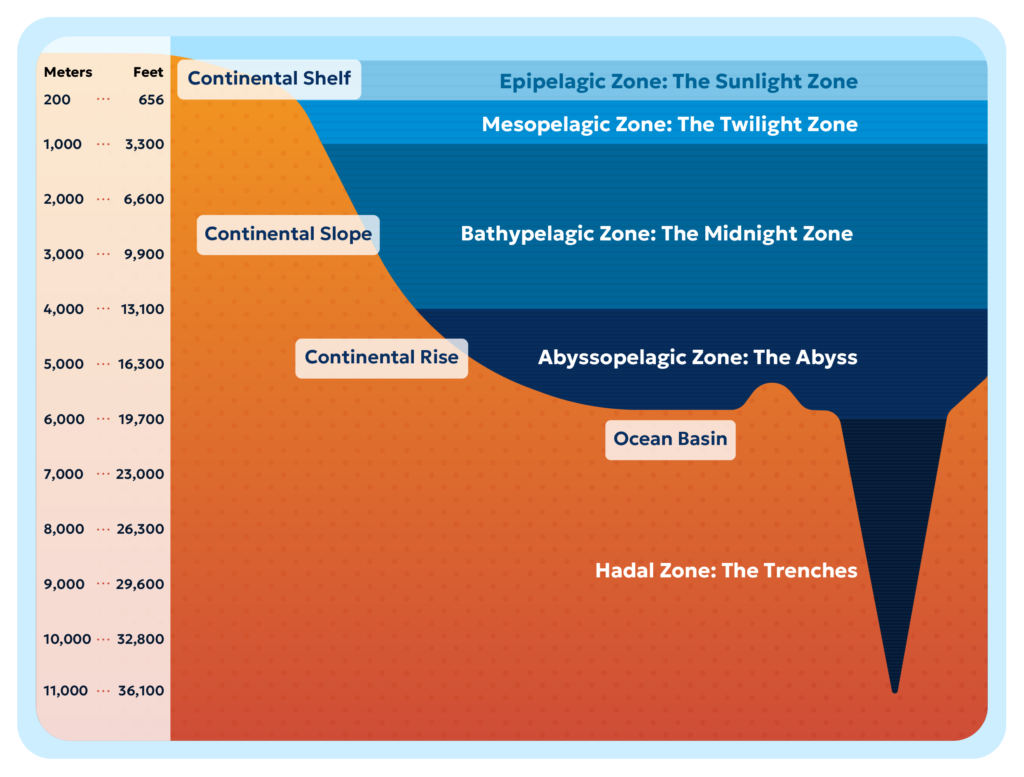
An illustration of the zones of the ocean floor, depicting depth in meters/feet on the left and the layers from light blue to dark blue and orange, listed as follows: Continental Shelf (Epipelagic Zone: The Sunlight Zone; Mesopelagic Zone: The Twilight Zone), Continental Slope (Bathypelagic Zone: The Midnight Zone); Continental Rise (Abyssopelagic Zone: The Abyss), Ocean Basin, Hadal Zone: The Trenches.

Done poorly, such development could have major ramifications for the health of our planet, jeopardizing the critical role these species play in regulating the planet’s climate and sustaining commercially and ecologically significant marine species. Species such as tunas (the world’s most valuable fishery), swordfish, salmon, sharks and whales depend upon mesopelagic species as a source of food. Mesopelagic organisms would also be vulnerable to other proposed activities including deep-sea mining.

A significant portion of the ocean twilight zone is in the high seas, and science and policy experts have identified key gaps in ocean governance that make this area particularly vulnerable to future exploitation. The BBNJ agreement’s provisions to assess the impacts of new activities on the high seas before exploitation begins (via EIAs) as well as the ability to proactively protect this area can help ensure the important services the ocean twilight zone provides to our planet continue well into the future.

What’s Next?

Notably, the United States has not ratified the treaty, and, in fact, just a few days before it went into effect, the United States announced its withdrawal from several important international forums, including many focused on the environment. While we at Ocean Conservancy were disappointed by this announcement, there is no doubt that the work will continue.

With the agreement now in force, the first Conference of the Parties (COP1), also referred to as the BBNJ COP, will convene within the next year and will play a critical role in finalizing implementation, compliance and operational details under the agreement. Ocean Conservancy will work with partners to ensure implementation of the agreement is up to the challenge of the global biodiversity crisis.

The post What is the High Seas Treaty and Why Does It Matter? appeared first on Ocean Conservancy.

https://oceanconservancy.org/blog/2026/02/25/high-seas-treaty/

Continue Reading

Ocean Acidification

Between Storms and Science: Easter in the Labrador Sea (04.04.26–13.04.26)

Published

on

Between all the scientific work, we celebrated Easter on board, although the weather had other plans for us. Due to rough conditions, we weren’t able to carry out any CTD casts.

Photo: Sarah Tomae

Easter itself was spent in a mix of rest and small celebrations. Some of us enjoyed a long Easter breakfast with traditional Easter bread, while others took the opportunity to sleep in. In the evening, we gathered with both crew and scientists for a small celebration. The ship’s cook even organized a quiz, and those who answered correctly were rewarded with Easter chocolate.

The next day, the weather improved, and we began early with the recovery of K1, a 3,495-meter-long mooring in the middle of the Labrador Sea.

We joined the nautical officers on the bridge before sunrise to search for it. Fortunately, K1 has a floating buoy with a light, so we were able to spot it even in the dark. The actual recovery started at first light, and it began to snow while we were working.

Photo: Sarah Tomae, GEOMAR

Amid all the CTDs and mooring operations, there was also a personal highlight: my (Sarah’s) birthday. Although I’ve spent birthdays away from home before, this one felt especially unique, being so far out at sea, with only limited internet contact.

Normally, I work the 4-8 shift, but my incredibly kind shift team gave me the morning off. That meant I could sleep in and even find time to call family and friends back home. In the afternoon, I was surprised with my favourite cake, baked by Julia.

Our work continued with the mooring array at 53°N, which consists of seven moorings. So far, we have recovered five (K7, K8, K9, DSOW1 and DSOW2), and three of them have already been redeployed (K7, K8 and DSOW1,).

Deploying K7 turned out to be particularly tricky. On our first attempt, sea ice drifted toward us faster than expected, forcing us to recover nearly half of the mooring again. While the ship itself can handle drifting ice, deploying a mooring is much more delicate: a long cable with instruments and floats is released behind the ship before the anchor is dropped, allowing the system to sink into place.

Two days later, we tried again and this time, the deployment was successful.

Photo: Sarah Tomae

Afterwards, we moved closer to the sea ice, which was a highlight for many of us. Seeing the ice up close and even spotting a seal swimming nearby, made the experience unforgettable.

Photo: Sarah Tomae
Photo: Sascha Gniosdorz

Due to the continuing harsh weather, the decision was made to return to K1 and make use of an upcoming weather window for deployment the following day.

German:

Zwischen Stürmen und Wissenschaft: Ostern in der Labradorsee (04.04.26 – 13.04.26)

Zwischen all der wissenschaftlichen Arbeit haben wir Ostern an Bord gefeiert, auch wenn das Wetter andere Pläne für uns hatte. Aufgrund der rauen Bedingungen konnten wir keine CTD-Messungen durchführen (Messungen von Leitfähigkeit, Temperatur und Tiefe im Ozean).

Foto: Sarah Tomae

Ostern selbst war eine Mischung aus Erholung und kleinen Feierlichkeiten. Einige von uns genossen ein ausgedehntes Osterfrühstück mit traditionellem Osterbrot, während andere die Gelegenheit nutzten, etwas länger zu schlafen. Am Abend kamen Crew und Wissenschaftler*innen zu einer kleinen Feier zusammen. Der Koch organisierte sogar ein Quiz, und wer die Fragen richtig beantwortete, wurde mit Oster-Schokolade belohnt.

Am nächsten Tag besserte sich das Wetter, und wir begannen früh mit der Bergung von K1, einer 3.495 Meter langen Verankerung mitten in der Labradorsee. (Eine Verankerung ist eine lange, am Meeresboden befestigter Draht, der mit Instrumenten ausgestattet ist, um über längere Zeit Ozeandaten zu messen.)

Noch vor Sonnenaufgang gingen wir mit den nautischen Offizieren auf die Brücke, um nach ihr Ausschau zu halten. Glücklicherweise verfügt K1 über eine schwimmende Boje mit Licht, sodass wir sie bereits im Dunkeln entdecken konnten. Die eigentliche Bergung begann bei Tagesanbruch und es begann sogar zu schneien.

Foto: Sarah Tomae

Zwischen all den CTD-Einsätzen und Verankerungsarbeiten gab es auch ein persönliches Highlight: meinen (Sarahs) Geburtstag. Obwohl ich schon öfter Geburtstage fernab von zu Hause verbracht habe, war dieser besonders, so weit draußen auf dem Meer und mit nur eingeschränktem Internetkontakt.

Normalerweise arbeite ich in der 4-8 Uhr Schicht, aber mein unglaublich nettes Schichtteam hat mir den Morgendienst freigegeben. So konnte ich etwas länger schlafen und hatte sogar Zeit, mit Familie und Freunden zu Hause zu telefonieren. Am Nachmittag wurde ich dann noch mit meinem Lieblingskuchen überrascht, den Julia für mich gebacken hat.

Unsere Arbeit ging weiter mit dem Verankerungs-Array bei 53°, das aus sieben Verankerungen besteht. Bisher haben wir fünf geborgen (DSOW1, DSOW2, K7, K8 und K9), von denen drei bereits wieder ausgebracht wurden (DSOW1, K7 und K8).

Das Ausbringen von K7 erwies sich als besonders schwierig. Beim ersten Versuch trieb das Meereis schneller auf uns zu als erwartet, sodass wir fast die Hälfte der Verankerung wieder einholen mussten. Obwohl das Schiff selbst gut durch treibendes Eis navigieren kann, ist das Ausbringen einer Verankerung deutlich anspruchsvoller: Dabei wird ein langer Draht mit Messinstrumenten und Auftriebskörpern hinter dem Schiff ausgesetzt, bevor am Ende der Anker gelöst wird und das gesamte System absinkt.

Zwei Tage später versuchten wir es erneut, diesmal mit Erfolg.

Foto: Sarah Tomae

Anschließend fuhren wir näher an das Meereis heran, was für viele von uns ein besonderes Highlight war. Das Eis aus nächster Nähe zu sehen und sogar eine Robbe in der Nähe schwimmen zu beobachten, machte das Erlebnis unvergesslich.

Foto: Sarah Tomae
Foto: Sascha Gniosdorz

Aufgrund der weiterhin rauen Wetterbedingungen wurde schließlich entschieden, zu K1 zurückzukehren, um ein bevorstehendes Wetterfenster für die Ausbringung am nächsten Tag zu nutzen.

Between Storms and Science: Easter in the Labrador Sea (04.04.26–13.04.26)

Continue Reading

Ocean Acidification

Humans Just Flew Around the Moon This Week. But Would Babies Born There Ever Truly Feel Gravity? Ask Jellyfish Babies.

Published

on

This week, NASA’s Artemis II crew made history by flying around the Moon and returning safely to Earth, the first human journey to the Moon’s vicinity in more than 50 years. It was a stunning reminder that humanity is no longer just dreaming about living beyond Earth. We are actively rehearsing for it.

And that leads to a much stranger, deeper question: even if one day we build skyscrapers on the Moon, raise families there, and turn space into a place to live, will babies born away from Earth develop a normal sense of gravity? Or will their bodies learn the universe differently?

To explore that question, NASA once turned to an unexpected stand-in for human babies: jellyfish babies. On the STS-40 mission, scientists sent thousands of tiny jellyfish polyps into space because jellyfish, like humans, rely on gravity-sensing structures to orient themselves. The experiment asked a simple but profound question: if a living body develops in microgravity, will it still know how to handle gravity later?

The answer was both fascinating and unsettling. The jellyfish developed in space in large numbers, but once back under Earth’s gravity, the ones that had developed in microgravity showed far more pulsing abnormalities than the Earth-grown controls. In other words, their bodies formed, but their sense of balance did not seem to work quite the same way.

That is why this old jellyfish experiment still matters today. Before we imagine lunar cities, schools, nurseries, and generations born off-world, we need to ask not only whether humans can survive in space, but whether developing there changes how the body understands something as basic as up, down, and movement. Jellyfish babies cannot tell us everything about human children, but they may have given us one of the first clues that life born beyond Earth might not come home unchanged.

Reference: https://nlsp.nasa.gov/view/lsdapub/lsda_experiment/0c10d660-6b12-573d-8c3b-e20e071aed3b

Image: GEOMAR, Sarah Uphoff

Humans Just Flew Around the Moon This Week. But Would Babies Born There Ever Truly Feel Gravity? Ask Jellyfish Babies.

Continue Reading

Ocean Acidification

First Week of Cruise MSM142 – Into the Labrador Sea

Published

on

After a slight delay of the Maria S. Merian caused by late-arriving containers our research cruise MSM142 finally got underway. By last Tuesday (24.03.2026), the full scientific team had arrived in Nuuk, the capital of Greenland, and the ship reached port on Wednesday (25.03.2026) morning. That same day, scientists and technicians moved on board and immediately began preparations, assembling and testing our instruments. Although the mornings on Wednesday and Thursday were grey and overcast, the afternoons cleared up beautifully. This gave us valuable time to organize equipment on deck and store empty boxes back into the containers before departure.

Foto: Julia Pelle

Given the forecast of harsh conditions outside the fjord, we carried out the mandatory safety drill while still in harbour. This included practicing emergency procedures and boarding the lifeboat. After completing border control, we were finally ready to leave Nuuk. We set sail on March 27th, heading into the Labrador Sea to begin our mission. Even before starting scientific operations, we tested the setup for deploying our gliders without releasing them during the transit out of the fjord. Once we reached open waters, we were met by high waves the following morning. For some on board, this was their first experience under such rough sea conditions. Seasickness quickly became a challenge for a few, while scientific work had to be temporarily postponed due to the strong winds and sea conditions. Together with the crew, we discussed how best to adapt our measurement plans to the given weather conditions. On March 29th, we were finally able to begin our scientific program with the first CTD deployment. A CTD is an instrument used to measure conductivity, temperature, and depth, which are key parameters for understanding ocean structure.  

Foto: Julia Pelle

During the following night, we continued with additional CTD stations and successfully recovered two moorings: DSOW 3 and DSOW 4, located south of Greenland. These moorings carry instruments at various depths that measure velocity, temperature, and salinity. DSOW 4 was redeployed on the same day, while DSOW 3 followed the next day. In addition, the bottles attached to the CTD’s rosette can be used to collect water samples from any desired depth. These samples can be used, for example, to determine the oxygen content, nutrient levels, and organic matter.

Foto: Julia Pelle

Both are part of the OSNAP array, a network of moorings spanning the subpolar North Atlantic. On these moorings are a few instruments, for example microcats which measure temperature, pressure and salinity.

We then conducted around 25 CTD stations spaced approximately 3 nautical miles apart across an Irminger ring identified from satellite data. This high-resolution sampling was necessary to capture the structure of an Irminger Ring, which had a radius of about 12 km wide.

Foto: Julia Pelle

The days leading up to April 2nd were marked by very rough weather conditions. Life on board became both challenging and, at times, unintentionally entertaining sliding chairs were not uncommon. During the night from April 1st to April 2nd, winds reached 11 Beaufort with gusts up to 65 knots, forcing us to pause our measurements. Fortunately, conditions improved by morning, allowing us to resume our work. As well as with the help of the crew we had to adapt to the harsh weather conditions to continue our scientific work. On the 3rd of April, we were able to deploy a few gliders and one float. An ocean glider is an autonomous underwater Vehicle, which you can steer remotely and send to different locations, while it is measuring oceanographic key parameters.

Foto: Julia Pelle

This research cruise focuses on understanding small-scale processes in the ocean and their connection to the spring bloom, an essential phase in marine ecosystem in subpolar regions. Despite the challenging start, we have already gathered valuable data and look forward to the weeks ahead in the Labrador Sea. 

First Week of Cruise MSM142 – Into the Labrador Sea

Continue Reading

Trending

Copyright © 2022 BreakingClimateChange.com