

Welcome to Carbon Brief’s DeBriefed.
An essential guide to the week’s key developments relating to climate change.
This week
Trump leaves Paris pact
US EXIT: Donald Trump signed an executive order to withdraw the US from the Paris Agreement on his first day in office, the New York Times reported. By exiting, the world’s biggest historic emitter will join Iran, Libya and Yemen as the only countries not committed to the global deal to keep global warming well-below 2C by the end of the century. The decision will take one year to take effect, the newspaper added.
‘FATAL SIGNAL’: European leaders speaking at the World Economic Forum in Davos this week condemned Trump’s decision, Bloomberg said. European Commission president Ursula von der Leyen said the Paris Agreement was “the best hope for all humanity”, while Germany’s economy minister described Trump’s exit as a “fatal signal to the world”, according to the publication. The Times reported that UK prime minister Keir Starmer refused to condemn Trump’s withdrawal from the pact.
CHINA ‘CONCERN’: The Associated Press reported that China expressed concern over Trump’s move, with Chinese Foreign Ministry spokesperson Guo Jiakun saying: “Climate change is a common challenge facing mankind. No country can be outside of it. No country can be immune to it.” At a press conference, however, he said China’s “resolve” to act was “unchanged”. African Business reported that the chair of the African climate negotiating bloc said the group was “deeply disappointed” by the decision.
US climate regime shift
WIND WOES: Amid shattering the record for the number of executive orders signed in one day, Trump also signed a bill temporarily halting offshore wind lease sales in federal waters and pausing the issuance of approvals, permits and loans for both onshore and offshore wind projects, the Associated Press reported. The Washington Post examined how the move could “significantly curtail” wind power growth over the next four years.
OIL AND GAS ‘UNLEASHED’: Trump became the first president to announce an “energy emergency”, as part of “a barrage of pro-fossil fuel actions to unleash already booming US energy production”, the Guardian reported. This included lifting the moratorium on new US licenses to export liquefied natural gas (LNG) put in place by Joe Biden, Bloomberg reported. The Financial Times reported that Trump could be thwarted by Wall Street’s “reluctance to approve another drilling binge” due to “investor pressure…[and] economic realities”.
EVS AXED: Reuters reported that Trump also signed an order to revoke a 2021 bill signed by Joe Biden, which sought to ensure half of all new vehicles sold in the US were electric by 2030. A Lex opinion article in the Financial Times said the move could be enough to have a “chilling effect on the market”. An FT editorial contrasted Trump’s approach with China’s push for EVs, calling it a “bet on the energy status quo, not on the future”.
Around the world
- COP30 HEAD: Brazil appointed André Aranha Corrêa do Lago – an “experienced climate negotiator” and the country’s secretary for climate, energy and environment – as incoming president of the COP30 climate talks, the Guardian reported.
- HEATHROW SPAT: The UK Labour Party is “split” over a plan from chancellor Rachel Reeves to approve a third runway at Heathrow airport, with energy secretary Ed Miliband and the mayors of London and Manchester strongly opposed to the move, according to the Independent.
- INDONESIA FLOODS: At least 21 people have been killed and 300 more displaced in flash floods and landslides in Indonesia’s Java province, the Associated Press reported.
- NIGERIA OIL PROTESTS: More than 20 environmental groups and local communities are protesting the planned return of oil drilling to Ogoniland, Nigeria – an area already deeply affected by pollution from oil spills, Reuters said.
- LA ABLAZE: Multiple new fires have erupted amid continuing dry conditions in Los Angeles, the Los Angeles Times reported. It added that rain is now forecast for the weekend.
One-third
The proportion of Arctic tundra and ecosystems that has become a source of emissions, rather than a carbon sink, according to research covered by the Guardian.
Latest climate research
- Anti-climate change groups are more likely to develop in countries with strong environmental plans, according to an analysis drawing on 30 years of data published in PLOS One.
- A study in Limnology and Oceanography Letters recorded how corals in one area of Australia’s Great Barrier Reef fared after facing their most widespread bleaching event on record in 2024.
- Arctic “ice roads” – temporary roads formed from the build up of snow that act as lifelines for isolated communities – have reduced because of climate change and are likely to decline further this century, according to research in Communications Earth and Environment.
(For more, see Carbon Brief’s in-depth daily summaries of the top climate news stories on Monday, Tuesday, Wednesday, Thursday and Friday.)
Captured

The EU generated more electricity from solar than coal for the first time ever in 2024, according to analysis by the thinktank Ember covered by Carbon Brief. Solar power output in the EU more than tripled between 2014 and 2024, while coal has plummeted by 61%. The analysis also found that wind and solar growth over the past decade has pushed EU fossil-fuel generation in 2024 to its lowest level in 40 years, despite a long-term decline of nuclear power.
Spotlight
Tracing climate fingerprints on tropical storms
This week, Carbon Brief explores a new tool that could be used to calculate the economic damages from tropical storms that can be attributed to climate change.
Tropical storms – known as hurricanes, typhoons or cyclones depending on what part of the ocean they form in – are typically the most costly of all extreme weather events.
Amid a growing field aimed at understanding the influence of climate change on extreme weather, they have also emerged as one of the most difficult events for scientists to study.
There are several reasons for this. One is that tropical storms are rare in comparison to other types of extreme weather events, meaning scientists have less data to draw on to try to work out how they may have changed because of fossil-fuelled warming.
Another is that one of the main tools that scientists use to study climate change – climate models – are often not of high enough resolution to recreate the relatively small-scale structure of a storm. Global models can typically simulate Earth down to around a 100 kilometre (km) by 100km scale, whereas the eye of a storm tends to be just 30-40km wide.
To try to address these issues, researchers at Imperial College London have come up with a new tool for examining the influence of climate change on tropical storms.
Rapid attribution
The “Imperial College storm model” (IRIS) is a statistical technique that can be used to calculate how the potential intensity of any given tropical storm globally could have been affected by climate change.
IRIS has been used to create a database of millions of virtual tropical storms. The computing power for this is supported by a citizen science project, where people can download an app to donate the processing power of their smartphones.
Researchers can draw on this database to rapidly calculate how the potential intensity of a tropical storm occurring today compares to one in a hypothetical world without human-caused climate change.
IRIS works in a similar way to models used by the insurance sector, explained its creator Prof Ralf Toumi, co-director of the Grantham Institute – Climate Change and Environment at Imperial. He told Carbon Brief:
“There’s been a few academic attempts to replicate these models. We’ve taken a very different approach to everyone else and that allows us to do this attribution quite quickly.”
Toumi’s team outlined the workings of IRIS in a paper published in Scientific Data in 2024.
Earlier this month, they published their first climate attribution study using the tool in Atmospheric Science Letters.
This study found that Typhoon Haiyan, the second-strongest landfalling tropical storm on record, which struck the Philippines in 2013, was “very unlikely to have occurred without the increase in potential intensity driven by global warming”.
In addition to this, Toumi and his team have been using the model to calculate how climate change may have affected the intensity of a wide range of recent storms, choosing to publish the results directly on Imperial’s website.
“We feel we should communicate [our results] immediately,” he told Carbon Brief, adding that the peer-review process for publishing scientific papers is comparatively “slow and painful”.
Loss and damage
In a recent analysis using the tool, the team estimated that around 45% of the $50bn in economic damages caused by Hurricane Milton, which struck Florida in 2024, can be attributed to climate change.
Toumi hopes that the tool could one day be used to inform discussions about how much money polluting countries should pay into a new fund for loss and damage from climate change agreed at UN climate talks. He told Carbon Brief:
“If a Pacific island says ‘we’ve just been hit by a category 5 storm, we need some money’, a donor country may argue ‘your nation is bound to be hit by hurricanes, how do we know the extra risk from climate change?’ With this model we could provide answers to such statements.”
Harjeet Singh, a UN climate veteran involved in aiding negotiations for the loss and damage fund, said that advances in attribution science could be a “game changer” in assigning responsibility for damages from climate change. He told Carbon Brief:
“However, rigorous, event-specific attribution studies can be time-consuming and may not always be feasible – especially for communities needing urgent support. Simpler frameworks based on historical emissions, technological capacity and GDP can be more practical, while still being guided by scientific insights.
“Ideally, a hybrid approach would apply detailed attribution for unprecedented or contested events, while a simpler, responsibility-based funding mechanism covers more frequent climate impacts to ensure fair and timely financing.”
Watch, read, listen
PARIS EXIT EXPLAINED: Veteran US climate diplomat, Sue Biniaz, explained the ramifications of the wording of Trump’s Paris Agreement exit order, in Just Security.
‘THIRSTY’ AI: The Guardian’s Today in Focus podcast explored what the UK government’s plan to boost artificial intelligence could mean for energy and water resources.
SAVIOUR OR VICTIM: In the Conversation, a group of female academics explained why the portrayal of women as either “climate victims” or “saviours of nature” can be problematic.
Coming up
- 26 January: International Day of Clean Energy
- 26 January: Belarus presidential election
- 28 January: EU event on public funding for carbon removal, Brussels and online
Pick of the jobs
- La Trobe University, river communities research fellow | Salary: Unknown. Location: Bundoora/Albury-Wodonga, Australia
- Climate Litigation Network, science adviser | Salary: £42,500 or €50,000. Location: London or Amsterdam
- British Antarctic Survey, marine biologist | Salary: £30,201. Location: Rothera, Antarctica
DeBriefed is edited by Daisy Dunne. Please send any tips or feedback to debriefed@carbonbrief.org.
This is an online version of Carbon Brief’s weekly DeBriefed email newsletter. Subscribe for free here.


The post DeBriefed 24 January 2025: Trump leaves Paris Agreement; EU solar outshines coal; Tracing climate fingerprints on tropical storms appeared first on Carbon Brief.

Three countries have been named by the Paris Agreement’s compliance committee for failing to submit a nationally determined contribution (NDC) and repeatedly snubbing offers of help with their climate plans.
After months of internal debate over whether to identify serial non-responders, the Paris Agreement’s Implementation and Compliance Committee (PAICC) named the three countries which have failed to engage with it over their NDCs on Friday.
It named Democratic Republic of Congo, Senegal and North Korea in a footnote of its annual report, adding that it decided to name them “with a view to facilitating engagement”, adding that representatives of the three nations had been invited to its meeting in early 2027 “with the purpose of identifying any challenges and constraints”.
“The Committee noted the importance of Parties engaging with the Committee in a timely manner, while noting that some delays may be due to the national capabilities and circumstances of the Parties”, the report said.
-
Under US pressure, World Bank says it will back gas “where appropriate”
The US wants the World Bank to expand its gas support while climate campaigners are pushing for it to end – its head spoke this week of limited backing for the fossil fuel -
IPCC scientists vow to press on with climate reports despite political deadlock
After governments again failed to agree a timeline, nearly 120 IPCC authors pledged to complete their assessment on time and with full scientific rigour -
Paris Agreement committee snubbed over missing NDC climate plans
Many governments have still not submitted a nationally determined contribution to the UN, breaching a key requirement of the Paris Agreement

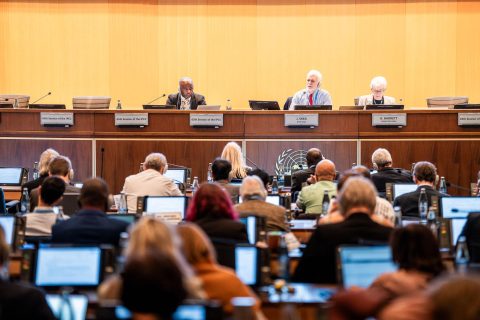

In July, PAICC said 12 countries had ignored its repeated attempts to discuss why they had not published an NDC as required every five years under the 2015 Paris accord.
Members of the committee had been divided over whether to name them, but at a September meeting decided to do so in their annual report to the annual climate COP summit.
By the time the report was published on Friday, only Congo, Senegal and North Korea “had not communicated an NDC or submitted a [Biennial Transparency Report] and had not yet responded to any of the Committee’s notifications, despite several reminders issued by the Committee in this regard”.
Rainforest and renewable energy ambitions
The silence from Congo and Senegal is notable because the former is home to much of the Congo Basin rainforest while the latter has sought billions of dollars in climate finance to support its renewable energy ambitions.
After Brazil, Congo has more rainforest than any country in the world. This forest, and the country’s peatlands, absorb huge amounts of greenhouse gas but are fast being lost to expanding farmland, charcoal production, logging and mining.
Senegal signed a Just Energy Transition Partnership with Canada and wealthy European nations in 2023, to help it meet its renewable energy targets under the-then government of Macky Sall. It was chair of the Least Developed Countries group between January 2022 and December 2023.

Tejas Rao, who is researching the PAICC as part of a doctoral thesis at Cambridge University, said the governments of the three countries should engage with the committee.
“Engagement costs these governments very little and the committee has shown it will listen,” he said.
“Silence leaves the committee with no basis to help, and it leaves the [governments] exposed to the narrative that they are simply disengaged,” he told Climate Home News.
Paris Agreement requirement
The 2015 Paris Agreement requires all parties to publish an NDC every five years outlining their emissions reduction targets, with each plan meant to be more ambitious than the country’s last NDC.
The latest set – the third round of plans, with new targets for 2035 – was due in February 2025. While most countries missed this deadline, all but around 30 – mostly small emitters but including Egypt, Vietnam and Argentina – have now submitted them.
Over the year, the PAICC – which is made up of government climate officials from developed and developing countries – has been communicating with governments that have not submitted NDCs and trying to overcome barriers to them doing so.
Some nations have cited exceptional circumstances as the reason for not submitting an NDC, a process that requires a significant amount of work in tracking emissions and consulting on how to curb them across the economy. For example, a letter from a Sudanese official to the PAICC, seen by Climate Home News, said that the country’s civil war had led to the suspension of its NDC preparation.
-
IPCC scientists vow to press on with climate reports despite political deadlock
After governments again failed to agree a timeline, nearly 120 IPCC authors pledged to complete their assessment on time and with full scientific rigour -
Under US pressure, World Bank says it will back gas “where appropriate”
The US wants the World Bank to expand its gas support while climate campaigners are pushing for it to end – its head spoke this week of limited backing for the fossil fuel